
Recommended for fans of: The Monolith Deathcult, Sigh, The Project Hate
Some people get a little mad when you make too many (or, in some cases, any) references to other bands when writing an article like this.
But when you’re dealing with a group whose creative palette is as wide as this one – the band themselves cite, in addition to the artists mentioned above, the likes of Arcturus, Atheist, Edge of Sanity, Thy Catafalque, and many more, as influences – it’s pretty much unavoidable.
So, without further ado, allow me to introduce you to the Avant-Garde/Progressive “Death Metal” of Azure Emote, a band whose main songwriter is actually their vocalist/keyboardist (Mike Hrubovcak, ex-Monstrosity) which perhaps goes some way towards explaining their more unusual and unorthodox approach to extremity!
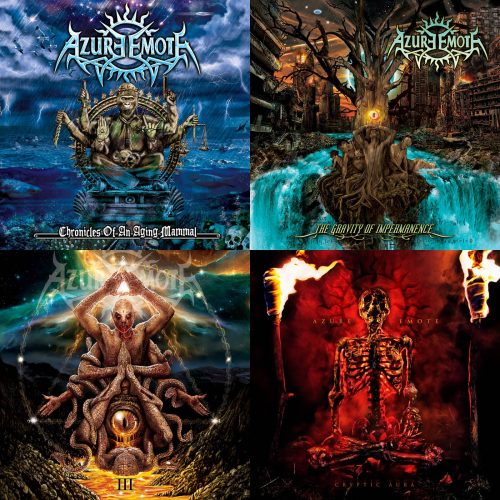
2007 – CHRONICLES OF AN AGING MAMMAL
Opener “Clarity Thru Apathy” is just over four minutes of hooky, subtly proggy riffs and cosmic keyboard melodies – topped off with a gravelly-yet-catchy vocal performance which (along with some mood-setting samples) adds a commanding and authoritative air to the music – that sets the groundwork for the rest of the record, upon which the even stranger sci-fi stomp of “Complex 25” (whose swirling synths and staccato riffs feel like a crossover between Pink Floyd and Atheist) and the harsher, heavier chug ‘n’ churn of “Justified End” build even further.
Things get even more weird (wonderfully so) during the ambient synthscapes (and relatively minimal metallic elements) of “Cosmic Tear”, after which the electro-symphonic sturm und drang of “Procreation Abnegation” hits a similar note (or notes, plural) to that of “Supreme Avant-Garde Death Metal” purveyors The Monolith Deathcult (only not quite as extreme).
That being said… if you are looking for extremity the calculated chaos of “Submerged (In Hollow Realistics)” – which showcases some of the most complex, contorted riffage on the entire album (courtesy of guitarist/bassist Ryan Moll) as well as some seriously OTT drum work from Patrick Battaglia – should definitely satisfy your cravings for spiteful sonic aggression, while the gloomy Industrial grooves of “March of Chemical Pessimism” serves as a welcome contrast and counterpoint.
As the album approaches its climax, Prog-Death oddity “Misanthropic Disgust” twists things up into an even more unorthodox and unconventional form – chattering blastbeats and high-velocity kick patterns propelling an array of choppy, rhythmic riffs and unpredictable symphonic electronics – in one penultimate burst of aberrant, avant-garde aggression (Hrubovcak’s vocals are particularly biting on this one) before the electro-ambient epilogue of “Dementia (Reflections of the Elderly and Infirmed)” brings things to an eerie, atmospheric close.
2013 – THE GRAVITY OF IMPERMANENCE
With an expanded line-up (Hrubovcak and Moll now joined by drummer Mike Heller, bassist Kelly Conlon, and violinist Pete Johansen, with guest appearances from, amongst others, Yakuza‘s Bruce Lamont, Pyramaze‘s Jonah Weingarten, and ex-Visions of Atlantis vocalist Melissa Ferlaak) and a similarly expanded sound – simultaneously heavier, proggier, and downright stranger than its predecessor – The Gravity of Impermanence feels like the band have jammed six years’ worth of ideas into a single album (which they pretty much have, considering the project was on hiatus for most of that time).
Opener “Epoch of De-Evolution” immediately introduces the listener to the band’s even more excessive approach, bursting out of the speakers like a weirdly a weirdly catchy combination of Arcturus, Aborym, and Akercocke, after which “Carpe Diem” takes the first of what will turn out to be many big swings in the form of almost eight minutes of moody, electronic ambience, soaring operatic cleans, gloomy, groove-heavy guitars, and showboating soloing that really needs to be heard to be properly understood.
It’s followed by the menacing, almost Mithras-level brutality of “Marching Forth” and the unnerving interlude of “Sunrise Slaughter”, which in turn leads into the chaotic, genre-mangling cacophony of “Conduit of Atrophy” (which, contrary to its bizarre opening, turns out to be one of the heaviest tracks on the album) and the vibrant, violin-laced avant-garde sonic expressionism of “Veils of Looming Despair” (which is the sort of track that resolutely challenges everything you might want, or choose, to believe about what “Death Metal” is, or can be).
“Dissent”, by contrast, leans much more heavily on Moll’s meaty guitars and Hrubovcak’s gritty vocalisations), downplaying the more “avant-garde” side of the band’s sound in favour of a deathlier and more overtly technical delivery (aided and abetted, as always, by Hrubovcak’s progged-out keyboard passages), while the back-to-back, blast-driven, sax-drenched stomp ‘n’ strafe pairing of “The Living Spiral” and “Obsessive Time Directive” marry the best bits of Sigh‘s wicked weirdness and the hammering intensity of The Project Hate.
After a welcome ambient breather (by the name of “Patholysis”) the band hit back with three more heavy-hitters in the form of the pseudo-symphonic blast-attack of “Destroyer of Suffering”, the pulsing electro-extremity of “Annunaki Illuminati” and the bone-rattlingly brutal strains of “The Color of Blood”, before the whole album climaxes (not counting the two bonus tracks, which are also well worth listening to) with six minutes of synth and violin laced heaviness in the form of the prodigiously powerful “Puppet Deities”.
2020 – THE THIRD PERSPECTIVE
It might have taken them another seven years, but the moment that the Khonsu-esque cosmic weirdness of “Loss” kicks in – immediately demonstrating that the band have achieved an even more natural and organic balance between bombastic Black/Death heaviness and scintillating sci-fi symphonics – you can tell that those years weren’t wasted.
“Curse of Life” then doubles down on this impression, showcasing how the band have integrated the synths, riffs, and violins even more tightly this time around while also reminding you that they aren’t afraid to go totally above and beyond the constraints of Death Metal when necessary (in this case by careening back and forth between machine-like Industrial intensity and mind-bending ambient electro-jazz)… but it’s not until almost-eleven-minute epic “Dark Realms” that you really get a feel for how much further Azure Emote have pushed things.
Sure, all the familiar elements from the previous albums are still there – the hefty, hooky riffs and mournful violin melodies, the commanding, cathartic vocals (which now include some captivating clean vocals, strongly reminiscent of Borknagar-era ICS Vortex, alongside the usual array of guttural growls and bristling bellows) and flurries of King Crimson inspired keys – but the extended run-time of the track (their longest so far by almost a full three minutes) just allows all the different, disparate parts to breathe a little more and flow a little better, giving the whole song a greater feeling of depth and a more organic sense of dynamic.
Even the shorter songs, such as Negative Polarity” and “Three Six Nine” – the former sitting somewhere between Trivmvirate (The Monolith Deathcult), Crimson (Edge of Sanity) and The Human Equation (Ayreon), the latter opting for a more focussed fusion of Prog, Electronica, and Tech Death influences – just feel that little bit bolder and smarter in the risks they take, while also being that little bit more refined and streamlined in their ultimate execution.
But it’s closer “Solitary Striving” that really feels like the band are pushing their most “progressive” ambitions to the limit… not by simply throwing ideas at the wall all at once, but by taking the time to let them expand and express themselves fully – the first four minutes are pretty much nothing but sombre acoustic guitar work, shimmering electronic ambience, and scintillating clean vocals (courtesy once again of the ultra-talented Melissa Ferlaak – after which the heavier and more metallic elements slowly but surely introduce themselves in a display of shameless catchy riffs and twisted tremolo runs, all topped off with a burst of extravagant, Mithras-esque soloing, that builds to the song’s (and the album’s) stupendously cinematic climax.
2025 – CRYPTIC AURA
Five years on from their third album (which actually counts as pretty prolific for the project) the band recently returned with what is arguably their heaviest album yet – the guitars are both hookier and heftier, the drums kick and punch with even more weight and solidity, and even the vocals bite that little bit harder – demonstrating that you don’t have to mellow out with age.
This is particularly apparent during the killer opening combo of “Into Abysmal Oblivion”, “Insomnia Nervosa”, and “Aeons Adrift”, with the seething Black/Death intensity of the opener immediately showcasing the album’s tighter, thicker guitar tone and punchier, more powerful drumming (as well as some nimble, fluid bass work by Kelly Conlon), after which the stomping, shapeshifting second track highlights both the increased technicality of the music (Heller in particular playing up a storm behind the kit) and the controlled complexity of the band’s songwriting, before the galloping grandiosity of the latter track ups the ante and picks up the pace even more.
That’s not to say the band have abandoned their proggier proclivities – all three tracks are layered with esoteric synth lines and weeping violin melodies, while also making time and space for excursions into more ambient and/or atmospheric territory – it’s just that the balance between the more metallic and more eccentric sides of their sound has been rejigged to highlight the former that little bit more this time around.
As the album progresses (pun intended), however, the group’s more idiosyncratic impulses start to reassert themselves a little more, beginning with the Dimmu Borgir-esque symphonic stomp of “Bleed With the Moon” and then continuing through the synth-and-string-heavy strains of “Defiance Infernus” and the giddily genre non-conforming “Provoking the Obscene” (the latter of which features both a welcome guest appearance from Cellar Darling‘s Anna Murphy as well as some of the most impressively intense and technical instrumental parts – especially from Heller and Conlon – on the entire album).
Don’t get me wrong, all three tracks retain that extra dose of heaviness which the band seem to have picked up some time over the last five years, but they’re also not afraid to get a little more weird with it… although, truth be told, it’s the ostentatious orchestral Prog Death of “Disease of the Soul” and “Feast of Leeches” which, arguably, strike the best balance between the group’s newfound metallic menace (Moll, Heller, and Conlon all really locking in as a tightly-wound Death Metal trio) and their willingness to think (and go) outside of the box with their love of winding strings and warping synths.
Sure, the album’s climax is a little underwhelming (the proggy “Return to the Unknown” is fine, but the pseudo-cinematic outro of “Writhing Lunacy” ultimately falls a little flat) but it still leaves you… and me… hoping that we won’t have to wait quite as long for whatever the band do next!