
(Andy Synn has three more bands from the UK underground for you to check out today)
There’s a passage in One Day, Everyone Will Have Always Been Against This by Omar El Akkad (which I’m currently re-reading) where he talks about his experiences as a young journalist and his desire to tell “stories of consequence… stories that, had you not read about them in my articles, you wouldn’t have read at all.”
And while the whole book is an excellent piece of work – engaging, insightful, and unapologetically devastating in the way it dissects and analyses why the world is the way it is, right here and right now, and what that really means when you strip away all the constant obfuscation and abnegation of responsibility by those who bear the lion’s share of the blame – this particular passage stood out to me a little more this time around.
Because, really, that’s something we try to do here at NCS – albeit, obviously, on a much smaller scale – when we focus on covering bands who we believe haven’t received the attention or acclaim they deserve (which, in some cases, means any at all).
Sure, we’re not afraid of writing about bigger bands who already have a decent level of exposure – they help bring eyes to the site after all, which in turn benefits their lesser-known cousins – but the ethos here has always been to try to use our platform as a place for articles and opinions you might not get elsewhere.
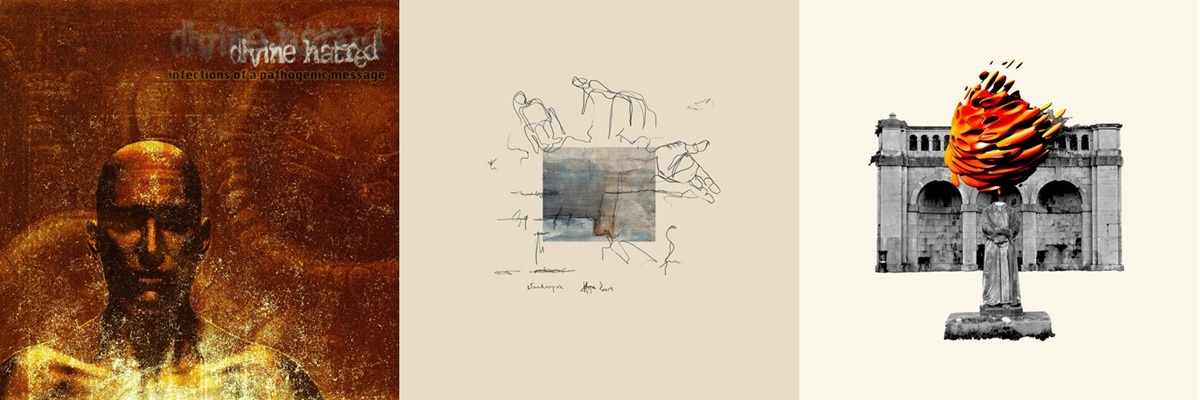
So, with this in mind, today I’ve chosen three debut albums by a trio of bands who don’t necessarily have the biggest profile outside the UK – even Divine Hatred, who have crossed the channel a couple of times already (and if they want to share some info about that with us, that’d be appreciated), don’t appear to have received much coverage for their new record – but who could (and should) all benefit from this article.
DIVINE HATRED – INFECTIONS OF A PATHOGENIC MESSAGE
It is a truth, universally acknowledged – or, at the least, it should be – that the amount of Metal/Hardcore in “Metalcore” is inversely proportional to its popularity.
And while we now live in a world where the term is more synonymous with angsty fry-screams, radio-friendly Pop-Rock choruses, and pristinely polished production, it’s always gratifying to find a band like Divine Hatred, who – as you can probably already tell by their name – definitely aren’t going to be angling for any sort of mainstream acceptance or approval any time soon.
Instead what they deliver on their debut album, Infections of a Pathogenic Message, is nine tracks of ripping, razor-edged “Metalcore” – which in this case refers to a stripped-down, fat-free blend of Death Metal and Hardcore – cut from the same sort of cloth as the likes of Integrity, Overcast, and Converge… all hard edges, harsh distortion, and hammering, edge-of-your-seat intensity.
But …Pathogenic Message is more than just a throwback, with tracks like “No Conscience” (whose bludgeoning riffs and bone-grinding rhythms could give the new Tribal Gaze a run for its money) and the lurching, discordant chuggery of “Plain Sight” bringing the band’s brutish, unforgiving formula firmly into the modern age with a bigger, beefier guitar/bass tone (a song like “Internal Resentment” possesses a punishing, almost physical heaviness) and a willingness to experiment (which includes the occasional use of Turkish/Arabic instrumentation like the Oud, Duduk, and Doumbek) that I’d love to hear them push even further in the future.
It’s not without its flaws – the posturing guest-spot from Desolated‘s Paul Williams in “Scarred For Life” is a bit of a mood-killer, IMO, and as much as people say that “less is more” I feel like we could have done with at least a little more here (the whole thing, including moody interlude “Lacerated From the Cradle”, isonly about 26 minutes) – but the leanness and meanness of the record (which doesn’t preclude a touch of menacing melody during killer cuts like “Blinded by Baseless Pride” and “Family of Knives”) is a major part of what drew me to the album in the first place, so any complaints are easily addressed by just spinning the whole record again!
VANDAMPIRE – HOPE SCARS
It’s clear from the moment that “Hope Scars” – the heaving, hypnotic title-track of the debut album from Vandampire – kicks in that the group aren’t necessarily trying to reinvent the wheel here… and why should they when the long-ago dissolution of Isis left them with a baton that they’re clearly more than happy to pick up?
Look, I know I’m mixing my metaphors a bit there (what else is knew?) but the point still stands that, since we’re never getting another album from Harris, Turner, and co., someone needs to step up and fill their shoes.
Of course, it goes without saying that many bands have tried to step into this role in the past (and, to be fair, a few have even succeeded) but that doesn’t make Vandampire‘s attempt any less compelling in either style or substance, especially considering the way that – unlike a lot of “Post-Metal” bands – they’ve managed to keep their songwriting relatively steamlined and succinct (the one exception being epic, twelve-minute closer “Let Ruin End Here) with a heavy focus on both brooding melody and driving dynamics.
Sure, this doesn’t entirely make them unique either, but if you’re not at least a little bit moved – whether emotionally or physically (and, ideally, both) – by the dense, metallic grooves and tense, atmospheric weight of “Ultralow”, or the bristling melodic electricity of “Eaves” and “A Promise” (all of which are representative of Vandampire at their very best) then you might want to get your brain chemistry checked out by a professional.
What makes Hope Scars even more intriguing, however – while also suggesting future creative avenues for them to explore – is the subtle ways it stretches the post-Isis “Post-Metal” formula, most notably in the more Screamo/Hardcore-inspired delivery of the vocals (which adds an unexpected sense of urgency to the proceedings) but also in moments like the calming, and purely acoustic, penultimate strains of “I Will Miss Everything I Forgot”, or the willingness to embrace ambient minimalism during the aforementioned “Let Ruin End Here” (with the closing piano piece being a perfect, and unexpectedly poignant, way to finish things off), with the end result being an album which firmly sets up Vandampire for future success… if they want it.
WAR CLUB – MONOPLANET
It can be hard to have hope in a world where the avenues and opportunities for progress and change for many seem to be getting fewer and fewer by the day… and gnarly, sludge-punk noisemongers War Club aren’t afraid to acknowledge this on their debut album, Monoplanet, a record which… in the band’s own words… is here to ask the question “a better world is possible, so why can’t we have it?”
Channelling the obnoxiously infectious, guitar-heavy grooves of High On Fire and the moody malevolence of Killing Joke – as well as touches of fuzz-fuelled, Melvins-style freakery and neurotic, Nirvana-esque grunginess – the band’s sound is built around a core of hefty, hypnotically repetitive riffs and lumbering, rumbling bass-lines, underpinned by some impressively energetic drum work (which is what keeps songs like “Make Us Free” moving forwards, despite their often cyclical nature) and topped off with lashings of spiteful, sharp-tongued lyrics (which are delivered with a significant amount of scorn and just a hint of knowing irony).
The band’s “big-riff manifesto” is on full display right from the start (massive Stoner-Sludge anthem “MBHW” is one hell of a way to open an album, make no mistake about it), with the booming bombast (and brooding melodies) of “Money Snakes from the Monoplanet” (and its visceral, viciously infectious, vocal refrain of “barely eating… barely breathing…“) and the amp-stressing, post-Sabbath, post-Hendrix hybrid of “To The River” only reaffirming the fact that “War Club want you to have a good time… while you can.”
Sure, there’s the occasional mis-step – the clean vocals in “Drowning” don’t quite work for me, if I’m going to be brutally honest, though their use in colossal, Crowbar-heavy closer “P.A.I.H.” (no, I don’t know what it stands for either… I just know that its absolutely humongous low end helps it leave a major impression) is far more effective – but the album’s raw, uncompromising energy and sense of impulsive spontaneity (it never feels like the group are over-thinking things or second-guessing their instincts, but instead just going with the flow, wherever it leads them) makes for a riveting (and riff-happy) listening experience throughout!