
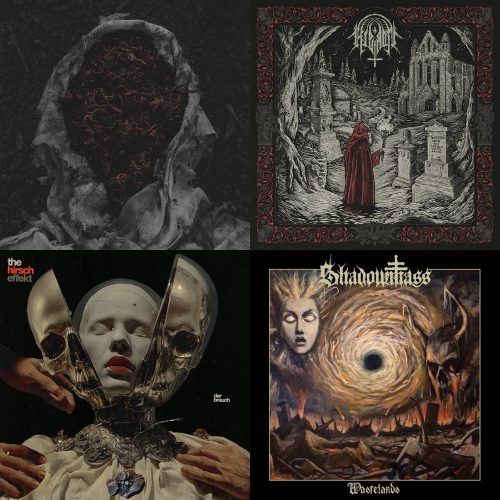
(Andy Synn offers up 4 more albums from last month which you may have overlooked)
As I may have mentioned in yesterday’s article, it feels like I missed more than the usual number of albums in January… and while I know that it’s impossible for anyone to properly listen to, let alone review, everything that comes out each month (despite some hyperbolic claims to the contrary by certain online clout-chasers) this has still bothered me quite a bit.
After all, we’re only a month into the year and we’ve already managed to overlook the likes of Blackwater Holylight and Pâro, Ultima and Stabbing, Dagger Threat, Gavran and Juodvarnis (the latter two possibly being lined up for a future edition of The Synn Report each)… and countless others I’ve probably forgotten about already.
At the very least, however, the four vibrant and varied and (in their own way) visceral artists and albums I’ve selected to talk about today should keep you all busy while I work out what I’m going to write about this month!
GORRCH – STILLAMENTUM
Devastatingly dissonant pretty much from the moment it begins, Gorrch‘s second album is a devastating, borderline delirium-inducing, deluge of abrasive aggression and scalding sonic spite
And yet, as unrepentantly harsh as the band’s sound is – even tempered by occasional dashes of sinister, ophidian melody (such as the sinister synths and chilling chants which infuse “Nimbus”) Stillamentum is never anything less than utterly scalding to the ears – there’s also something eerily hypnotic to the way they deploy their writhing riffs and cascading percussive patterns, displaying an artful method to the album’s madness.
Indeed, it’s this juxtaposition between scathing dissonance and mournful melody – the latter exemplified by the ringing, arpeggiated chords that permeate “Vorago”, the former perhaps best illustrated by the needling, discordant notes and frenzied, frenetic blastbeats of “Larv” (a song which, almost from the start, threatens to fly apart under its own eye-popping intensity) – which makes Stillamentum such a fascinating, albeit unforgiving, listen.
Make no mistake, I don’t use that word “unforgiving” lightly… after all, for all that the likes of “Crypt” and “Angor” are grounded in the fundamental elements of Black Metal (particularly the unrelenting blastbeats and constantly twisting tremolo guitars) the band have pushed them even further towards the boundaries of the extreme, maximising the distorted, disharmonic nature of the music without ever descending into formless noise.
In fact, it’s to the band’s credit that this constant push towards an ever more caustic and corrosive sound never results in Gorrch sacrificing clarity for sheer cacophony, which is also a testament to the album’s powerful yet polished production, which allows every biting riff and strangling note-sequence (and, in the case of the oppressive, atmospheric outro of “Phlegma”, every doomy dis-chord and sinister synth-line) to cut through like acid eating through metal… with the end result being an album that will leave more than its fair share of sonic scars long after the initial burn has faded.
HIERON – FROM THE TEMPLE TO THE GRAVE
We’re always on the look out for new bands to champion here at NCS and, considering that From the Temple to the Grave, the debut album by German quartet Hieron, was recently picked up and released by the always reliable Vendetta Records, it seems like we’re not the only ones.
Displaying both a fiery anarchic spirit and a knack for blazingly melodic Black Metal, opener “God’s Acre” – following a scene-setting intro sequence – practically bursts into flame in a crackling conflagration of scorching distortion and seething discontent… and from that point on the album rarely, if ever, takes its foot off the gas, with only the occasional passage of gloomy introspection (such as the moody melodic mid-section of “Reverence Lost”) to break up the raging torrent of blistering, blackened intensity.
Comparisons with the likes of Woe – especially when it comes to their ability to craft both powerful, ear-catching tremolo hooks and primal, blood-pumping grooves (“Forever Scorned” being a prime example) – Wiegedood, and Trespasser can certainly be made (particularly due to the band’s cathartic, and characterful, combination of savage snarls, visceral howls and guttural growls, all of which are delivered with a compelling blend of venomous aggression and anguished emotion), but should also be taken with a slight pinch of salt, as Hieron are clearly more than just the some of their peers and (potential) influences.
And while there’s still perhaps a little refinement to go – I’m not convinced that “Penetralia” really needed to be eight-and-a-half minutes long (although the climactic title-track more than justifies its extensive run-time, both through its subtle use of cinematic/atmospheric touches and due to the powerful, propulsive drum work which keeps on driving the song forward towards its conclusion) – and a bit more experimentation and expansion of the band’s sound probably wouldn’t go amiss next time around if they really want to stand out from the crowd, there’s no doubt in my mind at all that Hieron will have made a very strong first impression with a lot of new listeners (and new fans) with the release of From the Temple to the Grave.
THE HIRSCH EFFEKT – DER BRAUCH
As it turns out we’ve only ever mentioned German post-genre expressionists The Hirsch Effekt (who describe their music as an artful amalgam of “Post-Rock, Post-Punk, Progressive Metal, Pop and Classical”) once before, despite the fact that the band have six full-length albums to their name prior to this one.
I’ll grant you that it’s kind of understandable… we all have our blind-spots, after all, but it’s still not a great look that we’re only just now getting to them following the release of their seventh(!) album.
That being said, there’s never a bad time to make a new discovery, and Der Brauch is as good a jumping-on point as any, especially if you’re a fan of bands like Agent Fresco, Leprous and Hypno5e, as songs like dynamic opener “Der Brauch” and the even more elaborate “Der Faden” combine mellifluous acoustic string-work with bombastic Tech-Metal riffage, simmering, bass-rich grooves, and an arresting array of sombre/soaring/screaming vocal hooks, all seamlessly woven together (as is the case with the proggy, introspective… and, at times, stunningly heavy… “Das Seil”) with impressively intricate songwriting skill.
And while the band aren’t afraid to simplify things when the mood calls for it – “Die Brücke” is basically just pure Pop-Rock filtered through a subtly proggy prism – it’s the complex, yet captivating, genre-splicing delights of “Der Doppelgänger” and “Die Lüge” (imagine Leporus, once again, but even more artsy and cinematic in scale and scope) that truly epitmose the band’s multi-faceted mix of pulsing, atmospheric ambience, pounding, down-tuned guitars, and intricate, pseudo-orchestral embellishments.
Granted, the ending of the album is somewhat anticlimactic – while penultimate stand-out “Das Nachsehen”, part Periphery, part Porcupine Tree, part Project 86, juxtaposes some of the calmest and most immersive moments on the album with some of the heaviest and most aggressive passages the group have ever written/recorded, closer “Die Heimkehr” is probably the weakest track on the album, despite the band’s best efforts, and ultimately ends things not with a bang but with a distinct lack of closure – but it’s ultimately the journey, rather than the final destination, which makes Der Brauch such an enchanting experience.
SHADOWMASS – WASTELANDS
Cutting right to the chase, Greek quartet Shadowmass – who we’re covering here for the very first time – deal in an incredibly catchy combo of Black, Thrash, and Heavy Metal that frequently invites comparisons to the likes of Kampfar, Kreator, and Dreaming Neon Black-era Nevermore (vocalist/guitarist Stamatis Syrakos in particular often sounds like a cross between Kampfar‘s Ask Arctander and Nevermore‘s dearly-departed Warrel Dane).
And while the “blackened” elements ares ometimes less prominent than the band’s thrashier influences – though both ultra-intense opener “Purge and the Savage Preacher” (already a potential “song of the year contender”) and the blasting, galloping “Arriton”, as well as the heroic tremolo melodies of epic closer “Thy Will Be Crushed” (which makes for one hell of an ambitious closing statement), certainly make a strong case for the band belonging somewhere on the Black Metal spectrum – the sheer energy on display definitely puts the band on a par with their distant (or not-so-distant) cousins in bands like Skeletonwitch, Irdorath, and Imha Tarikat, despite their relative lack of “cvlt” credibility.
Pretty much every track (with possibly only the slightly over-wrought “Fading”) offers a compelling mix of red-hot thrash riffs, razor-sharp tremolo runs, and fretboard-racing leads (the wailing solo in moody, mid-album highlight “Into Wastelands” being a particular stand-out), as well as a hefty helping of head-banging groove (“Visions of Desolation”) and some gloriously gloomy, and subtly proggy, injections of melody (the hauntingly bleak second half of “Addramalech’s Laughter”, for example, really reinforcing those early Nevermore comparisons).
Overall, however, it’s the sheer, unrepentant hookiness of the music – the band packing every song with as many ridiculously headbangable riffs, insidiously infectious melodies, and cruelly catchy, half-harsh, half-clean, choruses – that makes Wastelands one of those albums that’s so easy to pick up (especially if you’re a fan of any of the other bands already mentioned above) but very difficult to put down.
That Gorrch album is top notch, it delivers from the beginning straight through till the end. Been listening to it a bunch!
Seconded! Gorrch is delightfully dissonant and hypnotic, and likely to snag a spot on my year-end list.
That’s good to hear. I know we’re only very early in the year at the moment, but there’s definitely been a couple of contenders released already (including the one I just posted about today).