
Recommended for fans of: Vintersorg, Enslaved, (early) Sólstafir
When one talks about “Progressive Black Metal” there are certain names that tend to get mentioned the most (some of which I’ve noted above already).
But Lithuania’s Juodvarnis (who recently released their 4th album) tend to get overlooked, which is a damn shame because the band’s evolution – their progress, if you will – has been a real joy to watch/hear.
Beginning as a a more ruggedly melodic, folk-ish band of brothers, the group have slowly evolved in an increasingly heavier and more “blackened” direction, which reached its apex on January’s outstanding Tékmés and – luckily for all you folks reading this right now – today’s edition of The Synn Report will give you an opportunity to follow the group’s creative progress/process right from the beginning all the way up until their current incarnation.
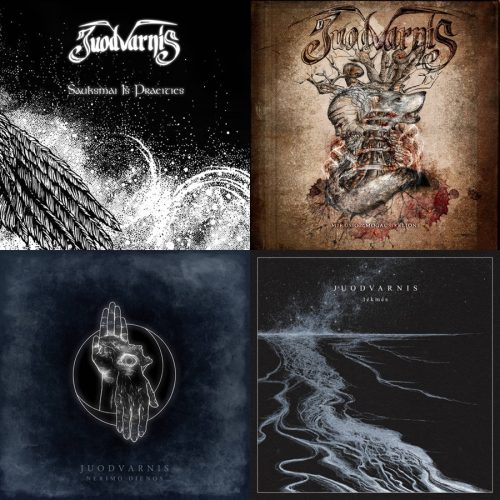
2014 – ŠAUKSMAI IŠ PRAEITIES
The band’s debut album certainly laid down the early foundations for their sound, with the likes of “Audra Prieš Tylą” and “Miško Sargai” – the less said about superfluous introductory track “Aidai” the better – combining a hefty, riff-happy backbone (mixing galloping guitars, whirling tremolo lines, and punchy, staccato rhythms) with a sense of melancholy melody, both in terms of the vivid, Vintersorg-esque clean vocals and the occasional dash of moody lead guitar magic.
And while there’s definitely a significant Black Metal element to the album’s DNA, the band’s focus on solemn-yet-scintillating clean-sung vocals and prominent use of passages of sombre intstrumental introspection (early highlight “1410” being a prime example of how the band’s “less is more… until it’s time for more!” approach pays off massively), positions them more as a Progressive (albeit “blackened”) Metal band first and foremost.
Both “Paukščiai Pakils” (another clear stand-out) and “Šauksmai Iš Praeities” (whose heroic, melodeath-inspired finale owes a fair debt to early Dark Tranquillity to my ears) are both prime examples of this, as its often their quiestest and/or most melodic moments – especially the former’s spellbinding, slow-burn intro, which seems to transport you to another place and time, as well as the latter’s ear-catching outro – that often make the biggest mark.
The similarly melodeath-influences “Užmirštoji Gentis” is, apart from a few awkward structural shifts (something which the band would go on to improve on for subsequent releases), seven-and-a-half minutes of shameless, subtly proggy, hookiness, paving the way – after the slightly unnecessary instrumental interlude of “Pabaiga Dienų” – for the album’s heaviest, proggiest, and arguably best track, “Pilkapių Varnas”, which really pushes the band’s expansive (occasionally unwieldy) songwriting style to its breaking point (while also setting them up for the next stage of their creative journey).
2016 – MIRUSIO ŽMOGAUS KELIONĖ
With no unnecessary intro track to get in the way, the band’s second album gets going pretty much immediately with the gloomily, almost doom-ily, melodic opening bars of “Amžinybė Nelaukia Tavęs”, balancing the shimmering keys, crooning vocals, and ringing guitars just that little bit better this time around… a feeling which is only reinforced when the song ramps up the more “extreme” aspects (punchier, riffier rhythms, proggier-yet-heavier percussion, and even an added layer of grit to some of the vocals) as the song goes on.
There’s no question, of course, that Mirusio žmogaus kelionė is the natural successor to its promising predecessor, especially when listening to a song like “Pabudimas”, which is bolder, more intense, and more ambitious, yet weaves in the grandiose keys, evocative clean vocals (plus the occasional throat-rending howl), and soaring leads even more smoothly.
And while the songs here aren’t necessarily massively longer – averaging out at a little over seven minutes, give or take – the ideas seem just that little bit bigger, that little more densely packed and woven together, that the vibe is definitely more epic and extravagant, whether you’re talking about the seethingly aggressive, sublimely expressive strains of “Leškojimas” or the simmering, then soaring, anthemic approach of “Išpažintis” (which might just be the album’s MVP).
That being said, if you’re in more of a “metallic” than a “melodic” state of mind, then the noteiceably heavier attack of “Mes Visi Pasmerkti” – where the guitars, bass (which shows off some nifty, proggy moves of its own), and guitars all lock in even more tightly than even – might be more what you’re looking for, while also serving as a welcome reminder that although Juodvarnis are a “Progressive” Metal band, first and foremost, they haven’t neglected the “Metal” part of the equation either.
Closing with the epic, Enslaved-esque “Kas Aš?” – whose Vertebrae era sound makes it another contender for the album’s “best track” – Mirusio žmogaus kelionė leaves you with the impression that not only are the band just coming into themselves, but the best is yet to come (which, as it happens, turned out to be true)!
2020 – NERIMO DIENOS
Four years later the band would return with an album that found them moving in significantly heavier waters (just listen to how much thicker, chunkier, and darker the guitars are on blood-pumping opener “Mechaninė Saulė”) and found them embracing their more aggressive side even more, without sacrificing the vibrant vocalisations and cinematic keys which defined their earlier works.
With more harsh vocals, more blastbeats, and more overall intensity, the likes of “Iš Amžių Šaknų” and “Diena Kai Pasenau”, for example, definitely hit harder than anything the band have done before, but aren’t bereft of those melodic moments or poignant atmospheric passages… to the point where both the chugging rhythms and clanging piano of the former, and the stunning, psuedo-symphonic heaviness of the latter, remind me of previous Synn Report recipients Oceans of Sadness (especially their final album, The Arrogance of Ignorance).
At the same time, songs such as “Triukšmo Vaikai” and “Tik Dulkės” display such shamelessly Enslaved-esque sensibilities – “Triukšmo Vaikai” in particular being a major stand-out in the way it undulates and shifts shape as it goes on – while still retaining a distinctive sense of their own identity (especially vocally) that it’s honestly shocking that you don’t hear the name Juodvarnis mentioned alongside their more famous Norwegian cousins more often (as they thoroughly deserve to be).
Pushing the boat out even further with extravagant, nine-minute epic “Kuomet Pasaulis Dega” – whose extended length allows the band to really dwell on their moodiest and most atmospheric inclinations, before delivering some of the most potent Black Metal-inspired sounds of their career – it should become clear, if it hadn’t already, that Juodvarnis are even more confident, and even more competent, than ever this time around, and far more capable of mixing and matching their progressive, aggressive, and expressive ambitions in increasingly clever combinations (with the Sólstafir-ian “Prisimink Mane” being another haunting highlight).
Concluding with the grandiose “Sielos Dugne” – a killer combination of Vintersorg-esque vocals and bombastic, Borknagar-adjacent instrumentation which, nevertheless, is instantly identifiable as Juodvarnis right from the start – you might reach the end of Nerimo Dienos thinking that the band had peaked… but you’d be wrong (even if it would take them six years to prove it)!
2026 – TĖKMĖS
Common wisdom will tell you that it’s normal for bands to get more melodic and/or proggier as they go on… but Juodvarnis have firmly flipped that trend on its head, first with Nerimo Dienos and now with Tékmés.
Right from the start this is obvious, as “Dvasios Ligos” kicks in with an energy and immediacy – it’s not long before the surging blastbeats come out to propel the seething guitars and shimmering synths to an even higher level – more reminiscent of the likes of White Ward/Dark Fortress/Horizon Ablaze, replete with bigger riffs, bigger hooks, and bigger, more aggressive vocals (along with the occasional burst of bright, proggy melody).
It’s not a total departure, by any means – the grandiose, Enslaved-esque atmosphere and vibrant, Vintersorg-ian vocals of “Laikui Varvant”, for example, remain firmly connected to the band’s earlier years, even if the overall vibe is heavier and darker – it’s more that the introspective intensity and crackling electricity of songs like “Tamsiausias Nušvitimas” and “Juodos Akys” (the former’s initial, brooding slow-burn approach concealing some seriously hefty riffs and raw, howling vocals, the latter’s punchy guitars and pounding percussion serving as one of the most simple-but-effective tracks in their discography) feels like the obvious (and most natural) next step for the group.
And while the album as a whole is undoubtedly a meatier and more metallic beast than its predecessors (especially when compared to the band’s earlier works), there’s still an almost Sólstafir-esque sense of atmosphere and melody to a song like “Svoris”, whose infectious melodic hooks and emotive, evocative singing make it one of the album’s catchiest and most compelling cuts (something which the proggier, and subtly heavier, strains of “Platybės” then build upon even further).
This then continues into the climactic title-track, whose soaring trifecta of melodic/metallic/atmospheric elements effectively combines all the best moments from the album leading up to this point – especially when it comes to the song’s vibrant vocals, luminous lead refrain(s), and overall sense of melancholy majesty – in a way that makes you wonder whether or not they might be due for a big break-through like their Icelandic cousin some time soon!