
(Andy Synn presents the first of two articles covering some of the many things he missed in March)
There were just SO many releases during March that I wanted, but didn’t have time, to cover, that you’re getting two “Things You May Have Missed” articles this week, rather than the usual one.
Of course, even with twice the usual number of entries I’m still having to leave a horrifying number of bands on the proverbial cutting room floor, and some (but not all) of the bands also considered for this article include Bedrängnis, Circle Back, Deadnate, Egocide, Funeral Pile, Mammon’s Throne, Mariner, Poison the Well, and Teratoma… with many more still on the short-list for the next article as well.
I’ve also got another edition of The Synn Report to somehow squeeze in before then too, so I’d better stop wasting time with this preamble and get to the music, which once again features a quartet of bands, all from different genres, that I would take it as a personal favour if you all checked them out.
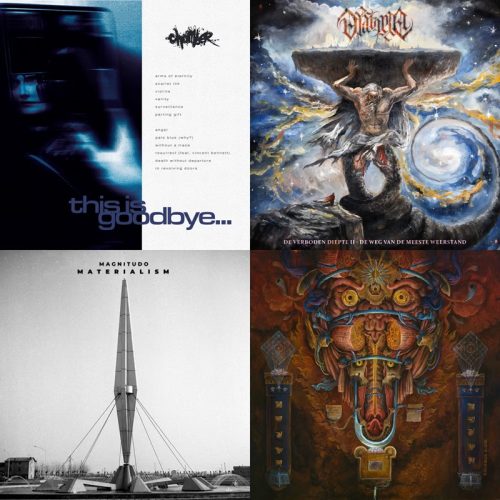
CHAMBER – THIS IS GOODBYE
There’s vicious, and there’s visceral… and then there’s the new one from Tennessee terrors Chamber, which is essentially a 30 minute assault of gnashing teeth and slashing claws disguised as an album.
And while the band have always leaned more towards the more “chaotic” end of Hardcore/Metalcore, This Is Goodbye… takes a step further into even more manic waters – it’s fitting that there’s a song called “vanity” (which also happens to be one of the album’s many highlights) here, as it’s that era of Eighteen Visions which I’m often reminded of as the band pile on the disgustingly down-tuned guitars, panic-stricken discordance, and uncomfortably ugly breakdowns (plus the occasional burst of spasming blastbeats or clean-sung crooning) – that threatens to put all their previous works to shame.
There’s an almost Car Bomb-esque unpredictability to the erratic, explosive intensity of “arms of eternity” and the spiteful “violins”, for example, with the band straddling the sometimes-invisible line between Mathcore and Tech Death without abandoning an ounce of their abrasive, Metallic Hardcore aggression (just take a listen to the seizure-inducing insanity of “pale blue (why?)” for an even more extreme example), while the likes of “parting gift” and “resurrect” successfully channel the essence of The Acacia Strain‘s early years (with Vincent Bennett himself popping in for a quick guest spot on the latter) and combine it with a touch of bleak, brittle atmosphere to great (and gripping) effect.
Sure, it’s not perfect – for all that This Is Goodbye… revels in its apparently chaotic nature, once the initial shock wears off you start to see certain twists coming, especially during the latter half of the album, such that some of the impact is lost – but it’s one of those albums that still hits just as hard on fifth, or fiftieth, listen as it did the very first time.
DYSTOPIA – DE VERBODEN DIEPTE II: DE WEG VAN DE MEESE WEERSTAND
Dystopia‘s previous album, De verboden diepte I: Veldslag op de rand van de wereld (which you can read more about here) had the honour of taking one of the highly-coveted spots in my Critical Top Ten of 2024, which means the bar for their new album has already been set very high indeed.
But we need not have worried, as while I’m not sure if De Verboden Diepte II: De Weg van de Meeste Weerstand (hereafter to be referred to as De Verboden Diepte II) is better than its predecessor, it’s certainly a more than worthy follow-up/companion piece which pushes the band’s progressive proclivities further than ever before.
Of course, one look at the track listing – featuring just two songs, the shortest of which is fourteen minutes, while the longer of the pair clocks in at just under nineteen – should have already clued you into this fact, as Dystopia clearly aren’t playing by the standard rules of “orthodox” Black Metal (and, truth be told, haven’t done for quite some time).
Take “Confrontatie”, for example, which isn’t hesitant to unelash waves of blazing blasbeats and winding tremolo early on, firmly establishing Dystopia as a Black Metal band of some variety… but also isn’t afraid to drop an entire horn section into the mix at the same time, or to then throw a series of edgy, erratic grooves and moodily melodic passages (including some cleverly layered clean/harsh vocal counterpoints) – along with several lengthy sections of atmospheric ambience – before concluding in an almost gratuitously grandiose fashion that seems, if anything, to mock the idea that “less is more”.
And while I want to leave at least a few surprises for you all to discover for yourselves, suffice it to say that “De Ultieme Roeping” is even more extreme, even more extravagant – especially during its cinematic, Morricone-esque mid-section – and even more unorthodox, firmly establishing De Verboden Diepte II is an album that refuses to subscribe to one specific “school” of Black Metal… but instead has lessons of its own to teach us!
MAGNITUDO – MATERIALISM
It’s already been a big year for the Sludge/Post-Metal scene(s), and the various bands who ply their trade along the borders between the two styles, which would make it all too easy for a band like Magnitudo to slip between the cracks.
Thankfully the group’s absolutely humongous sound – as good an example of nominative determinism as you’re likely to find – makes this very difficult, as the gargantuan guitars and thunderous vocals (mostly harsh, but interspersed with moments of sombre melodic crooning) of songs such as “Auferstanden Aus Ruinen” and “The Vision” (one of the album’s brightest, earliest, highlights) take up so much sonic space that they’re difficult, if not impossible, to ignore.
Aesthetically steeped in themes of urban decay and societal alienation, it’s an album as thematically heavy as it is musically crushing, erring more towards the purely punishing, less “atmospheric”, approach of bands like Cranial, Aortes, and Ether Coven (though not quite as ugly and sludgy as the latter), with the chattering, churning guitars and pounding, pneumatic percussive patters of tracks like “Hive” and the monstrously hefty (and misleadingly titled) “Hummingbird” making you feel like you’ve been lashed to the wheels of some merciless, unstoppable machine.
That’s not to say there aren’t occasional moments of subtlety – the brooding strains of “Soma”, for example, offer at least some relief from the album’s otherwise oppressive nature, while closer “The Realm of No Tomorrow” embraces a slightly more melodic approach that allows for a well-earned sense of catharsis at the end of the album – but, make no mistake about it, Materialism is an album that willingly and knowingly embraces brutalism as an art-form, and should be treated accordingly!
VOIDSTAR NOCTURNAL – NEXUS TELEPORT FRACTURE
While there’s a tendency, understandably, to label Black Metal as the most “avant-garde” friendly form of “Exteme Metal” – after all, I’m sure we can all name numerous examples of bands pushing the boundaries of the genre (and, sometimes, of good taste) right off the top of our heads – it should also be acknowledged that Death Metal can be just as weird and experimental in its own way… it’s just that, in general, it’s the dumber, stupider examples that tend to get all the attention.
Well, trust me, there’s nothing dumb or stupid about Voidstar Nocturnal or their debut album, Nexus Teleport Fracture, whose music twists and turns to devious, delirious designs pulled directly from the band’s collective unconscious, marrying charred, churning riffage and scalding, surging blastbeats to passages of warped anti-melody (as can be heard laced throughout “1/137”) and patterns of hypnogogic un-groove (“Saffron Neon”) in a manner that’s as unpredictable as it is unforgettable.
And while comparisons with the likes of Zealotry (RIP), Krallice (whose guitarist, Colin Marston, mixed and mastered this album, as it happens), and… yes… even current Prog-Death darlings Blood Incantation (though I’d hesitate to put too much weight on that particular resemblance) can certainly be made, if only for the structural and compositional adventurousness of the band’s sound, there’s no question that these eight tracks – from the cyberpunk psychedelia of “Holographic Neural Pathways” and the sinister downward spiral of “The Cypher of Samādhi” to the bombastic sturm und drang of “Convergence of Aeons” and the proggy-yet-primal strains of “Black Gold Ecstasy & Lumen Deformans” – are more than capable of standing on their own merits.
This is especially true, of course, of mind-bending, genre-splicing closer “The Tower”, which sits somewhere between Oranssi Pazuzu and Portal on the strangeness scale and ends the album by promising even bigger, and weirder, things to come!
Love Dystopia. These tracks don’t disappoint. Thanks Andy!
Oh, you’re very welcome. Such a good band, and criminally under-exposed!