
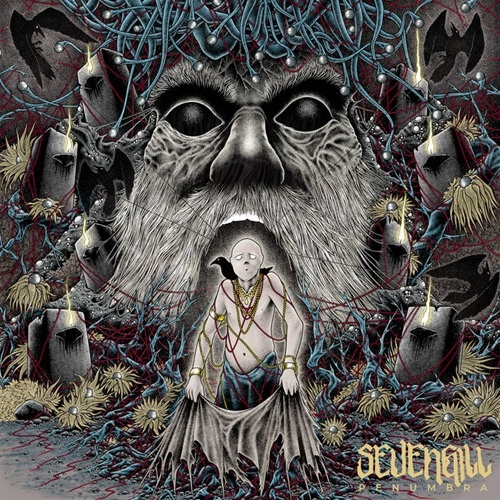
(Andy Synn takes a deep dive into the new album from Greece’s Sevengill, out now)
They say that you should never judge a book – or an album – by its cover.
And while I’ve yet to receive a satisfactory explanation of who “they” actually are – or, indeed, why any of us should listen to “them” – it’s been my experience that they’re not actually wrong.
After all, I’m sure we’ve all encountered an array of albums whose terrible/cheap/tacky (delete as appropriate) cover art has failed to reflect the actual quality of the music contained within (and vice versa).
That being said, an eye-catching album cover… such as, say, the one you can see above which adorns the front of the recently-released new album by Greek Post-Metal trio Sevengill… can definitely help capture the attention of potential new listeners before they’ve even heard a note.
Such was the case when I first stumbled across Penumbra earlier this month, as while I was unfamiliar with the group at the time (though I’d urge you all, after this, to go check out both Atem and Sea if you want a glimpse at how the band have grown and evolved over the years) there was just something about the artwork – attributed to one Mike S. Putrefurnaced – that drew me in.
And I’m glad that it did, as these four tracks of drifting, subtly doomy, and even somewhat Tool-esque, Post-Metal have proven to be an early highlight of my year so far.
Sure, the word “cinematic” is often used – and, indeed, over-used – when it comes to describing Post-Metal, so I’m going to try and avoid it here, but in this case there’s an undeniably expansive feel to the likes of “Oathbreakers” and “For the Sun”, whose dramatic, wide-screen scope and scale, coupled with an approriately benthic sense of dynamic depth (the band’s namesake, after all, is known for spending most of its time in the deepest, darkest parts of the ocean), is a clear testament to the group’s creative, and compositional, ambitions.
The guitar and bass work on the album’s three main tracks (“Ballata” being more of an introspective interlude piece) focuses primaily on tone and texture, rolling over the listener in waves of ringing distortion and chiming (almost chilling, in places) melody, buoyed by undulating undercurrents of gloomy atmosphere and interspersed with moments of bleak, haunting ambience whose sombre, shadowy nature proves more than fitting for the album’s thematic, oceanic, substance.
And while Penumbra is not wholly instrumental – unlike their previous release – the vocals are treated more as simply another instrument, rather than a focal point, used sparingly (in “For The Sun”, for example, they make their first appearance around the 4 minute mark, then don’t reappear for another 4 minutes, while immersive, Isis-esque closer “The Last One” holds them off until right near the very end of the song) to enhance the emotional impact of the music and to express only that which the band feels most requires a human voice.
So make no mistake, while the Sevengill itself my be considered a bottom-dweller, the band themselves appear to have all they need to enable them to rise to the top, as long as the currents move in their favour.