
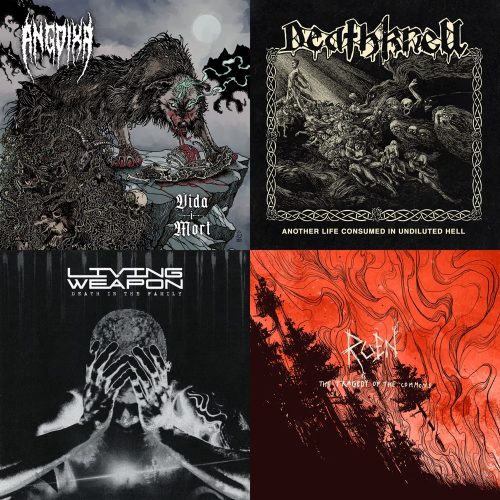
(Andy Synn caps off another busy month here at NCS with four more albums you may have overlooked)
Like I said last week, for the most part we prefer to focus our attention on bands who we think deserve more exposure or who simply aren’t as big as we think they should be, rather than expending our time and energy on artists who have been thoroughly covered elsewhere.
For example, I’m probably not going to be crafting a full Mastodon review this time (it’s a good album… occasionally a very good album, but occasionally held back by a few dud moments and an excessive length) or writing about the new Sigh (which, so far at least, I’m really not a fan of), as both those bands have already received more than enough coverage, so a few extra words from us – positive or negative – is unlikely to have much of an impact.
The four artists I’ve chosen to feature today, however, have never been written about here at NoCleanSinging before, which should make for some fun discoveries for all of us.
ANGOIXA – VIDA I MORT
It’s inevitable, things being as they are, that we’re never going to be able to cover every single artist and every single album that comes out each year.
But it’s still particularly galling to stumble across a band like Catalonian Death Metal crew Angoixa so deep into their career, having already put out three full length albums before the one I’m about to introduce you to.
Thankfully Vida i Mort (whose lyrics are all in the band’s native Catalan) is an excellent jumping on point, combining scything Swe-Death riffage, malevolently mesmerising, Dismember-ish melodies, and the occasional dash of gloomy atmosphere, in a way that’s most reminiscent of early 00s era God Dethroned (albeit with more of a focus on punchy, deathly groove and less “blackened” bite).
Possessing a taut, focussed heaviness that cuts deep and hits hard, while also being unashamedly hooky in nature, tracks like blasting, chugging opener “Despertar” and the lurching, melody-laced stomp of “Innocència” make me even more ashamed that this is our first time singing the praises of Angoixa… especially since these aren’t even the best songs on the album.
No, in my opinion that particular honour goes to – in order of appearance – the neck-wrecking riffosity and spiralling solos of “Esplendor”, the bombastic, Bloodbath-esque mini-epic that is “Zenit” (where the lashings of lethally infectious lead guitar work, aided and abetted by some moody ambience, basically steal the show once again), and the even more extravagant, eight minute slab of propulsive, subtly progressive, Death Metal majesty entitled “Esvaït”.
Truth be told though, there’s not really a weak moment here – though perhaps the extended ambient finale of “Mort” is a little anticlimactic – meaning that if, like us, this is your first encounter with Angoixa it probably won’t be your last!
DEATH KNELL – ANOTHER LIFE CONSUMED IN UNDILUTED HELL
Everyone knows the stereotype of Canadians being a polite, patient people… only, apparently someone forgot to tell thrashy crustmongers Death Knell, whose new album, Another Life Consumed in Undiluted Hell, definitely takes no prisoners and takes absolutely no shit.
While there’s no question that Death Knell are part of a long, ugly lineage of bands like Discharge and Disrupt, Amebix and Antisect – the likes of grim, groove-heavy opener “Undiluted Hell” and the Entombed-esque “Conditional” aren’t ashamed to wear their ragged patchwork of influences loudly and proudly – they’re not just a simple “throwback” act, as the occasional extra dash of Thrash and Death influence helps update their sound to something a little closer to the likes of Black Breath, Toxic Holocaust, or NCS-approved riff-mongers Hvrt.
This is particularly apparent as the album continues to pick up speed and momentum with the likes of the thrillingly thrashy “Sediment” (with the drums in particular pushing, and hitting, harder and harder as the song goes on) and the even heavier, riffier, “Scars of Atrocity” (both of which are major stand-outs to my ears), which represent an even heftier, darker, and more modern form of “Crust” which still stays true to the genre’s history.
That’s not to say, of course, that Death Knell aren’t willing to get down ‘n’ groovy when they need to – both the booming intro of “Sorrow” and the chunky, chugging second half of “Loss” find the band easing off the gas just enough to get your heads banging and your body moving without losing an ounce of the album’s intensity – but they’re never very far away (whether that’s the savage, snappy snare beats of the aptly-named “Bombardment” or the give-no-fucks ferocity of “Blackwater”) from cutting loose with yet another burst of visceral Crust-core catharsis that’ll get your blood, and your bile, pumping once again.
LIVING WEAPON – DEATH IN THE FAMILY
The debut album from Living Weapon, one of the most exciting newcomers on the Hardcore scene, has been getting a fair amount of buzz recently (though not nearly enough, in my opinion)… and it doesn’t take long for Death in the Family to make it clear exactly why.
Kicking off with instant face-melter “The First Element”, then pretty much refusing to offer any reprieve (the slightly superfluous strains of glitchy interlude “Parthenogenesis” notwithstanding) until the humongous “When No Light Compared” comes to its crushing conclusion, the band blend the brute-force bluedgeoning of END and The Acacia Strain with the calculated chaos of Converge and Car Bomb… and then, just to make things even nastier, throw in a hefty helping of abrasive electronic noise reminiscent of the likes of Godflesh and Leeched at their ugliest and most unforgiving.
It’s an impressively intense debut, that’s for sure, and what the songs lack in length (by necessity, as a more extended beating would probably be truly hazardous to the listener’s health) they more than make up for in sheer sonic density, with the mangled fretwork and monstrous chuggery of “Metastasis”, the ridiculous, red-lined uber-heaviness of the groaning, grinding, “Dead Like You”, and the squalling, screeching, howling assault of “Qui Transtulit Sustinet” all detonating out of the speakers like a barrage of auditory cluster-bombs whose use shoudl probably have been banned by the UN.
That’s not to say, as abusive and abrasive as this album is, that it’s not capable of being harshly hooky as well – “The Leaving Process” being the obvious example in this regard (at times reminding me of back when Cephalic Carnage occasionally flirted with the idea of being slightly more accessible with their Grind-infused psychosis), though if you’re not reacting to the heaving, pseudo-Sludge-y breakdown that makes up the entire second half of “Metastasis” you might well already be dead – but overall it’s about as subtle as a sledgehammer, and twice as impactful… and that’s just the way I like it.
RUEN – THE TRAGEDY OF THE COMMONS
Last, but by no means least, we have something a little more off our usually beaten track, courtesy of Poruguese Anarcho-Punk collective and their new album, The Tragedy of the Commons.
Presenting a fittingly fiery amalgam of Crust Punk, Screamo, Post-Metal, and Folk sounds – with the latter being particularly notable due to the record’s prominent use of acoustic guitar, banjo, violin, and viola – the band’s approach may be a little less “Metal” than most of what we write about (though there’s no denying the belligerent bite of a song like “When the Wolves Howl”, which possesses an almost Ludicra-esque intensity, both lyrically and musically), but should still absolutely appeal to any of our regular (or irregular) readers who consider themselves fans of bands like Pantopticon, Yovel, and Fall of Efrafa.
That being said, don’t expect anything as heavy – sonically, at least, as the lyrical content, bewailing the destruction of the natural world and the rending of the social contract (“You held my waist, as reality collapsed / Calloused hands gripping the ghosts of moments gone past“) is certainly more than “heavy” enough – as those acts, as the likes of “Wintering” and “Towards the Blood Dark Sky” would fit better alongside one of Austin Lunn’s more acoustic endeavours (which, to be clear, is no bad thing).
With all that context out of the way, however, I can now get to praising some of the album’s obvious highlights, from the electrifying, Respire-esque Post-Rock-Folk-Punk of “A Neglected Spark Burns the House” (if you only listen to one song from this record make it this one) and visceral blend of seething fury and sombre despair that is the aforementioned “When the Wolves Howl”, to the harrowing grief and gloom of “The Land Was Never Yours to Promise” (which, in places, recalls the doomier, earthier moments of both Fall of Efrafa and October Falls).
But as bleak and as brooding as this album is – and there’s no way that an album about our ongoing ecological collapse and the slow death by a thousand cuts of our shared humanity could be anything else – it still possesses a spark of hope… it’s not about just dancing in the ashes, but about saving what we can and building a new “commons” to replace what we’ve lost, one step, one day, at a time.
Loved that Angoixa record.