
Recommended for fans of: Sadist, Cynic, Obscura
Sometimes it’s a real struggle to decide what band to focus on for the next edition of “The Synn Report”… and sometimes, like this one, it’s an easy choice.
One thing that made it pretty easy was that so far this year we’ve had editions focussing on scorching Screamo (Ostraca), brooding Doom (Todomal), pounding Post-Metal (Erdve), riff-tastic Death/Crust (Black Breath), and a host of other genres to boot, but not really much that touches on the “thrashy” side of things… so this felt like a prime opportunity to tick that particular box.
Of course, the fact that Czechia’s Mindwork are such excellent purveyors of prodigiously proggy thrashery – one whose heaviest moments ably blur the lines between Thrash and Death Metal, while their willingness to indulge their proggiest proclivities often push their sound into more free-form, jazz-fusion inspired places – also made it a pretty simple decision, especially since their new album (their first since 2012) is such a killer comeback.
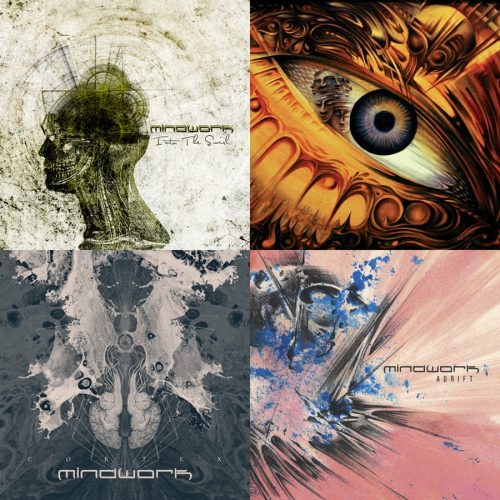
2009 – INTO THE SWIRL
The fluid fretwork and limber bass-lines of the album’s instrumental title-track offer a smooth introduction to Mindwork‘s sound on Into the Swirl, with ex-Pessimist guitarists Martin Schuster (who also handles all the lyrics and vocals) and David Vaněk (who would depart the project after the release of this album) and letting their proggier and more melodic sensibilities shine before diving headlong into the sharper, spikier riffage and twitchy rhythms of “Unrecognized Entity” (which also features an indulgently ambient mid-section).
The album really takes off, however, with the more aggressive and technical attack of “Inner Consciousness”, whose early-Coroner-meeets-proto-Pestilence approach provides the first real showcase of just how good Mindwork can be, individually and collectively, when they balance their more “progressive” ambitions (especially when it comes to the shimmering synths that permeate the track) with some serious metallic muscle.
The rest of this album, having now found its equilibrium, finds the band mixing and matching these two competing – and, thankfully, largely complementary – impulses in subtly different ways, at certain times opting for an even heavier, pseudo-Death Metal approach (“Essence of Existence”, “Twisted Priorities”), at others letting their freak flag fly with a mix of moody ambient moments and some shamelessly showboating lead guitar work (“On the Path to Oblivion”).
The aforementioned “Essence of Existence” and “Twisted Priorities” are both obvious highlights of course – not just for their increased, Sadist-style intensity but also for the clever contrast with their jazzier, Cynic-esque elements, as well as the stellar sticksmanship of drummer Filip Kittnar, whose performance helps elevate both tracks to an even higher level – but those of you looking for something a little more straight-forward and stripped-down won’t be disappointed either, as the taut thrashiness of “Wretchlessness” and the twisted technicality of “Parasite” (another one which errs pretty close to Death Metal at times) should scratch that particular itch too.
It’s an impressive debut, no doubt (with only mid-album instrumental “Freedom of Mentality” not really sticking the landing, in my opinion) and one which deserves to be spoken about much more often and much more highly!
2012 – ETEREA
Reduced to a trio after the departure of David Vaněk, the band’s second album saw them lean even more into the prog side of their sound (for better or worse).
This is immediately apparent on surprisingly soft and laid-back intro track “Enter Eterea”… though it’s up-front stand-out “Perceiving the Reality” that really makes this shift clear, mixing the twitchy technicality of early Death Metal (back when it was still separating itself from its Thrash Metal roots) with a much more melodic sensibility (including some crooning clean vocals reminiscent more of Porcupine Tree‘s Steven Wilson than Cynic‘s Paul Masvidal) in a manner that’s likely to prove divisive even now.
Thankfully the excellent percussive patters of Adam Palma remain a highlight of the song, and of the album as a whole, and his performance really helps anchor the various shifts in style and sound here and elsewhere on the album (such as during the even more extravagantly proggy “The Stream of Causality”).
Of course, your tolerance for “Prog” (with a big “P”) will likely determine your overall reaction to Eterea, especially when it comes to the likes of “Mind Renewal” (which should, at the very least, appeal to any fans of Traced In Air out there) and the decadently Dream Theatre-esque prog-ballad that is “Causality (The Reconciliation”)… though the less said about “Stillness of the Sea” the better, in my opinion.
That being said, the more metallic-minded amongst you should still find a fair bit to love here, from the unconventional Jazz-Death of “Reaping of Waters” to the darkly epic, prog-powered strains of late-album highlight “Enthusiastic Waves” (which joins and juxtaposes both the cleaner, more melodic and harsher, more metallic sides of the band’s sound to form a greater whole).
Sure, Eterea isn’t the album the band’s fans expected, or wanted… and the intervening years since its release still haven’t been particularly kind to some of its lesser, more lethargic cuts… but get past the initial shock and you’ll find that there’s still some solid fun to be had with this one (with closer “Eterea Collapse”, at the very least, providing an impressive exhibition of the trio’s instrumental abilities).
2021 – CORTEX
The band’s “comeback” release, if you want to call it that, and their first new material featuring new bassist Dominik Vozobule, doesn’t so much abandon the sound of Eterea – though it’s definitely a heavier, more Thrash/Death influenced record – as it does learn the lessons from the group’s last album, what worked and what didn’t, and weave them into an increasingly darker, deathlier sound.
“Depersonalized”, for example, sounds almost like a long-lost Cynic song, one that bridges the gap between Focus and Traced In Air, while the even moodier and more metallic “Last Lie Told” (probably my personal favourite track on the EP) wouldn’t sound out of place alongside early Extol or even latter-day The Faceless.
Hell, I might even go so far as to say that the blending of intricate fretwork (both guitar and bass) and shimmering melodic ambience that makes up “Grinding the Edges” has an almost Fallujah-esque feel to it, which makes it even more galling to think that Mindwork aren’t more well-known and more widely-appreciated by the Prog/Tech scene!
2026 – ADRIFT
After another fairly lengthy gap (though not quite as long as the gap between Eterea and Cortex, obviously) the band returned with their third – and, arguably, best – album, one which continues to build on the Tech-Thrash/Prog-Death hybrid of their debut (while increasingly leaning towards the latter), without sacrificing the dreamlike ambience and proggy melodies which have been part of their sound for so long.
Opener “Adrift”, for example, reminds me a fair bit of The Anchoret, while first “full” track “The Great Deception of Mind” takes the band’s Cynic/Obscura-adjacent sound and adds an extra measure of moody, Devin Townsend/Opeth style melodic introspection (plus some smooth, jazzy saxophone) in amongst the powerful-yet-restrained riffs and proggy-yet-catchy lead work.
It’s a near-perfect fusion of the more metallic/technical and melodic/progressive sides of their sound, and – just to prove it’s not a fluke – the following two tracks only help reinforce this impression of Adrift as the sound of a band in possession of a renewed sense of focus and direction, with the thunderous strains of “Breach the Cosmos” (where a lot of credit needs to go to drummer Kittnar and Vozobule for locking down an incredibly tight, technically complex, low end) showcasing a significant shift towards pure, punchy Prog Death, while “A Moment of Clarity” errs even more towards the Prog side of things with its flittering fretwork and fluctuating dynamic.
A Devin-esque cover of Talk Talk‘s “The Party’s Over” then follows, and integrates shockingly well into the album’s track order, after which the hefty, hooky, jerkily jazzy and gleamingly melodic strains of “Solitary Man” bring back some of that deathly power, the song’s shapeshifting structure and captivatingly catchy delivery often reminding me of both underrated (and sadly defunct) Prog Death prodigies Hieronymus Bosch and recently-resurgent Italian icons Sadist.
Following a short instrumental interlude (“The Branches and the Wind and the Rain”) the band double-down on the more Death Metal influenced sound they’ve developed since their last album, with the darkly electric riffs, nimble-fingered bass lines, and driving drums (including some unexpected bursts of precise, punchy blastbeats) of “Mess From Now On” (which also features some impressively jazzy breaks and some soaring saxophone) putting the band on a par with the likes of Beyond Creation, Obscura, and Serdce before the closing acoustic balladry of “Stars” ends things on a poginantly melancholic note.