
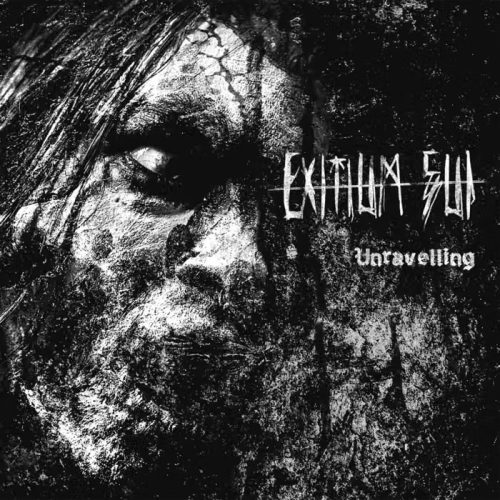
(Andy Synn has some grim delights to share with us today, from an album set for release tomorrow)
The weather here in the UK has recently taken a turn for the worse, shrouding us in a grey cloud of damp and humidity that somehow manages to combine Meditteranean swelter with Scandinavian chill at the same time.
What this signals, of course, is that our glorious (read: parched) days of Summer are now over, and we’re staring right down the barrel of another wet and wild Autumn/Winter.
And what better way to prepare for this than with the latest sepulchral slab of oppressive blackened Doom from the one and only Exitium Sui (AKA Chris Gebauer).
Those of you who’ve been readers of our humble site for a while now will probably be at least passingly familiar with Gebauer’s work, both as Exitium Sui and as part of Deadspace, but there’s a pretty decent likelihood that at least some of you reading this right now might not have encountered this particular project prior to this review.
Luckily for you, however, Unravelling might just be both the perfect “jumping on point” and their best work yet, providing the most complete, cohesive, and captivating insight into the dark heart of the artist behind the gloom.
Straddling the line between Black Metal and Doom (think the grim, scarred intensity of Lifelover on the one hand, and the solemn sonic mass of Eye of Solitude on the other) the sound of Exitium Sui has never been what one might call “enjoyable”, in the strictest sense, but – because misery just loves company – has always possessed an undeniably mesmerising melancholy, which here is made immediately apparent by the haunting-yet-harrowing strains of outstanding opener “Only Death Remembers”.
And while the core ingredients – massive, slow-moving riffs underpinned by a gloaming morass of sinister synths and pounding percussion, interspersed with occasional moments of scorching, blast-driven savagery or sombre, atmosphere-heavy introspection – haven’t changed all that much (though I’d posit that the vocals have been pushed even harder this time around, allowing a few more ragged imperfections to creep in around the edges, which only emphasise the raw power of every abyssal growl or wounded howl) there are two specific aspects of this album which, to my ears at least, seem to have taken on new life and prominence.
Firstly, there’s the prominent, mournfully melodic overtones – particularly in the moody, majestic lead guitar lines which murmur and ring, shiver and sing throughout each and every track – which more clearly than ever positions songs like “Draped In Black Flame” and “Drowning Viracocha” as part of a lineage which owes just as much of its gloomy glamour to the bleak, baleful beauty of My Dying Bride as it does the more “macrocosmic” sound of Mournful Congregation (though the latter, I would say, also recalls the darkness and desolation of Monotheist-era Celtic Frost, at least in part).
And then, perhaps just as importantly (if not even more so) there’s the surprisingly dynamic way these tracks are all structured, capturing and maintaining a sense of focussed momentum that balances out the album’s unforgivingly oppressive atmosphere and love of hypnotic repetition, such that even a song like titanic, ten-minute centrepiece “Crippled By the God Hand” (which quite effectively denies the commonly-held catechism of “less is more”) still feels like it’s always moving, always in constant, crushing motion, in a way that a lot of lesser, but equally doom-obsessed, bands (especially those which flirt with Funeral Doom) never quite manage.
Of course, there are one or two moments – namely during penultimate track “Septikinesis” – where things do start to drag a little (truth be told, if I were asked what one track I’d cut from the list it’d be this one), but thankfully the simmering slow-burn towards catharsis that is “Until the End Hath Found Us” (which wisely holds off the clean vocals until right at the moment where they’ll have the most impact) quickly returns the record to its former glory, ending Unravelling with one of its finest, most moving, compositions, that fully (and finally) reaffirms that initial impression that this is the album the project has been building to ever since its inception.
PS – if you’re not entirely broken by the weight and the woe of what you’ve just experienced, I also recommend tracking down and giving a listen to the band’s version of “Silence” by legendary Canadian electronic act Delerium (who some of you may also know as Bill Leeb and Rhys Fulber of Front Line Assembly).
Not only is it an excellent cover track, one which retains enough elements of the original (especially the instantly recognisable climactic vocal refrain) to be recognisable, while still putting a distinctively dark and doomy spin on things, but it also – spiritually, at least – actually recalls the more sombre and subdued nature of the initial version of the track that was first released, rather than the more upbeat remixes which became more popular (which, if nothing else, is a fun observation that might make you look clever at the right parties).