
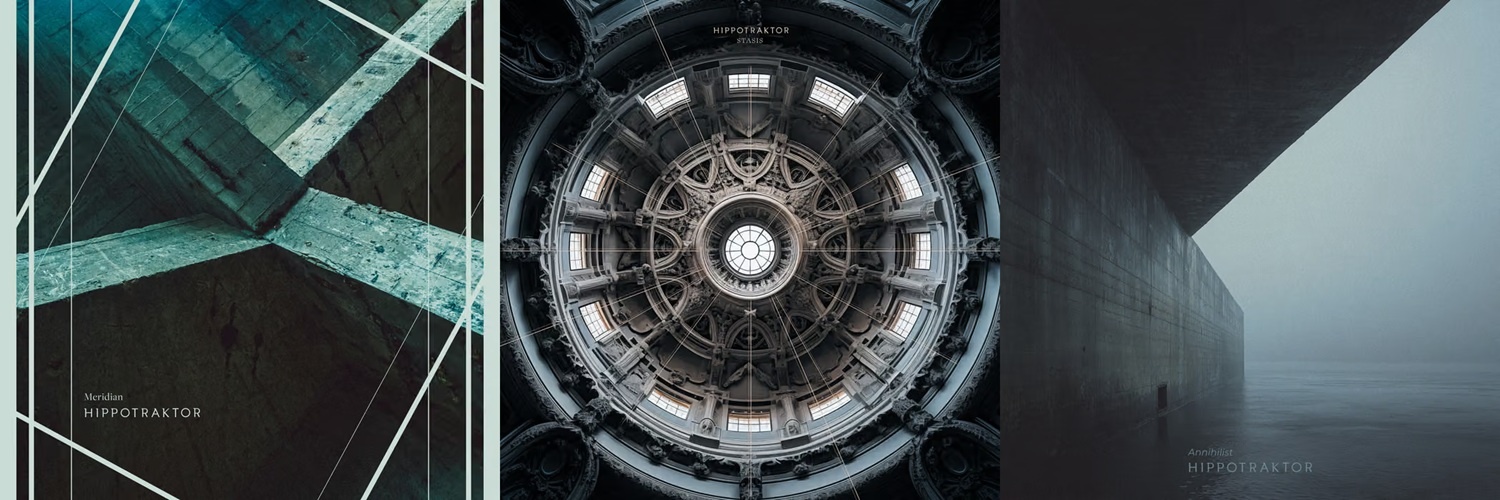
Recommended for fans of: Hacride, The Ocean, Benea Reach
As the person who’s largely been responsible for featuring Hippotraktor here in the past, it only made sense for me to be the one to write about their upcoming third album, Annihilist, which comes out this Friday.
And when I realised that this might well be the first time some listeners are encountering the band (the fact that they’ve been announced for this year’s Damnation Festival here in the UK has certainly helped increase their exposure too) it only made sense to pull together what I’d previously written, give it a bit of a tweak and polish, and then add some (hopefully) useful thoughts and insights about the new album, and call it this month’s edition of The Synn Report.
So if you like your music proggy-yet-punchy, complex-yet-catchy, heavily down-tuned but hauntingly melodic, then you should probably get to reading (and listening) all about these bombastic Belgians.
2021 – MERIDIAN
Right from your first listen to opener “Manifest the Mountain” it should, hopefully, be apparent that Meridian is one of those debut albums already in possession of both a clear vision and well-defined sense of identity, one which carefully balances both melodic accessibility and proggy unpredictability without sacrificing an ounce of integrity or intensity in the process.
Indeed, the impressive richness and depth of the band’s sound (aided and abetted by an impressively powerful production) was one of the first things that drew me to them, with the focussed metallic momentum and immersive atmospheric ambience of “Manifest…” and the brooding tension and moody melodic textures of “Mover of Skies” quickly laying the groundwork for the record’s subsequent success.
It helps, of course, that the band are standing on the shoulders of giants – channelling both the pneumatic power of Meshuggah and the fluid creativity of The Ocean, to name but two of the group’s obvious influences – amd aren’t afraid to steal from the best (the mechanical rhythms and celestial melodies of “God Is In The Slumber”, for example, recall both Benea Reach and Focus-era Cynic, while the dynamic push and pull of “Beacons” sits somewhere between the crooning catharsis of Klone and the grinding grooves of Gojira).
And while the group’s more melodic moments definitely possess some serious mainstream crossover potential – the harmony-drenched “Juncture” in particular feels like it could, and should, have been an unexpected radio-friendly hit – there’s still an almost Hardcore-inflected heaviness underpinning the music (especially when the group juxtaposes their pristinely-proggy clean vocals and gnarly, tooth-gnashing snarls in a manner not dissimilar to that of Burst or Cult of Luna) that helps keep them feeling that little bit grittier and more grounded.
Of course, if you’re pathologically averse to these sorts of down-tuned, post-Meshuggah grooves then Meridian probably won’t change that… although climactic closer “A Final Animation” might be enough to make at least a few of you reconsider your stance, seeing as how it fuses the band’s proggiest proclivities to a hulking backbone of bombastic, biomechanical heaviness reminiscent of Hacride‘s underrated 2009 masterpiece Lazarus, bringing the record to a suitably stunning finale.
2024 – STASIS
At first it may seem like not much has changed when it comes to the band’s second album – oh, sure, the sound is a little bigger, and a little brighter, but that’s mostly what you’d expect from a sophomore release – as the gargantuan, post-Meshuggah grooves and pristine, Post-Metal melodies of “Descent” suggest that Stasis is just going to be Meridian all over again… just with a little more of everything.
But as the album progresses (“progress” being the key word here) through the gorgeously groovesome “Echoes” and the moodier, broodier “Silver Tongue” it soon becomes clear that Stasis isn’t just bigger and heavier (though it’s certainly both) it’s also proggier and more immersive, with an increased emphasis on captivating clean vocals and intricate interweaving of richer, more resonant metallic/melodic/atmospheric layers.
The likes of the almost Deftones-esque “Renegade” and the creatively catchy ebb and flow of “The Indifferent Human Eye”, for example, showcase a songwriting style that’s simultaneously more rhythmically complex and more instantly infectious, once again reminding me of my beloved (and much missed) Benea Reach, while also recalling the proggy-yet-poppy approach of Coal-era Leprous to an extent.
This doesnt, I must stress, mean that Stasis is in any way lacking in Meshuggah-style metallic weight – the title-track in particular is a massive, biomechanical monster that cleverly juxtaposes some of the calmest and most crushing moments on the entire album – it’s just that the heaviness on display here is less of a primary focus and more of an intentional by-product of the tightly-woven textures and densely-packed structures of each track.
Sure, the more introverted feel of some of the songs demands a bit more of your attention than last time around if you want to really appreciate all the subtle twists and nuances – the sombre, slow-burn strains of “The Reckoning”, for example, might seem like an odd choice for a finale at first, but the track’s prodigious Post-Metal pay off is absolutely worth the wait (and definitely delivers just the right amount of weight, right when it’s needed, to bring the album home) – but, by counterbalancing the hookier, more infectious side of their sound with a proggier, less-predictable collection of smart songwriting tricks, the group prove themselves willing to change and evolve… just not willing to compromise.
2026 – ANNIHILIST
On their third album, set for release this Friday, the band continue their slow-but-steady evolution, focussing more on refinement than reinvention, with the end result being a record that builds nicely on its predecessors, continuing to place an added emphasis on mood and melody while also serving as a nice summation… for now, at least… of the group’s development.
What differentiates it from both Meridian and Stasis, however – even if only subtly – is the more focussed and concise songwriting, with only one of these seven songs (namely the pulsing, Tool-esque Prog-Metal of opening highlight “I Breathe. I Am.”) stretching past the six minute mark this time around (and even here you barely feel it, due to the song’s fluid, dynamic structure).
As a result not only is Annihilist the shortest album of the band’s career so far (by several minutes) it’s also the most immediate, with the stuttering rhythms and soothing clean-sung choruses of “Courageous Apathy” and the absolutely gargantuan, groove-heavy riffs of “Builder of Eden” (whose melodic verve is ably provided by a guest appearance from ex-The Ocean frontman Loïc Rossetti) locking in right from the start.
Some listeners might… and, I stress the word might… miss the more extensive atmospherics of Stasis, but should at least be pleased that some of these elements do still remain (the album’s shortest, and heaviest, track, “Oblivion Walker”, for example, dedicates almost its entire final minute to a haunting, minimalist soundscape that contrasts perfectly with the heaving metallic intensity which precedes it), while those who preferred the proggier side of the band should be similarly satisfied that Hippotraktor haven’t abandoned these touches either, with moments like the riveting drum-work in the aforementioned “Builder of Eden” or the gorgeously gloomy slow-burn build-up of “Annihilist” reminding you that there’s a science behind the sound.
Indeed, the band push the progginess even further (while still retaining the album’s characteristic concision and precision) on “Everything Is Permissible”, whose more restrained riff-work and greater emphasis on melody (plus a plethora of ear-catching percussive patterns, particularly during the song’s shamelessly funky mid-section) errs even closer to the likes of Klone or latter-day Leprous (the latter esspecially) in a manner which suggests, to my ears at least, that this might just be a direction worth pursuing further next time around.
Before then, of course, there’s the sweeping cinematic grandeur of “A Different Now”, whose climactic combination of subtly technical riffage, complex-yet-catchy drumming, and one absolutely soaring solo, ends things on an unexpectedly triumphant note that’s sure to have listeners coming back for more.