
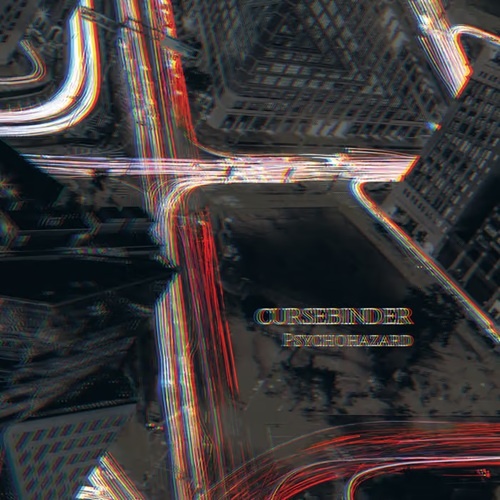
(Andy Synn recommends you all drive carefully, because there’s a Psychohazard ahead)
It was about three-and-a-half years ago, by my count, that I first wrote about excellently-named Polish “Post-Black” quartet Cursebinder just prior to the release of their debut album, Drifting (read all about it here).
Of course, a lot has changed in the world since then – some of it good, much of it bad, and a fair amount still largely inexplicable – and there’s no guarantee that the Cursebinder of 2026 (despite having managed the rare feat of maintaining a consistent line-up since they were formed) will still be the same band they were in 2023.
If anything, however, it seems like the group have only become more themselves – more confident, more collected, more creative – in the intervening years, with the result being that their new album (set for release one week from today on Avantgarde Music) is easily their most wide-ranging, yet also more cohesive, work yet.
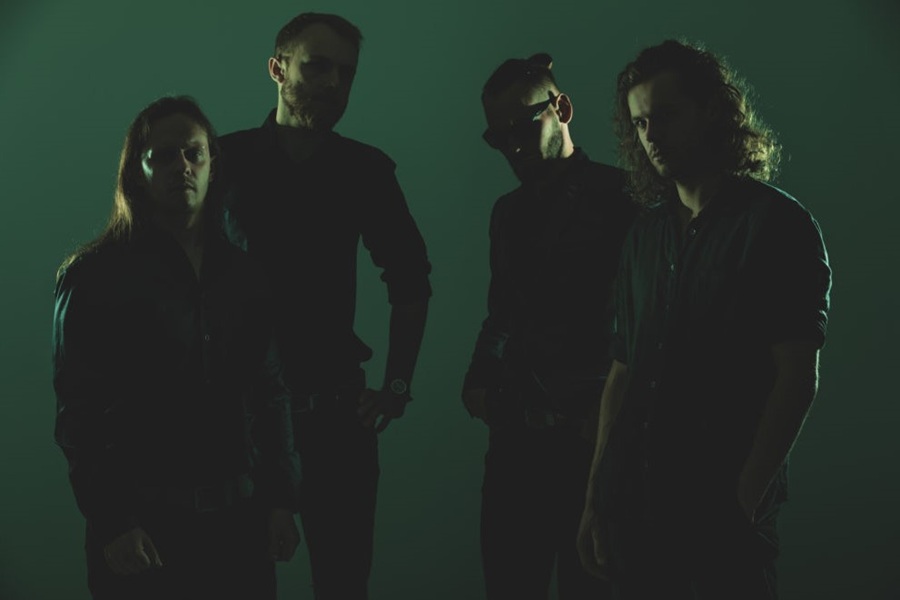
Artfully composed and cunningly constructed from the penthouse down to the pavement, Psychohazard – so named, one assumes, as much for its menacingly memetic properties as for its moody, metropolitan sprawl – is an album that positively thrives on contradiction, every action catalysing an equal and opposite reaction that in turn fuels the thrilling creative tension at the heart of the album.
Or perhaps it’s better described as conversation, a dialect if you will, with every song – from the static-charged shimmer and pounding metallic pulse of “Limits” to the strobing synths and surging riffs of “Made to be Sold” – feeding off the energy generated by the conflict between the initial blackened thesis which drives the music and its opposing, jazzier antithesis which guides and shapes it, to create something… a synthesis, if you will… that’s neither one thing nor the other, but a highly-evolved hybrid of both.
In layman’s terms, this manifests as a tense push-and-pull between the existential urban ennui of Wesenwille and White Ward (a comparison aided and abetted by the appearance of WW saxophonist Dima Dudko on mind-expanding, attention-demanding early highlight “The Astronaut”) and the nocturnal, neon-lit ambience of Portishead and Perdition City-era Ulver, with the resultant sound – epitomised by the shape-shifting sonic assault of extravagant eight-minute stand-out “Prayers for the Living, Flowers for the Dead” – both defying convention and resisting easy categorisation.
It’s why I’ve tried not to use the term “Black Metal” too much in this review, as while Cursebinder‘s foundations are undoubtedly rooted in blackened soil (the scalding, throat-scarring vocals and seething, snare-driven percussive patterns should have been your first clue) you get the sense that Psychohazard – much like its eye-catching, anaglyphic cover art – has more dimensions to it than can be perceived at first glance.
That doesn’t mean, of course, that your first encounter with the record won’t be rewarding – the instant impact of songs like the dissonance-laced “Death Season” (one of several tracks where drummer Marek Koszycki puts on an absolute clinic behind the kit) and “Saturnine Rage” (which builds, brick by brick, to a sky-scraping, synth-drenched finale), for example, is practically impossible to deny – it’s just that these rewards really begin to replicate and multiply the deeper you look and the more you decipher the album’s underlying patterns.
And if the album’s ambitious length perhaps stretches things out a litle too far (the inclusion of prowling penultimate bonus track “Naked City” pushes things well past the fifty minute mark) the climactic strains of “Under the Skin” – whose darkest, moodiest moments recall the eerie, alienated ambience of the massively underrated Jonathan Glazer movie of the same name – bring things back into stark, unflinching focus, ending the album with an all-too necessary reminder that what we believe, and the world we perceive, is not always true, and that “…the fact that millions of people share the same mental mythology does not make them sane.”