

(written by Islander)
Rintrah is an unusual musical collaboration whose lineup consists of Otrebor (Botanist, ex-Lotus Thief) on drums and vocals, Arsenio Santos (Howling Sycamore) on bass, William DuPlain (aka Cynoxylon, ex-Botanist) on vocals, and acoustic classical guitarist Justin Collins. They describe Rintrah as a project “that pays tribute to Romantic period art, poetry, and music (circa 1798-1837),” in part by drawing their lyrics from “classical pieces by Romantic era poets, presented unaltered and unabridged.”
Last year we premiered Rintrah‘s debut demo (here), and we also wrote about another demo track that came out later in the year (here). Those were rough versions of four songs that will appear in their final form, along with seven more songs, on Rintrah‘s debut album The Torrid Clime.
That album will be released on this coming Bandcamp Friday, August 1st, via Fiadh Productions, and pre-orders by the label and the band are starting today. Tomorrow we will premiere a full stream of the album with a review, and we’re including one of the new songs (“In Tempests”) at the end of this article.
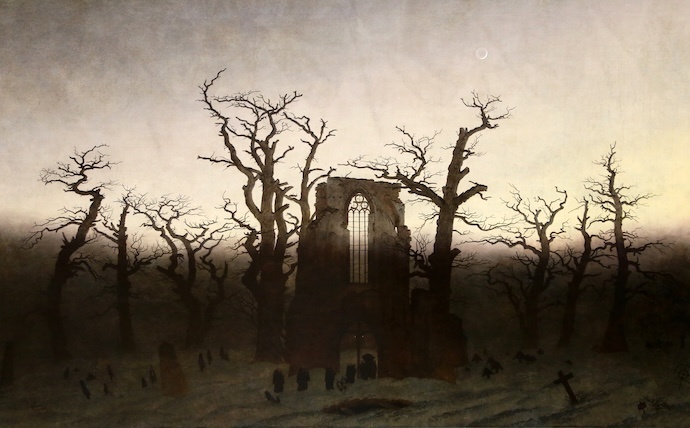
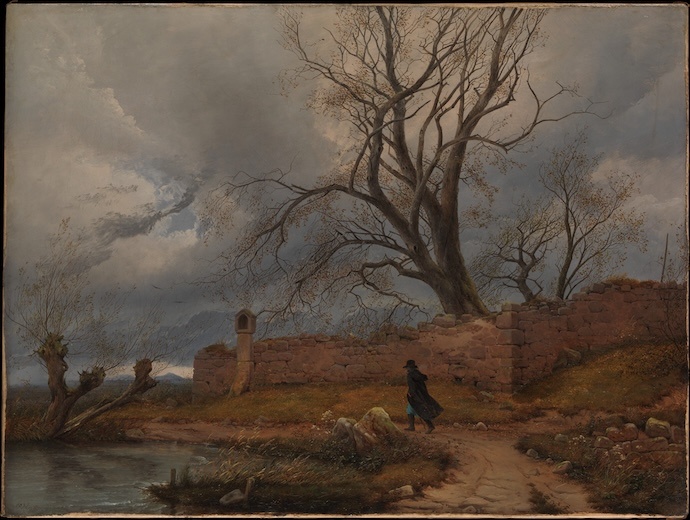
To help pave the way to these events, I interviewed Justin Collins to delve deeper into how Rintrah came to be, and how the music was made. That discussion follows, illustrated with paintings by Caspar David Friedrich and one by Julius von Leypold (excerpts of some of these appear in the booklet accompanying the album).
Justin, let’s begin with a few “nuts and bolts” questions. First of all, how did you and Otrebor join together on the idea of making music together?
Otrebor basically conjured this into being. I was an “internet acquaintance” of his because I reviewed a lot of Botanist albums, and I supported his Patreon. As a response to a request for recommendations way back in 2020, I think, I sent him a link to one of my classical guitar recordings as a goof. He posted it in a newsletter and said, “Justin C sent me this maybe partially as a goof, but the piece ain’t no goof…I’m going to be checking out the other pieces he’s uploaded on the bandcamp.” So that was pretty cool.
Fast forward to February 2023, and Otrebor reached out and asked me if I would be willing to try to write songs based on drum tracks he’d already recorded. The new project he had in mind was to use Romantic era poetry (like Percy Bysshe Shelley, Lord Byron, Emily Dickinson) as lyrics. I said I’d give it a whirl. I’m not just a classical guitarist, but that’s what I mostly focus on these days, so we decided to try that. I figured he’d hear my first attempt, realize he’d made a horrible mistake, and politely thank me for my time, but it didn’t happen that way. He liked it, and we were off.
What was the early songwriting process like?
My first idea was to try to write songs in the style of Romantic era music. I have a few favorite pieces from that era. But I quickly realized that (1) I’m not actually an expert in Romantic era music, and (2) that wasn’t necessarily going to be that fun for me in the long run. So the first song I wrote (which eventually became “In Tempests”) was the first and last attempt at being strictly classical and “period correct.”. Otrebor ultimately encouraged me to do whatever the hell I wanted, so although I played them all on classical guitar, some of them lean pretty hard into folk, jazz, more contemporary classical pieces, and whatever else struck my mood at the time. For example, “Angels With Wild Beasts’ Eyes” is actually a mutated riff from a Coltrane song. I just wanted to see if I could make it work.
How did the project grow and develop?
The plan was always to have a full band. Arsenio Santos on bass was our next recruitment, because Otrebor knew him from previous projects. I might have been three or four songs in by that point, and then Arsenio started writing and recording the basslines for the guitar and drum tracks. All of this was over the interwebs at this point. We’d never even met in person. But Arsenio’s contributions made it start to feel like a real band.
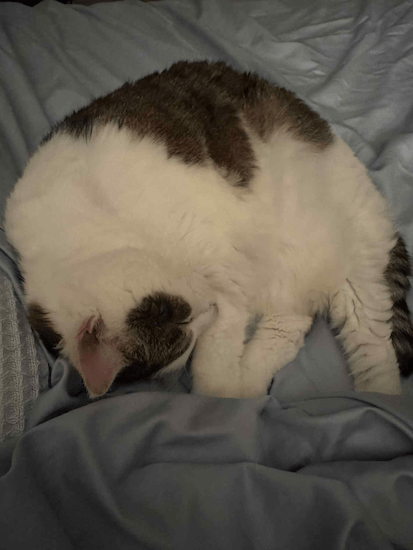
Otrebor was still doing preliminary vocals at that point, but we had always been interested in having another singer. Otrebor eventually lured in William Duplain, who sang on a couple of Botanist albums, including Ecosystem. William was the last piece of the puzzle, and at that point, we started adding what would become the final vocals. My memory might be a little hazy on this point, but I think I’d actually written and recorded most of the guitar for the album at that point. We finished off the vocal recordings with Otrebor and William in my house in Massachusetts–which my cat was very confused about–and in William’s house in New York. That was the first time any subset of the band was in the same room at the same time.
When did you all decide that a song was finally finished? Did things continue to change during the mixing/mastering phase of things?
We went into mixing and mastering with most things “done,” although of course things always change and evolve. We had re-amped my purely acoustic recordings to add distortion, and we were still picking at that element a little bit because I wasn’t sure if it worked everywhere–after all, I hadn’t written or recorded the guitars with distortion in mind. But through kind of a happy accident, the engineer’s first pass left almost all of the distorted tracks buried in the mix, so we ended up with a clean sound. Less metal, but I’m really happy with how it sounds. I think that’s when we started referring to the music as “chamber prog.”
The vocals were probably some of the more complicated parts to finalize because Otrebor pushed William to do a lot of harmony tracks, so we kind of went with a “throw it all at the wall and see what sticks” approach. We pared some of it back, but we still have some pretty ambitious harmonies happening in there.

All 10 songs on the album that have lyrics pull the words from 19th century Romantic-era poetry, from poems by the likes of Shelley, Emily Dickinson, Lord Byron, William Blake, Charlotte Smith, and Baudelaire. Whose idea was that, and what is the explanation for this choice of lyrical focus?
I’m going to toss this one over to Otrebor and William, as they were the driving forces of choosing the themes and poems.
Otrebor: A class on Romantic literature in high school impassioned me to this period, and my interest had already been piqued by Iron Maiden’s adaptation of the epic Romantic poem “The Rime of the Ancient Mariner.” Being shown that work in its original, complete state was a thrilling discovery of connection. I didn’t really further connect the parallels between Romantic philosophy with my lifelong fanaticism of heavy metal until black metal had a chance to sink its hooks into me for at least 15 years. Finally, the light went on and I view metal, and black metal in particular, as the finest musical expression of the Romantic sublime: finding the true God in Nature, the sense of the primordial as channeled through the self, nostalgia for the past, using fantasy as a tool to reshape dissatisfactions with reality… I wanted to pay tribute to both these worlds in a way I wasn’t seeing in art or music, by letting the works speak for themselves, unedited, unadulterated, with original music that was written with these themes in mind.
William: I came into the project having a long standing preference for particular Romantic authors, but also had wonderful organic experiences of randomly opening a book at a cafe and having Lord Byron’s Childe Harold’s Pilgrimage stare back at me. I used entire pieces of that epic poem for the lyrics for “Without a Grave,” “In Tempests,” and “Into an Echo,” taking some liberty with the cadence of the verses and where the stanzas begin and end to serve the song. The vocal music flowered out of the poetry’s dynamics, like with “Angels With Wild Beasts’ Eyes.” I enjoyed working with the impressively cohesive breadth of content that centers around traditional themes of nature, but also those of isolation and woe.

The name of the album is The Torrid Clime. What is its significance or meaning?
It’s a phrase from Byron’s poem “Dark, Blue Sea.”
Thou glorious mirror, where the Almighty’s form
Glasses itself in tempests; in all time
Calm or convulsed-in breeze, or gale, or storm,
Icing the pole, or in the torrid clime
Byron’s going through all the different, far-flung parts of the world that the sea touches, including the frozen poles and the hot, “torrid clime.” It sounds cool. And since “torrid” can mean both “hot” and “tumultuous,” it’s a pretty good way to describe recording an album.
https://rintrahmusic.bandcamp.com/
https://fiadh.bandcamp.com/album/the-torrid-clime
This was cool, interview and music. Very unusual.