

(written by Islander)
This coming Bandcamp Friday will bring the release by Fiadh Productions of the debut album from an unusual musical collaboration that has taken the name Rintrah. That album, The Torrid Clime, pays tribute to Romantic period art, poetry, and music (circa 1798-1837). It does that in part by drawing the songs’ lyrics from classical pieces by Romantic era poets, presented unaltered and unabridged. The themes include “finding the true God in nature, the sense of the primordial as channeled through the self, nostalgia for the past, and using fantasy as a tool to reshape dissatisfactions with reality”.
The participants in Rintrah include Otrebor (Botanist, ex-Lotus Thief) on drums and vocals, Arsenio Santos (Howling Sycamore) on bass, and William DuPlain (aka Cynoxylon, ex-Botanist) on lead vocals — and guitars were composed and recorded by classical musician Justin Collins.
Yesterday we published an interview with Justin about how Rintrah and the music became a reality. We’ll use parts of that interview as reference points again today, but the main subject now is the music itself, a genre-bending and time-traveling experience that you’ll now be able to enjoy in its entirety.

For those who may not be well-versed (pun intended) in the Romantic era, The Font of All Human Knowledge describes it as “an artistic and intellectual movement that originated in Europe towards the end of the 18th century” whose purpose was “to advocate for the importance of subjectivity, imagination, and appreciation of nature in society and culture in response to the Age of Enlightenment and the Industrial Revolution”:
Romanticists rejected the social conventions of the time in favour of a moral outlook known as individualism. They argued that passion and intuition were crucial to understanding the world, and that beauty is more than merely an affair of form, but rather something that evokes a strong emotional response. With this philosophical foundation, the Romanticists elevated several key themes to which they were deeply committed: a reverence for nature and the supernatural, an idealization of the past as a nobler era, a fascination with the exotic and the mysterious, and a celebration of the heroic and the sublime.
As noted above, lyrics for songs on The Torrid Clime were drawn from poems by some of the era’s greatest poets, including Shelley, Emily Dickinson, Lord Byron, Baudelaire, Charlotte Smith, and William Blake. The album’s title was also excerpted from a Byron poem, “The Dark, Blue Sea.” And Rintrah was the name of a roaring figure in Blake’s mythos. But the music itself is not strictly tethered to musical traditions of the period.
As discussed in yesterday’s interview, the songs started with Otrebor‘s drum tracks, which sometimes have a distinctly metallic flavor, and although Justin C. then performed all the guitar parts on classical guitar, he roamed widely, leaning “into folk, jazz, more contemporary classical pieces, and whatever else struck my mood at the time” (and seemingly without having specific poems in mind as he did so). Those variations turn out to be a big part of what gives the album a start-to-finish grip. No doubt the lyrics influenced the vocal expressions by William and Otrebor (how could they not?), but the singing (yes, singing!) also pulls from different and more contemporary wellsprings.
Considering how the songs were put together, one might fear a musical resemblance to Frankenstein’s monster, with the bolts still showing as in the Boris Karloff version. Yet the music, though startling in more ways than one, sounds anything but haphazardly stitched and bolted together. To the contrary, the songs have a cohesive emotional resonance and power, and in their mood and sensations they sound in line with the key themes of the Romantic era — a rejection of convention, a fascination with the exotic and the supernatural, a grasping for the sublime, fearless and fearful contemplations of death and eternity.
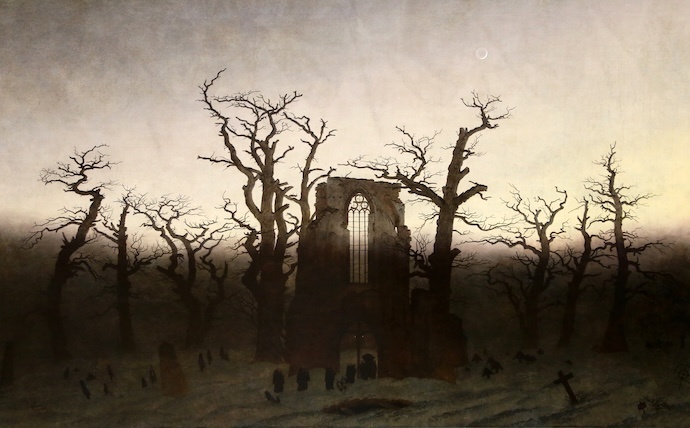
The Torrid Clime includes 11 songs, and it’s tempting to comment on each one of them. But that risks tedium, which would be unfair to an album that’s anything but tedious. So we’ll just pick a few (okay, more than a few) and add some more overarching thoughts after that.
“Fearful Symmetry” opens the affair, set to the words of Blake’s poem “The Tyger”, which includes this closing stanza:
Tyger Tyger burning bright,
In the forests of the night:
What immortal hand or eye,
Dare frame thy fearful symmetry?
Otrebor is off to the races right away, with drums blasting. The guitar strangely rings over throbbing bass notes and that rushing percussive drive, much like the audio version of glowing and glittering eyes peering hungrily from dark woods. The vocals are high and go higher, delivering impassioned wails that become a bit torn and a bit unnerving to hear.
As the song unfolds, the drums and bass change frequently and so does the guitar performance. Those sounds become musing and mesmerizing, but they also continue ringing in ways that are bright but strange, reminding of minor-key and microtonal adventures rendered by some avant-garde metal bands, and the bass maneuvers grow more animated and adventurous themselves. Moreover, the guitar follows the changing of the drums in both tempo and mood, though as you hear it all happen, the changes are unpredictable.
It’s a fascinating and somewhat disorienting way to begin — intricate and elegant, sinister and seducing, buoyant but also (for want of a better term) psychedelic.
Jumping ahead to “The Chariot“, that song takes as its text the poem of the same name by Emily Dickinson, which famously begins this way:
Because I could not stop for Death,
He kindly stopped for me;
The carriage held but just ourselves
And Immortality.
As in every song, the guitar work alternates in ways that follow the alterations in the drumming but sometimes diverge. The notes fluidly ripple, brightly ping, frolic and skip, but also seem to moan, joined by a bass that hums, snarls, and pursues its own frolics. As before, the vocals are striking in the way they express Dickinson’s ode to death and the passing into endlessness.
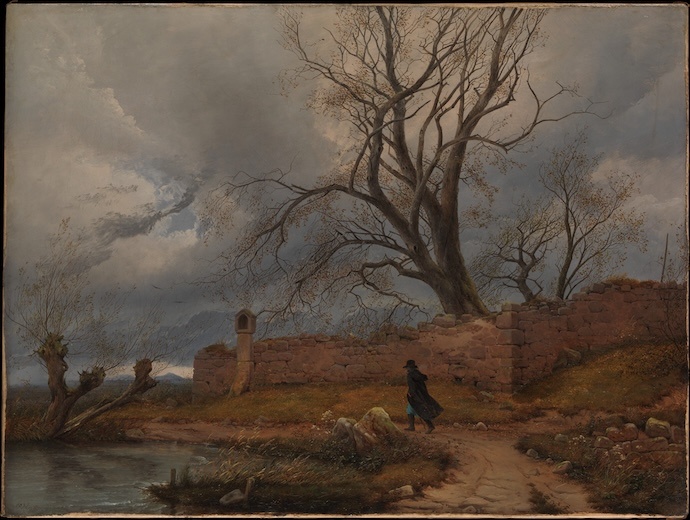
Just one step further this time, into “Mutability“, lyrically drawing from Shelley’s poem about the constancy of change in life. It begins this way:
We are as clouds that veil the midnight moon;
How restlessly they speed and gleam and quiver,
Streaking the darkness radiantly! yet soon
Night closes round, and they are lost for ever:
Justin told me that the guitar parts for this one were inspired by a contemporary classical guitarist from Cuba whose work he admires. The pacing is slow; no drums appear until the song is almost half gone, and they’re comparatively simple and subdued when they do. Especially when combined with the quavering tones of Otrebor‘s haunting vocals for this one (here he is the vocalist, while contributing harmonies elsewhere on the album), the soulful music sounds like a melancholy lament, or a wistful remembrance, though interspersed with flamenco-like fretwork bursts.
The sublime, guitar-only, interlude track “Nocturne, Op. 4. No. 2” written by Johann Kaspar Mertz (1806-1856) is the only musical piece on the album that was actually created near the Romantic era, and in its mood it makes for a very good follower to “Mutability“.
One more leap ahead, to land on “In Tempests” (sailing over, among other things, the tremendously infectious and both fiercely fervent and disturbingly distraught “Giddy Brink“). The text for this one is an excerpt from Byron’s epic poem “The Dark, Blue Sea” (which is also the source for the album’s title). I’ll share the lyric words in full:
Thou glorious mirror, where the Almighty’s form
Glasses itself in tempests; in all time
Calm or convulsed-in breeze, or gale, or storm,
Icing the pole, or in the torrid clime
Dark-heaving; boundless, endless and sublime-
The image of eternity-the throne
Of the invisible; even from out thy slime
The monsters of the deep are made; each zone
Obeys thee
The riffing here sounds ghostly, just as bright and intriguing as ever, but with an apparitional quality, like greedily grinning phantoms manifesting in high desert plains (or at least that’s what came to this listener’s mind); and occasionally something seems to snarl around the corner. The song is grounded by head-moving, foot-tapping groove (with hammering to come), and the vocals really go stratospheric, like persons possessed.
And then there’s the beautifully uplifting and sublimely soulful “Memorable Fancy“, much more folk-influenced than any other song, almost reminiscent of Delta blues and southern gospel — immediately followed by the a cappella closer “Into An Echo“, whose choral vocals go even further down that willowed river road, though (in keeping with Byron’s words) it sounds like a funeral hymn. These two make an unexpected good-bye from Rintrah, but in truth it’s hard to say that anything on the record is expected.

Overall, the album’s tonal qualities are intriguing. The clean sound of the guitar makes the music glint, gleam, and stand out, but there’s also a brittle sharpness to the picking sometimes, and the notes don’t always flow in harmonious directions, with at least as many minor keys as major ones in the works. Perhaps it’s the power of suggestion, but in their sounds they often struck this listener as kindred spirits to those of Otrebor‘s hammered dulcimer in Botanist‘s records.
There’s usually subdued warmth in the bass tones, though that doesn’t prevent the ever-nimble bass perambulations from seeming dangerous or demented at times, and the drums also have an organic but multi-faceted sound, sometimes like hand drums, sometimes like weaponry. William also has a very effective singing voice, with enough range to amplify the emotional push and pull of the music, and it seems to stand in just the right place in the mix — not too far forward, not too hidden. It brings an emotional rawness that contrasts with the glitter and glow (the recurring sprite-liness) of the guitars.
To get even more overarching: The Torrid Clime has a few of its many tendrils in metal worlds, most especially the drumming (though it’s also adventurously unpredictable and experimental), but it doesn’t sound like anything else you’re likely to find in those realms, or probably anywhere else. In its combination of tones and stylistic influences, not to mention its lyrical inspirations, it’s persistently “out of this world” — frequently dazzling, at times disconcerting and even diabolical, and ultimately sublime.
The lyrics for the closing song are from Byron’s “Childe Harold’s Pilgrimage”. They reflect a sense of finality, the extinguishing of a torch, the breaking of a spell, the end of a reverie, with little or no hope for anything more. I certainly hope that Rintrah‘s choice of those lyrics wasn’t intended as a final word, and that they will have more to say to us in the future.
You’ll be glad to know that as very wordy as this introductory review has been, it still doesn’t give away the whole show, and probably couldn’t even if I’d tried. To get the whole show, settle in and press Play now:
The Torrid Clime was recorded between 2016-2025 in California, Massachusetts, and New York, with audio production by Aki McCullough at Nu House Studios.
The album will be released on this coming Bandcamp Friday (tomorrow!), digitally by Rintrah and in a jewel-case CD edition by Fiadh. It includes a 7-page booklet illustrated with excerpts of paintings by Romantic-era artists and featuring the poems used for the songs’ lyrics.
PRE-ORDER:
https://fiadh.bandcamp.com/album/the-torrid-clime
https://rintrahmusic.bandcamp.com/