
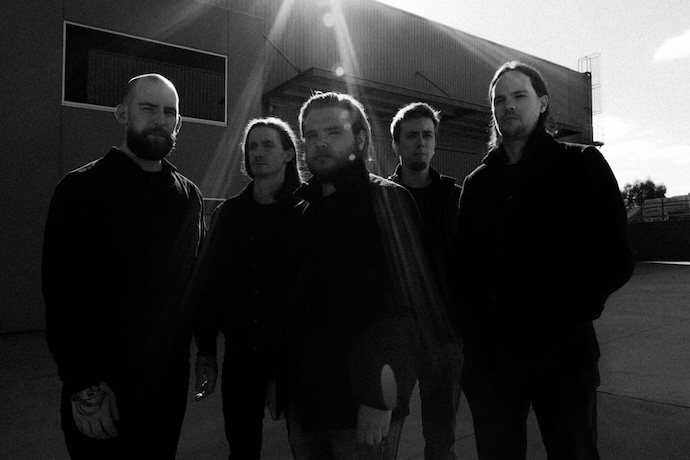
Photo Credit: Oli Sansom
(NCS contributor Tør last appeared in our shredded pages during the depths of the covid pandemic, but he rejoins us today from Australia with a very extensive and interesting interview of keyboardist Steve Merry from the Australian progressive/melodic death metal band Be’lakor following completion of their recent North American tour and just a few days away from the band’s three-date tour of Australia with Persefone and Orpheus Omega. We’re grateful to both of them for all the time and thoughtfulness they devoted to this discussion.)
NCS: Years ago when I was still in the US, I was always looking forward to you guys doing a US tour. So, that’s where I want to start because it kind of relates to me personally, but also just knowing that the tour landscape in the US is logistically so brutal. There’s a lot of travel involved, it’s a different culture, there’s gear challenges, and lots of other things going on. So my first question is, how did it go for you guys? Did it live up to your expectations?
SM: Well, firstly, I hope you’re coming to our Melbourne show, we’ve got you on the guest list.
NCS: Yes, I am!

SM: Yeah, yeah. It’s a bit of a shame that our timing was such that you couldn’t see us when we were over there and so on, but hopefully we can give you a good show in Melbourne. Regarding the US tour, we had wanted to do it for some time, probably 4 or 5 years of talking about it, and knowing we were going to try and do it but just not quite sure when we would. At some point we made a plan that we said we would just stick to which was the 2023 Europe and 2025 US tours.
But I mean the tour went really well so we were happy with everything and we feel it was a great success. It was a lot of hard work and stress to do. I think we started the visa preparations in November 2024, and we had our final interviews at the consulate in August 2025, about 10 days before we flew out. And, there was a lot of stress there around the fact that if any single one of us had issues at that point, we might have a really big problem. But basically we knew it was going to be hard work and it was and we obviously had someone to help us—a visa broker based in the US—to help us with the process.
That’s probably the single biggest factor in future decisions about going to the US because the crowds were awesome, the response was very good. And partly that’s because I think we hadn’t ever been there so there were certainly a lot of people that had been waiting a long time. They were telling us how excited they were and that they never thought they’d get the chance to see us, and we’re happy that it happened. So all that was really awesome. We did make some profit—merch sales were strong—all those things mean we would like to go back. But we’re just going to always have to balance up the practicalities of mainly the administrative time, which is the biggest factor that’s just a lot of that work. We are actually probably even more surprised by Canada. We had five shows in Canada and 12 in America and the Canadian crowds nearly accounted for 50% of the ticket sales.
NCS: Oh, wow!
SM: But that’s not to say the US ones were bad. It’s just to say how ridiculous the Canadian ones were. Like Montreal, I think, sold out at 900 or 930. And for us, that’s nearly or pretty much our biggest ever club show anywhere. So the Canadian crowds were very strong. But overall, every single show felt like a success and we felt very lucky to be able to make this all happen.

NCS: Sounds like it was a great time and, in terms of Canada too, Montreal is an institution so I’m not surprised that they packed out to see you guys. I was looking at the US stops that you had and it looked like you pretty much have been all around the country, right? There was definitely a run through the south and then both coasts, if I remember correctly?
SM: Yeah, exactly. And the only part we didn’t get to is the middle. So there were some people in some of those states in the middle that were upset that we weren’t there. But then some of them did travel five, six, seven hours to come and see us somewhere, which was amazing. But we would have liked to get into the center as well. But yes, I think what we achieved in three weeks was better than maybe we thought we could have achieved in terms of basically doing a lap of the perimeter of the US and then up into Canada as well.
And we were very lucky to do the entire tour with Solemn Vision and they were kind enough to provide the drum kit. So we put that in our trailer. They were sort of on the road behind us for a lot of the time, but the gear was often in our trailer. And we also have a setup where a lot of our actual gear is done through a lot of digital emulation of amps, so we’re not carrying around too much gear other than a drum kit, some guitars, a bass, a keyboard. Not much in the way of amps and cabs, so we were able to do that pretty well.

NCS: I was going to ask whether there was a moment during this tour where you thought, you know, “Yeah, this is it. This is totally worth it!” But it sounds like the entire North American tour was a massive success. So were there any logistical or even performance related things you guys picked up on this tour?
SM: I would say yes, but it’s almost like a part one and part two of a learning journey. The European tour two years ago, I’d say, was the bigger learning curve for us. And this tour was like part two where we filled in the gaps. And I think the two of them together, yes, we now feel like we kind of get how to do a tour internationally, what to do, what not to do. Some of the biggest takeaways this time were probably to be more mindful about border crossings and how many there are and when they’re happening. Because, you know, the US into Canada, back to US, back to Canada, back to US, was a lot of stress and a lot of hassle.
And we probably need to think more about, you know, where do we get merch printed? What country should we print it in? Things that we probably learnt that might be specific to the US and Canada for future tours. Even things like the bus, we were in a bandwagon (RV) and that was really good, but for a future tour, maybe it’s more cost-effective to go with a tour bus and try to have a co-headlining tour where the other band shares the cost of the nightliner with you. So there’s always things to learn, but I think this tour, nothing really went too wrong, which is a great relief.
NCS: Any funny stories from this tour that you can share with us?
SM: To be honest, our biggest focus this tour was not repeating a mistake we made in Europe, which was super embarrassing, which was, we left our guitarist—he got out of the bus really early one morning—and the bus drove off; it actually drove for three hours.
NCS: You’re kidding! In Europe, that’s long enough to cross national borders, right?
SM: Yeah! We actually left him in Germany and we were in the Czech Republic approaching Brutal Assault Festival and our drummer got a Facebook message from the police in Dresden saying, you know, “This is the police, we have Shaun, your guitarist”. And we went to look in the bunk and the bunk was empty and we all just had a complete, like, “This is crazy!”, like, “We’re in huge trouble!”
And obviously the experience was even worse for him—he was walking around in bare feet without a phone and without anything. So that’s our funny tour story which our goal in the US was to not repeat. And we succeeded—but we’ve become ridiculously paranoid now, you can imagine. The bus will be in a truck stop and the driver will move it four meters and we’re all freaking out!
NCS: That’s hilarious–that is actually awesome!
SM: Yeah, we’ve become like a post-traumatic stress band about being on the bus.

NCS: That’s fair enough, I mean as funny as it sounds, stuff like this does happen especially when overseas and on a long run. What about the food? Did you get to experience some of the culinary culture as you moved around North America?
SM: Yes, because we were with Solemn Vision, they were quite good at saying, “Hey guys, by the way, this place you’re in is famous for this food”. Like Texas barbeque, Philly cheesesteak, in Canada it was Poutine. So there were a few like that. The other thing is, just a complete oversupply of truck-stop burgers and food that makes you feel sick after the fourth day of eating. And then we had our merch guy Dan, who is American, who we hired to help sell merch on the tour, and he was the guy helping us understand, “This is how you actually should be doing it”. We haven’t done many tours where we have a fridge, microwave, and a freezer in a bus.
So, the very first time we stopped at a Walmart he came back with a full trolley of frozen foods, protein powder, yogurt, fruit, and frozen fruit, and he basically had an entire dietary planning done for the tour. And we’re still walking around with a packet of chips, you know, learning from him how to actually do it properly. So, yeah, I think it was a combination of learning as we went and then trying to handpick a few famous dishes in certain places as we were traveling around.
NCS: That’s awesome. And that’s kind of what makes the memories, right? When you’re on tour, because, you know, aside from how amazing it is to play every night to the crowds, you also kind of want to at least try to see as much of the places that you’re going to and document it for yourself. And food is a great way to do that, right?
SM: Absolutely but yeah it is always sad. We’ll get to a city we’ve never been to, we’ll do sound check, so we end up having about an hour to two hours at most to ever see any place. You get an hour to walk down the main street and even though you’re in a city that you could spend two days in or four days in you’re actually going to have an hour to look at it. So that’s probably the downside of the tour when you do come home and people say, “How is this place and that place?” And you can only tell them about, like, two restaurants. You know, you have to do the best you can.
NCS: What are some of the differences between touring in a place like the US versus Australia?
SM: There are bands in Australia that do something we’ve never done, which is, they get in a van and they drive around and maybe play a bunch of smaller regional towns like Geelong, Newcastle, and the Gold Coast and they may string together a tour of 15 shows but only three or four or five major cities. I think if you’re going to tour Australia and just play the major cities, you basically have to fly, probably. And, in our case, we often end up doing it on a Friday, Saturday type of thing on weekends.
I think you’re right that when an Australian band goes to the US or Europe, they’re much more flexible around, we could make this two, three, four, five weeks, we can play a show every day, we can play a major city every day, and we can drive without needing to take a bunch of flights. So I think that’s definitely a big difference. The thing we were shocked by in America was just the distances between everything. So if the bus parks somewhere you might still have to walk 10 to 15 minutes before you really get to anywhere you can eat. You know, just the sprawl of the country and the sprawl of the cities, whereas in Europe, it was often that you can do a whole lot on foot, once you stop somewhere you can get all around the city on foot. Whereas American cities were all quite big and there’s all that kind of suburban sprawl between the Walmart, the truck stop, the venue, you know, those sorts of things.
NCS: So having done Europe and the US/Canada now, what’s next? Is there a ceiling anymore? Or do you just see success as a continuation of big tours all over the world going forward?
SM: We often have this conversation. It’s hard to know as a band at this stage of what we’re doing, what your next goals should be. For example, I think we would need to quit our day jobs and commit to a year or two of not one tour like we did, but five to six tours a year like we just did, if we were going to be like our goal is to take the next leap and become a band that’s five to ten times the size that we are now. It feels like that would be the next step, whereas in our case we have reached a stage where we went overseas and played mostly to our existing fans. I think the feeling was it’s a fan service, it’s a chance to play for people who wanted to see us and we’ve wanted to play for them and that’s sort of amazing. Whereas I think if you’re talking about growth, it might be that we need to go and be a support to a band like Amon Amarth or whoever it might be.
Some band that has a lot of fans—a lot more than us—and could expose us to new audiences and, you know, it’s hard to know. But I think we’re not really looking at doing too much of that thing where we all quit our jobs at this stage. So it’s more a case of gradual growth, focus on putting out music that we’re proud of and enjoy making, and then trying to do as big tours as we can in the context of our lives, that kind of, give our fans what they want and help us see different parts of the world. We have talked about whether we go to Japan or South America, there’s other options we’d like to look at. There’s also big parts of Europe we haven’t done. So there’s a lot we can do, but it’s just a case of trying to be strategic and knowing the right time, I guess, to do those things.
NCS: What are some of the main challenges that an up-and-coming Australian underground metal musician faces? Because we are a smaller market, and we’re far away from the rest of the world, and that brings with it certain challenges. And how have you been able to successfully overcome those challenges?
SM: I think if we had started out with the goal of getting to a stage where all of us have one job and that is the band, then we probably would have been frustrated and given up because we all know that in metal, that is extremely rare. I think you’ve got to be one of the 30, 40 biggest metal bands on the planet to do that, I think, or something in that kind of realm. So I think what we’ve enjoyed is the fact that we’ve always had a balanced life, like things we enjoy, meaningful jobs that we enjoy as well, which means the band has had 20 years of longevity and maybe a lot more ahead because it’s never become a chore and it’s never been a problem if the band takes time to achieve something or if the band takes four years to make an album. There’s no pressure on us to do that, so we can focus on making music we like and so on.
But I think the barriers bands face when they have the goal of professionalising as musicians are many, and streaming and things like that may have affected it. Certainly the way physical music sales have changed is a big factor. But in Australia, just the distance, like I think you would need to travel overseas three or four times per year as an Australian band to access the markets that exist in metal. And the European summer is the best example. You would need to be in Europe every single summer, and you’d need to be playing all those festivals every summer if you’re serious about doing it as a profession. So I think if you’re based in Scandinavia, or even if you’re based in the UK, you’ve got amazing access. You can basically take a day off work or three days off work or just have your summer holidays and go and play some incredible festivals every single year.
Whereas in Australia, you’ve got to sort of pick how you’re doing that and you’ve got obviously expensive flights to go over there. And then the same is true of America, but you can add in probably visa costs and some things as well. So yeah, I think the location of Australia and the small number of big cities here does mean that Aussie bands essentially have to find a way to get overseas really regularly. But, for us, we’ve been in some ways lucky that that’s not really been the goal in any meaningful way. So we’ve probably just been able to enjoy the process.
NCS: You mentioned luck. I think every band that I’ve spoken to that has had measurable success on the global scene has also mentioned luck. Or that, you know, through certain periods, events kind of transpired in a way that didn’t make sense at the time but really helped propel them forward in hindsight.
SM: Yeah, I think you’re exactly right. I think luck and timing are massive. So for us I’d say when we released our first album in 2007, and probably the two years before that was when MySpace was at its most popular, so I remember we put three recordings of just live versions of tracks—before we had any albums out we had some live recordings—and we put them on MySpace and we would sit down and kind of send friend requests to people who were followers of, you know, In Flames and things like that. We did it every day, but when people found us through that, they actually got to hear things, and it just happened that MySpace was big then, and before we knew it, we had something of a following. And then I think the other thing that helped was, back then, there were sort of 50 really popular blogs, you might recall the websites that had album reviews, and they each had like three thousand readers, so we sent our first album out to all of them that we could find to review.
And, you know, back then that was quite different to today where there were hugely passionate readerships of these websites and if you got a good review you kind of instantly saw sales. So we would see the review go up and we’d see the comments and we’d get like 10 sales that day. That doesn’t really exist anymore. I think you need to rely more on your social media game now and somehow crack the algorithm, whereas back then you had these real people really paying attention on these sort of niche sites. So all those things were lucky where in the first three years we had taken advantage of that and before we knew it, we were kind of rolling. Whereas I think now starting from cold would be really hard.
NCS: In addition to social media, what’s the band’s approach to new technologies whether they be recording software or anything else?
SM: We probably could do more. I think we keep it fairly simple and we’re not one of those bands that’s at the forefront of technology in any respect. We’re usually slightly behind and we modernized a few things on the recent US tour. We used MIDI switching in Ableton live to trigger the effect changes on our guitar pedals. So Shaun and George could just play and they would switch automatically from clean to distorted to wah et cetera automatically at the right moments in the songs. So these are things that bands have been doing probably for quite a few years that we’re just getting onto now. But, yeah, we’re not one of those bands that’s at the forefront of all that.

NCS: Of course, the three-date Australian tour is happening in October. But thinking about each album as a specific time capsule that encompasses the emotions and everything that’s happening at that point in time for you guys, what can we expect from the next time capsule?
SM: Yeah, it’s a good question. And one of the things you might have heard us say about our music is like we try to keep it timeless. So where some bands, if you look back through their discography, their lyrics might reflect their political views or their personal lives at that time. We would avoid that if we can. So, every album is a story or is a set of poetry that has no bearing on current events of the world. So, that sort of time capsule idea probably is a bit less present in our discography, which is kind of intentional. But what we probably do have after the live shows is a feeling for what riffs people like and what moments in songs get people most excited and are most fun to play live, and just the energy, the flow of a song.
I’m trying to keep that fresh in my mind because it’s useful in songwriting. And we’ve never really written songs in a way where you’re trying to think “how will this go live?” We’ve never really thought about it. But part of me does want to keep that in mind because it’s not bad information to have when you’re writing a song. But, yeah, nothing too groundbreaking. And I don’t think the next album will reflect anything in particular around our journey or where we are as people or anything like that now. But we’re always just trying to make it an album that we find exciting and hopefully the fans will like, but especially that we—most important is that—we are excited by it.
NCS: And is there a specific timeline for the writing process and then going into the studio?
SM: We’ve got a preferred timeline of what we want to achieve, but we have to be prepared to change it if the music needs that. Because we would be embarrassed if we rushed something and put it out and we weren’t kind of happy with it. So, yeah, I think the goal is a 2027 album release and tour on the back of it, but that will require us to have the album finished in 10 to 12 months’ time and recorded during the second half of 2026. So that’s up to us. We’ll work hard and see if we can get it done. And if we can’t, then we’ll just have to change the timelines.
NCS: And can we expect another tour between now and the release of the next album?
SM: I would imagine not. I think these three shows coming up in Brisbane, Sydney, and Melbourne will be the last shows we play until we have a new album. And the reason for that is just because we meet up for short times each week, and when we meet up, we have to decide how we’re spending that time. So, it’s normally either rehearsing for a tour or writing new music, and it’s rarely both. I think when we were 21, 22, and still in university, we had a lot more time. We sort of did both but these days we have to pick. I think we’ll be focused on album work after this run of shows.
NCS: And we’ll be looking forward to it. Before we finish, I have to ask: did you guys have a tour playlist on the bus?
SM: We did! And what we had was essentially Elliott, our drummer, was our Spotify man. And he would just hand his phone around and people would add songs to the queue. And you can imagine how broad—like it was just whatever. A lot of the listening was obviously not new material. I think one of the things that could be good about us but also maybe is a negative in some people’s minds is, part of us is stuck in the 2002 to 2008 music world, where a lot of the albums we love are from that period. So, George will have a leaning to heavier stuff. Elliott and I will have a leaning to a bit of Archspire, as one recent band. But, probably most of it was metal, but a broad range of metal across the board. But a lot of it is not new. Then I’d throw in some occasional random stuff like ’80s pop and old pop punk and stuff like that. We did start out listening to that stuff in the early days but if you were to say, “What are the current trends in metal?” I could probably only tell you Sleep Token are popular and I could tell you Gojira is still crushing it and beyond that I’d be struggling to know what’s happening.
NCS: Does anybody in the band have any weird pre-show rituals?
SM: There’s a little bit of that. Like I brought with me one of those physio lumpy foam logs you put behind your neck. So, before a show you might see me rolling around on the floor with that on my back and my neck. You’ll see John doing stretches like he’s about to play a game of tennis. George will be walking around doing vocal warm-ups. Elliott actually does push-ups before every show. So, you know, in the green room, when you see Elliott on the floor doing 20 push-ups, you know that we’re probably on stage in about six minutes. Before every show, our sound guy Troy would play “Black Hole Sun” as the final song before we went on stage. We used to joke on the tour that we were becoming like Pavlov’s dogs. When we’d hear that song, we’d start pacing around the green room and Elliott would start doing his push-ups and all these sorts of things. It was quite funny.
NCS: So, if you weren’t a melodic death metal band, what genre would you play?
SM: Honestly, different answers depending on who you talk to. George and I would be trying to write pop music. Like, you know, The Weeknd. We love extremely catchy, well-made pop songs. Yeah, we’d be tempted to do that. I think Elliott would definitely be in a black metal band, and in fact he is, in Dusk Cult, which is a side project of his. Shaun would be in an Alcest-style band, where it’s all delays and clean guitars and it’s like shoegaze. John would be making EDM, electronic, you know. It would depend on who you talk to, and that’s maybe one of the strengths as well, as we do bring different preferences to what we’re actually making as a band.
NCS: Yeah, that’s pretty eclectic and cool! And finally, I just want to turn it over to you. What message do you have for all the North American fans that came out to see you? Obviously, it was a monumental thing for a lot of fans. The commentary online was absolutely out of this world.
SM: Well, I guess the big thing was just a “Thank You!” And we enjoyed meeting the people in the US and Canada that were there for those shows. It felt just like we were meeting people similar to us. You know, people who were in the same kind of age bracket, who have been on the same journey we’ve been on, they know the songs and have been living our albums with us for 20 years. No other message than to say we’ll be back. We have to come back because it was so successful and so much fun. We just don’t quite know when. And yeah, a new album is coming. So be patient with us and we’ll deliver something that hopefully is good to listen to.
https://belakorband.com/
https://www.facebook.com/belakorband
https://www.instagram.com/belakorband/
Great interview. (Poor Shaun)
Can’t wait for saturday’s Melbourne show!