
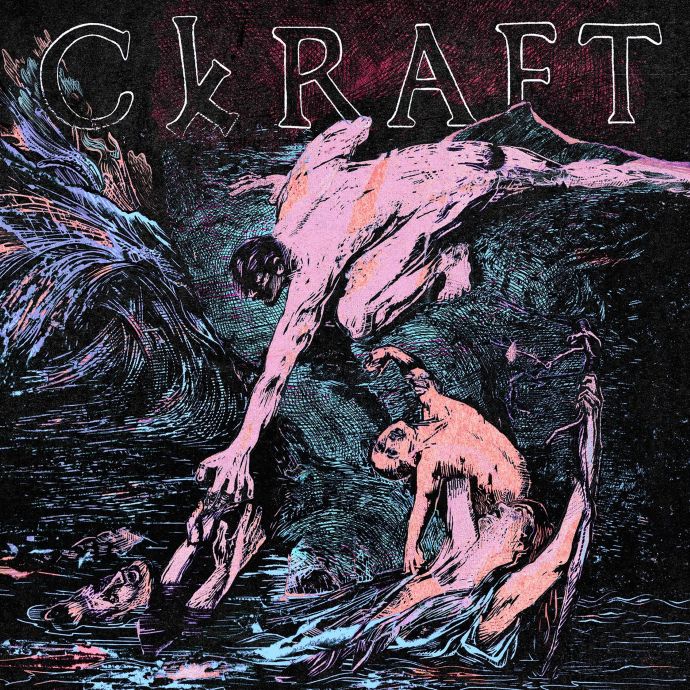
(Settle in, make some time, prepare for detours into a labyrinth of rabbit holes, and eventually reach a wildly inventive discussion of wildly inventive music. In other words, we have another remarkable review by Vizzah Harri, this time focusing on a remarkable album by the French band CKRAFT that was released way back in January of this waning year.)
One type of madness is to take pattern-seeking to the level where one actively looks for connections. It’s been pretty stormy in my neck of the woods this year. Not being able to account for how others experienced a year filled with despair for many, no-one can claim to be able to right or mend all wrongs on our earth in the current zeitgeist. There is however a criminally underplayed and underrated album that demands attention. It will be revealed after a bit of a detour. People that groan about nothing good coming out anymore are living under a rock and probably still send each other this meme for kicks.
Every now and then you hear a melody that reminds you of something else. Only recently becoming acquainted with Emerson, Lake & Palmer led me to listen to their Tarkus album and when Stones of years came around I was pinching myself to make sure I wasn’t dreaming. I heard that vocal melody before. I was like, this is Hail Spirit Noir, but it very obviously was not.
It’s never a chore to go through one of the best avant-garde/prog/psych/rock/black metal band’s whole discography to look for just one melody, though the answer should have been obvious. It was a time reference, and I should’ve known that it related to Pneuma’s penultimate track Into the Gates of Time. Lo and behold, I found a calque/homage of proportions that gave me the biggest fuckin scat-consuming grennian (sorry, I like to etymologize the fuck out of words). The vocal melody is like beat for beat the same.
I time-stamped it for you, but if the videos somehow don’t open that way, the Tarkus suite’s Stones of yearsat the 2:57 mark goes “has the dawn ever seen your eyes?”
and then Hail Spirit Noir’s Into the gates of time at the 1:06-ish mark goes “step into the gates of time, step through the pale gates of time”
The latter is probably in my top 13 favorite bands of all time. Not a weak song on any of their stellar albums and their year of the dragon album Fossil Gardens just kept expanding and refining their sound.
However, in the search for more musical memes one could divert from say Rush E to other original meme artists such as Alkan, or even inanimate objects like this broken electrical typewriter playing jazz. But then, did you know about the door that plays Miles Davis’ Bitches Brew? No, it does not in fact stop there, here’s the quartet version. Then another door decided it wanted to pass the threshold into jazz. Other inanimate objects took notice and wanted to join in the fun, like this cubby hole (glove compartment).
Not content with infiltrating the freeform world of jazz, supposedly inert implements decided to enter the universe of metal, like this washing machine trying to emulate Sepultura’s Refuse/Resist. And this is when things got wild when poultry got involved with both a rooster and a cockatoo signing up for some mayhem. Another washer was resolved to a less dignified fate. Ultimately leading to the air conditioner doing a jazz drum solo that sounds very close to Gojira’s The art of dying. Unaware of its metal homage it got joined by the doors as an ensemble, expanding further with the glove box and a bin and then a human took notice.
So, can you make music from anything? The next band play actual instruments, but they took Gregorian chants, jazzed and riffed it up, and their record contains not even a whisper.
Detour #2:
‘Gemynd’-e afvalligheid
Apostasy of mind
Brandishing that banner
As you debark from sep
‘Gemynd’ is an old word for ‘mind’ of Germanic origin while the kitchen Dutch word is ‘apostasy’ translated. Sep is sapience etymologized, for the truth-seekers, etymologos. The banner being that unofficial South East Asian flag, that of vectoring forwards, a march towards that darkest of fantasies, progress.

This was my curtain for six months.
The original form of this poem and introduction is lost in aethereal liminality and contained the words “walking away from…” instead of “as you debark from…” or even “depart”. Progress, comes from putting one foot in front of the other in what would become a walk, shuffle, or amble forth, opposite to moving in a backwards direction, not regressive. This is the flag, whether it is seen as jest, those leeches and gatekeeping ticks… Afr. gate=’hek’, hek-tick (thanks Deon DuToit), indeed hectically fervent for their insatiable voraciousness in consumption, or more aptly, hoarding.
“Once all currency is understood to be as worthless as the paper burnt as offerings to magically transfer nominally useless insurance, effigial ash QR’d to bone dust of forebears forgotten in putrescent stasis of buried ideations in that cerebellar room of petrified suzerainty over a suspended dust mote. Dreams of the dust of progress indeed.
“And the dust of those dreams manifested in nothing of import, for even those worshippers of the golden calf are drawn to genuine creation. Though not too near to the truth pray tell, one can hear in accusatory refrain for their money being on their mind (ek sien jou Norra Marris), and their sapience locked to currency, prestige and status, for one drive around the largest graveyard in the northern reaches of Tonkin one could discern a foghorn ominously howling: convenience.
“Even this itinerant slush of words can survive monuments erected in lieu of that which is compensated for, the lack of which blares more loudly than the distance between oscillations perceived as sounds vibrating on our eardrums. So instead of marching towards the sun setting on the futures of our collective progeny, choose not to debark into the dust swirls of collective suicide.
“Rather step backwards, submerge into that lake named after the evening redness, submerge into the uncomfortable truths of old informing your present. And so, flip that debarkation. To embark the ship of life is to craft, for life is art, and art is life. Craft into being even an idea, whether of memetic infectiousness or just the first swerve out of the hydrochloric acid mind-flush that is the nonsensical strife towards enrichment through subjugation.”
Crafting into being still holds stronger magic than that which disparages, festers, debases, destroys, and disillusions. We know this for, trve ‘ars’ (skilled/craft – art etymologized) derives thusly from being skilled (skil – Old Norse for discernment and knowledge) and as a craft (from cræft – ‘strength, skill’, Germanic in origin, i.e. Kraft and so too linked to the Dutch, Kracht). Art, is a craft that is cheapened by money when the pursuit of creation gets stilted by fiscal concerns.
I’m sorry if anyone waited too long, but the case is more zenzizenzizenzic (the eighth power of a number, obsolete math term) in zugzwang (a situation in chess where every possible move is a bad one). It’s the dickhead that tends to pandiculate (act of stretching and yawning) and lives in a constant hypnagogic state.
I lived in a very loud place, perhaps the reason I’m leaving it is to find more sonic calm and ease. If you’re feeling that error 404 sign brightly scaled up to big-ass-Las-Vegas-hotel-neon sign levels in your small room. Or if you’re in the path of a killer volcano, no, I meant this one… perhaps it was supposed to be the other way round, whatever da funk is happening?! (such a great music video if you click the second link, the end is timeless and a reminder as to how life can be poignantly finite and hilarious at the same instance)
Why is this troll slamming me with acid house, just cos it ain’t alkaline, he doesn’t have a house, is everything else just basic to him?! I mean, Fatboy Slim apparently “admired the simplicity of the TB303’s controls so much that he named his first single “Everybody needs a 303.” But before we get into the intergalactically infinite question of life, the universe, and everything presented on one of the tracks below, it might be good to start at the beginning.
So if you also ever found yourself stuck in a silver box and needed some resuscitation from the hectic fever of the grind and pound of everyday horrors, then for some it would be good to divert into Uncommon Grounds. There is Sleep Token (I have no idea what they really sound like and apparently that makes me elitist?), then there is Sleep Terror. Everyone has a bit of a taste for variety, spice, for hybridizing genres… Well, that’s what CKRAFT do. Just not in the same multiverse? (Not all links are jokes)

Uncommon Grounds boulders in with a bass drum thump almost as if to say, here is what you have to focus on. The other instruments quickly follow suit and it turns out not to be anything at all like what you would expect. Neither is the drum solo, tempo change- and drop in atmosphere within not even a third of the track length. With an intriguing mix of drums, bass, and guitar with saxophone and a synth-accordion not just for flavor but as main ingredients.
The opener for this mindbender of an album puts all the cards on the table, furious interplay and a mélange of melodicity, technicality, and legitimate bone-crunching bravura. Toeing the line between brawn and finesse like a butterfly with a stinger, or rather more like a hummingbird but with a charmed bastard sword for a beak, the kind that holds within it a conduit to a bleak singularity.
All You Can Kill is a great title and has less to do with the proverbial purge than the propensity humanity has to “spread death,” in “reference to the concept of the ‘all you can eat’ buffet.”

“Priorities“, Soviet Caricature about USA, 1953
We like to know where bands draw inspiration from, and it might not catch you offside that this record was inspired and written chiefly around Gregorian chants; seeing as Islander wrote about this very track last year already. The first track is based fittingly on Dies Irae, day of wrath, the march of the dead.
The entrance of Bring Forth the Imperial Ghost might induce thoughts of a Parisian café, though the classic black and white film quickly turns postmodern, surrealist, and positively absurdist. This track is based on “Salve, Sancta Parens” “the sacred mother who brings forth the king.” The title being a wordplay on the action and the band feeling moved to infuse some of their influences from both Imperial Triumphant and Ghost, whoever they might be. Interspersing chugging and airy atmospheric forays with dizzying sax and accordion interchange which then fall back with the rhythm section keeping time with the percussion, if you can keep up, to make way for stadium guitar leads and a solo.
On paper the album, and each song for that matter, should seem bonkers in concept. In actuality, it’s more than insane, it’s fret-bustingly fantastic. With a not-too-distant affinity towards convention just to keep the listener off-guard, here the side quest is the main journey. Taking a concept of sonic values to allude to, tether it to the here and now in consciousness, and then subtly scraping the temporal lobe with a steel brush.
Steadfast (In the Face of Tribulations) steers away from liturgical plainchants and has a foundation in the shuffle of the blues. Or as the band tells it, “the foundational rhythm of blues, swing, jazz, rock, metal, serving as the ultimate cultural bridge. The title honors the essence of the blues: resolute, faithful, and unwavering in confronting challenges and life’s trials.” It also functions as an interlude of sorts, not that it is in any way lesser than anything else on offer, but the palette needs to be cleansed before the main dish is served. Ending on an open chord fading into a silence of nearly a holy 7 seconds for the maelstrom that is to follow.
According to the band that charitably described each of their tracks: “Misconstruction of the Universe refers to the misinterpretation of the universe. The Gregorian chant “Universi Qui Te Expectant” translates to “Of all those who have their expectation in you, none will be confounded […] make me know your ways, teach me your paths.” The paths of religions are all more or less similar, but always esoteric. CKRAFT mimics this with the main riff being based on a rhythmic key that is impossible to understand and using “Universi Qui Te Expectant” as the main lead.”
There is a belief that sometimes artists try to be complex for the sake of being complex, which is paradoxically simplistic. There are other times where there is a vagueness and lack of exposition so to speak, not just for the listener or person experiencing the art to make up their own mind, but to show that there are in fact no strict boundaries. We are after all a part of the art upon interacting with it.
As far as Misconstruction of the Universe and its ambiguity compared to how the other tracks were presented, if you’re gonna put a line in there stating that it is in any way possibly indecipherable, well, I didn’t ask any musicologists but I did ask a drummer:
“from what can be denoted, it is that they were trying to create something so far removed from a grip on reality, something so metaphysically complex that there is no groove to hold on to. To pursue and examine complexity through [a construction which is hard to decipher] is a very interesting dualism and paradigm”
This is not for me to look cool, I didn’t even pass counting via Abacus 101 until grade 12, but even if you were a human metronome you’d be hard-pressed to count the riff in Misconstruction of the Universe.
“It appears as if they’re playing in 15 with a very long progression, [which is rather weird to a drummer used to at least semi-convention] though this makes it rather close to something played over 16 beats. Like an anti-4/4, not a 16 or 8 cos one beat is left out, which makes it hard for the listener to recognize the beginning or the end of the riff.”
“There are themes that hold tread, but they constantly change and include so many subdivisions in the riff that it is nearly fucking impossible to count it out to see what time signature they’re playing in. Quarts, 16ths, thirds or triplets, one hears 6/8 and then 4, fuck heavy with the note values. With so many subdivisions in one riff, from beat to beat, instead of time signatures.”
“Each beat has a different subdivision like a salad mixed up with seemingly random ingredients on the spot. There’s also a heavy play on dissonance with two notes put together with horns and accordion with notes on top which results in comforting unease.” A riff much more elegant than that clumsy transcription of my metronomic buddy.
“Maybe most people understand subdivisions as that, but to report on the veracity of the claim made by the artist, the riff is indeed written in such a way for it to be incomprehensible. A lot of weird jazz in planes not usually encountered, with keys that don’t usually share the same space and with ‘n fucked up dissonant tonality, in that respect the term ‘universi qui’ or universal key, makes a lot of sense. Basically, what they are saying is that there is nothing of which you can be certain.”
If you close your eyes listening to this track one can ponder the very birth and death of gargantuan stars and alien worlds or even nebulas never observed by inferior technology, the significance of consciousness and insignificance of time, how simplistic it can be to accept that there is more complexity out there than what we can ever grasp in full. Don’t be confused by the fake finishing flurry. The silence only lasts for 10 seconds until the outro kicks in as cipher or simply as impetus for repose.
The title track is a love letter to music, it’s no simple task to encapsulate the diversity, variety, and vastness of the musical landscape within a mere 179 seconds, but that was never the goal. With references towards the cosmos in the preceding number, here the band again say it best in their own words: “Composer Charles Kieny and his musicians navigate a stylistic realm that merges seemingly disparate worlds – jazz, metal, and medieval Gregorian chants – on the shared creative platform of a jazz-metal quintet.
“The timelessness of art is celebrated through influences drawn from Middle Ages melodies and the reinterpretation of their beliefs: CKRAFT‘s universe is rooted in the legends and imagery of that era. The quintet immerses the audience in a realm that simultaneously feels familiar and enigmatic, where powerful and amplified riffs reminiscent of Gojira, Meshuggah, Car Bomb, coexist with psychedelic saxophone and accordion-synth passages evoking avant-garde jazz luminaries like John Coltrane and John Zorn.” A celebration of the universality of music as a medium which can bring together musicians and listeners of backgrounds as diverse as the influences in this record. Finding mutual understanding, or enjoyment, in uncommon and seemingly counterintuitive ways.
Pageantrivia mixes jazz and metal. Woah, what a concept. There are melodic, tonal, and compositional themes that run throughout the album and which can seem like ideas regurgitated or masticated in yet another stomach but one with a freak evolution of gnashers instead of gastric acid for the breakdown. Playing with words is also a constant, and then medieval chants as inspiration. This one is based on Salve Regina (tonus solemnis) and is an exercise in conveying the questionable solemnity the masses hold for that which is inspired by one of the strongest artificial drugs man ever created, magical thinking.
Flirting with the grandiosity and magnificence of social constructs while being a critique of our conception of the corporeal plane and what we find significance in. When reading the liner notes the composers have a more reflective way of approaching critique towards what can be seen as trivial, which is refreshing. So is the music, which only contains the type of trifle that is layered with goodness.
Swallowed by the storm puts a spin on an old tale. ‘Sospitati Dedit Egros’ is the Gregorian chant honoring St. Nicholas, one meditated upon by sailors back in the day. Here the band really lean into their Gojiran and even Opethian influences at the outset, but contrary to the old tale of the saint coming to the rescue, this storm is more akin to a typhoon, or a hurricane if you’re stateside. They didn’t start playing blackened death metal, but the storm instead of abating persists, and audio shuts off abruptly as if to show that there was “no deliverance from religions.”
Nostre is a reinterpretation of the “Kyrie” from the “Messe de Nostre Dame” by Guillaume de Machaut, a significant polyphony from the 13th century.”
The finale opens solemnly. Lamenting the fact that we have to depart from what has been created, experienced. Goddamn if there were only brief hints at metallic influence, Nostre pulls no punches. It builds into a crescendo of ferociousness in the strings and percussion all the while keeping it both grounded and lifted with melodious versatility in the accordion and sax. As if we forgot that some of these musicians have a jazz background, the closing track is both the heaviest and jazziest. It’s a magnificent closing statement, it also ends unexpectedly, and I’d be surprised if you didn’t click on the first track to relive the whole wondrous experiment again from the start. Thirty-four minutes and 18 seconds never went by so quick.
They did release one more song after the album with a making-of video to talk about the process. I think it is an interesting conversation which I will not spoil:
You can listen to Uncommon Grounds here:
CKRAFT is:
Charles Kieny – synth-accordion
Théo Nguyen Duc Long – saxophone (Robin Antunes, Why Patterns?)
Antoine Morisot – guitar
Marc Karapetian – bass (Yessaï Karapetian, Terry Lyne Carrington and Tigran Hamasyan)
William Bur – drums
Credits:
Produced by: Charles Kieny
Mixed by: Marc Karapetian
Recorded by: Corentin Anis (Subversive Soul Studio) Jean-Pascal Boffo (Studio Amper), Matis Reynaud
Mastering: Thibault Chaumont (Deviant Lab)
Artwork: Olivier Laude Distributed by Blood Blast (powered by Nuclear Blast)
Publishing/Sync : Les Airs à Vif
Video by: Olivier Reb & Brice Jacquin
Location: La Douche Froide (Metz, France)
Links:
Awesome Tarkus/Pneuma connection