
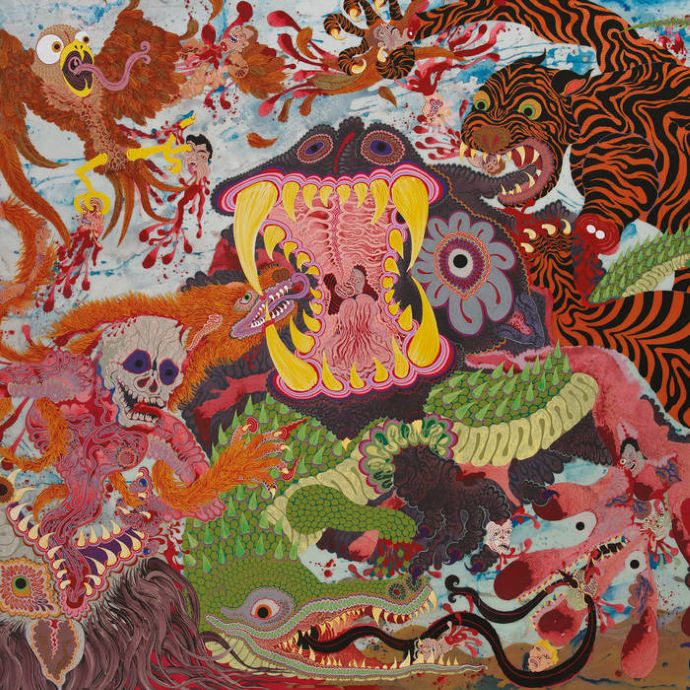
‘Now we hunt Hippopotamus’ by Aaron Johnson. done in a style they call “reverse painted acrylic polymer peel painting.”
(Vizzah Harri dives deep into and around the latest album by the UK band Pigs Pigs Pigs Pigs Pigs Pigs Pigs, which was released this past April by Rocket Recordings.)
Bands with PR in three settings across the globe can hardly be considered underground, though postern gates with stairways leading down to caverns advertising treasures would at least induce a probing glance or load-bearing check of the first step.
If opener Blockage was your introduction to this band or their approach, as it was the case for me, you’re in for a trip that results in an antonymic flush. You are forgiven, however, for still being fixated on Aaron Johnson’s stirring phantasmagoric artwork.
Lifted from the Jeremyriad blog is this quote from the artist about the origins of the piece:
“Now We Hunt Hippopotamus is a convergen ce of disparate influences, specifically including The Hippopotamus Hunt by Rubens (one of my favorite paintings by one of my favorite painters), Indian firecracker graphics (which I discovered traveling in India in 2005, a trip that completely exploded my color palette), and the David Lynch film Wild at Heart (the title of this piece comes from torrid moment when Isabella Rossellini stares down the barrel of her pistol pointed at the camera shouting ‘Now We Hunt Buffalo!’).”
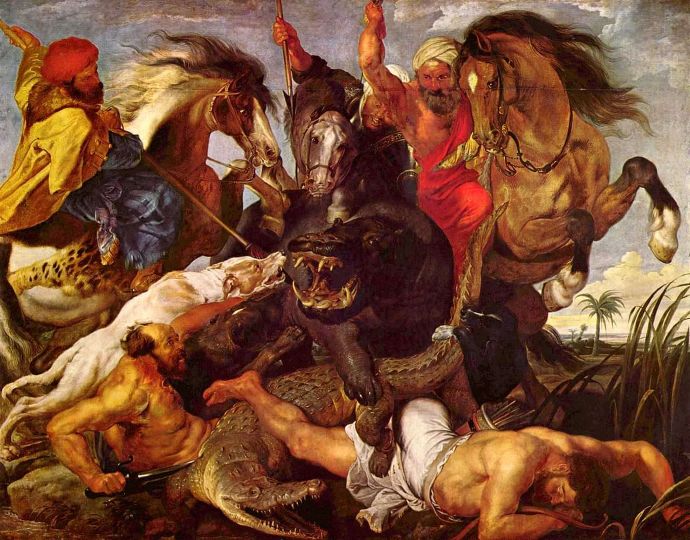
Peter Paul Rubens – The Hippopotamus and Crocodile Hunt (1615-1616)
A work that inspired imitation as far back as 400 years ago when Rubens was still alive, this 180-degree horizontally flipped etching on paper is every bit as cool and with a bit more contrast compared to the original:
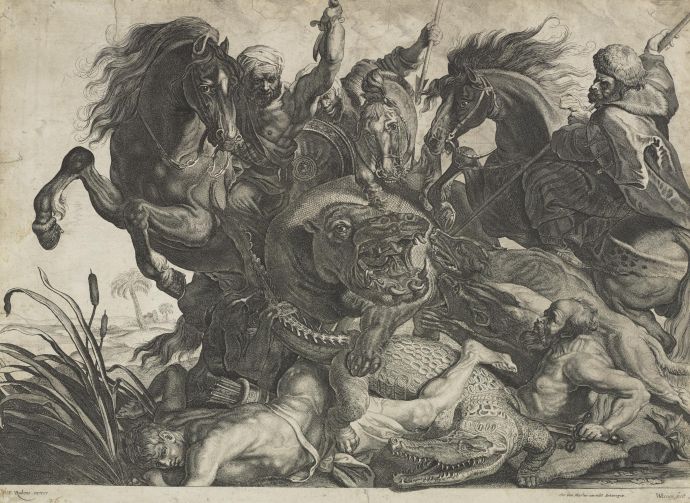
Willem van der Leeuw – Crocodile and Hippopotamus Hunt. National galleries of Scotland collection. Photo, National Galleries of Scotland. (1623-1624)
Mild pedantry ensuing, it was really the sister of Rossellini’s character Perdita, Grace Zabriskie’s Juana Durango, that utters “we hunt buffalo no(w)” in the vicinity of a firearm in this freaky clip. Spoilers: In the original script it was “WE TOUCH BOTTLES NOW,” and the scene was cut shorter for being too graphic and obscene. Something to do with purported necrophiliac masturbation, though that could just be speculation cos the cut scenes don’t exist anymore and Lynch passed on earlier this year. Credit is due when expiry looms. Here are the Geordie boars crooning and cavorting about Motown, encounters a tad less fraught:
We live in strange times. While there are scions of a bygone depression making new moves against an innovation permeating not just global information highways but our current collective consciousness, invested detractors of the supposed dot-com bubble of our time are aligning not just with instruments of deceit, control and genocide, they’re also supportive of tech-infused philosophies inspired by a chase of Kardashev scale emulation of which some extremist offshoots are indiscernible from cults that lambast their naysayers of being the doomsayers that one can intimate they themselves are contradictorily pursuing. Consider the paradox of infinite regress in effective accelerationism, though that might just be dismissed as abstraction.
When the deemed nature of instruments put in place supposedly to watch and adjudicate universal actions most foul are impotent, when desensitization for doomscrolling and the inveterate squall of unceasing terror-bedrenched and infinite influx of information unvetted leaves us reeling as to the power we actually have, it becomes an existence of uncertainty. I’m no Kurtz and I haven’t ever experienced war in the accepted sense, but I have been in ‘Nam too long, that’s why you see adjectives shuffled with their nouns as is custom in Vietnamese syntax.
Idiocy is suffering glorification. Enter Pigs Pigs Pigs Pigs Pigs Pigs Pigs from Newcastle Upon Tyne. Say it super-fast and you could have an unwitting passerby thinking you’re continually uttering “speak speak speak.” This new album is about not giving up, about speaking out.
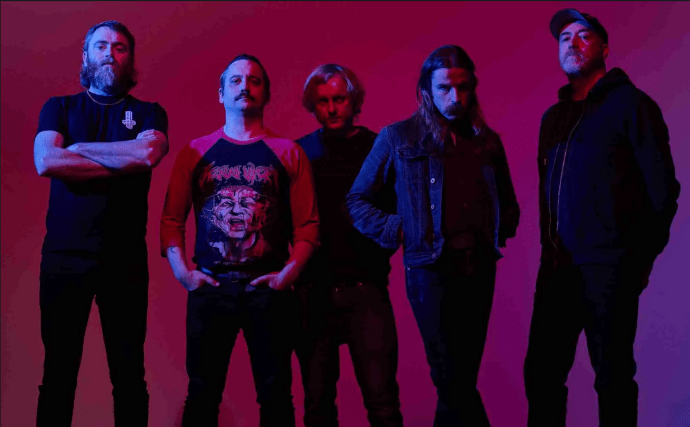
Pigsx7 L-R: John-Michael Hedley, Matt Baty, Sam Grant, Adam Ian Sykes, Ewan Mackenzie. Image by Alex Telfer
Death Hilarious has received high praise in numerous destinations on the net; the one you’re reading will be the longest. Paste magazine’s review clocked in at 769 words after which the other ones without a paywall descended in verbiage exponentially to a mere 66 words on a site named after the eternal vacuum.
Music critique dates back to the 18th century; apparently research into earlier times have not been fruitful. The law of diminishing returns married with Moore’s law philandering the effect of social media clickbait evolving a deteriorating capacity for attention have resulted in articles of every description to shorten, excessively. The French and Germans were a bit ahead of the English by a few decades on critique, even so, the Chinese said hold my baijiu with the purported Classic of Music dating back to the ancient time of Confucius, presumably lost to history in a mass book-burning phenomenon.
The first account of English critique came from a certain Charles Avison, himself a composer and Newcastle native, in the form of An Essay on Musical Expression published in 1752. Some of his more notable compositions were reinterpretations, but his essay is a great introduction to classical music and criticism. These early efforts ran tens of thousands of words, basically novellas. Enter the oft-cited Alan W. Pollack’s first edition of his massive Notes on the Beatles series with “We Can Work It Out” that came in at 1445 words. The second deep analysis he did was on “Eight Days A Week” and ran at 2156 words. One song, zero meandering intertextuality or revisionist history on amphetamines; apparently people in the ’70s didn’t know that WWII Nazis were on speed.
Perhaps Lester Bangs, who some Americans deemed the most important rock critic of his time, influenced where we went in terms of depth, seeing as his review of one of the essential releases in rock and metal history, Black Sabbath’s self-titled debut, was slated in a mere 575 words. Actually, 308, the other 267 words were reserved for (The) Gun’s second album. The .308 is a pretty powerful rifle, to shoot yourself in the foot with.
It starts off with a good line: “Mediocrity doesn’t tutor greatness often — when it is influential at all, its progeny usually achieve even ranker nadirs.” First calling Cream “essentially an egotistical group of lazy artisans,” he then terms Sabbath as Cream imitators, typifying “the paradoxes and possibilities inherent” in imitation. Sabbath are “unskilled laborers,” their hype “claptrap” with music that’s “not that bad, but that’s about all the credit you can give them. The whole album is a shuck…” “just like Cream! But worse.” Haha.
Robert Christgau, self-described dean of rock, gave it the equivalent of a 1-star review with a rating of E which later got upgraded to a C-, though he kept hating it into the ’80s. That piece of writing? Here, you can count for yourself: “Bullshit necromancy? Yes, bullshit necromancy.” Epitome of rolling on the floor, cackling. Supposedly supportive of feminist ideals, Christgau, now 83, should be aware of “better late than never” cos man… the take on Cass Elliot’s Don’t Call Me Mama Anymore is backwards as fuck. Apologies if this is old news, I am today years old learning about his capsule write-ups.
Pigsx7 are not a Sabbath worshipping band, though as a sludgy- psyched- kraut- doomed- stoner- metal tagged act, you’re sure to find some flavors Iommic and Wardian within Death Hilarious. Like in Stitches, which ain’t about snitches:
Frontman Matt Baty’s lyrics are anything but phoney, or Sinatra, they are frank as fuck though. Coyote Call can read as commentary on the ineptitude of “doilum critics aalwiz gan on gobshitin’ aboot the clag clarts” in their own pants (some hack’s attempt at Geordie vernacular)… with a loose reference to Rodney Dangerfield’s tagline:
“Ever heard the story of the ghost
Who manifested on a TV show?
The apparition that found its fame
Born again to entertain
But over time, it was bereft
Of admiration and a lack of respect
And then it blew a fuse
After reading a bad review
No hope for the empaths
Guided by psychopaths
Carved an epitaph, so it read
“They will exploit the dead”
“Nothing’s sacred”, that’s what the spectre said
“Nothing’s sacred”, from cradle to the grave”
There is no evidence as to the album title being connected in any way to another celebrated and divisive American writer, but it is contained within the second sentence of one of the most [insert desired superfluous/archaic attributive] descriptions ever written. Page 52 and 53 of blood meridian or the evening redness in the west by Cormac McCarthy. And yes, it is uncapitalized on the paperback cover; within it is all capitals. I’m not here to tell you which filters to dress or detach from your eyes and which lens and angle to view it from, though valid discussions on narration, perspective, deconstruction of text, designs, or motivations do exist. By no means comprehensive or final.
The supposed moralist attempting to suggest there are no absolutes and in so doing uttering one. As a passage, or like my friend who is a better human and teacher than I ever was by a Kovalskyi shot liked to say: “that’s a fuckin run-on sentence if I’ve ever seen one man,” it does run… Can we get to the passage yet? Sure, scroll on down.
“Already you could see through the dust on the ponies’ hides the painted chevrons and the hands and rising suns and birds and fish of every device like the shade of old work through sizing on a canvas and now too you could hear above the pounding of the unshod hooves the piping of the quena, flutes made from human bones, and some among the company had begun to saw back on their mounts and some to mill in confusion when up from the offside of those ponies there rose a fabled horde of mounted lancers and archers bearing shields bedight with bits of broken mirrorglass that cast a thousand unpieced suns against the eyes of their enemies. A legion of horribles, hundreds in number, half naked or clad in costumes attic or biblical or wardrobed out of a fevered dream with the skins of animals and silk finery and pieces of uniform still tracked with the blood of prior owners, coats of slain dragoons, frogged and braided cavalry jackets, one in a stovepipe hat and one with an umbrella and one in white stockings and a bloodstained weddingveil and some in headgear of cranefeathers or rawhide helmets that bore the horns of bull or buffalo and one in a pigeontailed coat worn backwards and otherwise naked and one in the armor of a Spanish conquistador, the breastplate and pauldrons deeply dented with old blows of mace or sabre done in another country by men whose very bones were dust and many with their braids spliced up with the hair of other beasts until they trailed upon the ground and their horses’ ears and tails worked with bits of brightly colored cloth and one whose horse’s whole head was painted crimson red and all the horsemen’s faces gaudy and grotesque with daubings like a company of mounted clowns, death hilarious, all howling in a barbarous tongue and riding down upon them like a horde from a hell more horrible yet than the brimstone land of Chistian reckoning, screeching and yammering and clothed in smoke like those vaporous beings in regions beyond right knowing where the eye wanders and the lip jerks and drools.”
The pale expansionist colonialist lens of the narrator can be more taxing than the grotesque violence found within the text, as is readily apparent in that passage and upon rereads neutrality becomes less viable towards an objective reading of intrinsic human savagery. Another 83-year-old, Gayatri Chakravorty Spivak, one of the most influential postcolonial thinkers, had a thing or two to say about language. In her 2021 essay entitled How the Heritage of Postcolonial Studies Thinks Colonialism Today, one passage acts as a brick through shuttered windows towards divergent perspectives, akin to some of which are found within Death Hilarious:
“Language becomes more parabolic to break down enforcement alone. We expand, we repeat with many acknowledgeable instances: one person’s profit brings death to many. Keep what you need but use the rest for greater good. Narrative as instantiations of the ethical is an altogether ‘universal’ method with a millennial history. If some of us do not learn to use it in an intensive and hands-on way of attempting movement from feudal loyalties and convictions to gendered democratic intuitions: namely, autonomy and equality for me and my group as well as other people, other groups, unlike us—then we are at best looking forward to a ‘democratic’ world ruled by tyrants, where democracy is body count disguised as rule of law.”
Death Hilarious is an album that displays the fresh weals and abrasions, the scarification of voluntary slicing of veins, the sickening yellowed purple bruises of needle pricks, the darkened rims on dead poultry skin sub-haloed under eyes devoid of spark. I could have just said it wears its heart on its sleeve, and no person can claim to comprehend another’s ordeal with the trepidation that not only lingers but creeps into one’s very calced frame heavier than the meat corpulently reduced that it carries on its cyclic lack of explaining a reason to will better than nails nine inches in length (that NIN single dropped on the same day as Death Hilarious, but 19 years ago).
It doesn’t shirk away from the realities of what it feels like to be psychologically blocked. It’s a cathartic listen. If you’re going to be the kind of singer that enunciates clearly, one would hope that the writing is good. One can hide bad writing with riffs of stratosphere-scraping quintessence bolstered by a percussion that cracks and lashes louder and more efficiently than the whip held finally by the indentured. Mediocrity can blend within an atmosphere curated with an overwhelming attention to detail, to flow, to the sickly-sweet savory brothiness that a master cook could only dream of. This be no middling mountain ruggedness. Matt Baty and co. eats mediocrity and shits fire.
It is life-affirming to read the words of someone that was mature and brave enough to bleed their vulnerability dry onto the page and then transpose it with a bear growl of apposite atavistic plenary about the penury of a spirit exhausted of essence. Everybody also loves a good drumroll fill before the drop. Collider has a good dyad of them and just a little bit of reaper-fearin’ cowbell as garnish.
One of the greatest lines are in this very song:
“I could work hard at being kinder to myself
But it’s way more thrilling
With existential dread
Hold on tight
Watch me ride”
It sure is a pleasure beholding you riding the wave sirs, cos you’re fucking hanging ten while doing it. Being self-aware enough to joke about existential dread and the permutations and ennui of anxiety and depression is refreshing as fuck.
Glib-Tongued can be read in any way you want. The way I read it is a castigation of golden-era fallacies and conservatism that stifles progress.
There was a time when I drove a delivery truck in Ravenna, OH. Go Ravens! Every single fucking time I happened to be in downtown Ravenna at midday, like clockwork, this neanderthal cosplaying as human straight out of Deliverance would drive his big-ass red pick-up truck through town with the flag of failure. No, not the whyte one. So, when Baty intones:
“The silhouette of a flag
The murmuring of some national anthem
Parades of monochrome hair
There’s a nostalgic sense in the air
I smell of cigarette butts
Spray-on deodorant and teenage lust
What a shame
It all stagnates
Clings to the past
Necromance”
One can almost see the dead divined from their grave captured in danse macabre.
The band were able to employ half of Run the Motherfuckin Jewels on that track. El-P here is not some cameo out of place; his verse hits hard as a jaw crunched on a curb and it fits so well one could almost think, why don’t the man named after vinyl itself produce themselves into more records with some distorted riffage? Man’s a natural.
The Wyrm seems like it has a long intro. Fuckin sit it out. The payoff is worth it. “Of wasted time.” None wasted here my friend. With a stellar production from guitarist Sam Grant, tracks like The Wyrm have undercurrents, that one wishes one could dive into the maelstrom of atmosphere to bask in it.
A Carousel, once abandoned and decrepit, now reclaimed. The synths layered in with a nigh spacey effect flitting away when the vox boom out. The riffs are commanding, and they sound great live too:
How to use feedback correctly? Well make sure that your sound engineer understands how to record bass and your singer got hypno-therapized with anti-westerns so that the clarion call of great literature sounds out with perhaps a bit more vengeful intent: “Keep marching on.”
These hebdomad swine captured in sound the fuzzy stroke and shirk of wall-shattering continuums that encapsulate an urge to get the fuck out of bed and to do. Death Hilarious is a force galloping with metered precision to lance hearts through rib bones and it has the cool fire of surcease burning on the bare flesh of a head scalped by tones and licks sharped for disemboweling even the Kevlar strapped gut.
This album is for listening so fucking loud that you get noise complaints two counties over. There is not a track here that lacks replay value. Packed to the brim, concise, and unwitting in its execution of a sound perfected on stages hallowed.
This is not the antidote to the doom and gloom in the world, but it can be the energizing companion we didn’t know we needed. The 4th dimension, however constant and paradoxically amorphous and incorporeal it might be philosophically, has one constant held within it. It’s part of our very bones; our helix of synapse mapping memorial ancestral strife is one that we are struggling to grow out of. Our technological skyrocketing juxtaposed to our reversion into an age paradoxical for its overabundance in knowledge yet we still allow ideologies to constrict it.
I can taste ferric sediment as I clench my teeth and unclench them to subdue an anxiety that is waylaid by perhaps only the runtime of the record. Not a box I’d drop anyone in carelessly, but uncoffined here stands before us an iteration of doom as a testimony of perseverance, even that it is okay to repose sometimes in the inglorious mire of self-loathing and cyclic chronic embarrassment that is depression.
Iron, because there is blood carved into bark here and the very resin that acts as kintsukuroi to this record of crippling doubt is infused with the blood of artists who refuse to let up. It is visceral, it cuts to the bone. “My deprecation sends me sideways” is the final utterance on this massive sludge siren of whatever one deems hope to be anymore. That might be the final exclamation and fitting, for instead of playing the cheap trick of “everything is going to be okay,” it’s a reminder that tomorrow the demons haven’t magically disappeared. The darkness awaits every spin of our little rock and the creatures of shadow that don’t just lurk anymore but proudly proclaim in the clear light of day their disdain for everything that humanity holds sacred will not vanish.
Art and science are married in their search for meaning and truth and whether this particular piece of art may not have been written as a political statement, art is intrinsically a political vessel. Ideologies and entities that exist in a construct of pure subjugation fear truth, and they fear honest art. I’ll leave you with the rest of the cutting commentary of El-P’s verse on Glib-Tongued:
“Hallelujahs shouted up to skies
The book of everything is fine if everything is mine
You’ll find them kind as long as nothing is disrupting time
Sand in the hourglass, must not pass where they draw the line
It’s all assisted, your resistance here does not apply
You will adjust now, you will learn to love how you’re despised
A ticker-tape parade, a curb to place a different face
It’s no surprise, you should have known that was the truth of lies
The open secret is the oldest ways are in their prime
Chewing tobacco-flavored spit into your crying eyes
Notice that flag attach the pickup you’ve been dragged behind
You drive on gleefully unbothered, flash an okay sign
Oh, how they pine to hold the hive as one connected mind
The party line that you exist in is committing crime
Under the shade of Oakley glasses, there’s no eye-for-eye
Freedom of choice, you can be ruled or you can fucking die”
Listen/stream here:
Pigs Pigs Pigs Pigs Pigs Pigs Pigs are:
Ewan Mackenzie – Drums
John-Michael Hedley – Bass
Matt Baty – Vocals
Sam Grant – Guitars
Adam Ian Sykes Guitars
Guests: El-P (vox track 5), Richard Dawson (additional vox and cowbell), Sally Pilkington (additional vox)
Production: Produced and mixed by Sam Grant, mastered by Robin Schmidt, engineered by John Martindale, Chris McManus and Tim Schakel (track 5), designed by Chris Reeder, artwork by Aaron Johnson.
Links: