
(written by Islander)
The Russian band Goatpsalm first caught our attention almost a full decade ago, when we reviewed their third album Downstream a few months before its February 2016 release by the UK’s Aesthetic Death label. Back then I wrote (in part):
The music of Goatpsalm is spacious, mystical, shamanic. It conjures images of aboriginal rituals, as if holding the keys to dark communions with nature and with spirits that have been long lost to time. Some of this effect comes from the band’s frequent use of sounds from the natural world — rain, wind, waves breaking on a shore, bird song — and some derives from unusual instruments….
While all of the songs on Downstream make significant use of dark ambient and electronic music, sometimes touching the edge of industrial music, that’s only one aspect of the album. Yes, there is a meditative, and even narcotic, quality to the album, but it’s often heavy as hell and chilling, too….
[I]t’s the kind of album that really will carry you away. In your head, you’ll be far downstream from where you started by the time it ends — and for me it has been a trip worth repeating. I haven’t heard anything else quite like it this year.
And now here we are, a decade later, and Aesthetic Death will be releasing Goatpsalm’s fourth album, Beneath, at the end of this week. There’s an interesting story about how the album came to exist and why its completion took so long, and we’ll share that with you later in this article, but first we’ll give you a chance to hear Beneath in its entirety.
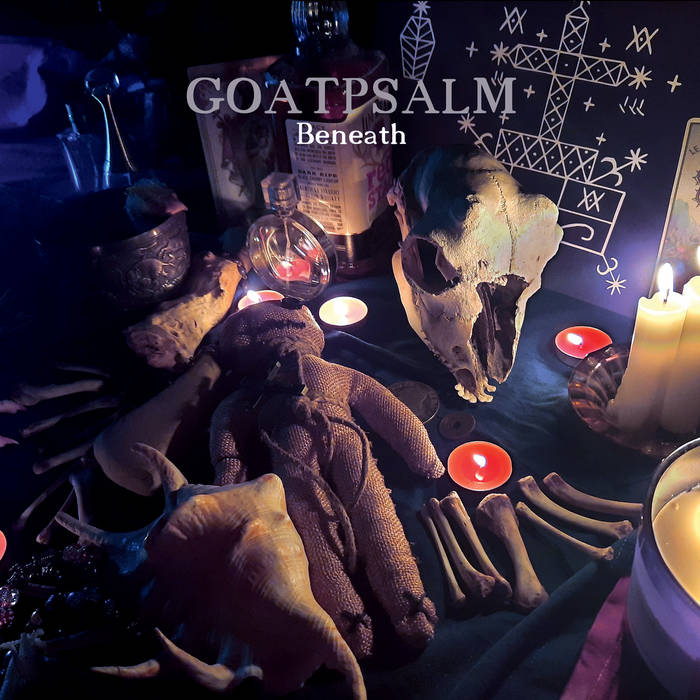
Musically, this new album differs from Downstream, just as Downstream differed from the band’s two preceding albums. It was inspired by a book on voodoo practices, and Aesthetic Death describes the music as “falling somewhere within sounds of ethnic, ritual, trance-like doom metal”.
The album’s opening track “Veve Of Smoke And Rum” functions as a sub-two-minute instrumental introduction, or shall we say, the beginning of the album’s voodoo ritual. Beginning in silence, the sounds gradually develop and become very strange, as odd percussive tones combine with eerie flute exhalations and beastly exhalations that are much more frightening.
Goatpsalm follow that intro with the album’s first (and only) single, “Heart Of Damballah Wedo“. Some internet searching reveals that Damballah Wedo refers to a primordial spirit (Damballah), the most important of all loa “in West African Vodun, Haitian Voodoo and other African diaspora religious traditions such as Obeah,” and that “Damballa originated in the city of Wedo (Whydah or Ouidah) in modern-day Benin.”
In the music of the song, ragged and ruined notes slowly worm and reverberate around big heart-like beats, and the words come forth from a howling and growling voice whose frequencies have a serrated edge. The music dismally moans, brutishly clangs and chugs, and brightly quivers, creating an utterly surreal sonic vision, while the gut-punching kick-drum, the neck-biting snare, and the subterranean bass-lines indulge intriguing and menacing but muscle-moving frolics. Eventually, in the track’s upper reaches, the music wondrously shimmers and flows.
That first full song is a fascinating one that unfolds like a sinister spell; listening feels like taking a hallucinogenic drug. That feeling persists in the follow-on track “Spit Soil“, which opens with picked notes that slowly (and menacingly) twang, warble, and reverberate. Goatpsalm ratchet up the feeling of menace with immense, crashing, dissonant chords, pulverizing drum-blows, high-pitched keyboard notes that squirm and squeal, and another appearance of those abyssal vocals.
This track is the most funeral-doom-influenced song on the album, but it’s nonetheless a psychedelic and psychotic experience, mind-bending as well as oppressive. It also shifts into a faster gear and brings in feverishly throbbing grooves, and then introduces an expansive wailing melody that seems to channel abject misery.
In “Kalbas Whispers Of Death” the music dramatically changes again as Goatpsalm leave the metal behind and return to their shamanic voodoo themes with the rhythmic patter of hand drums, ticking percussion, and a shaken rattle, meshed together with whistling flutes, simmering keys, and something that twangs. A sinister gasping voice utters some kind of chant; a big bass begins to moan, drone, and throb; the combined effects are strange but hypnotic — and grow much scarier at the end.
Goatpsalm save the album’s longest piece for the end — the closing song “Exequies” clocks in at more than 17 minutes and consumes almost half of the record’s run-time. Without pretending to trace all of its movements, we’ll say that by turns it’s heavy and harrowing, mystical and mysterious, caustic and chugging, searing and soiled, shamanic and spooky.
In making these maneuvers (and more), the music occasionally deploys bone-bruising bass and gut-slugging or neck-cracking drums, swirling and swarming keys, and ringing guitar arpeggios, and the vocals include not only monstrous growls but also unhinged screams.
In addition, after a big pause, the music also evolves into a haunting phase of astral ambient shimmers, tumbling percussive bursts, off-kilter jolting grooves, musing and meandering bass tones, rhythmic cymbal ticks, and perhaps insects and birds, as well as deep quavering drones and echoing chant-like singing that again connects with the music’s voodoo inspirations.
In that phase, we’re drawn deep into a mind-altering musical trance, though the music is still too unsettling to become completely entrancing. Part of what makes it unsettling is that a listener doesn’t know what Goatpsalm will do as the final minutes pass. As it turns out, they just gradually drift away into a long silence, occasionally broken by only the dimmest of throbbing electronic moans. By the time the last second passes you may have to remind yourselves where you are and who you are; through the unusual experience of this record you may lose track.
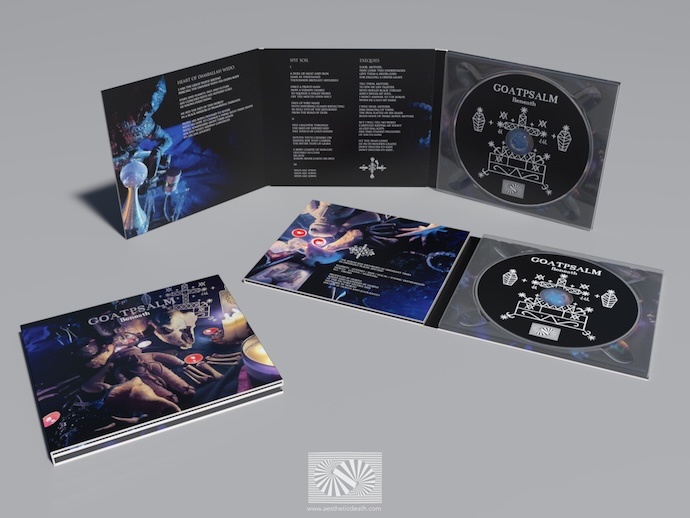
Beneath is available for pre-order now on CD and digital formats (see the links below). At the beginning of this article, I promised to share some information about how the album came to exist, and after the links you’ll find that, in a statement by Horth of Goatpsalm.
PRE-ORDER:
https://aestheticdeath.bandcamp.com/album/beneath
https://www.aestheticdeath.com/
https://goatpsalm.bandcamp.com/
THE BAND’S STATEMENT
It’s always difficult for me to find the right words when speaking about something I’ve helped create, and Beneath is no exception. It’s not easy to reflect on something that, in one way or another, has been part of you for the past eight years — and has now begun to live a life of its own, independent from you. It’s even harder to evaluate objectively something you’ve listened to hundreds of times: sometimes with a sense of pride, but far more often with frustration, questioning your own limitations and shortcomings.
This album began as a small studio jam session, recorded at my request by the guitarist of Sickrites and the drummer of VTTA — both from now-defunct bands. The result was more curious than compelling, but I felt there was potential in that raw material, something that could be shaped into something more meaningful. At the time, I had no idea what kind of journey I was setting in motion.
I added some keyboard parts and shared the demo with Vaarwel. He immediately dismissed the guitars but was drawn to the drums, so we decided to use them as the foundation and build from there. What followed were months — and eventually years — of painstaking, often tedious work. I’ve lost count of how many mixing and mastering versions I went through. At times, I felt tempted to leave everything as it was, or to archive the project entirely and forget about it. Occasionally, we were sidetracked by other work, leaving Beneath — which didn’t even have a name back then — untouched for months, only to return and begin again.
After recording Downstream, I felt I had exhausted my interest in northern themes and wanted to explore something different. I initially started writing material inspired by southern cults, focusing on the goddess Kali, but after a couple of tracks I lost interest. Perhaps we’ll return to those ideas one day — who knows. Around that time, I came across a book on voodoo practices, and that’s when it became clear what direction the new Goatpsalm album should take. As it turned out, that instinct was the right one.
Each of our albums tends to differ from the previous one, and Beneath follows that pattern. The shift may not be as drastic as the one between Erset La Tari and Downstream, but it is still noticeable. There’s a simple reason for this: Vaarwel’s contribution this time was significantly greater than mine, and that inevitably shaped the final result. The compositions feel more developed, more layered — and, in many ways, far removed from the raw material we started with.
Special thanks must go to Stu, owner of Aesthetic Death. He was the one who kept gently reminding me that it might be a good idea to actually finish something he could release. Without his persistence, this album might still be unfinished — or might never have been completed at all. Thank you, mate.
So, another chapter in the history of Goatpsalm comes to an end. What will follow Beneath? I honestly don’t know. Perhaps we’ll revisit and complete some material from the archives; perhaps we’ll start something entirely new. Time will tell.
Good luck.
Horth of Goatpsalm