
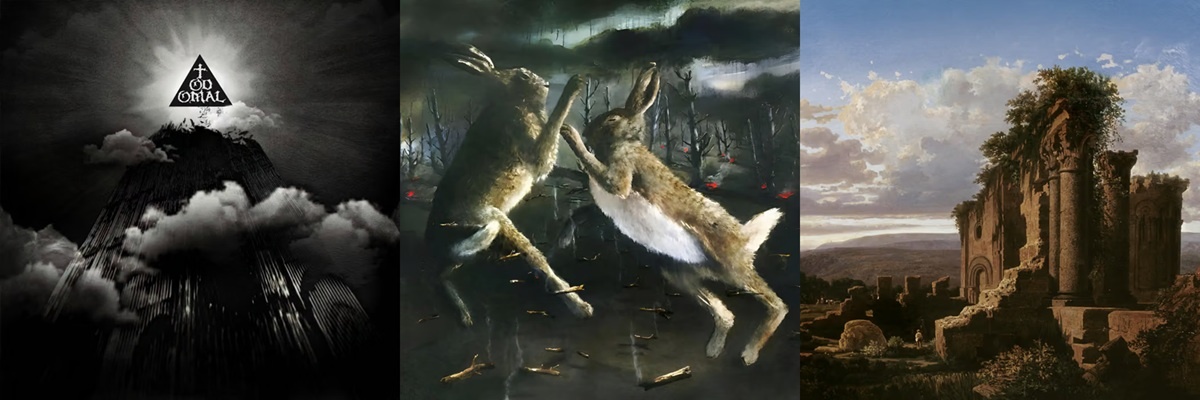
Recommended for fans of: Moonspell, Anathema, Tiamat
I always try my best to ensure that each edition of The Synn Report is different from the last, in the sense that I never want to have too many Black Metal, or Death Metal, etc, entries in a row.
For example, so far this year we’ve had some maddeningly technical Death Metal brutality (Eximperitus), broodingly proggy Black Metal (Juodvarnis), genre-splicing Industrial Electro-Punk (Doodseskader), riff-heavy Death/Hardcore crossover (Black Breath), and gnarly blackened Sludge (Erdve), so today we’re continuing to keep things fresh by featuring the doomy romanticism of Spain’s Todomal (whose new album is out on Friday).
2021 – ULTRACREPIDARIAN
Knowing what I do now, about how the band’s sound would grow and develop over the next few years, it’s easy to see how Ultracrepidarian laid the groundwork for Todomal‘s future success.
That’s not to say that the album isn’t good in its own right, however – though its follow-up would be an even greater good – as the grandiose riffs and gorgeously melancholic vocal melodies of “Wraith” and the atmosphere-heavy stomp ‘n’ shine of the title-track, equal parts subtly restrained power and rivetingly raw emotion, are prime examples of the duo’s impressive, semi-symphonic songwriting skills (with the use of synths/keys being neither overbearing or underwhelming, but helping to artfully accentuate the emotional impact of the music).
Of course, the spellbinding vocals of frontman Christopher Baque-Wildman – whose voice is, at times, reminiscent of both Ulver‘s Kristoffer Rygg (especially during the sullen, seven-minute slow-burn of “The Growing Pain”) and Anathema‘s Vincent Cavanagh (“Ultracrepidarian”) – will, inevitably, be the main focal point for a lot of listeners, but it’s worth noting that the album is far more than just an excuse to listen to one man sing his heart out (hell, he doesn’t appear at all on “Horror Vacui”, instead allowing the captivating croon of Teodora Gosheva to take centre instead).
In particular, the intricate instrumental layering – no individual instrument being too complex or technical, but all combined into a rich sonic tapestry – courtesy of both Baque-Wildman and his equally talented collaborator Javier Fernández (who was also a member of underrated Spanish Post-Doom collective Nahemah, which explains the album’s eloquent ambient/atmospheric undercurrents) helps makes tracks like the dreamlike “Gods Fucking In The Sky” and the heartbreaking strains of “The Growing Pain” even more engaging and immersive, so that by the time the shadowy weight of “Born of the Earth” brings the album to a climactic crescendo there’s a good chance you’ll want to dive right back in to experience the whole album all over again.
2023 – A GREATER GOOD
Beginning with the gloriously gloomy glamour of “Silent Mass” – if you didn’t get the Moonspell comparisons before you definitely will now – and ending with the more delicately proggy, Anathema-esque vibes of the title-track, A Greater Good just takes everything that made its predecessor so good, and so promising, and makes it that much bigger and that much better (there’s a reason I put it in my f the “Critical Top Ten of 2023“),
The aforementioned opener, for example, is equal parts hooky and haunting, the song’s powerful guitar tone and booming, organic drum sound laying down a strong foundation for the expressive, emotive vocals and subtle symphonic embellishments, while the more introspective, string-and-synth-laced strains of “High Time” find the band digging even deeper into their well-stocked bag of doomy tricks.
“Infero Tristi” goes even heavier on the Doom (with a capital “D”) – that opening riff is a thing of crushing, post-Candlemass beauty if ever I’ve heard one – but also showcases how much the band have expanded their dynamic too, with multiple passages allowing the vocals to ring out in near total isolation, further enhancing the impact when the waves of sombre sound and subdued fury come crashing back in.
Even more interestingly, the song slowly shifts towards a more meditatively proggy mode as it goes on (including some captivating lead guitar work), making it seem even more ambitious and grandiose than its six minute run-time suggests (which is perhaps why piano-focussed interlude “Ultima Lucerna” is positioned where it is).
The second half of the album then eases you in with the mournful melancholy of “Dust and Nothingness” – all calm, collected contemplation and sublimely sorrowful singing (plus another excellent, if brief, solo) – before the irresistibly infectious Goth-Doom of “Antichrist of Love” (where the band’s obvious love of Tiamat in particular comes shining through) ups the ante with even more vivacious and vivid vocals (Teodora Gosheva making her presence felt again during the song’s unashamedly catchy chorus), even more soaring symphonic touches, and an even bigger, more bombastic guitar presence (both riffs and leads).
Gosheva then takes centre-stage once again for the stripped-down acoustic balladry of “Loss”, which serves as a welcome breather – especially after the preceding song’s outlandish (and outstanding) excess – prior to the climactic title-track, which features both some surprisingly weighty guitars as well as some scintillating, 70’s Prog style synths (shades of Pink Floyd abound in both the lead guitar and bass work too) that help guide the album to its hypnotically hooky finale!
2026 – GRAVEYARDS OF JOY
For their third album (out this Friday), and the conclusion of the trilogy which began with Ultracrepidarian, the duo seem to have made some subtle – albeit noteable – shifts with their sound, while still retaining their core essence and a clear link to their past.
The synths, for example – especially the enigmatic opening bars of “Mare Ignis” or the weighty, looming ambience which hovers over early highlight “Point of Coalescence” – often remind me more of Martin Brändström’s work with Dark Tranquillity than the Moonspell-esque pseudo-symphonics which characterised their previous two albums (though considering Brändström’s connection to Tiamat this is perhaps not as big a shift for the band as you might imagine).
At the same time, the more propulsive riffs and rhythms which drive the likes “Lucid Nightmare” and “Humanised Gods” (the latter of which, along with the equally catchy “Unholy”, also lets the bass breathe and rumble a little more) conjures a grungy groove that seems to owe a lot to Alice In Chains (in fact the vocals also occasionally channel a bit of Layne Staley influenced languor here and there, especially during the former track).
Don’t be fooled into thinking that Todomal have drastically changed their sound here, by any means – the rippling acoustics, crashing chords, and ebbing, flowing, doom-laden dynamic of “Deliverance” for example feels most like a child of both Ultracrepidarian and A Greater Good (especially when the synthetic symphonics reach their crescendo) – it’s more that Graveyards of Joy finds the band emphasising or enhancing certain aspects of their sound this time, without abandoning any of what made them so good before.
Whether that’s the increased weight of the guitars (and increasingly thrilling soloing) of “Lucid Nightmare”, or the sheer hookiness of “Humanised Gods” (both of which, by the fact that I’ve mentioned them twice now, are another two obvious stand-outs) or the stunningly proggy blend of the organic and synthetic which elevates the climactic title-track to be one of the best things the band have ever written, while also allowing Baque-Wildman to demonstrate, again, why he’s one of the most underrated vocalists out there right now (that final refrain of “all I see is open skies!” has stuck with me ever since I first heard it), it’s clear that Graveyards of Joy is an absolute triumph, and should… hopefully… help introduce the band to a whole new potential audience.
Estoy deseando oírlo entero, A Greater Good es una maravilla de disco. Me gustó mucho la frase ” si Anathema no hubiera abandonado el Metal”.
I’m glad you liked that one. I didn’t want to imply that they’re derivative, by any means, but the comparison seemed valid.