
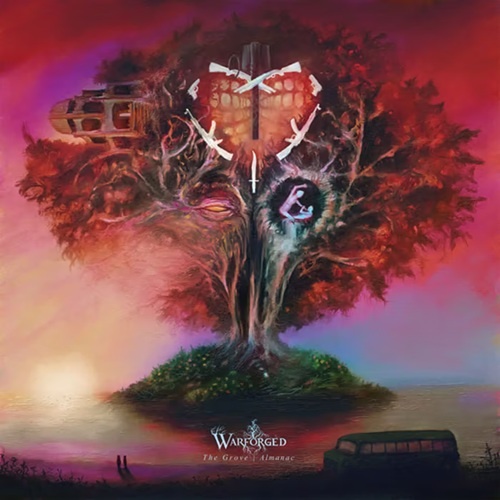
(Andy Synn courts controversy yet again with his review of the new Warforged album, out now)
We should probably start things out today by laying all our cards on the table, yes?
While many people were impressed by Warforged‘s debut album, I: The Voice, I’m afraid I wasn’t one of them.
Don’t get me wrong, there’s still an impressive number of ideas, and a lot of technical talent, on display across the album’s unwieldy, almost 73 minute run-time (this is definitely not a band who ascribe to the theory of “less is more”, that’s for sure) but I ultimately found the execution to be disjointed and uneven, with too much of it just haphazardy thrown at the wall in the hope that something would stick.
Their second album, however, showcased a darker, more atmosphere-heavy, sound (as well as a new vocalist) that felt – with a few slightly janky exceptions – more focussed and intentional, harnessing the band’s more experimental and unpredictable impulses with a greater sense of direction that made all the various parts, even the ones which didn’t quite work, feel like they were actually contributing to a greater whole, rather than pulling the record in a thousand different directions at once.
And, luckily for me – though this may end up disappointing a certain section of Warforged‘s fanbase – Almanac is very clearly both a spiritual and sonic successor to Sundial, continuing the ongoing story by adding a fresh new chapter to the band’s career.
One of the most interesting, to me at least, things to observe surrounding people’s perception’s of Warforged over the years has been the shift, and the divide, in how different sections of fans talk about them, especially when it comes to the use of the dreaded “D-word” (Deathcore).
Because whole “Progressive Death Metal” still remains a reasonably accurate descriptor for what the band do, there’s no denying that the sheer sonic density of both Grove albums (Sundial and Alamanac) probably owes more to the weighty intensity of a band like The Acacia Strain than someone like Between the Buried and Me (and there’s little question that the latter’s outlandish technical wizardry definitely had much more of an impact and influence on the group’s debut).
Of course, it matters less whether a song like enigmatic, slow-burning opener “Miserable No Life King” is categorised as Death Metal, Deathcore, or something in between… what’s more important is the progressive nature of the songwriting (and whether that’s “progressive” with a big P or a little one is up to you), which clearly favours mood and tone – slowly and carefully laying down layers of off-kilter melodies, eerie, unsettling synths, and strangely-shaped chords until they coalesce into critical mass of heaving, groaning distortion and pummelling drums – over flashy technicality or shameless showboating.
Indeed, as the album progresses – through the twitchy, unconventional rhythms and jarring riffs of “Streets” and the pounding, doom-laden chugs and prog-happy ambience of ambitious early highlight “A Bustle In Your Hedgerow” (think the monstrous intensity of Aseitas combined with the moody melodicism of Cynic) – Almanac comes more and more to resemble the likes of Autotheism (The Faceless) or The Work (Rivers of Nihil) in the way the band’s obvious instrumental abilities (drummer Jason Nitts in particular puts in a particularly striking performance) are shaped and structured to serve the needs of the songs, and not the other way around.
That being said, the similarities to the latter album/artist also extend to the record’s occasional mis-steps too, with the awkward tonal shift of “I Wish You Could Live Forever” and the risible “The Verb “2 Hate”” feeling like they’d have been better off left on the cutting room floor (especially when compared to some of the richer and more fully-realised compositions which surround them).
These mis-steps, however, are perhaps an unavoidable consequence (or, if not unavoidable, then at least an inherent risk) of trying to think, and write, outside of the box like this, and thankfully for every moment where the songwriting stumbles there’s multiple others – contrast, if you will, the punishing power of second-half highlight “Flourish in the Filth” with the more sombre, and primarily clean-sung, strains of “Novocaine Grace” and the humongous, more Deathcore-ish heaviness of epic penultimate stand-out “Narco Cavalier”, for a prime example of the group’s impressively expansive yet surprisingly cohesive creative range – where it becomes clear that Warforged‘s artistic ambitions continue to bear fertile fruit (even if some of it is a little bruised).
But, as imperfect as it may be, these flaws nevertheless do nothing to dull the shine of what is a real diamond of unorthodox progressive extremity… no matter how you categorise it.
I like what it is. Good development from Grove.
I’ve been a fan since their early EP Essence Of The Land and then hated I: Voice, due to the apparent bloat and disjointedness.
But a few parts of a few songs were always stuck in my head (the shifting groove of Beneath The Forest Floor and Nightfall Came and the Will Smith feature on Willow).
I returned again and again and discovered a world. A literal forest inside my mind.
I like Grove and I like Almanac.
I: Voice changed my life. Few albums are lodged this deeply inside me. And at this length there is only really Slice The Cake’s Odyssey to the West