
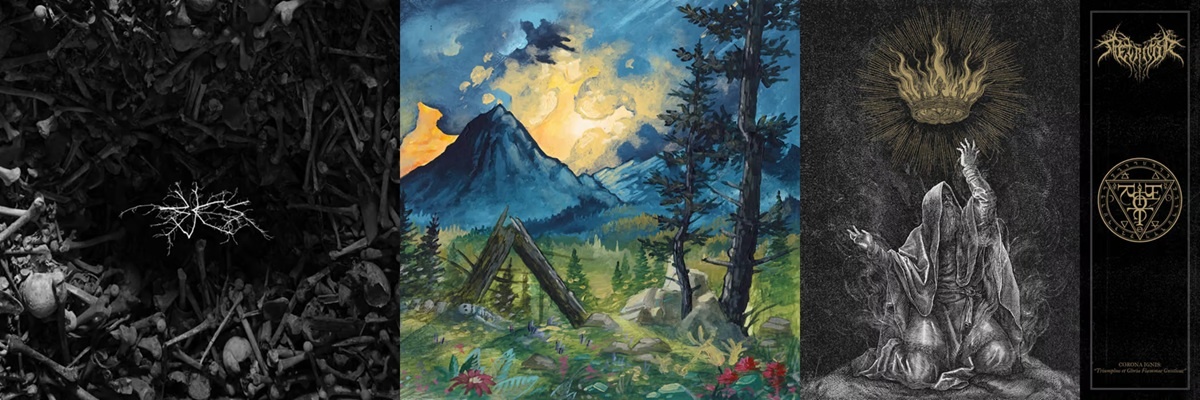
(Andy Synn has three more albums for the more Black Metal inclined among you)
I’m a busy, busy man at the moment, both in my personal life (it turns out selling a house is hard), and my musical one (did I mention we’ve got a new EP out?).
But I’m still making sure to find time to listen to – and, just as importantly, to write about – new music that I think our readers might appreciate.
And with my recent focus being mostly on various forms of Death Metal and/or Hardcore I felt this week it was about time to get back to our more “blackened” roots with a collection of three relatively recent records dedicated to the glory of Black Metal.
BJES – PROPASTÍ
Despite being in use for a long time now, the term “Post Black Metal” remains pretty nebulous, to the point where it sometimes feels like it’s used to describe any and every band that steps even the slightest bit outside of the traditional Black Metal formula.
In the case of Czech quartet BJES, however, it’s a pretty accurate descriptor for the group’s particular blending of electrifying energy and gleaming melody – interspersed with moments of calm contemplation and keening catharsis – that bears more than a few sonic similarities to the likes of Downfall of Gaia, Deluge, and Der Weg Einer Freiheit.
From the melancholy melodic hooks of opener “13:31” (whose repetitive lead refrain is all but guaranteed to take up long-term residence in your head) and the simmering, surging sturm und drang of “Labyrint života” to the groove-heavy rumble of “Tyrana” which closes the album, Propastí (which combines the band’s two previous EPs with two new tracks to complete the ensemble) has more than enough meat on its bones (even if some of the flavours might be a tad too familiar) to satisfy all but the most jaded and cynical fans of this particular style.
True, of the two new tracks only one of them – the more sombre and subdued “Padám” – really lives up to the standard set by the group’s previous/existing works (with the title track, oddly, being a rather disappointing collection of largely forgettable riffage), but thankfully the more epic and evocative strains of “Juan Garin” prove that there’s still a whole lot of untapped potential in the band’s sound, just waiting for them to fully unlock it.
GROUSE – JACKALS OF EDEN
To describe Jackals of Eden as “Krallice-esque” would, I feel, be both accurate and overly-reductive, in that while it absolutely shares a fair amount of sonic DNA with the myriad works of Weinstein, Marston, Barr, and McMaster – and whether that’s due to the band’s direct influence or simply a case of convergent evolution we may never know for sure – it doesn’t tell the whole story by any means.
For one thing, the overall sound of tracks like “Hex of the Pathless Fog” and “Nightseer” is a little rougher and a little warmer – whereas his New York cousins have, at times, been accused of perhaps being a little too cold and cerebral, the Montana-based Black Metal of Grouse tends more towards the organic, more rural plight than urban blight, you might say – even if it is, in its own way, perhaps just as complex.
For all its creative complexity, however – and the fact that four of the album’s five songs extend past the nine minute mark should clue you in to how involved and intricate these compositions are – Jackals of Eden is also capable of delivering some surprising immediacy (there are moments during the seething guitars, slithering bass lines, and spiralling leads of “Heliophobia” that wouldn’t sound out of place on an album by Geryon or Yellow Eyes, for example) while also capturing something more intimate and immersive (“Lichen Draped Skeleton”) that recalls the best of Marston et al circa Crystalline Exhaustion.
But it’s the climactic title-track which really demonstrates what the album is capable of when all the stars are aligned in perfect synchronicity, delivering thirteen minutes of shimmering, glimmering, rippling and rattling Black Metal that combines oppressive intensity and smartly restrained technicality with a keen progressive mentality and a vibrant sense of artistic spontaneity that almost fools you into thinking the song is being conjured into existence, moment by moment, rather than being the product of a singular, carefully constructed vision.
A strikingly impressive debut, from a project which we’ll hopefully be hearing more from soon (though ideally not too soon… music like this deserves to steep and simmer until it’s just right).
PETRICOR – CORONA IGNIS: TRIUMPHUS ET GLORIA FLAMMAE GNOSTICAE
Last, but by no means least, we’re heading to Chile for some “Australis Black Metal” courtesy of Petricor and their new album, Corona Ignis: Triumphus et Gloria Flammae Gnosticae.
In practice this take the form of some synth-rich, semi-symphonic Black Metal that balances blazing blastbeats with moments of brooding ambience in a manner not too dissimilar to classic Dimmu Borgir or early Vintersorg (while also sharing the latter’s passion for the glory of the natural world).
What’s perhaps most interesting about this album is that there are only really three fully-fleshed Black Metal songs – “Ante Hiemem, Ante Finem”, “Umbra Creatrix”, and “Imperium Occultum” – and yet the prominent involvement of synthy symphonic interludes (especially the grandiose prelude and coda which book-end the record) actually helps disguise this fact pretty well.
Of course, some may be disappointed by this – if moody ambient passages aren’t your thing then this album will not be for you – but thankfully those three mini-epics should help ease any lingering dissatisfaction.
“Ante Hiemem…”, for example, is eight minutes of writhing guitars and rattling drums, interwoven with an array of pseudo-religious, artificial symphonics and topped off with a back-and-forth pairing of savage, masculine snarls and crooning feminine cleans, the overall combination of which achieves a captivating form of catharsis as it builds towards its climactic crescendo, a pattern which repeats for the arguably heavier, but even more haunting, “Umbra Creatrix”.
The aforementioned “Imperium Occultum”, however, is the album’s brightest (and darkest) gem, erring more towards early Emperor with an extra emphasis on dark intensity and grim grandeur that I, for one, would love to hear even more of from the group going forwards (though I can’t fault them for deciding to close things with the suitably cinematic strains of instrumental closer “Actus Coronationis”)!