
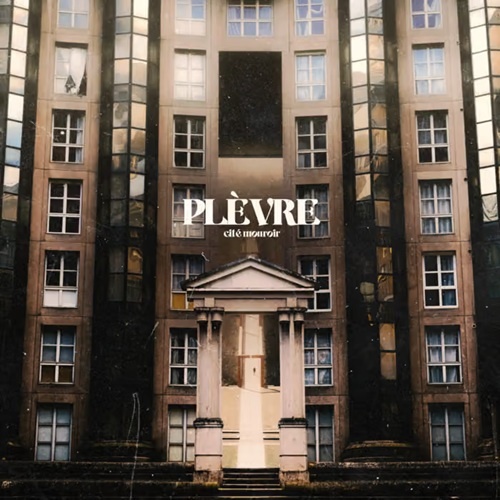
(Andy Synn takes a journey through a dying city with France’s Plèvre)
This… is not the review I was supposed to be posting today.
No, that review will now be coming next week, due to the fact that – just as I was coming to the end of the writing process – I was approached by one of my contacts with an offer for an exclusive premiere for that very same album that I/we simply couldn’t refuse.
Of course, this left me with something of a dilemma… what was I going to write about for today instead?
Thankfully my ever-expanding “to do” list furnished me with numerous options, some of which I’ll hopefully still be able to get to after this (even if only as part of my regular “Things You May Have Missed” round-up at the end of the month), with the fascinatingly dark debut from French Post-Black foursome Plèvre (which comes out tomorrow) ultimately demanding my attention (and, hopefully, yours) the most.

Driven by a deep-seated sense of urban alienation and existential emptiness – summed up, succinctly, by the band themselves as “asbestos, brutalism and lost illusions” – Cité mouroir (translated, roughly, as “Dying City”) is a bleak, but brilliant, statement of intent from a brand new band whose deliciously dark vibe ironically suggests they have a very bright future ahead of them.
Sitting somwhere between the electrifying intensity of Fex Urbis… era Ludicra (which is perhaps some of the highest praise I can give) and the moody introspection of latter-day Downfall of Gaia (which, to be fair, is also pretty high praise in my book) songs like obvious early highlight “Décimées” and gloom-shrouded penultimate track “Dissociation” are as heavy, and as hooky, as they are haunting, capable of balancing some surprisingly hefty riffage (just give “Asbestose” a listen) with an impressive grasp of atmosphere and dynamics.
And while phenomenal frontwoman Ophélie may be a singular star in the making – her visceral array of venomous snarls and ravenous growls, coupled with a strikingly expressive and evocative singing voice, provide a brilliant blend of raw emotion and sublime melody over the course of the album’s forty-something minute run-time – one mustn’t forget that, as striking as her performance is, even the best vocalist is only ever as good as the musical canvas which they’re given to work with.
Which is why it’s just as important to acknowledge the similarly excellent performances put in by Paul B-C (guitar) and the two Oliviers (B, on bass, and M, on both guitar and drums), whose fluid songwriting skills, moving back and forth between gloomy calm and glorious catharsis, deliver multiple moments of shamelessly hooky showboating (the soaring lead guitar work in both the aforementioned “Décimées” and captivating closer “Sillons sanglants” being particularly noteworthy) amidst just as many passages of blazing, blast-driven ferocity (“Tord-boyaux”) reminiscent of Der Weg Einer Freiheit at their most ferocious.
True, some of these elements occasionally feel a little roughly stitched together (“3955 kHz” in particular, despite some great parts, almost feels like a song from an entirely different album), which means there’s still some room for improvement here and there – including, ideally, a slightly tighter focus next time around – but this is undoubtedly a fantastic first step from a band who, on the evidence presented here, already have all the skills, and the vision, necessary to build into something truly outstanding.