
(written by Islander)
It’s tempting to think of the French artist Hazard as a musical Jekyll and Hyde. In his longest-lived solo project, Les Chants Du Hasard, he is committed to “revisiting nineteenth-century symphonic music in the light of a black metal attitude” (to quote the label I, Voidhanger Productions). In his more recent solo project Hasard (again to quote the label), “the perspective is reversed: the darkest and most dissonant black metal is the fertile ground on which fascinating orchestral melodies with a dark, melancholic and resigned mood flourish.”
And so it’s tempting to compare these two different aspects of Hazard‘s musical talents to the creations of Robert Louis Stevenson (who frantically wrote his novella in the grip of illness or drugs or both) — to compare them to Dr. Jekyll, the educated and erudite Victorian-era physician who was nevertheless beset with persistent urges he considered depraved, and the outright evil and remorseless monstrosity of his alter ego Edward Hyde, in whom Jekyll fruitlessly sought through potion to confine impulses he wished to suppress, an experiment that ended in despair.
I don’t intend to press the comparison too far, despite the fact that photos of Hazard themselves seem to be set in a much older era than our own, but it serves at least a superficial purpose, because it may help you prepare yourself for the ravages of Hasard‘s new album Abgnose, which I, Voidhanger will release at the end of this week (a Bandcamp Friday).
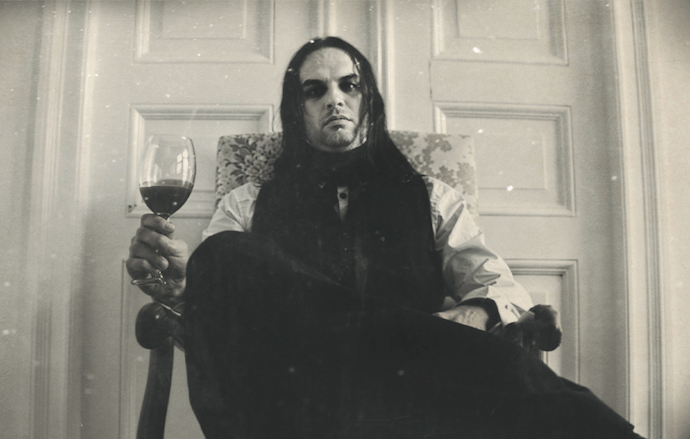
wine, or a serum?
While Stevenson had his own ideas for what the nightmarish but tragic tale of Jekyll and Hyde would represent, this is what Hazard says about this new Hasard album:
Abgnose is a testament to the greater force that governs our lives, neither a god or a devil, but only pure chance. There is no greater entity sitting in the sky or below the earth, who watches with interest our petty lives. Only pure chance and random events. We spend a short amount of time as a small point on an equally small planet lost somewhere in the universe and we die, only for our futile achievements to be forgotten as fast as we’re replaced. Just count the here and now, as there’s no afterlife. Abgnose stands for removing the idea of the divine, thus leaving only the despair of having to live and not be rewarded for our actions in this world.
Among the reasons why it would be misleading to press the Jekyll and Hyde comparison too far: there’s no sign of repression or external constraint in anything Hazard has done, including under the guise of Les Chants Du Hasard; the music of Les Chants Du Hasard is often fierce, and on the other side of the coin there are aspects of refinement and elegance even in the music of Hasard; and while Abgnose often rages, the anger is obviously fueled by clear-sighted conviction, even if it leads to frustration and despair, rather than being a manifestation of pure malice.
Having said that, the music on Abgnose is frightening and often monstrous.
The first song on Abgnose is “Oniritisme“. It is an overwhelming experience, almost all 8 1/2 minutes of it. It catastrophically crashes and booms, heaves and convulses, maniacally boils and roils. Frantically shrieking fretwork pierces through the sonic storms and earthquakes; symphonic instrumentation ominously towers overhead; the vocals are utterly deranged; the drumming is delirious but sharp; the symphonic horns in the closing crescendo are tremendous.
Everything combines to create a nightmarish atmosphere of madness, discord and destructive calamity on an immense scale, and shattering hopelessness. There you have the rage and the ruin, the cruelty of chance, the heartlessness and heedlessness of a vast universe, and the insanity and fear such uncontrollable forces can produce.
If the album’s motivation is the need to purge delusional notions of heaven and hell from our thinking, its methods are ruthless, the opposite of pandering. The music’s uncomfortable blast-furnace intensity and daunting immensity are through-lines of all the songs.
The music is uncomfortable because it’s so confrontational, channeling the war we must wage against our own delusions, and the horrors and cowering fear that might become manifest in our existence once we’ve thoroughly stripped them away — not supernatural horrors but the dreadfulness of life hinging on cosmic dice rolls and the insignificance of individual existence within a universe of unimaginable expanse.
Those are significant through-lines, manifest in humongously heaving low-end undercurrents; blistering and explosive percussive eruptions; shrieking, roaring, and choking vocals; dismally vibrating guitars and strings; and frantic convulsions of shrill, piercing dissonance.
The classical symphonic elements aren’t always dominant (though often they are), but when Hasard gives them center stage, they sometimes seem to portray the breathtaking grandeur of the cosmos (often with sounds of massed horns), its daunting hostility (often with sounds of booming timpani), and at other times the frantic and fraught nature of our own dwarfed existence within it (often with sounds of vibrant strings).
We mentioned earlier that even in his guise as Hasard the artist reveals refinement and elegance as well as violence and horror. That’s evident not only in many of the music’s symphonic ingredients, but also in the occasional presence of choral voices and sprightly dancing keys.
But there are relatively few points in the album when the music is less than overwhelming, less than wholly engulfing, either towering or obliterating. When they come, as in “Negascendance“, the music is still usually vast, and in that song terrifying, despairing, and grief-stricken. The blood-freezing introduction to “Antienne Estrale” is another such moment, paving the way to truly tortured vocals and ranging sounds of armageddon, and then once again in the mysterious but tension-inducing mid-section of the title song.
If the object of Abgnose was to shock and stun people out of complacency, it succeeds, providing a truly daunting and devastating experience. And now, with that great volume of words behind you, here’s the music:
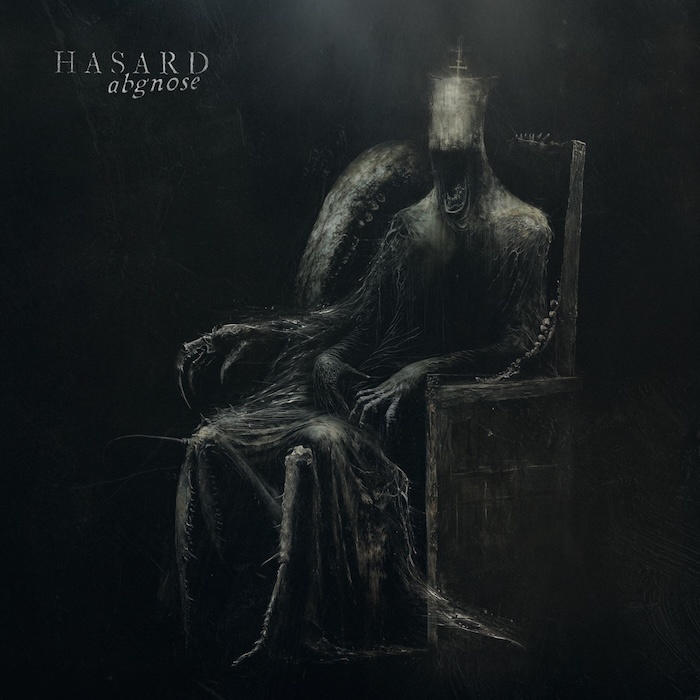
Hazard was responsible for the music, the vocals, and the sound engineering. Olivier Prouvost performed the mastering, and the ghastly cover art is the work of Roy de Rat.
I, Voidhanger will release Abgnose on September 5th, on CD, vinyl LP, and digital formats, and recommends it for fans of Akhlys, Aoratos, Blut Aus Nord, and Wreche.
ORDER:
https://i-voidhangerrecords.bandcamp.com/album/abgnose
EU: https://metalodyssey.8merch.com/
U.S.: https://metalodyssey.8merch.us/
HASARD:
https://www.facebook.com/leschantsduhasard/
https://www.instagram.com/hasard_malivore
https://leschantsduhasard.bandcamp.com/album/livre-quart
Too dissonant for me. This seems like songwriting by just going up and down disharmonious chord scales. Dissonance is the centerpiece of the songs, apparently just for its own sake. This sounds like a movie soundtrack that was purposely re-recorded out of key.