
(Just a handful of days ago High Roller Records released a new album by the German funeral doom band Lone Wanderer, and that provided the occasion for Zoltar to conduct the following interview with the band. Doom on….)
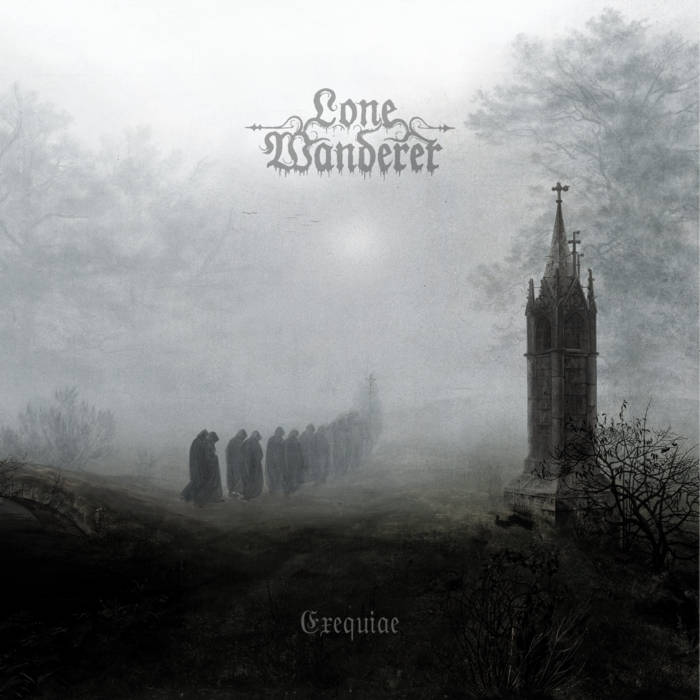
Silent hooded sinister figures in line disappearing into the mist next to a cenotaph as cover artwork, a nearly 25-minute opening track titled “To Rest Eternally”… Even before pressing play, you more or less know that you’re treading here on funeral doom territories, and that’s somehow exactly what Lone Wanderer proudly deliver with Exequiae, their third album.
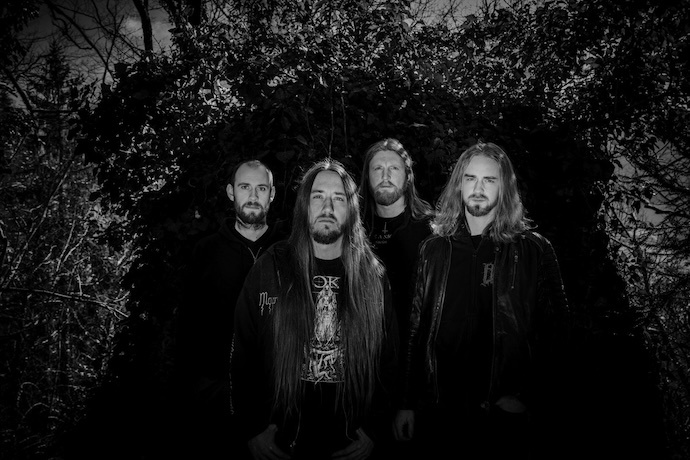
But what’s interesting with those Germans is that besides their unusual background – three out of four members also played pure classic ’80s heavy-metal with Kerrigan – and the fact this is being released on High Roller Records, a well-established label and mail-order whose well-deserved reputation was built on high-quality classic metal vinyl reissues — they’ve managed to somehow tweak their genre’s otherwise firmly established assets into something quite personal, albeit still pretty much in debt to Mournful Congregation, whose mastermind Damon Good actually mixed their first two records. The band collectively agreed to lift the veil on their funeral obsessions…
You’ve been around for a decade yet you’ve been pretty discreet so far… Then again, I assume that by starting a band in a funeral doom vein, you weren’t expected to end up selling over 100.000 copies and being invited to play Wacken, isn’t it?
We’re trying to convey an atmosphere through our music that’s solely about confronting oneself with feelings of grief, loss, and misery. It’s not a topic meant for everyone and we try to keep ourselves rare and only show when we have something to show. Like with this new album. But you can expect more live shows in the future, as we want to celebrate this new work in a proper way. You will never see Lone Wanderer underwear-merch or excessive social media stories. But you can be on the lookout for some intense ceremonies of pure funeral doom.
The funny thing is that while some people may think that Lone Wanderer is made up of heavy-metal musicians wanting to experiment with funeral doom, it turns out it was the other way around wasn’t it?
In the end, we are a collective of friends and like-minded musicians who happen to share the same taste of different sub-genres. We started many years ago as Lone Wanderer and our ‘other‘ band, Kerrigan, was an offshoot, born from spontaneous inspiration and it went in a completely separate direction. As contradictive as it may sound, the two bands have nothing in common except three of the bandmembers.
Was it surprising signing to High Roller due to your heavy-metal project Kerrigan, whose debut was released by the very same High Roller label? As far as I know, they had never released any funeral doom album, have they?
We have a very close relationship to High Roller, they are a fantastic label – maybe the best that the metal world has to offer. It was only natural that we show them the recent LoneWanderer album in a demo stage, and that’s when they said they were intrigued. So we made it work and we are happy for their trust and support in a rare genre like this. The quality of the release is superb, as well as having it on all formats, analog and digital.
How does one bring something new to the table in the funeral genre in 2025? As much as I love it, I would be the first one to say it has some sort of strict rules, if you see what I mean: songs have to be long, like really long; vocals have been growled or whispered; tempos strictly slow, etc. Isn’t it too restricting? Or do you embrace those limitations, if you want to call them that way?
When I am writing the music I do not ever think about bringing ‘something new’ or how the result should be. For example, I never intended to write an almost 25-minute song. It just happened, out of mood and inspiration. For me, Funeral Doom opens a lot of doors when it comes to harmonies that are otherwise lost or restricted, say, in faster metal genres. If you enjoy this record and listen to the actual harmonic arrangements you will find a lot of nuance and details that make this album. There are some breakout moments where we go into heavier and slightly faster tempos, which I guess is a new aspect to Lone Wanderer, but something which felt right.
I think it’s very liberating to write without the tight corset of having to keep a steady beat, letting harmonies breathe and be the focus of the music.
Does funeral doom leave room for evolution?
It’s a question that could be posed to any genre. When it comes to the actual musical content, I think Funeral Doom is an open field and comparable to classical music, as the high-gain guitars serve the roll of a string instrument, really. For me, there could always be the next amazing funeral doom album and I’d like to see a more classical approach tried for more bands, instead of relying on power-chord based, very slow death-doom.
When you play this slow and such long songs, isn’t it tempting at some point to suddenly rush in and deliver some violent blasts to shake things up?
Not at all. It’s not the mood we are in when we are performing these songs. Most of them are contemplative. However, there are a few breakouts in tempo, even an atmospheric blast beat in “To Rest Eternally”. We’re really looking forward to see how these will come to life with an audience. If we wanted to do faster, more death-doom or even death metal music, we would opt to form a new band.
As you’ve said, the new album opens with your longest track ever, almost 25 minutes long. How does one manage to keep a dynamic when dealing with such a length?
If you dissect the song, there’s different sections with different tempos and moods, sometimes even key changes. The song is meant to be a journey to be experienced, with new soundscapes waiting around every next corner. There is almost no repetition of the riffs and sections, so I think this keeps it fresh to the ears. We would never do a 25-minute song where riffs just loop. Also, we tend to avoid traditional songwriting rules, like verses and choruses that are supposed to be repeated. To me, the dynamic is in the evolution of the riffs, harmonies, and variations.
The album’s title (Exequiae) means “funerals” in Latin. First of all, why use this dead language? And two, isn’t it the funeral doom equivalent of being a death metal band and calling your album, well, “death”?
What would fit better to the theme of lost history, funeral, contemplation, and death itself, than a dead language? Lone Wanderer’s topics are rooted in a Faustian concept, going back to western Philosophy, which is deeply tied to Latin, as many source texts are in Latin or Greek. The name Exequiae (plural) exemplifies that these songs should be enjoyed as a complete funeral ritual. Also, one of the best death metal bands ever is called Death isn’t it?
Why this fascination with abandoned buildings and ruins for your cover artwork? It must go beyond the simple “oh it’s great for the atmosphere”, isn’t it?
Abandoned ruins state what’s often overlooked: everything that flourishes, must also wither away and ultimately be forgotten. It’s a fundamental, pessimistic outview of even the greatest achievements which inevitably end in futility.
People have complained about you sounding too much like Mournful Congregation. What do you think of those accusations? I guess the fact that Damon from MC did mix your previous album didn’t help did it?
I don’t see this as an accusation or complaint, but rather a high praise. We are admirers and friends with Mournful Congregation and Damon has mixed our previous albums and did a fantastic job with it. They have been a huge personal inspiration to start the band, but we are going our own direction. I think it comes down to not having many bands that do this melodic style of funeral doom, which makes the two bands comparable. To me, the music is wildly different, if you listen closely.
https://www.facebook.com/lonewandererdoom
https://lonewanderer.bandcamp.com/album/exequiae