
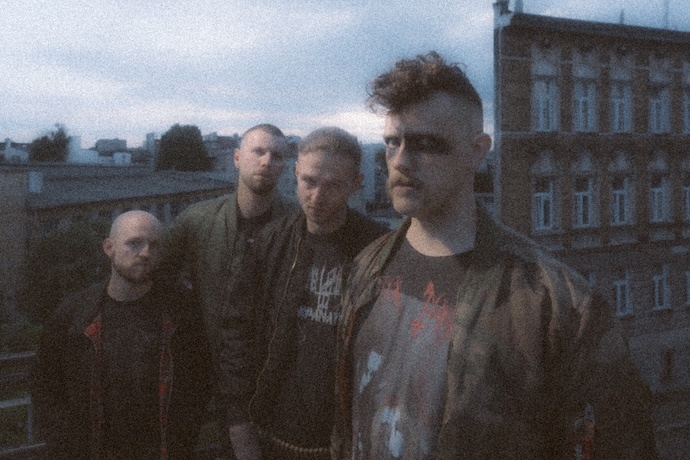
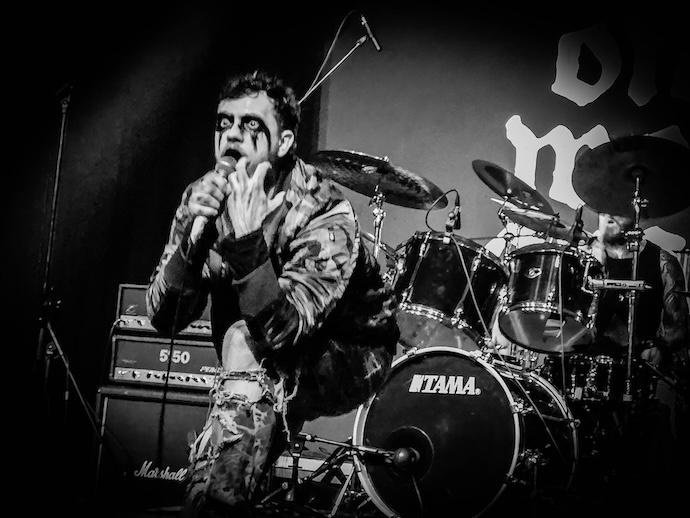
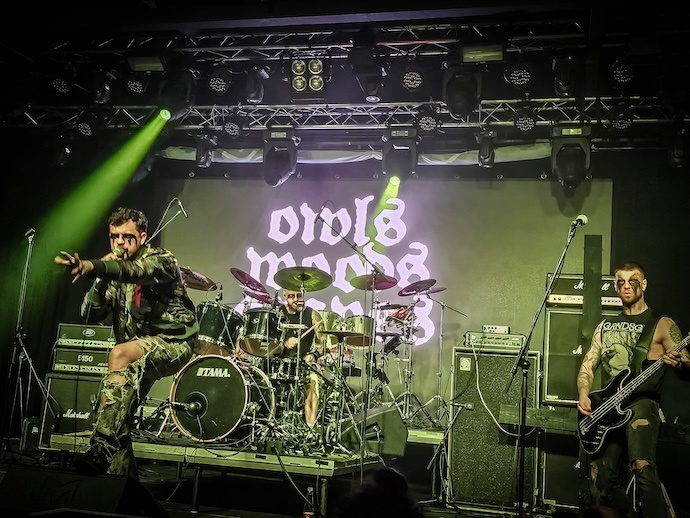
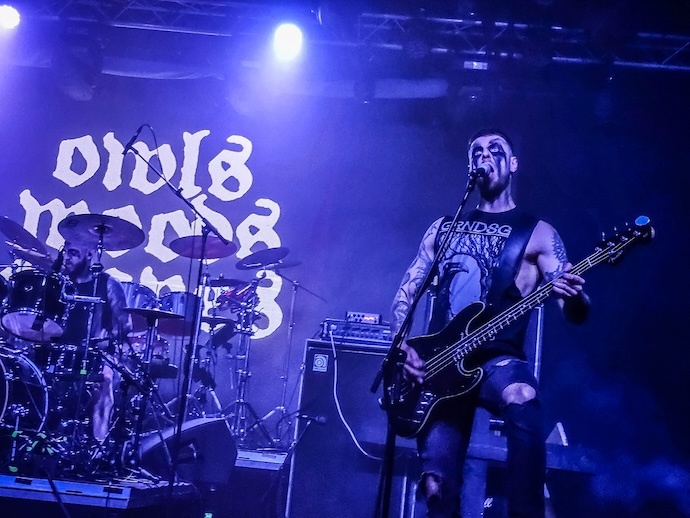
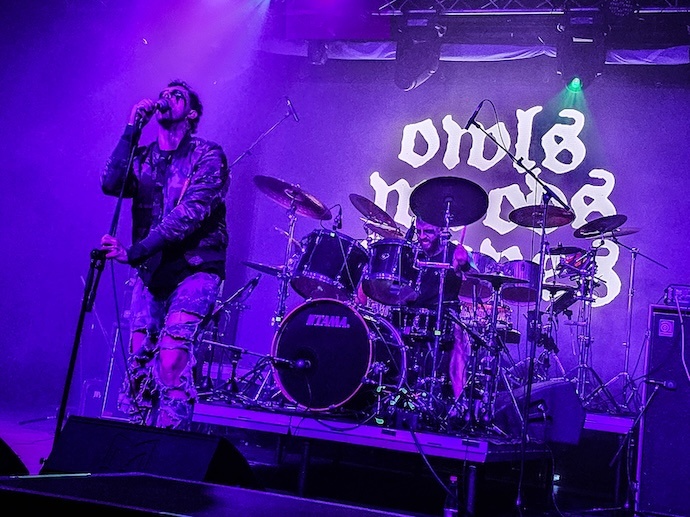
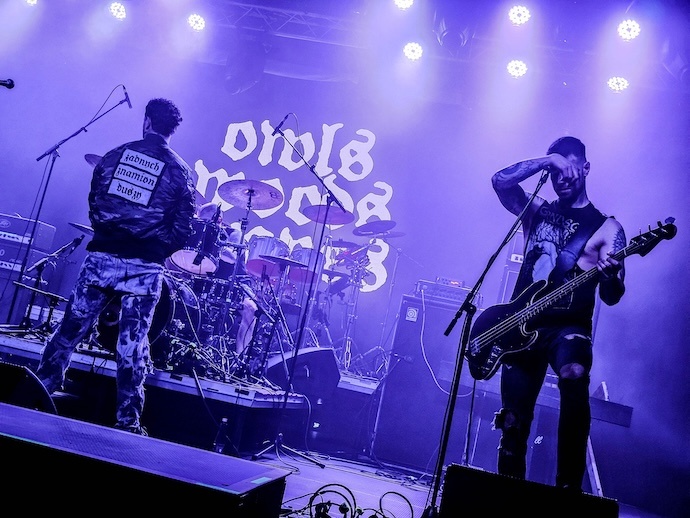
(We are most happy to welcome back to NCS The Goat Tavern, a metal enthusiast based in the UK but with roots in Poland. He caught a live performance of the Polish black-metal/punk band Owls Woods Graves in Budapest and then followed that up with an excellent interview of the band’s frontman The Fall, which we now present below. We’re also including photos that The Goat Tavern took of that performance in Budapest. To follow The Goat Tavern, go here and here.)
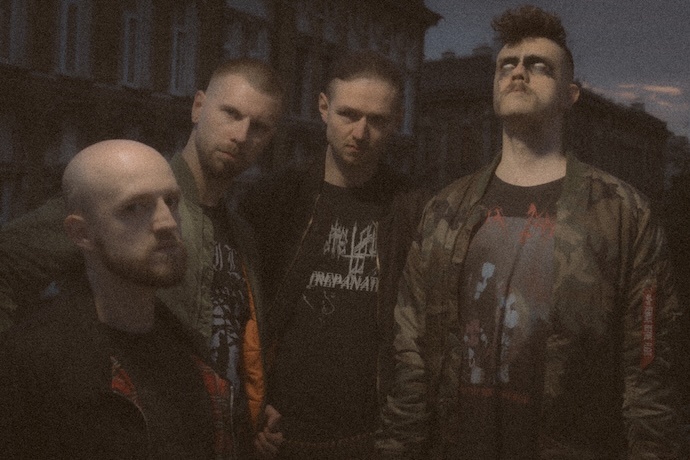
Anyone drawn to the primal, unfiltered essence of underground metal might have already heard what Owls Woods Graves are all about. With their third album Strix out now, the band has been spreading their punk and black metal mixture like a plague. Their recent show in Budapest as support for the mighty Tormentor and Morbid was a perfect excuse to talk to The Fall, the band’s frontman. We discussed Strix, reflected on the blurred boundaries between punk and metal, and took a closer look at the band’s unique identity and evolution.
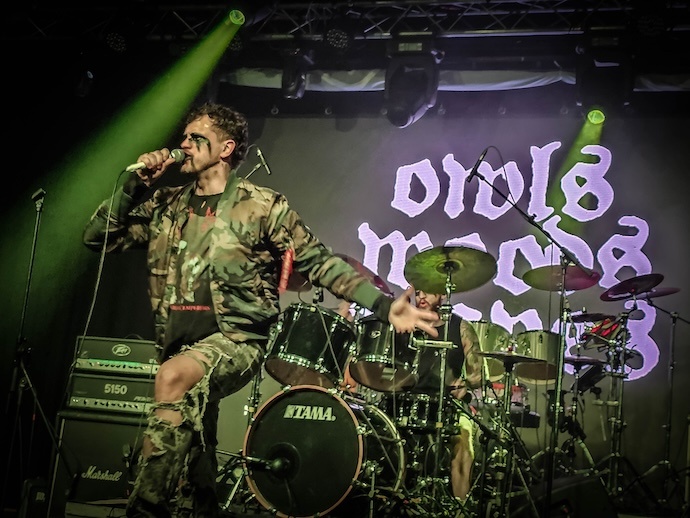
Thanks for finding the time to talk to me. I would first like to ask you about your impressions after your recent concert in Budapest. I saw your performance and, in my opinion, you did a great job as support to Tormentor and Morbid. I also ran into a few proper Owls Woods Graves supporters, so I guess you’ve got fans in Hungary too?
Even from the very early days, right after we released our first EP, when we were a very small band and basically only had a record, a t-shirt, and a backpatch, I remember we were already getting a lot of orders from Budapest. In general, there were quite a few Hungarians from day zero who were interested in what we were doing. So, I had a feeling it would go well and that we’d find people there who listen to us. We felt very much at home there! And I really loved Morbid! It was like a time machine. Similarly with Tormentor, which for me was a bit like experiencing what it must have been like to see KAT in the ’80s. It was so beautifully anachronistic, and I had a great time listening to both bands.
It was great to see Tormentor with that kind of energy on their home turf and I think the comparison to KAT is very fitting…
Yeah, yeah! It’s kind of the Hungarian KAT, but the one which managed to survive without any line-up changes, without any splits – just continuously carrying on what they’ve been doing since the ’80s.
How did it even happen that you got invited to play before such legends?
To be honest, I’m not very involved in those matters. All those offers go through the guy who books our shows. But from what I know, Balázs, the concert organizer, is a fan of Owls Woods Graves. But we also played with Mayhem last year, so maybe that contact with Attila helped. I was a bit surprised myself when the offer came in, because even though I think we fit there well, there are a thousand other more satanic-thrash bands that would fit even better. For example, Deathhammer, or the Polish Sexmag, or something like that. But maybe it’s a good thing that Owls Woods Graves somewhat broke up that whole ’80s satanic-thrash atmosphere of the event.
Maybe they just wanted something slightly different, a bit of a change from that vibe. I saw you for the first time after your latest album, Strix, and I have to admit your energy was incredible! Where do you get it from?
It’s hard to say. I think we just enjoy playing, right? Above all, we like playing fast and intensely. The studio, just like the stage, is a place where you can really let go. You can, in a kind of “laboratory” way, stop being a civilized person. You can regress to something more primitive. It’s hard to define it, but recording in the studio or being on stage is clearly a different state of mind for me than the one I’m usually in. And that state of mind also comes with a different level of energy.
Even something as silly as doing your face up in a Sarcófago-like corpse paint already makes me feel a bit different. There are a lot of clichés here – you could say “stage persona” or that a concert is a “ritual.” These are all very cliché terms, but they do kind of describe what I would also call it. It’s like there’s another being inside you, in the same body, that wakes up when you’re playing music.
And if we looked at it more anthropologically, this kind of metal music has a lot in common with tribalism. I think it’s more shamanistic than many movements that call themselves shamanistic and use visual fetishes to look like shamans from the past. That rhythmic noise and this kind of transformation into someone slightly different have quite a lot in common with a kind of primal, shamanistic ritual.
Wouldn’t you ever want to do something like Dead’s brother before Morbid – being brought onto the stage in a coffin before your show?
I’d like to leave the stage in a coffin one day (laughs).
Yeah, that works the other way too! But maybe save that for a farewell tour…
But in this whole spectacle or ritual, there’s always something of death in music. Death is always present there, and it’s cool that in this intense metal music there’s always some element of dying on stage. That’s very important to me.
Let’s talk a bit about your latest album, because it’s been about half a year since its release. I remember when I got the promo, I was in Belgium and getting ready to catch a train home back to the UK. I thought I’d put the album on once I was sitting comfortably on the train. I’ll admit honestly, it was hard to sit still because the energy was just incredible. I knew what to expect, but it still surprised me. How do you look at Strix now, from the perspective of these past few months? Is there anything you think you should have done differently, or are you completely satisfied with the result?
It’s very hard for me to admit, but I am satisfied with the result. I’m rarely satisfied with albums. Very often, even with albums I think are good and that had a great reception, there’s always some little detail that bothers me like a pin stuck in my body. Strix isn’t perfect or polished at all, but I accept it in its dirty form. I accept its imperfections. I wouldn’t change anything about it.
You chose The Flag Is Raised as the single. Why that track? Do you have a personal favourite from the album?
Choosing the single was very difficult, because in some way it defines how listeners perceive things. They hear the single and start expecting something, and a lot of the tracks on this album are actually not representative of the whole. The album has quite a wide aesthetic range. There are very different songs on it. There’s one that’s basically an oi-style track, there’s a strictly black metal one, there’s something with more ‘’sung’’ vocals, there’s something I’d probably describe as neo-crust with elements of black metal.
We struggled with it, but we deliberately chose a track that misleadingly builds an impression of what the album will be. We knew every choice would be wrong, so we decided not to hide it and just pick a track that misrepresents the album and misleads the listener. The effect would have been the same, no matter which track we chose as the single. I think it’s smart to think about this already at the stage of creating the album – to shape the material in such a way that there is something like that. But here we probably lacked that kind of calculation, that kind of forethought. I consider the “single” mission a complete failure, but the “album” mission absolutely accomplished.
I remember that my first impression, apart from the fact that I felt like running around the train carriage, was that something sounded different to me? It was this feeling that you supposedly know the band well, but this time something was different. And only later did I find out that the album had been recorded live, in one take. What’s the hardest part of that approach? Did you have a lot of rehearsals, preparation? What does it look like?
We played a lot, and for a long time. Back in the day, recording live was the standard, because the foundation of creating material was working in the rehearsal room. Bands would meet and just play the material. Nowadays, material isn’t created that way. Today, it usually works like this: one or two people in the band, sometimes more, just sit at home and use a computer to record fragments of riffs, piece them together, arrange them. That’s the absolute standard now. It has a lot of advantages and a lot of disadvantages.
The biggest advantage is simply speed. You’re able to put songs together quickly, without having to travel across the city to a rehearsal space where you sweat with five guys in terrible ventilation, crammed into three square meters, performing some kind of sauna ritual. But the downside is that a large part of the music’s organic quality gets lost. Let’s say you have three people in a band and your guitarist has a tempo for a riff in mind. If he records it at home, sets a metronome to it, and then asks the drummer and the rest to play along, that tempo will be exactly as he intended. But if those three people play it together in a rehearsal room, the tempo naturally averages out. Some kind of chemistry starts to form between the musicians, because music is a bit like a sheet – if three people grab that sheet and each pulls it slightly in their own direction, it starts to stretch. Sometimes it tears, sometimes you have to sew it back together, but if one person holds the sheet alone, it just hangs limp to the floor and there’s no tension in it.
Already on the previous album, Secret Spies of the Horned Patrician, we decided that the best option for what and how we play is simply to bash through the material in the rehearsal room without a metronome and then record it that way. I initially sketched these songs a bit at home, but we worked through all of them together in the rehearsal room as a full line-up until they turned into proper reference material for going into the studio. The biggest issue here is simply the time you have to dedicate to preparing the songs. When you record live, whether with a metronome or without, everyone plays at the same moment, and that moment gets captured and selected. When you listen to your record, you know that it happened exactly then – that this moment took place on that specific Saturday at 1:30 PM, the stop button was pressed, and that’s what got recorded.
That also makes the album more personal.
I think so. Each of us remembers that we took those songs and played them six times, and then chose the fifth or sixth take. For me, the experience itself, that I’m playing in a certain way, is what matters. Sometimes, that’s more important than the final result. That’s also why the level of intensity and aggression came from that tension. When we were recording in the studio, each of us knew that if someone messed up at a given moment, they would ruin the entire take. That affects how people play – how fast, how intensely. These are nuances, you don’t hear them that clearly, but when they add up, they start to be noticeable on the record.
From what you’re saying, there are a lot of factors in live recording that influence how the album sounds. Do you want to repeat this approach on future albums?
It depends on the situation. If we have the time and logistical possibilities, we’ll definitely do it again. But if we have to compromise, recording with a metronome isn’t some terrible thing, and I think we’re capable of handling it and putting together solid material that way. Our self-titled EP and Citizenship of the Abyss were recorded with a metronome, after all. Secret Spies… wasn’t – it was also recorded live, as a power trio. I was playing drums at the time, E.V.T. was on guitar, M. on bass, and then we added vocals afterwards.
As for the music on Strix itself, it’s hard to deny that it’s Owls Woods Graves. Someone who knows you immediately recognizes the band, and at the same time there are new influences and nuances we hadn’t heard before. Do you have control over the direction your music is heading in, or do you accept that it naturally evolves along with you as people?
I think those two things you mentioned don’t exclude each other, because we do have control over it, but the fact that the music changes also comes from us. The question is whether we’ll be brutal censors of our own changes, or whether we’ll guard the band’s DNA and try not to change it in any way. It’s hard to say, because I also think a very common phenomenon in music is that a musician, under some kind of emotional pressure, latches onto a particular nuance – for example when a new technology or musical trend appears and a lot of people try to jump on it. I don’t think that’s a bad thing, but I do think that when creating music, it’s good to use both emotion and a bit of coldness, just to balance the two. That fire and ice you have while creating.
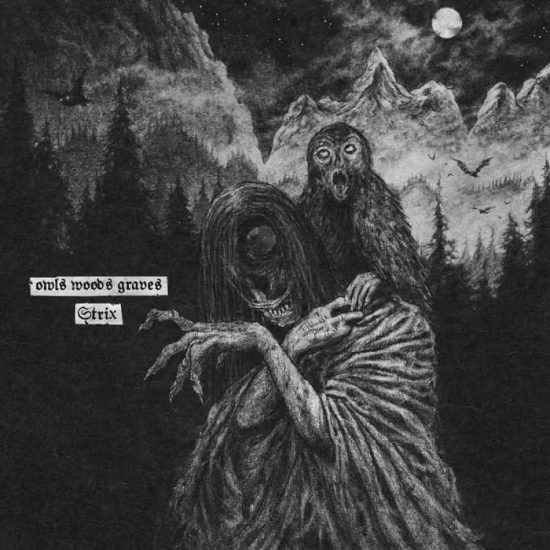
There are plenty of catchy moments on the album again, things that stick in your head right away. Who is the main author of those most interesting motifs, and what does your creative process look like in general?
Which songs do you mean?
There are quite a few, but Black Flame in Our Hearts was the first that came to mind, because that main theme is so cheerful that I actually laughed to myself when I first heard it. The Flag Is Raised has some great parts too, and Nightshifts which immediately reminded me of Burzum’s War.
The ones you mentioned are all my songs. When it comes to music in Owls Woods Graves, I do the vast majority of it. E.V.T. is also a composer to some extent. But we arrange the songs together – we do it as a four-piece. On the latest album, the initial idea, which usually came from me, would then pass through everyone’s hands until it was shaped into a full track.
And has that process changed compared to when you started as a duo?
Definitely! When we started as a duo, we were both quite overwhelmed with work. At that time, I was working full-time and also already touring with Mgła and playing in Medico Peste. I didn’t have much time. I worked more so I could later have more time off for trips. Back then, E.V.T. and I made a rule that at every rehearsal we had to create one track. When we made the first EP, we met five times for about two or three hours each, and every one of those rehearsals ended with a finished song for the record. The sixth track was basically brought into the studio and we recorded it there. It was all done on the fly, quickly and with full spontaneity.
I’d give a lot to see the rehearsal where Do You Deny the Evil? was created…
I remember it very well, and I still have that first version recorded on my phone. That track was created in two hours.
And when it comes to lyrics, weren’t you tempted to write more in Polish on the new album? It worked brilliantly on Idzie Diabeł (Devil is Coming), and I think the Polish language generally fits that kind of energy really well.
I think the Polish language is absolutely wonderful. I love Polish and the possibilities it offers. I read a lot. In fact, in Owls Woods Graves there are clear references to one of my absolute favourite writers, Bruno Schulz and Żadnych Znamion Duszy (No Signs of the Soul) is, of course, one of his quotes. I love Polish, but I’m also someone who grew up on non-Polish music. Most of the metal or punk bands I’ve listened to all my life didn’t sing in Polish. As a kid, I listened to Metallica, Misfits, Cradle of Filth, and I didn’t have much fascination with music that had Polish lyrics. Besides, there are very few good lyrics in Polish metal.
I would very much like to write in Polish, but I still struggle with it – it’s easier and faster for me to write in English. My absolute dream would be to make a full album in Polish someday, but it’s something I’m constantly struggling with and trying to push myself toward. I had a goal that on this latest album there would be two or three songs in Polish, but I couldn’t squeeze out a single one. I hope it’s just a matter of time and that I’ll manage to do it.
An Owls Woods Graves album entirely in Polish would be something amazing…
Yeah, that would be very cool. Maybe someday…
I wanted to talk a bit about the beginnings of Owls Woods Graves. Do you remember the circumstances in which the idea for that kind of aesthetic was born? The devil, nature, paranormal phenomena – where did the idea to combine all that come from?
During some Medico Peste rehearsal, our drummer popped out for a cigarette. It must have been around 2013. We were bored, so I sat down at the drums and started playing. E.V.T. joined me on guitar, and we started playing some Darkthrone track, completely naturally and spontaneously, just the two of us. That was the moment of understanding between us. Sometime later, E.V.T. invited me out for a beer and we went to this dingy bar in Kraków. There he told me it would be cool to put something together and that he had an idea. He wanted there to be a bit of punk, a bit of Swedish death metal. A bit of Misfits and a bit of Entombed. He said: “imagine something with graves, forests, owls.”
I picked up on that theme. And once we started playing, that idea of the cover became our common thread from the very beginning. The element of black metal has also started appearing naturally. The first song we ever started playing at rehearsal, and our first composition – essentially E.V.T.’s composition – was On the Swamps We Dance. And that’s how it all started. As for the lyrics, there was no concept. I just wrote about whatever I wanted to write about, whatever quickly left my mind. I didn’t have time to sit and think about a concept back then. I’d just take a piece of paper and write something on the bus on my way to work or to rehearsal. Part of the idea, especially in the beginning, was that everything should be created very quickly and very spontaneously.
Was it a deliberate idea from the beginning for it all to be so cohesive? Because that’s something that always impressed me about the whole concept, that everything fits together so well. You’ve got the music, the lyrical layer, and von Ritter’s artwork. A real full package.
No, but I also don’t fully agree with you. Maybe now, when we look back at it, it seems cohesive, but if you think about the fact that in 2014 or 2015 you’re playing a track where half of it sounds like Cock Sparrer and the other half like Swedish death metal with elements of black metal; suddenly you’ve got some clean vocals in the style of Misfits, then some filthy, very unpleasant-to-listen-to black metal – I don’t really see a strong cohesion there.
Maybe I should clarify, because I don’t mean the music itself, but the cohesion between it and the lyrical and visual layers. Those three aspects seem to come together somehow.
That’s probably something that just slowly brewed in the cauldron. As for von Ritter, I don’t remember exactly how it started. He had worked with Malignant Voices on some covers, and I think our label suggested we try working with him. We actually worked on every cover for a long time, and along the way there were many rejected ideas. There always had to be an element of ’80s punk and ’90s black metal. There would be this Norwegian, Kittelsen-like element, but at the same time the vibe of xeroxed Minor Threat or Black Flag tapes.
It’s only missing those fold marks on the covers, right?
Exactly.
I remember the first track I heard years ago was Do You Deny the Evil? Back then, I didn’t know anything about the project yet, but I remember I completely lost my mind, and I still kind of do when you play it live. That fusion of black metal and punk was something I hadn’t heard in that form before. This is probably a question that could’ve been asked at the very beginning – Is Owls Woods Graves more punk or more metal?
Owls Woods Graves is that phase of punk and metal where the two weren’t distinguishable. That’s quite common in music. Especially in the ’80s, there were a lot of movements where you couldn’t really tell at first whether it was punk or metal – Sarcófago, where the guy had a mohawk; bands like Motörhead, which sit right on that wall between punk and metal. You also had Metallica’s Garage Inc. with covers of Discharge or Misfits, or Slayer’s Undisputed Attitude with punk covers. There was also a band like Amebix, which was also hard to define.
But I also remember a moment that was important to me in terms of the creation of Owls Woods Graves. Somewhere I read someone recalling their first encounter with Bathory – the first album, back in the ’80s. And that person wrote that it felt like some kind of extreme, frenetic punk. Those beats that were almost out of rhythm, and riffs that resembled GBH more than Metallica. If you didn’t know whether it was a guy with a mohawk and a big “A” on his shirt or a guy on a motorcycle, you couldn’t tell if it was metal or punk. Especially in the ’80s, that boundary wasn’t so clear.
I think later there was a strong split, especially in Poland, where you were either metal or punk. You couldn’t listen to both KAT and Dezerter at the same time, because those were completely different worlds and you weren’t supposed to mix them. And the ’90s in particular were a very strong wall with barbed wire between those two subcultures.
Now, I see that a lot of punks go to metal shows. Metalheads, in turn, admit to listening to things like Armia and their album Legenda, which is considered a punk record. But is it really a punk record? If it weren’t for Brylewski or Budzyński, who were strongly tied to the punk subculture, and instead you had guys in T-shirts with skeletons on motorcycles, long hair, and dark sunglasses – wouldn’t that album be considered some kind of metal classic? Similar story applies to the great self-titled album by the band Moskwa.
Do you even think genre labels are necessary nowadays? There are so many of them now. Is there any point in asking whether Owls Woods Graves is punk or metal?
I don’t know, I don’t really ask myself that question. For me, there’s something in between. I’ve always focused on that bond, that place where the two rods have been welded together. I look at that weld and wonder what it is and how to name it. Are labels necessary? We’ll always categorize – we can reflect on it, and then we’ll still take the first random album we hear and put it into some category. I think for the sake of organizing what we listen to, there’s nothing wrong with categorizing. And there’s nothing wrong with saying that Owls Woods Graves is a punk or metal band.
But I think that even though musically it sits strongly at the intersection, identity-wise we’re much more metal. Our bassist and drummer have more of a punk background, but me and E.V.T. are definitely metalheads. We had long hair, we played and still play in many different metal bands. For me, metal is a natural environment. I always listened to punk more occasionally, and a lot about that subculture fascinated me, but I never had a full-on punk phase in my life. I’m more of a “scene tourist.” I listen to very basic stuff like Bad Brains, Minor Threat, or The Exploited, and I’ve never been deeply immersed in punk.
I’ll tell you a funny story I just remembered. Before the first Owls Woods Graves show, I went to this vegan place I used to go to frequently. Two guys sitting next to me started talking about the concert, and one of them said that Owls Woods Graves weren’t punks at all – they were just old metalheads who probably only know Sick of It All. At that moment I felt like getting up and saying: “hold on, I also know Agnostic Front, I know The Exploited – I’m not some old metalhead who knows nothing about punk!” (laughs). I just chuckled to myself, but in a way, they were right – we are those metalheads who lean a bit into punk, and our knowledge of punk music is pretty basic.
What does authenticity in music mean to you?
For me, authenticity in music is about not calculating. Above all, it’s about making decisions that aren’t necessarily good or profitable. It’s about making decisions that come from your inner need, not from external factors. If someone calculates too much, censors themselves a lot, and makes decisions based on things like money or other people’s opinions, then they lose their authenticity.
And do you think that authenticity is lacking on today’s black metal scene?
It varies. I think the issue with black metal is that it went from being a niche genre to a quite popular one. You get this phenomenon of “scene tourism”. But I actually think that’s more of a good thing. People who listen to music they didn’t know before get a chance to discover it – that’s completely fine. But this phenomenon also brings a group of people who play this music, but as soon as black metal stops being popular, they’ll be gone. One look in the eyes and you know who is who.
That’s a bit sad to me, although I don’t like acting like some kind of veteran who spent a thousand years playing for five people in underground bands – it wasn’t like that. But it’s a normal phenomenon in any subculture. When there’s any possibility of gaining something from it, those kinds of people will appear. It’s still not mainstream, but you can see that at some point the number of such bands increased.
You’ve been playing live with Owls Woods Graves for a few years now. I remember flying to Kraków three years ago specifically for your debut show. You immediately won me over with that youthful energy, simplicity, and some kind of primal force I hadn’t seen in a long time. Do you have any memories from the day of your first gig?
I have good memories of that concert. I think everything went according to plan. We were happy that a lot of people showed up. We were even a bit surprised by the reception – that a lot of people knew the songs. The other bands played well too. We knew it would be good, but we didn’t know it would be that good. I kind of have a blank spot when it comes to that show. I remember it a bit, but not all of it.
That probably means it was good, right?
Yeah, probably. Maybe some strong emotions made it so I don’t remember everything from that day.
Aside from the line-up, what has actually changed in Owls Woods Graves as a live band since then? Do you think it’s going in roughly the direction you intended?
We didn’t really choose any direction, but the direction it’s going in is good. We don’t really have any plan other than to play well. I think now we’re becoming more and more seasoned as a band. The four of us have been playing together long enough that we understand each other better and better, we know more and more what to expect from one another on stage. There’s a growing sense of unity between us.
You’ve been performing with Mgła for years as a session bassist, so the stage isn’t new to you. Did that experience help you in Owls Woods Graves, or is being a frontman a completely different story?
I had never been a frontman before and didn’t know what it would be like. It was a leap of faith. I just figured I’d go to that concert and see what happens. Maybe I’d manage as a frontman, maybe not, but the most important thing for me was to switch off my thinking – so that I’d know the lyrics and songs on a muscle-memory level. And that’s what I did at that first show.
Maybe that’s why you don’t remember it that well?
Maybe that’s exactly why. Only later, watching videos, I looked at it and thought I’d manage.
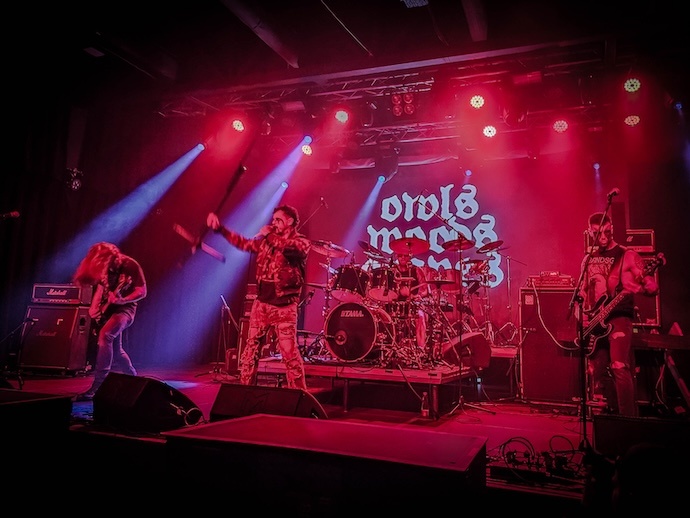
I’ve seen you a few times, and Owls Woods Graves’ music is very energetic – it almost demands interaction with the audience. Over time, I’ve noticed you’ve become more confident and your relationship with the crowd has developed. Do you feel comfortable on stage now? Or, as you said, do you still switch off and just go with the flow?
Again, those two things don’t exclude each other. I switch off, but to switch off you have to feel comfortable. You can’t spin pirouettes in a minefield. You need to know there’s a mat under you that you can fall onto.
I really like the stage and the noise. I like shouting and having that contact with the audience. That moment when a kind of energy ping-pong starts between you and the crowd. I’d describe it as feedback – people react to you, and you react to them. Some kind of magnetic field forms between the audience and the band. And that’s a very nice, intense feeling that I enjoy.
Of course, sometimes you play to a “dead” audience, which isn’t necessarily a bad thing – people experience music in different ways. Sometimes I stand like a statue myself, listening to music, and I’m having a great time internally. That doesn’t mean I have to go wild in a mosh pit or do acrobatics in the middle of the venue. Different nationalities react differently.
Oh yeah, when you played in Norway at the Beyond the Gates, it was mostly statues among the audience…
Yeah, exactly! That wasn’t my first time playing in Norway, so I knew very well what a Norwegian audience was like. And I know that playing a show in Trondheim is different from playing in, let’s say, Belgrade or Skopje. That energy exchange can also happen on different levels. I also really like and respect a listener who just listens – that’s something cool too. Generally, if people don’t leave, that’s already good (laughs)!
That’s already some kind of success, right? Speaking of places you’ve played, you’ve toured quite a bit of the world with Mgła. Do you have any favourite places to play? If you could play somewhere outside Europe with Owls Woods Graves for the first time, where would it be?
Outside Europe? I’m curious what it would be like in South America. We toured there with Mgła, and it’s one of those places with the wildest audience. I’d like to see whether they would understand our music or not. But I don’t think I have a specific country I’d pick. Besides, one thing is the country and the mentality of metal fans there, and another is that one specific show. The concert itself matters more than the specific people.
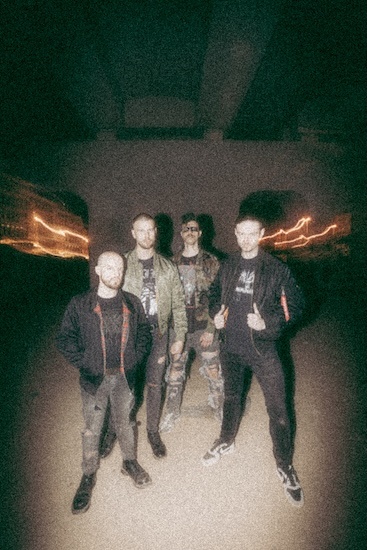
To wrap up the topic of concerts – early on you played with M. on bass. I saw three shows with him, and I have to admit it was quite a surreal experience to see him unmasked, especially when you hear his voice, so familiar from Mgła, in the backing vocals. It was a bit of a mindfuck. What changed that M. no longer plays in Owls Woods Graves?
For me it was also a mindfuck, but for a different reason – because in Mgła I play bass and stand on the left side, while M. stands in the middle with a microphone. There were many times when we walked on stage and I instinctively moved toward the bass, only to remember that this wasn’t that band (laughs). M. is a very busy guy, and it turned out he wasn’t able to dedicate that much time to the band. We had to part ways, reluctantly, and look for someone new.
M. actually offered his commitment himself at the beginning when he joined the band, so we had really good chemistry. We recorded one album live together, rehearsed a lot, and played the first shows together, so he’s a very important figure here. But unfortunately, time isn’t elastic, and M. has his own bands and private matters, and not everything can be reconciled – especially considering that we’re a much smaller band. Sometimes we have to drive for a day and play in some dingy, small place because we’re not in as comfortable position as Mgła, which can choose where and what to play.
What are your concert plans for this year?
We have a few shows, mostly in Poland. We’re playing in Zduńska Wola with Madball. We’re also playing in Szczecin at a new festival called Hell’s Bells, which has a very cool line-up, so we’ll probably go there for two days. We’re playing in the UK at Call of the Crow. There’s also the Atak Szczurów festival in Wrocław. In the autumn we’ll be planning a few things that haven’t been announced yet.
Apart from Owls Woods Graves, you’re involved in other projects. We’re also quite fresh off the release of the new Ashes album, where you played drums. Can you tell us more about your contribution to Into the Woodlands?
My contribution to Into the Woodlands isn’t big – it’s mainly Nefar’s project, where I record session drums. We’ve known each other for a long time, because Nefar is a guy we were already recording with in Medico Peste. Our first material together was recorded back in 2010. Because we know and understand each other musically and listen to similar things, we communicate quite well when working on Ashes. My contribution is purely drumming. I’m not an outstanding drummer – I play more with heart than technique, putting a lot of passion into it. I think that fits quite well with that post-Norwegian, melancholic but also forest-primitive style of playing that you hear in Ashes. These were drums recorded very quickly, not polished in any way – we went for that raw rehearsal-room feel.
It’s also been about two years since you released Hauntologist with Darkside. I know that Hollow was older material written earlier, but is there any chance we can expect a follow-up?
We’ve decided that we would continue, but I have no idea how long it might take us to record an album. We don’t have any specific plans or pressure. We’re gathering ideas, meeting up – we both want to record something, we’re both working on it, but I have no idea how long it will take.
By the way, I’d personally love to see Hauntologist live. Is there a chance of that?
Yes, there is some chance. It’s something we’ve talked about a few times and considered a realistic option. But while the album will definitely happen, playing live would require a certain alignment of the stars. We’d need enough time and the right people, and if those two things come together at some point, then there’s a real chance we’ll play live someday.
You also have your own project Over The Voids…, with which you’ve released two albums – the last one, Hadal, in 2020. Are you still active on that front?
Yes. Here I have the classic problem of creative block. The album is practically recorded. I recorded it two or three years ago, but I haven’t finished all the instruments yet. I’ve recorded drums, guitars, and bass. Somehow, I got stuck with this material, and every month I promise myself I’ll finish it—and it’s been dragging on like that. For about four years now, my New Year’s resolution has been to finish the next Over The Voids… album. I think I could finish it in two weeks, but I keep hitting some kind of mental wall. This year I also promised myself and the label that I’ll finish it in 2026.
Another project of yours is Alembik, more in the dungeon synth vein, which you’ve even performed live with. Are you planning more shows?
Yes, we’re actually playing next week in Warsaw. It’s a specific kind of thing, because Alembik largely isn’t based on playing with a laptop, but on using a hardware sampler and old vintage keyboards, which the other member of Alembik collects. When I met Robert, he had around 100 different keyboards. Now he has a bit fewer, but still – the gear fetishism is very, very strong here. So yes, we’ll be playing, but these are small, niche concerts for a very narrow audience.
Looking at the bands and projects you’re involved in, they’re quite diverse musically and emotionally. Isn’t it difficult to balance between them? Or do you just fully focus on one project at a time?
It would be difficult for me to focus on just one. The fact that I have several outlets for ideas allows me to sort them. I think that if I had only one band, it would be some terrifying mess – a kind of black metal monster on steroids that would be unlistenable, because I’d try to throw all the things buzzing in my head into one container. I think it’s much better to pour the blood from your veins into several different containers, depending on whether it’s that darker blood from an artery or the lighter blood from a finger.
To wrap up our conversation – can you recommend something you’ve been listening to recently? Do you follow the Polish black metal scene at all?
Not really. I have a problem with that, because I’d really like to discover something cool, so I’m open to listening to new things, especially in Polish. But in recent years I don’t think I’ve come across any young band that really excited me. Lately I’ve been listening to much calmer music. I listen to a lot more William Basinski, Dead Can Dance, or Coil. That kind of music is also twisted in its own strange way, but it inspires my ideas in more aggressive, metal-oriented bands.
Thank you for the conversation!
Thanks!
https://owlswoodsgraves.bandcamp.com/
http://www.malignantvoices.com
https://www.facebook.com/owlswoodsgraves/
https://www.instagram.com/owlswoodsgraves/