
(written by Islander)
Obviously, we host a lot of premieres here — we’ve done so almost every weekday for many years. The point, of course, is to introduce people to new music they haven’t heard before that we’re inspired to support. But our tradition of premieres holds the same benefit for us — it introduces us to music we haven’t heard before, and even more than that, to bands we haven’t previously discovered.
In the case of this premiere, it has introduced us to the intriguing Hungarian black metal band jöjjön (the solo work of Zsolt Sipeki). Jöjjön has already released two albums, Faust’s Grave in 2022 and Stoic Neurotic in 2024, but those eluded our attention. And now jöjjön has readied a third album, Szelet Vet, which will be released via Bandcamp on November 6th.
This new one we have discovered in a timely fashion, thanks to the invitation to premiere a song from Szelet Vet named “Mutability“. It is an entirely captivating piece of music, and the album’s thematic conception and lyrical composition is equally eloquent and enthralling, as you’re about to discover.
Further down below we have an extensive and erudite statement from jöjjön about the album’s themes. It’s well worth reading, but for now we’ll just excerpt part of it:
jöjjön’s third full-length album sets black metal against medieval chant and acoustic passages, electronic and new-wave textures, and lyrics drawn from Shelley, Goethe, Byron, and Walter de la Mare — wrapped in cover art reinterpreting a 12th-century illuminated manuscript.
The title, “Szelet vet,” is a Hungarian phrase for something like “sowing the wind” — the same idea behind the old warning that whoever sows the wind reaps the whirlwind. The record takes that literally: wind runs through nearly every song, but it’s never a kind metaphor. It doesn’t judge, doesn’t spare, doesn’t even live — it just moves, and things get made or destroyed in its path either way.
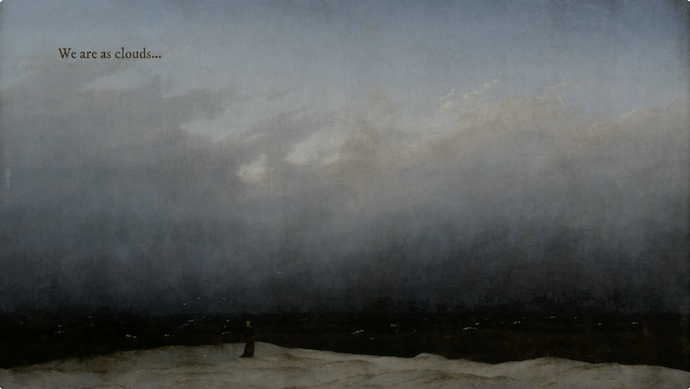
The song we’re presenting today, “Mutability“, takes its principal lyrics from the poem of the same name by Percy Bysshe Shelley, whose message (to quote jöjjön) is that “nothing endures but change itself, offered as neither tragedy nor comfort. Just the fact that holds.” It is presented in a video that features a painting by Caspar David Friedrich named “Der Mönch am Meer”.
The song is a gem of many facets (the poem is a gem too). In its changing phases it is elegant and poignant, wistful and tormented, tempestuous and harsh, ancient and modern.
Beautifully rippling and ringing acoustic notes open the song in spellbinding fashion around musing bass notes. Slowly staggering beats emerge, and the music’s ringing melody grows more intense, more immersive, and more depressive in its mood. The lyrics begin in deep, gritty growls and tormented howls, and the guitars seem to miserably writhe.
The music’s intensity continues to climb, inflicting sudden jolts and infiltrating throbbing arpeggios, and then blasting beats, wildly contorting guitars, and elevations of soaring and rapidly swirling splendor. A vividly trilling tremolo’d guitar takes the music’s emotions even higher — but then the music rings again with a lilting acoustic melody whose vibrancy is matched by the vigor of the rhythm section.
Yet the music slows and returns to more depressive moods (along with the return of the harsh vocals), accented by mandolin-like instrumentals and nuanced bass notes. After climbing to one further crescendo of intensity, the song concludes much as it began with a beautiful acoustic instrumental harmony that briefly casts another spell.
And now, here’s the full statement we’ve received from jöjjön about the new album:
jöjjön’s third full-length album sets black metal against medieval chant and acoustic passages, electronic and new-wave textures, and lyrics drawn from Shelley, Goethe, Byron, and Walter de la Mare — wrapped in cover art reinterpreting a 12th-century illuminated manuscript.
The title, “Szelet vet,” is a Hungarian phrase for something like “sowing the wind” — the same idea behind the old warning that whoever sows the wind reaps the whirlwind. The record takes that literally: wind runs through nearly every song, but it’s never a kind metaphor. It doesn’t judge, doesn’t spare, doesn’t even live — it just moves, and things get made or destroyed in its path either way.
I built the album around older texts that already understood this — Shelley’s cloud that “changes but cannot die,” Goethe’s pagan revelers defying the priests on Walpurgis Night, Prometheus enduring what can’t be endured, de la Mare’s “The Listeners,” whose imagery has haunted me since I first read it — set against my own lyrics doing the same work in the present tense.
“Cre(m)ation” opens the record with a boat ride across a wind-driven sea through the mysteries of human mind to the afterlife, arguing cremation and creation are the same act seen from two directions. “One with the Wind” is the other side of that: not myth, just someone who plans, builds, loses everything to something bigger than them, and stops fighting it.
Underneath all of it is one small idea I kept coming back to while writing this: something mortal and tiny, looking straight at forces it can’t outlast or control, and choosing not to look away — not comforted, not defeated, just still standing there. By the closing track, Shelley’s “Mutability,” that’s stated plainly: nothing endures but change itself, offered as neither tragedy nor comfort. Just the fact that holds.
Musically it’s old-school black metal severity — closer to Immortal or Abbath’s solo work than anything modern-polished — but I’ve never been shy about giving a song an actual hook, even where that’s unfashionable in this scene. If that sounds like a contradiction — good. That’s one of the album’s main arguments.
Two songs reach back to the project’s first record — “The Druid’s Rave” answers “Faust’s Rave” from 2022, and “Prometheus II.” returns to a figure I’d already set to music once before.
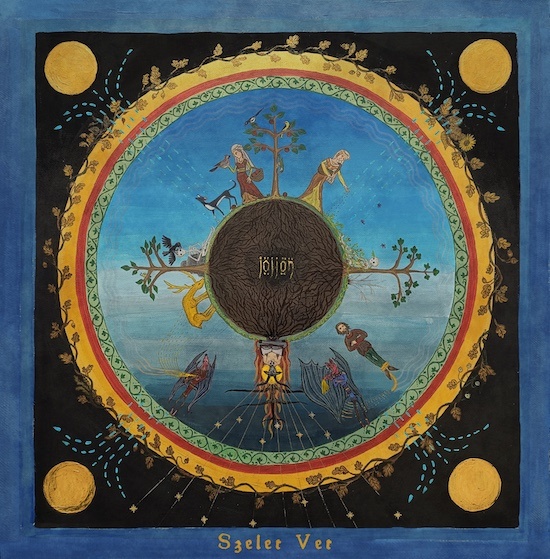
The album cover reimagines one of Hildegard von Bingen’s illuminated manuscript paintings — her wheel of the elements, the seasons, the cycle of a human life laid out around a fixed center. It’s one of the strangest, most vivid pieces of medieval art I know: flat, dense, almost obsessively patterned, built entirely around the idea that everything — birth, decay, the weather, the self — turns on the same wheel.
As noted above, Szelet vet will be released through Bandcamp on November 6th. For more info as that date approaches, follow jöjjön at the locations linked below.
https://jojjon.bandcamp.com
https://www.facebook.com/jojjonmusic
https://www.youtube.com/@jojjon