
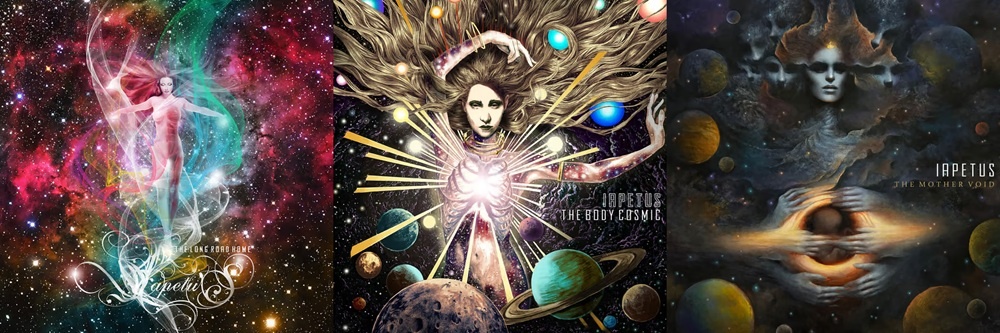
Recommended for fans of: Ne Obliviscaris, Nightrage, Wintersun
Wow, 200 editions of THE SYNN REPORT… how time does fly.
Of course, strictly speaking there’s actually a few extra ones knocking about, but those were all “special editions” and don’t count towards the official total (plus 200 is a nice round number, so let’s stick with that).
For such a momentous milestone it’s only fitting to choose an equally momentous band, one whose work has impressed us with each and every release – up to and including their new album, The Mother Void, which came out last month – in the form of cosmic Melodeath maestros Iapetus, aka Jordan Navarro and Matthew Cerami.
2017 – THE LONG ROAD HOME
It doesn’t take long for the band’s debut album to take off – just after the two minute mark of “…Of Hangmen & Vertebrae”, by my count – as the band set out to boldly go (RIP Sir Patrick) where… well, not exactly where no bands have gone before, but at the very least going there with a freshness and a boldness that immediately marks them out as “the next generation”.
The riffs are agile and gleamingly sharp, the drums, while programmed, provide a propulsive burst that pushes the song onwards and upwards, and the bright, shining leads – especially during the song’s climactic, Be’lakor/Insomnium esque refrain – positively drench the track in soaring, starlit melody.
It’s the more aggressive and animated strains of “Lachrymae Rerum”, however, which really help the album slip the surly bonds of earth,the song’s nimble, flowing bass and keening lead guitar lines winding in and out of the song’s punchy riff patterns and vibrant, visceral vocals (which intersperese some occasional spoken word parts amidst the scathing screams of vocalist Matt Cerami), while the extended, proggy mid-section allows for some welcome introspection and a chance for the band, and their listeners, to take a much needed breath.
And it’s this dynamic contrast between moments of soothing calm and scorching intensity – “Savior Solitude”, for example, recalling a more restrained, more emotionally vulnerable version of Ne Obliviscaris with its evocative back-and-forth between electrifying metallic force and mesmerising melodic majesty (the song’s simmering acoustic guitars laying the groundwork for some gorgeous female clean vocals) – which keeps the rather aptly-named The Long Road Home engaging and exhilirating throughout, despite its impressive (some might say excessive) seventy-six minute run-time.
Speaking of excess… the second half of the album is dominated by three absolutely massive Melodeath masterpieces in the form of “My Father, My God”, “Eviscerate Divine”, and the climactic, just-under-sixteen-minute title-track, with the former’s heavy synth presence and gritty, gravel-throated vocals giving off some major Omnium Gatherum vibes, while the bombastic “Eviscerate Divine” is almost at its best when it takes its foot off the proverbial gas pedal and allows its moodier, more progressive side – especially during the track’s poignantly proggy mid-section and riveting, classic In Flames style, acoustic outro.
The closing title track, of course, is in and of itself a veritable odyssey of stormy ambience, ringing, plucked acoustic notes, and shamelessly infectious lead guitar melodies, all interspersed with passages of rattling, rocket-propelled blastbeats, rich, powerful riffage, and the occasional atmosphere-enhancing Prog-Rock detour, which – even in the absence of any vocals – still manages to tell a captivating story.
2019 – THE BODY COSMIC
If The Long Road Home was the sound of a band taking flight, then The Body Cosmic is that flight reaching warp speed, going further, farther, and faster than anyone else (with the exception of maybe the equally brilliant Eternal Storm, who were perhaps the only other band of 2019 to achieve a similar stature).
What really makes The Body Cosmic feel special though is that – unlike some other bands attempting a similar sound (including some who feel like a direct influence on Iapetus themselves) – nothing here feels contrived or calculated… there’s no formula, nothing is forced… every song just positively crackles with a sense of boundless, organic energy, moving fluidly from moment to moment, from riff to riff, like a living, breathing ball of electricity, one which is constantly pumping out a seemingly endless array of high-impact hooks, high-voltage leads, and high-velocity drums (skillfully delivered by Ne Obliviscaris skin-pounder Dan Presland).
It’s not so much that Iapetus are totally breaking the mould or reinventing the wheel either – the seething blastbeats (Presland’s presence behind the kit immediately making the band sound more energetic and more organic), solar-flare fretwork, and galaxy-striding grooves of the opening title-track picking and choosing from the best bits of bands like Dark Tranquillity, Eternal Tears of Sorrow, Mors Principium Est, etc – it’s just that there’s an aura of vitality and spontaneity about this album, one that constantly has you asking “how has no-one arranged all these parts and pieces like this before now?“, that’s impossible to deny.
The song “I Contain Multitudes”, for example, really does… multitudes of catchy riffs and clever rhythmic shifts, majestic melodies and cathartic vocals, pounding percussive patterns and passages of intricate, progressive instrumentation… over the course of fourteen-and-a-half fantastic minutes, while the even more phenomenal “For Creatures Such As We” marries the blazing melodic brilliance of Before the Dawn and the focussed ferocity of A New Disease Is Born era Nightrage (Presland has never sounded quite so good as he does here, even in his own band) with the profoundly proggy ambition of An Abstract Illusion (Emi Pellegrino’s outstanding clean vocals giving way to an almost Opeth-ian mid-section of warm, brooding acoustic guitar, bleak, moody piano, and pristine, Pink Floyd-esque lead guitar work) in a way that lifts the whole album to even greater heights.
It’s important to note, however, that the album’s less extravagant moments – from the minimalist ambience of “Dark Matter Genetics” to the intricately layered instrumental textures of “Hadean Heart” and the solemn atmospheric epitaph of “Angelus Novus” – are just as vital to the album’s overall dynamic and narrative flow, displaying a rewarding restraint which allows songs like eighteen minute penultimate track “The Star of Collapse” to really cut loose in a stunning display of prodigiously powerful, ambitiously proggy, Melodeath might that once again identifies Iapetus as true masters of their craft.
2026 – THE MOTHER VOID
Somehow I’ve managed to get this far through writing this article without once using the word “epic”… so allow me to thoroughly abuse that particular term in reference to The Mother Void, an album which might not quite dethrone its genre-redefining predecessor, but which nevertheless doubles down on the even more epic and extravagant side of the band’s sound.
To help them achieve these more epic ambitions the band have brought onboard a number of guests, with Brody Taylor Smith of Invent Animate handling the drums and Eluveite‘s Fabienne Erni adding her vibrant, vivacious vocals to multiple tracks, while both Benjamin Baret (Ne Obliviscaris) and my old buddy Frank Harper (of the sublime Caelestra) give the almost nineteen minute “TON” a major boost in character.
Of course, special features like these can only take you so far without a solid foundation of killer musical material… and thankfully The Mother Void still has a frankly epic amount of that to offer, especially during the back-to-back-to-back brilliance of “The Mother Void”, “Aniara”, and “Red Giant” in the album’s first half.
The title track, for example, showers you in rivetingly tight tremolo runs and rapid-fire down-picked riffs – plus an array of rippling leads and soaring solos – that actually make The Mother Void seem slightly heavier than its predecessor… yet, at the same time, it’s the song’s moodier and more atmospheric moments (of which there are many, with these also being where Erni makes her presence known most strongly) that perhaps stand out the most.
Similarly, the seventeen-minute “Aniara” – whose lyrics, if I’m no mistaken, reference the epic poem of the same name (the movie adaptation of which, FYI, I thoroughly encourage you to check out) – while possessing an intensity and immediacy that puts recent Ne Obliviscaris to shame (even with Dan Presland’s return to the fold) also delves even more deeply into the more ambient side of the band’s sound, especially during the extended introspective mid-section, where shimmering synths and ringing notes sing out into the empty vacuum, providing a captivating sense of contrast which builds towards an even more epic (there’s that word again) crescendo.
And then there’s “Red Giant”, which feels like it packs every razor-sharp, string-skipping riff that Nightrage, Wintersun, and Mors Principium Est never wrote into a veritable torrent of Melodic Death Metal fury that propels the song right to the bleeding edge of the genre.
Sure, the band’s ambitions occasionally outstrip their execution (the instrumental interludes don’t seem quite as vital this time around, and the titanic “TON” feels like it would have been just that little bit better, and definitely a little bit tighter, with a few excess minutes trimmed off it), but it still goes to show that Iapetus, even after almost seven years of silence, are way out ahead of most of their peers and competitors still.