
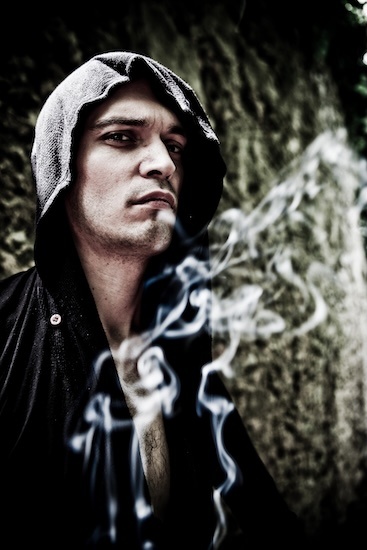
(Not long ago the Antiq label released a new album from Rauhnåcht named Zwischenwelten. It is a very impressive and moving assembly of music, and so are the eloquent answers given by the band’s mastermind Stefan Traunmüller in response to the questions of our Comrade Aleks in the interview we present below.)
Stefan Traunmüller is a veteran of the Austrian underground. His first project was the melodic black gothic band Golden Dawn, founded in 1992, and it’s still somehow alive. But Stefan also took part in about a dozen projects, the most fruitful of which is Rauhnåcht. Zwischenwelten (“In-between Worlds”) is the fifth album in the fifteen-year history of the project, not counting five smaller releases.
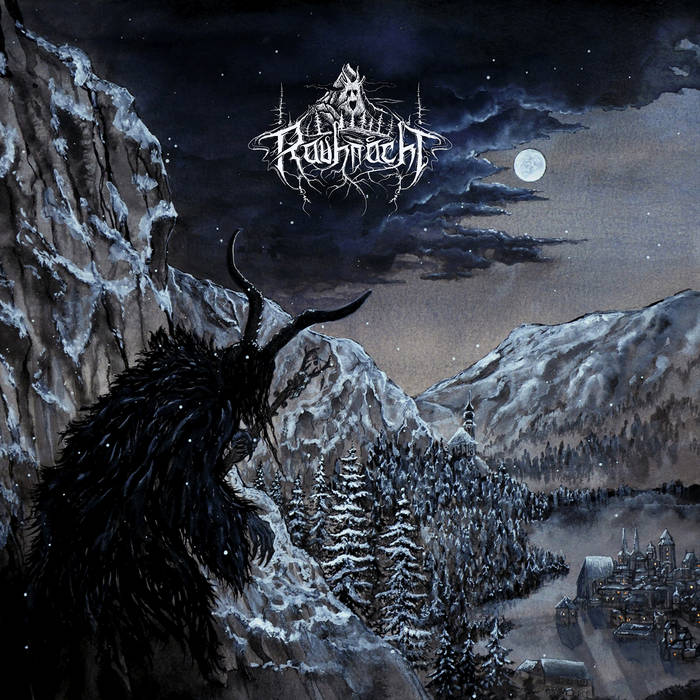
The new forty-minute full-length consists of six compositions, performed in the spirit of nostalgic, charged, and aggressive (by measure of anger-management courses) yet atmospheric black metal. Conceptually, as one can already assume from the cover of Zwischenwelten, Stefan adheres to pagan positions with an emphasis on the spirit of old Bavarian legends.
Nevertheless, I wouldn’t call this work totally “pagan” or “folk”, and the author himself entitles his creation precisely – “Alpine black metal”. Hence the prickly cold of high-speed black metal and the sublimity of contemplative ambient, providing short-term respites along with infrequent acoustic interludes – it’s a breathtaking journey through the blizzard and piercing cold of the mountainside in the company of old spirits of that land. The vocal parts are represented not only by screaming, but also by clean, harmonious singing, which is characteristic of pagan metal in general.
All the elements of Zwischenwelten are composed in such a way that you easily agree that Stefan‘s black is precisely Alpine, and Stefan is the best choice if we want an excursion in the world of Rauhnåcht.
Hi Stefan! How are you? What are you currently doing in terms of music? Which of your projects is the most relevant for you today?
Hi there, first of all many thanks for the opportunity to be featured in your magazine! I’m doing fine, but honestly I’m not very active with music at the moment. I am currently working on the mix for Véhémence and Heidnir, two very promising bands that some of the readers will certainly know. There’s also a hard rock band I’m producing in my studio. At the same time, I’m planning to release an album with my ambient project Bannwald.
Do you see yourself rather as an artist than a sound engineer? Or are both branches the same for you?
I love producing because it combines both analytical and artistic aspects almost at the same time. You know what it takes to make a certain instrument present in the mix, while at the same time you have to feel its impact and the song as a whole. When I compose, I also produce at the same time, but of course the analytical part can sometimes limit the creative flow, so the focus is more on creativity. And then there is something in between that I really love: when people send me rough sketches or plain ideas, and I can work on them and “paint the full picture.”
What about your project Golden Dawn? Is it on hold now?
Well, yes. The peak and best energy for Golden Dawn was in the ’90s, and nowadays I feel quite different and therefore no longer connected to the project. But when I listen back to the material today, I can still feel the magic moments I experienced back then.
Do you mean that there’s not so much of that “old you” left anymore? Actually, almost the standard question I tend to ask as years pass by.
It is still present but I don’t feel a need to express it anymore.
Golden Dawn was founded in 1992 and was a part of the Austrian Black Metal Syndicate. What did it mean for you in those early years? Do you see yourself as a part of it today?
In the early days the whole scene meant a lot to me—connection, power, and a sense of being united through the same emotions and lifestyle. The commercialization of black metal together with the rise of the internet and digitalization took away much of that old spirit, at least for me. Today I don’t feel part of any particular scene anymore.
What kind of old spirit do you mean? I remember how black metal was really “true&evil” back in the ’90s, and honestly its symphonic (untrue!!!) sibling doesn’t work well most of the time.
Yes, it changed when Dimmu, Cradle, and later Satyricon went big, but apart from that the sheer number of bands – plus the advent of the internet and digital music production – changed a lot for me. The old spirit, for me, was that sense of obscurity surrounding the whole scene. You only knew the protagonists from a handful of interviews in xeroxed fanzines, flyers, and tape-trading lists. It took me months to find out who this mysterious Quorthon was – or could be. You wrote personal letters, and you learned music production by doing punch-in recordings with your big toe on the record button of a 4-track tape deck. During the second half of the ’90s I lost all of this little by little.
Rauhnåcht took part in the split record with Vinterriket, Drudensang, and Tannöd four years ago. What do you have in common with these bands?
With Vinterriket I’d say the nature-loving approach, with Drudensang and Tannöd the inspiration from local myths. Musically, all bands on this split share significant influences from traditional melodic ’90s black metal.
Which aspects of traditional melodic ’90s black metal did you aim to keep in Rauhnåcht?
Hm, I can’t really answer that in detail, because it has been tied to my way of writing riffs and melodies from the very beginning. When I started making music, the second wave was just beginning as well, so I can’t deny those influences. To put it the other way round: I hardly have any influential bands that came up after the ’90s. So as long as I create Black Metal songs, they will most likely always contain some traditional aspects, so to speak.
Four years isn’t that much in terms of some bands, yet what slowed down the process of composing new Rauhnåcht material? Did you need a certain state of mind to return to it?
I do need a special state of mind, but usually I can create it when I want to compose. This time, however, it was very difficult for me to finish the material. I started composing in 2019, but for years I struggled with the vocals and lyrics. I also kept changing details in the mix over and over again. That’s the burden of being solely responsible for everything. Maybe I’ll find new motivation by working with other people in the future—time will tell.
Zwischenwelten is Rauhnåcht’s fifth full-length album in fifteen years, not counting EPs and splits. What is most important to you in this project? How much of yourself is in its concept?
It all started with the Alpine folk of Sturmpercht back in 2010, when I took some of their music as the foundation to create Alpine black metal. That became the first album Vorweltschweigen. The mood of this music was something I had never created before, but the strange attraction of local myths, the musty smell of old wooden houses, and misty mountains put into sound overwhelmed me, and I felt a deep resonance with it. My love for nature and hidden places in the mountains was renewed and intensified in the early years of Rauhnåcht.
Do you really feel that these frequencies, these distorted sounds, are common to nature? Or do you see all of this like a metaphor? Your perception of nature through music?
Imagine being caught in a snowstorm or standing very close to a waterfall – I think that does sound distorted. But yes, it’s more the latter of what you said. I love incorporating sounds of nature into my music, but also arranging like an approaching thunderstorm – moving from calm and subtle to overwhelming and back again. But above all, I want my music to reflect the moods of my deeply personal experiences in and with nature.
You’re from Sankt Koloman, Salzburg, and I believe there are many “local influences” in Rauhnåcht. How natural was it to channel these themes through your music?
That’s actually a misunderstanding—probably from Metal Archives. St. Koloman is the home village of Markus from Sturmpercht, and that’s where it all started. I live in Bavaria, near Salzburg. The Untersberg with its secrets and myths is very close by—I was raised at its foot. So the local influence for me comes from the power of the surrounding nature, not from people.
Exactly! I found it in Metal-Archives! So you’re from Bavaria… Okay, then… Do you have a reputation of being a black metal hermit in your local area?
I think I really do live the life of a hermit, at least almost. I do interact with people, but I try to spend as much time alone in nature as possible. I also rarely invite anyone to my home, apart from musicians who come to record or produce albums with me.
In Zwischenwelten you contrast the modern world with ancient times. What kind of past do you see as an opposition to today? Or rather, what values do you admire in times gone by?
This contrast is maybe more expressed in the artwork than in the music or lyrics. The album leaves a lot of room for interpretation. For me, the “worlds between worlds” is more of a state of mind—between life and death, dream and awakening, the seen and unseen, thoughts and the unspoken. But yes, it can also be interpreted as you mentioned. In my surroundings there are places where you can still feel a strong energy, which was certainly valued and used by our ancestors. That’s why churches were often built on such grounds, and their aura hasn’t completely vanished.
Every era has its qualities. Ancient people had their path to walk, and so do we. On those paths, similar experiences occur, though their form or manifestation changes. There is a “world between worlds” within ourselves, because each of us must decide: do we reconnect with nature and our true self, or do we drown in materialism and digitalization? The only real limitations are within us. Truth and reality are never uniform.
Honestly, I didn’t think about things like this from this point of view. I appreciate your opinion, it’s really interesting. So what kind of “constants” do you see for most human generations besides “the feeling of nature”?
No matter how the face of the world and the “outside” may change throughout the centuries, the inner themes remain the same. Issues such as the pressure to keep up with expectations, the struggle to find one’s own path independent of them, coping with loss, or coping with fear – challenges like these have not changed. In shamanic healing, there is a process of reconciliation with the ancestors of seven generations, based on the belief that some of their problems, illnesses, and conflicts are invisibly passed on to the next generations. In this process, you may recognize how you are “re-singing their song” in one way or another, and through that, heal yourself and even your entire bloodline.
How much of your first album Vorweltschweigen is present in Zwischenwelten in terms of spirituality?
Not that much, to be honest. Maybe I will complete the circle one day by creating another album about local myths, with more influences from traditional folk music. Time will tell.
I can interpret the album’s theme as an imaginary escape from the modern world’s agenda. But how much does it actually affect you? Do “woke” agendas and trends disturb you directly? Do you encounter them where you live?
Of course people try to spread their views, because they believe in them and feel the need for an imaginary sense of control. People want the security of a simple truth, and there is always someone to blame. That way they don’t have to confront the idea that they themselves might be responsible. I try to accept that. Since I work with children, I do see a lot of “agenda.” I would even say that there is a clear agenda behind the entire school system.
Black metal has a reputation for being violent, hostile, and evil, yet there are many subgenres. While Rauhnåcht isn’t depressive black metal, I still sense a grim melancholy and maybe even disillusion in it. How would you describe the main mood of Rauhnåcht?
For me it’s the sublimity of a mountain view, the mystery of secret places between worlds, and yes, also the melancholy of existence.
What are your further plans for the rest of 2025?
More mountain trips, more inner peace. Thank you for the very interesting questions, and I hope some of the readers will resonate with my music.
Thanks for the interview Stefan! Did we skip some important points?
I think we’ve covered the essential points for now. Thank you again for giving me the chance to share my thoughts on these topics.
https://www.facebook.com/alpineblackmetal
https://antiqofficial.bandcamp.com/album/zwischenwelten-2