
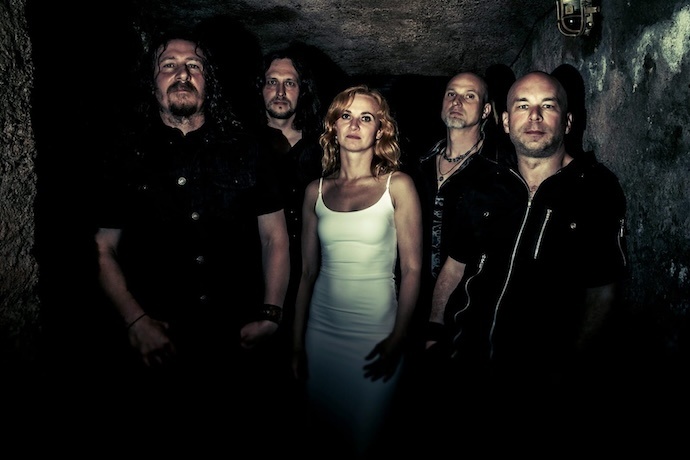
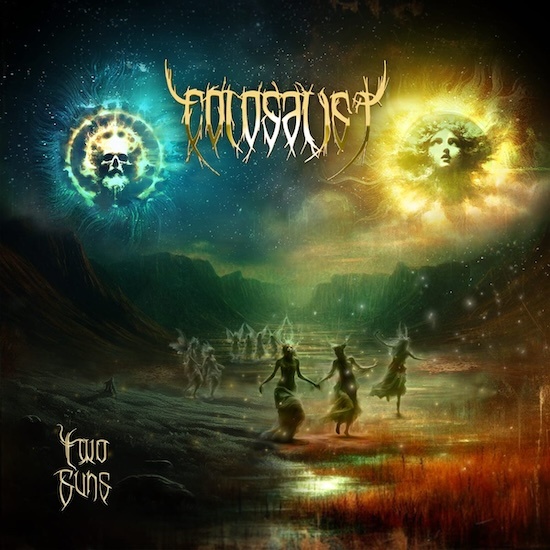
(On September 9th Hoggorm Music released the debut album of Colosalist, a Czech band of veteran members split between Norway and Czechia. Comrade Aleks fell for the album and arranged the following excellent interview with Colosalist‘s well-spoken founder Petter (formerly Petr) Staněk.)
In the mid-’90s Petr Staněk was a guitarist and vocalist in two Czech bands – the death metal crew Scapegoat and the doom band Silent Stream of Godless Elegy, but the first one only managed to record a few demos, and creative differences forced him to leave the second one somewhere around 2001. Much water has flowed under the bridge since then. Petr moved to Norway, managed to play gothic with LiveEvil and industrial with Robotized, and then remembered the past and started Colosalist.
He recorded his first Colosalist EP Pass into Oblivion with the bass guitarist of the Czech band Endless, Petr Hutin, back in 2014, but it was only seven years later that he assembled a full line-up and recorded his first large-scale work Two Suns. Petter Staněk is now joined by two more former members of SSOGE: Zuzana Zamazalova Klementova (vocals, violin) and Filip Chudý (bass), as well as Jan Jaglarz (drums), who played in the gothic doom band Euthanasia since 1994, and Tomáš Paulus (guitar) from Second Chance.
Well, this is some kind of miracle, but as a result, Two Suns sounds like a decent doom album from the second half of the ’90s with significant gothic metal influences and the characteristic sound of SSOGE of that period! “Creeping Frost” with its rhythm, rough vocals, and violins laid on driving metal reminds one of the album Themes. It’s even interesting that Petter’s voice hasn’t changed much in a quarter of a century!
There are echoes of Behind the Shadows in the doomy “Die Inside Me”, but in a modern setting. Strong riffs and violin delight in “From the Others”, reminding of the past only thanks to the vocal parts, and the powerful rhythm section brings back memories of the unbridled pagan hymns of the same Themes. At the same time, Petter does not mark time and presents something new: the lively and tenacious gothic hit “No Angels at Home” is really good, and here Colosalist successfully avoid all the pitfalls, without sliding into blind imitation. And the sentimental thing “Soul of Birds” is good in its own way despite the abundance of keyboards in the chorus.
Two Suns, on the one hand, attracts with its recognizable sound, the authenticity of the good old Silent Stream of Godless Elegy. On the other hand, this project is viable even if we don’t take into account its roots. So I hope that you remember SSOGE and that this interview with Petter will entertain you as well as me.
Hail Petter! How are you? How do you prepare for the release of your debut album Two Suns?
Hi Aleks and all readers. I’m fine, thanks. Yes, I’m quite busy due to the Two Suns release. I try to keep up with answering emails and interviews that are coming in. It’s a demanding period, and I balance it with trips into nature—otherwise, I’d probably go crazy. There’s really a lot going on.
Did you get all this promo-chaos because of your own old relationship in the underground or is it because of Hoggorm Music’s involvement?
We handle all promotion through our label Hoggorm Music. I don’t really have any old contacts left in the underground – it’s been more than 25 years since I was last active on the doom metal scene. So all the promo work is carried out officially under Hoggorm Music.
Petter, you were actively involved in the metal underground in the ’90s when you were playing in Scapegoat and Silent Stream of Godless Elegy. What happened then? It seems like you took a pause for an entire decade and didn’t play metal at all.
You’re right, I wasn’t really visible. I’m not the kind of person who needs to be in the spotlight. I moved to Norway where I’ve been living for many years, collaborating at a distance with some musicians from the Czech Republic. My time in SSOGE ended in 2001, when I was kicked out of my own band. Honestly, there was no place to continue anyway—the lineup at that time was terrible, and in hindsight, it was good that I didn’t invest even a single new song into it. On top of that, I was struggling with social phobia, alcohol, and work. Life made it very clear to me that I had to move on.
Scapegoat found a successor in the album Timehookers Scumjob (2018), recorded under the name Robotized. A one-time project, but I recommend giving it a listen. I also recorded four albums with LiveEvil, the EP Enymls with Newpork (death/punk/roll), and I keep writing new songs all the time. I’m addicted to it.
So how many active projects do you have at the moment?
At the moment the only really active band is Colosalist. The other projects are more like future plans or side ideas. In my free time I’m working on an EP for my project LiveEvil, and I would also like to record a black metal album with another project of mine called Yrgh. At some point in the future I’d love to do a second album for Robotized as well. The plans are there, but right now all my time and energy is taken up by Colosalist. That’s life.
How did you come to the idea of Colosalist? What kind of music did you want to perform with this band?
Colosalist is a continuation of the visions I had back in the SSOGE era. There are still many people who are devoted fans of the first three albums I wrote for SSOGE, and they are actually the reason why Colosalist exists.
In any case, because of my own philosophy, I strictly refuse to glorify any historical, biblical, Slavic, or Germanic figures, or any pagan deities. I describe things in my own language, with deep awareness of the inseparability of humans and the Earth, humans and the universe. My visions are not inspired by books or history.
Musically, I think we partly reflect the ’90s scene, which gave birth to the best metal albums and still influences everything recorded afterwards. I love Norwegian black metal, and even if it’s not obvious at first listen, I believe it has influenced me in shaping Colosalist.
Hah, yes, it’s not obvious indeed! Which aspects of Norwegian black metal reflected in Two Suns?
It’s not about black metal riffs, but more about the atmosphere. You may feel the heaviness and coldness that Norwegian black metal carries. Another aspect is the absolute rejection of organized religion, while embracing a pagan perspective – not about worshipping old gods, but about connecting with the Earth, with freedom, and with our inner core. For me it also reflects the core values of black metal: defiance against dogmas, being yourself no matter what is expected, turning away from the mainstream and walking your own path. It’s about what is hidden inside us and in our relationship with the Earth – individualism, rebellion, and breaking away from the herd.
According to Metal-Archives the band was founded by you in 2013, and you pretty quickly recorded the EP Pass into Oblivion together with Petr H. on bass. How long did you bear the ideas for these songs actually?
Well, I opened a drawer full of material I had originally prepared for SSOGE. The concept of that music was still inside me. You don’t forget that. But when I started digging into it again, I reworked the original ideas a lot, because I was listening to a lot of black metal back then. Let’s say those four songs began to take clear shape shortly before recording, but the ideas had always been there in the form of visions.
What else did you do with Colosalist during this first period?
Nothing, man. It was a one-time project, I moved to Norway, and the lights went out. For a short moment, there was a spark to do more—we recorded a cover for the Dissolving of Prodigy compilation, with drummer David Najbrt, who now plays grindcore in the Czech Republic. Then there was a long pause until 2021.
Two Suns is a mix of gothic and death-doom metal with a flavour of the ’90s. There is a lot of everything in this album, and these elements sound familiar, like something we had witnessed back in those years yet with a modern touch. How do you see the essence of this material as its author?
You are right. I think the old albums from Tiamat, Paradise Lost, and My Dying Bride are, in a way, unbeatable — and I know why. I proudly stand by this ’90s legacy, but I do it in my own style and way. There’s no point in making copies, but you can try to capture that vibe. And I’m glad it’s there, because it carries great power, rawness, and emotional energy.
I believe that besides the clear ’90s reference, we are pushing boundaries further and bringing a different approach. The handwriting should be recognizable from the very first tone, and I put a lot of effort into making sure that’s true for Colosalist. That’s exactly what made those past records so special.
What kind of lyrics did you write for Two Suns? Why “Two Suns”?
It’s hard to talk about lyrics in the case of Colosalist. Some are very abstract and reflect my vision of the connections and conditions of existence. To simplify: all existence is relative and conditioned. Existence—whether we call it a form, a state, or a phenomenon that can be described, observed, measured—always depends on conditions. Let’s say the Two Suns are those conditions. Light and darkness. The beginning and the end of existence. The transformation from one state to another. Plus and minus.
Applied to human life: birth and death, sorrow and joy, day and night. We usually speak of two states, right? That’s why Two Suns. People have always danced between these two Suns, and that’s the essence of one of the oldest philosophies humans have ever created.
Silent Stream of Godless Elegy and Dissolving of Prodigy, where your bandmate Filip Chudý played, used lyrics written in Czech from some point. I always admired that, but it’s sad that both bands weren’t widely known abroad; I guess they could reach more, yet they would lose their identity. How comfortable is it for you to rely on English texts in Colosalist?
The world would be a much easier place if we all used one language. I understand what you mean — it’s certainly exotic to sing in Czech or other unusual languages. But for me, sharing information in the simplest, most understandable form for everyone worldwide has always been more important. That’s why I never wanted to use Czech in my music—except for one exception, the song “Hrob”.
Both of the bands you mention originally sang in English. SSOGE and Dissolving both fucked it up somehow, in my opinion, and basically gave up on reaching a broader audience. Yes, you’re right, that’s a pity.
Nope, I don’t think that using a mother tongue is good only for exoticness’ sake. We need to keep a connection with our roots. However, I loved SSOGE’s Iron and Behind the Shadows, and I appreciate Themes too. But it’s said that a language barrier often still serves as an obstacle on the way of some bands. Speaking about Norway, how good does globalization work there? Is it only about positive sides?
For me, any language is simply a learned tool of communication, and honestly I consider that to be its only real role in society.
I don’t agree with an economic model that is based purely on the level of consumption. It bothers me to see people walking around in Adidas shoes that are made by people living in misery. At the same time, it also bothers me that I can’t even order a simple fish in a Norwegian restaurant because it’s too expensive.
Norway is, I would say, quite traditional, but at the same time it is prepared to respect your faith, skin color, cultural background, sexual orientation, even the way you dress. Still, I dare to say the society remains rather traditional here. Personally, I keep away from social festivities – I am more of an individualist. I need society, but at the same time it scares me.
You took part in the Dissolving of Prodigy tribute in 2018. Did you ever share the stage with them?
Yes. Not only some gigs during the SSOGE era, but also with LiveEvil we played shows together. We were friends. With “Fusaty” we shared a lot of visions—and also drank a lot of beers together. May the earth be light upon him.
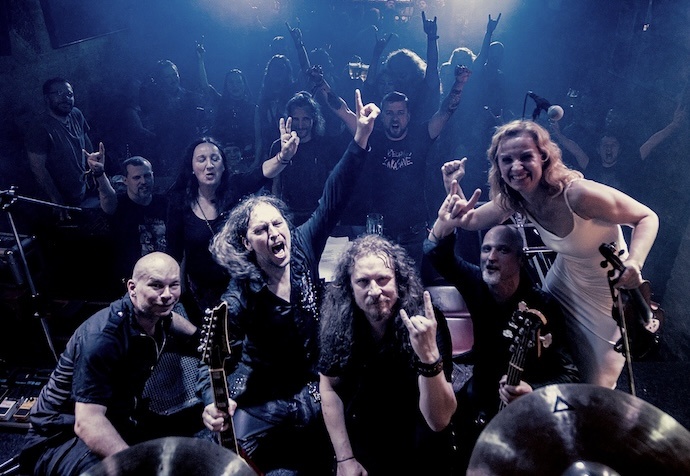
You found most of the lineup in 2021, and now the band consists of three ex-Silent Stream of Godless Elegy members, as well as Jan from Euthanasia, one of those bands from the ’90s. Did you hang together all this time? How did it happen that you gathered such a lineup?
All SSOGE albums, including demo recordings, were reissued on LPs. Together with Filip Chudý, I approached SSOGE with the idea of playing a few shows in the original lineup for our fans. It didn’t happen—the idea was blocked from the SSOGE side. So, I suggested to Filip that we should do it with Colosalist instead and perform those original SSOGE songs, plus I already had material for a new album.
He got excited and brought in guitarist Tomáš. I had known the whole Euthanasia band for years, and at a garden party during a visit to the Czech Republic, Jan Jaglarz was there—I asked him if he wanted to try, and it clicked. We invited Zuzana to guest on concerts and the album, and she agreed. I’d say it was the right time. The cosmos aligned so we could meet again.
What are your plans for promotion of the Two Suns album for the rest of 2025?
In autumn, we’ll play several concerts in the Czech Republic, and my wish is to introduce the album to a wider audience worldwide. Hopefully this album deserves it, and it would be a pity if potential fans didn’t hear about it. So, there’s a lot of work ahead. But we’d also like to play in more countries, and we’ll direct our efforts toward making that happen with several concerts across Europe. Keep your fingers crossed for us—we’re really looking forward to seeing you.
Do you have an opportunity to play in Norway? I guess there’s only one “old” doom band left and it’s Funeral.
Yes, we do have that opportunity and I am planning concerts here. You are right in pointing out that doom metal almost doesn’t exist in Norway anymore. But Colosalist is not a typical doom metal band, and I can easily imagine us sharing the stage with bands from different genres. The reality, however, is that there aren’t that many concerts, and people here are used to going mainly to established names rather than to unknown bands… and let’s be honest, Colosalist is still an unknown name. That will be a challenge for us.
Thanks for the interview Petter! I wish you all the best in the forthcoming mini-tour and I hope that we’ll return to Colosalist once more when you have a new album done! Any final words for our readers?
Thank you for your time and for giving space to Colosalist and to myself. Don’t hesitate to write to us in your own language – we will always find a way to understand and to reply. I wish you all the best in discovering music that speaks to your soul and words that truly matter.
https://colosalist.bandcamp.com/album/two-suns
https://www.facebook.com/colosalist/
Fantastic interview with Colosalist! Your questions offered great insights into their music and creative process. Really enjoyed this read!