
(NCS contributor Vizzah Harri, domiciled in Vietnam since his first appearance here, has now returned home to South Africa. But the change of scene hasn’t affected his unmistakable and inimitable writing style, as you’ll see from his review of the first album by Smiqra, which is a different guise for the person behind Ὁπλίτης [Hoplites].)
I’ll be honest, I’ve been sitting on this review for a long time and it came to the point where I realized it might never happen. It perhaps stems from a feeling of inadequacy. I don’t think anyone will be able to write about this album with an honesty and attention to detail without missing something. The unpronounceable Rɡyaɡ̇dźé! might not make it to the top of many AOTY lists this year, apart from the underground, for music that takes a few leaps outside the bounds of what our usual comprehension of what a ‘type’ of music should sound like can be seen as simply an oddity, flash in the pan.
If an album starts on musical hijinks as an inside joke, breaking the 4th wall so to speak, for heading to Bandcamp the track loaded into the player ready to fire is number 9, Major Revision!; it’s a nice way of informing us that what we’re dealing with is a meme of the highest order.
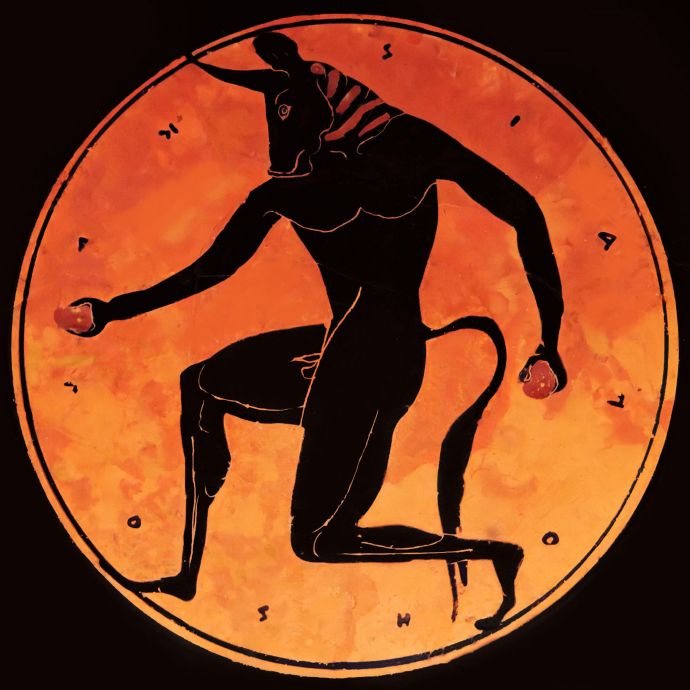
If you typed in “Hoplites – Bandcamp” and clicked on Ὁπλίτης’s account that is still apparently based in China, you’ll first have been enthralled by the eye-catching-as-fuck and self-referential memetic Greco silhouette bathed in either the rising or setting of a marigold dusk-til-dawn-spanning masterpiece.
It was posted immediately as it came out on one of the music pages I follow on BaceFook and I commented that all I needed to do was see the artwork to know it was gonna be on my aoty list. I’ve been waiting for this album, had more anticipation for it, and was greatly disappointed when I couldn’t find any fucking audio shops open that sell mp3 players that hit harder than my laptop or phone can through my base-rate Sennheiser’s. Fuck.
Back to the topic at hand. Everything about his album is of memetic punnic(?) and Punic veritas; this fucker went and memed the fuck out of himself, language, metal, authority, a list that can be expanded upon if one is willing to jump down the rabbit hole.
The artist who goes by J.L., and the force behind Vitriolic Sage, Ὁπλίτης, and now Smiqra’s name on the archives, reads as Liu Zhenyang. Zhenyang can mean exalted, Liu means battleaxe. The ‘J’ standing for Jactus, when etymologized, after subtracting both ‘cactus’ and ‘iactus’ in the browser (as in: -cactus, -iactus) brings you to… ‘new old words’ haha.
There is much talk of bovine creatures and therefore melding the Greco inspired art of their previous existence in Ὁπλίτης (Hoplites) with a theme in the new project, that of oxen; makes sense for it being a minotaur marching with what could be hearts in its claws. ‘Yak heart’ as a loose translation for the only track with lyrics on Bandcamp seems to support this assertion.
“The spaces of Cretan musical networks remain like the corridors of the labyrinth inhabited by a musical minotaur that confronts intruders; later recoiling into the secrecy and safety of the inner chamber of ‘the tradition’…” Minotaurs are then the defenders of tradition?
Smiqra is listed as avant-garde metal in the archives, though classified more as surrealist; when I listened to this record and thought of art to accompany it, I’d mostly lean towards Zdzisław Beksiński.
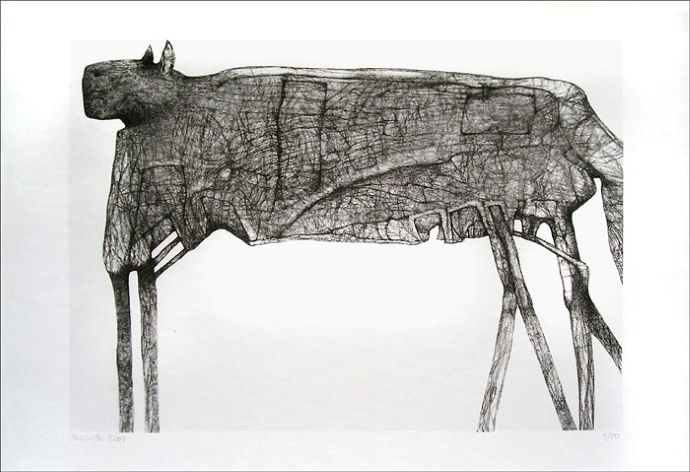
It takes a madman, one with perhaps a touch of genius and a Diogenean fire for parodic inclinations and boxing that one gets here. This is perhaps the most accessible yet confounding of their works to date. I am not the perfect choice to deconstruct what is on offer, but there are common themes running through the album, there is play with repetition and even with innovation and experimentation.
The jolted, halted inception of the album is a statement in itself. It’s a challenging listen, albeit refreshing whilst at the same time obfuscating. Opening with a promulgation of fury. Straight to the matter at hand, there is an instantaneous rip and tear with little break between sonic assails.
The overturing wash of uproarious guitar onslaught is appeased with an announcement from our narrator, and then straight back into it again with a primal chest thumping proclamation before the tribalistic hypnotic pounding keeps ensuing. What sounds like a synthesizer and a saxophone had a baby on fentanyl produces a solo in the mix and the first track is over before you’d even noticed the time elapsed before jumping into the title track.
There is very little pause in Rɡyaɡ̇dźé! between songs set up to play as one piece. Rgyalrongic is a Sino-Tibetan language with the first 4 letters being the same as that of the album; the ‘ɡ̇’ and ‘ź’ can be used to transcribe Arabic, Moroccan, and Pakistani languages into Latin. I should have asked the artist what it all means because as we say in kitchen Dutch, it’s above my fireplace (out of my intellectual grasp).
The title track warps the musemes and motifs found in the opener and expands upon them. The new album from the person behind Ὁπλίτης is an experiment of repetition and deconstruction, one of mischief and top-notch memery, even if this mentally challenged reviewer struggles to figure any of it out.
Vdzärnga is where it really kicks off, but this is not the type of thriller that just waits to give you the expected plot twist at the end of each episode. No, this is the mind-altering heuristic-breaking sonic assault that prodigies of Ada Lovelace could inspect regarding complexity. The whole discography would be nice, and then there are the Jupiterian oceans of bands that came before and exist still now that push the envelope.
Vdzärnga is a unique word just like the preceding track. Perhaps it is commentary on so many groups/acts using made-up languages of late and on their prolific output. Doubt it though. The vocals are demented and pissed off and at times not even sung, more like Gaia got a voice to tell off its children for their wayward ways.
1960怪人 has some acoustic vertical bass play that informs the riffage, both building and descending and at times reaching frenetic shrill points at the edges of what ears can handle.
Don’t worry, bangers like po-ti-ni-ja! are bound to get you hyped up and excited for the right reasons, and no, it is not just an endless angularly riffed ascension. po-ti-ni-ja! is the second longest track on the album at nearly 5 minutes. The piano interludes and solos here are a welcome breath of fresh air with spoken word soothing us before the inevitable plunge back into a maelstrom of ferocity. Tribal allusions remain, like oratory renditions or a ritual chant in gang vocal style before a vocal solo, you read that right, in strained despairing wails. Who would have thought that madness sounds this good?
The first track titled in Chinese contains a female robotic voice, some free jazzy upright bass, piano, and a drunken sax, and an even bigger break from convention than anything coming before it. Met by our second narrator and the weird starts setting in, and just a teaser of fuckin note as the intonation of an undisguised slur is slowly undistorted. An elementary transcription would produce this result:
“Cheap patriotism/ served on finest plates/ proud conscience, talks to the dogs.”
Here there is pause.
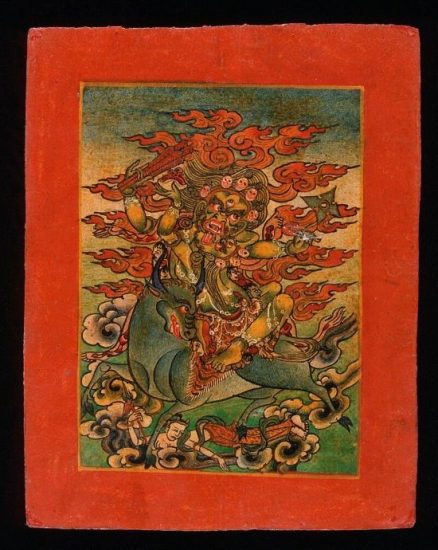
Yellow Yama (?) and Consort on Bull, Nyingmapa Buddhist or Bon Ritual Card
_and_Consort_on_Bull,_Nyingmapa_Buddhist_or_Bon_Ritual_Card_LACMA_AC1998.253.1.jpg)
Imaginary Minotaurian academia puts you in not just the casual surfer’s tumble-dryer, it’s a Mavericks hold down. Dropping back into metallic territory of disjointed riffs and unexpected breaks, but is it that unexpected anymore at this point? The first listen through of this album with no prior experience with J.L.’s work might be taxing. Track 7 breaks new ground with a sameness in formulaic composition of strained guitars as driving force, recess and repeat. The squeaks of both string and wind instruments are a recurring theme, which is not what one would have expected of a jazzed-up avant-garde thrashy black metal artist to depict in its listeners’ minds the picture of oxen. The other great theme in this album. This album is not made for human ears after all, so how the fuck would I know what oxen like to listen to?
The electronica gets ramped up in Peer review by oxen and I’m all here for it. It might be about a jibe at the fact that someone somewhere down the line thought it’d be a slight to tell someone who lives a life in another world altogether than the music they make that following a life of music is purely for oxen. J.L. turns it on its head with some of the other titles like 犏牛心 (Yak-heart), which contains the only lyric on Bandcamp and which is untranslatable to the uninitiated.
If what came before proverbially rag-dolled you in vicious swell, then Peer review by oxen is where the near-death experience sets in. What in the actual fuck. You make it to the surface again for a brief gasp of air before the roiling chaos of the next mammoth wave’s wall hits you before you can even think of duck-diving, relentless yet rhythmic, and before you can be forgiven to think squeals of the string and wind variety are the only tricks up JL’s sleeve, in comes the electronica and the hooks you didn’t know you deserved this deep into the fuckery.
The off-kilter, disjointed, toned to the tune of purgatorial hellscapes squeaks take crack, gasp-breathes it, crushes the bowl and then hits a whole goddamn line of krokodil for good measure.
Major Revision! is loaded into the player when going to Bandcamp. It’s a perplexing piece of squall shrieks, mutes, and bursts of energy. 68 seconds of avant-garde saxophone yelps and guitar blips announcing the name change and revision of content.
And to just fuck with expectation even more, Track 10 is catchy as all hell to start with, it has something to do with breaking down formulas and/or formulaic thinking on how things should be set out.
Not unaware of what listeners perhaps crave in consistency, refrain, and melody, track 10 gives us just that, with a twist. The artist had some sympathy for his listeners, with 反哲學牛 starting on the most listenable tones and most conventional structure. That structure gets fucked with as 反哲學牛 sounds like an anime or ’80s TV show opening theme transliterated into a metal song which then exponentially ascends in pacing. Here, breaks between attacks are waylaid again for perpetual destruction of earholes with no break in between that there aren’t actually sonically speaking any divisions, flowing into each other.
That toe is gonna start tapping, that knee better be tied down cos it’s gonna kick the nurse in the face tryna hold it down after your patella just got moved past the funny bone criteria.
Reprieve is found with the next exclaimed number though, that beautiful acoustic bass with minimalist yet frantic drums and a chant from the narrator that brings us back to our opening riff, yet altered so slightly. It isn’t long before we’re entertained again by our friends the saxophone and acoustic bass, but they were on a rager of sorts of paraphernalia akin to Early Tombs, an aside of dementia before the guitars bring us back in to melodic normalcy.
Some sections of this album are extremely headbang-able, catchy as fuck and even bordering on the infectious; one part is the outro to the third last track that is preceded by a sci-fi enhancement. With an echo and self-reference to earlier themes giving the listener a welcome ‘in’ of “hey, you remember that part, here it is again and yeah, I know you liked it.”
Break, bridge, interlude? It’s the kind of train smash that you can see is going to happen, yet cannot turn your eyes from.
And then we get to the part of the album that could have flopped it. Music is indeed for oxen. Track 14 is weird as fuck, not as strange as the musical ideas that came before, but for full on self-reference. “Music is for oxen” might be off-putting as repetitious as it is, and perhaps that is the point.
The penultimate track does not disappoint in the rehash, the starring role, the revisiting, how do you take an album so warpingly insane and then use the closer to take everything without making 100 percent sonic allusions to encapsulate the whole album in just one ten-minute track?
Themes are revisited in melodic and riffage motifs. Yet the music ascends again into the realms of splendor with some ultra neanderthal ‘oofs’ added for effect. Most people would end their album with an outro as found in the tri-ultimate track. The sax says no. We are in for the most bizarre, laughable, and ridiculous part of the album.
qa-si-re-u! is a goddamn monument of avant-jazzy-extreme music.
Taking all the themes from what came before, melding, transposing, and then enhancing them into the Leviathan Wakes/ World War Z/ Blood Meridian mash-up of an alien tree of undead infants. It is a most satisfying reprise in matching the unpleasantness of the imagery preceding this sentence.
The song takes a rest when a voiceover gets played with Zen music in the background and pensive bass in the foreground. A blade sharpens, a chant, rising waves of distortion, a drowned-out scream, bass proliferates and intensifies in monotony and then adds a third note with drums skittering before deepening, yet this section is extended lengthily before we get back to disjointed riffage amping up the intensity if it were even possible.
The percussion takes the limelight and we have one more break into electronic and flutish meandering with still no let-up from the strings and a callback chant that sounds a fuckton like ‘precedence’ before a possibly well-proportioned lady rings out a final note. But with a linguist, a profession known for their humor in naming things, it isn’t over of course, because the voice of our narrator leaves us with a final quote.
Stare at that final song. Listen carefully. And then think, what does that last song’s name sound like if enunciating the words? Ever heard of the phrase “Bull in a china shop?” This is not that, the words you read here are from someone that green behind the ears.
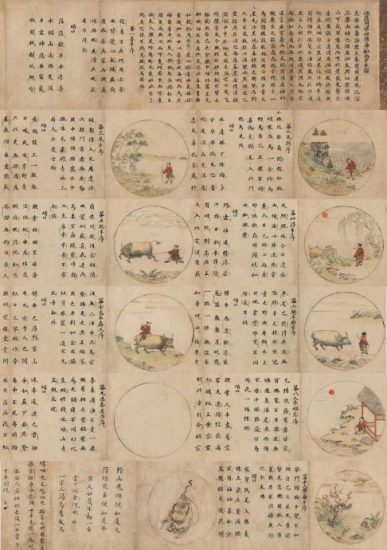
“Illustration and Preface of the Ten Oxherding Pictures“, Japan (1278), currently housed in the Metropolitan Museum of Art

Taking the line “Treating elephants for oxen” lead me to an article of which this is a small extract:
“’Oxen and Elephants,’ refers to two pieces of art from the Zen and Tibetan tradition. A series of ten paintings depicting ox-herding as a metaphor for the path to enlightenment is a commonly used tool in the Zen tradition… Elephant herding is a metaphor used in the Tibetan tradition with regard to training the mind in samatha or ‘calm abiding’ meditation. Thangka paintings of this process are common. Although not an exact parallel, it is an interesting notion that both traditions use the herding metaphor to explain pieces of the Buddhist practice.”
Reading a bit more about elephants and oxen in Tibetan and Zen Buddhist practices respectively, one gets a better idea of why there is so much reference to oxen in this album. Used as metaphor for training the mind on the path towards enlightenment, who knew that extreme metal can conjure up meditation music? I use different forms of the word hypnosis a lot; even if writers were looking to achieve using at least a few hapax legomenon in their offerings, that word a hapax is not, neither the very term referring to something that appears only once in a piece, like erudition, which I have next to zero of when it comes to meditating. If I had to meditate on any album I’ve heard so far this year, then I probably have already been induced to reach a state of cognitive ease inadvertently.
The creator of this album has stated previously that they find inspiration from anime as well as a lot of other media. Perhaps even memes of whatever level one can conceive, even incorporating a snuff track, spoiler alert, in which it is stated that the entity conceiving this record dies epi-morphologically, rising above language so to speak. And with all the yak, bull, oxen, as well as Tibetan Dzo references, the latter two of which are historically sterile, it can indicate as castigation or criticism of consumption, perhaps just a fun language meme of creative castration.
If art rock, prog, and theses on the deconstruction of language for which most would utter “I still don’t know about the details” were thrown in a blender, then Smiqra’s ‘debut’, to me at least seems like a natural progression from Ὁπλίτης with some riffs from Παραμαινομένη and even Ἀντιτιμωρουμένη cannibalized and incorporated into the sonic rendition of dark matter alchemized that is Rɡyaɡ̇dźé! The album is a fierce “fuck you” to genre-bias and boxing in.
The post-script on Bandcamp reads as follows: “各种语言的文字游戏、牛、批判、JL的日常生活、人,” which to the lazy translator means “Word games in various languages, cattle, criticism, JL’s daily life, people.” In answer to queries for other publications the artist mentioned an urge towards attaining a level of going ballistic, in reaching what they called “theia mania,” or “divine madness.” I’m not going to be so presumptuous to suggest that people might develop that type of mania spinning this record, but going by the statement of the artist and their history, the passion poured into this project alone is unmistakable.
If po-ti-ni-ja! can be read as a phonetic rendition of a certain Vlad, then “qa-si-re-u!” could be a similar rendition of Que Sera? The closer runs closer to some of the epic-length tracks on previous releases under their old name. There’s an audio clip around the 4-minute mark that sounds like it’s from a piece of media with a voice-over that eventually gets drowned out, which I doubt is contained within the lyrics. qa-si-re-u! Mandela-effected the fuck out of me. It brings the whole album together thematically and sonically. It’s also the longest track on the album.
I don’t have the language ability to deconstruct the translations, meagre on my part, for what each track means. I also don’t have the lyrics. But you don’t have to be a linguist or highbrow jazz enthusiast to enjoy this record. The acoustic asides are soothing, even if they were not meant to be. There is an extended sample halfway through the closer, and even if you couldn’t pick up any of what was said, it is meditative, to me at least. It leads into a closing ascension of intensity drawn out as a massive tease for what’s to come.
The drums and guitars morph to eventually mirror what came before afore we once again get some saxophone, and a precedence of classic Ὁπλίτης with an anti-solo. Going against the convention of what it is, does, and sounds like a hint as to what this record in effect recorded. If you asked me what the sound of 2025 was, I’d point without hesitation to this album. It is volatile, it is hard to categorize, it shirks convention, there are referential lines to what came before, and as an album that leans even way more into the avant-garde than much of what they produced under the Ὁπλίτης banner, it is not so frantically obtuse as to be un-listenable; in fact, to beat a dead ox, it just gets better on repeat listens.
This album is infinitely jammable even in its manic ferocity, and fakes death with the operatic sounding out of a formidably high note; it certainly is not over for J.L. either as far as music is concerned, even if we simply keep seeing signatures of their work under different Ψευδομένη/pseudonyms in the future. If you’re a fan of paradoxically unconventional avantgarde that pulls no fucking punches, with clout and thunder evincing the ordered yet incomprehensible chaos of the nascency of a universe, then Smiqra’s Rɡyaɡ̇dźé! is for you.
Smiqra is:
Drums: 包子
Everything else: you (J.L.)
Guest vocal: 非邪 from Holokastrial