
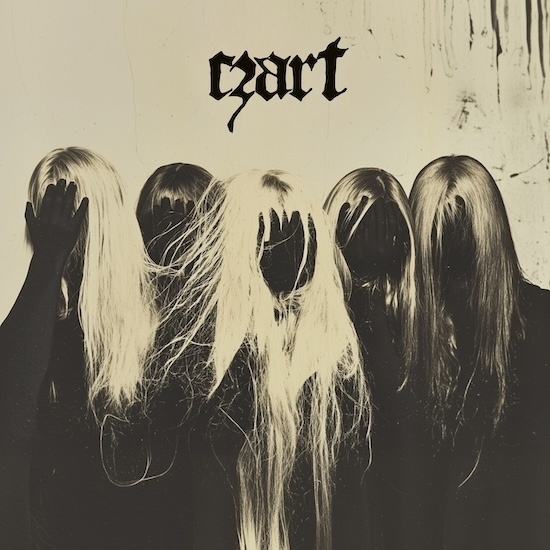
(Not long ago code666 released a concept album by the Polish band Czart that’s rooted in medieval Polish demonology. It attracted the attention of our Comrade Aleks, who succeeded in conducting the following extremely interesting (and undoubtedly controversial) interview with Czart founder Michał Chrościelewski.)
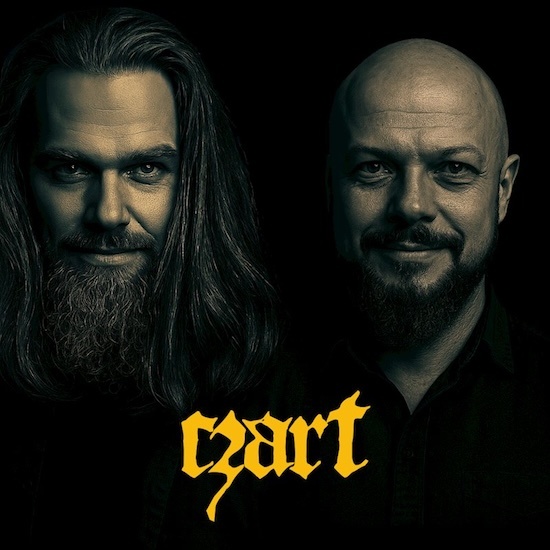
On October 17th code666 presented a debut album Czarty Polskie by the Polish project Czart. The project’s crew is Michał Chrościelewski (probably guitars and something else), Paweł Smarkusz (drums), and Monika (vocals/keyboards), but I’m not sure, as the album and all videos to its songs were made with the help of IA.
Yes, it’s one of Czart’s cornerstones, and it’s ironic as Czart (or “tchort”) means a minor demon in Slavic tradition, and the entire album is based on Czary i czarty polskie oraz wypisy czarnoksięskie (“Polish Witchcraft and Devils, with Sorcery Excerpts”), “a 1924 book by renowned Polish writer Julian Tuwim”. And besides that, Czart is an “audio-visual” project, and almost each track has its own video, and you need to see them first before you judge. Who would use cutting-edge technologies to transfer an atmosphere of ancient deviltry and folklore? Yet here we go.
You see, what a contradiction we meet in starting a talk about Czart? This interview (a damn worthwhile reading thing) shows a deep artistic philosophy behind Czarty Polskie, an album you will talk about even to your colleagues at work.
Hi Michał! How are you? What’s new on your side?
Hello! Thank you, everything is going great for us. On 17 October, thanks to our label code666/Aural Music, our debut album entitled Czarty polskie premiered, and we are very excited about the positive reception and interest from people who like what we do. We are constantly creating both music and music videos, but for now we are enjoying the release of our album and the energy we are receiving from our fans.
Can you tell about your musical background? Where did you play before Czart?
CZART was born out of a long-standing musical friendship and shared roots in Poland’s north-eastern region Suwalszczyzna (Suwalki Gap).
Drummer Paweł Smarkusz began his journey in the 1990s, co-founding the technical death-metal act Crusade in Suwałki and recording early demos in the same Gdynia studio where Behemoth made their debut. He and CRUSADE in 1993 recorded an album entitled Voyager which was published in Poland via Morbid Noizz Productions in 1995. Guitarist and composer Michał Chrościelewski entered the scene in the mid-1990s with his project Mucus, creating a home-produced demo tape praised in Thrash’em All magazine. The two met in 1996 and soon formed Lede.
In 2001 Paweł joined Monika’s acoustic rock band Poza Ciszą, which recorded two albums containing, among others, Monika’s original compositions, vocals, and guitar playing. That’s when we all met.
Around 2003, Michał and Monika started to record post-rock alternative music together as Seledyn (with Michał on guitars and Monika on vocals). Seledyn recorded „Zimy” and Paweł concentrated on Nook, with whom he was active for the next 10 years, recording the album The Stand in 2010. Nook’s second album was recorded in 2018 but released only in 2025. All three of us have managed to combine our artistic projects with our full-time jobs. Post-rock ventures such as Poza Ciszą, Nook, and especially Seledyn marked a turn toward more cinematic, atmospheric forms of expression. Paweł joined Seledyn after 2014 and the band rehearsed extensively since then. Monika has also continued formal musical education in classical and jazz piano, and vocal training.
The idea of CZART was born in 2024. It was inspired by Michał’s discovery of Julian Tuwim’s book about Polish witchcraft and devils. Drawing on centuries-old Polish folklore and demonology, the band transforms these myths into dark, poetic soundscapes that bridge the past and the modern age. Musically, CZART emerged naturally from a long creative evolution — fusing Paweł’s early death-metal precision with Michał’s experimental, visual approach to composition. Later Monika was invited to join this musical journey. We decided to give the “demons” new life in a modern form — fusing the heavy sounds of death metal with electronics and ambient, intertwining live instruments with samples and effects created using AI tools.
What were your key ideas regarding the project’s sound when you started it?
When we began working on Czarty Polskie, we set ourselves several artistic and conceptual goals. Artistically, we wanted to create a union of sound and image — a complete work that would be more than just a collection of songs. We aimed to record a diverse album, showing different shades of metal — from aggression and brutality to lyrical and even surprising moments — yet still unified by a consistent atmosphere. The key goal was to weave the music together with its visual layer.
We decided that every track should have its own music video, so that sound and image would create one immersive experience. What’s interesting, 100 years ago, in his book, Julian Tuwim described how devils, although formless, could mold bodies from air and earthly vapors, and speak in an “artificial language”. This poetic idea inspired the use of modern AI tools in the creative process behind both the music and the videos. That’s also where the idea for the band’s name came from. We decided to conduct an experiment.
What AI added, both musically and visually, was a certain unpredictability, which in turn inspired further steps. At the same time, we wanted to preserve a sense of poetic folk mystery; hence the inclusion of archaic Polish quotations from Julian Tuwim, which add authenticity and atmosphere.
Your music is a mix of death, doom, industrial metal, jazz, post metal, and sludge. How difficult was it to combine everything together?
The key goal was to weave the music together with its visual layer. We decided that every track should have its own music video, so that sound and image would create one immersive experience. Basically, everything we listened to since the ’90s had an influence on our songs, primarily death metal, but not only – also rock, sludge, ambient, jazz. The music influenced the imagery and the imagery influenced the sound. Visual chaos suited brutal death metal, emphasising its abstract energy, while more lyrical music required different images and styles.
How much time did it take to compose and complete Czarty Polskie? What were the hardest stages of this recording?
This is a difficult and at the same time easy question. We managed to prepare everything within eight months, but many of the musical ideas we used had been created much earlier. Music was our hobby in our free time outside of work. In fact, the biggest challenge was finding the time to create. Once we had the time, the remaining technical obstacles were not that significant. It is natural that nothing goes smoothly all the time, but what is important is the determination to see your ideas through to completion.
Well, the official press release states that your album is an exploration of ancient and modern demons. First of all, how do you explain this exploration? What’s the point of this act?
Czarty polskie is a concept album rooted in medieval Polish demonology. It explores horror as a holistic phenomenon — unfolding across both music and imagery. The narrative draws from ancient beliefs that attributed evil deeds and misfortunes not to humans, but to demonic forces, serving as a way to rationalize human wrongdoing. In Slavic belief, a czart is a demon of evil, in Christian belief, it is the devil. With use of AI generated growling vocals the unknown and unreal suddenly became visible and audible, and so our vision was born.
Conceptually, the album was meant to carry a clear message. We are interested in medieval demonology not as a fascination with evil, but as a metaphor. In the past, people often explained misfortune and wrongdoing through supernatural forces, escaping personal responsibility. We wanted to reverse that idea — to emphasize that the source of evil is often human: our choices, our weakness. Our lyrics criticize the tendency to blame “devils” for our own actions. We see many similarities to how people used to fear the unknown, calling various bad things that happened to them the work of the devil. AI today is also unknown and controversial. AI tools used in CZART give the project a similar meaning as something to be feared or despised.
And the second, what are the modern demons? How do you differ them from the ancient ones?
There’s a fascinating linguistic twist: in computing, a “daemon” is a background process that runs without direct human interaction. These daemons operate continuously, silently managing tasks. While benign in intent, the metaphor of a daemon reinforces the sense that autonomous agents are managing our digital lives, often without our knowledge — resonating with the idea of “demonic forces” shaping our world from behind the curtain. In theology and literature, demons often operate behind the veil, influencing events indirectly or from the shadows. Similarly, in the cloud era, massive data infrastructures and machine learning algorithms operate invisibly, collecting, processing and acting upon data without human oversight or full comprehension.
The demon, in the digital age, is less a literal being and more a conceptual tool, a way to talk about power without accountability, automation without transparency, and knowledge without wisdom. It helps us confront the alien logic of the systems we’ve created, which often exceed our understanding and control, much like the demons of old.
Earlier you said “that the source of evil is often human”, but when you take a look around and witness the madness happening all over the globe… It’s totally absurd, it’s inhuman. And it’s easy to believe in demons, or a new world order, or an anti-human conspiracy. Although… I have a quote of Russian writer Pelevin, I think that we can use it for any country and any nation, but here’s the original one: “Anti-Russian conspiracy exists, there’s no doubt. The only problem is that almost the entire adult population of the country is involved”. So, after all, what is your understanding of demon? Is it just a reflection of human nature clad into poetic form?
Yes, the source of evil lies within humans. For example, politicians who make decisions that can be considered inhumane because they cause harm to other people, animals, or the environment. Pursuing one’s own interests, whether by global corporations or governments driven by economic gain or corruption affects everyone. It is the few who shape the world we live in. No matter how they justify their decisions, those choices impact countless lives.
We have never had such access to knowledge as we do today. Thanks to the internet, one can read about virtually anything and there are many who believe they possess universal truth or conspiracy theories that “expose” certain matters. I think people often look at what’s happening in the world and search for explanations or excuses in such theories. But in the end, it all comes down to human decisions and the consequences that follow.
So you based the album upon Czary i czarty polskie oraz wypisy czarnoksięskie (“Polish Witchcraft and Devils, with Sorcery Excerpts”), a 1924 book by renowned Polish writer Julian Tuwim. Do you believe it’s true? Did you ever witness signs of the world beyond in your own life?
The lyrics incorporate authentic excerpts from Czary i czarty polskie oraz Wypisy czarnoksięskie (“Polish Witchcraft and Devils, with Sorcery Excerpts”), a 1924 book by renowned Polish writer Julian Tuwim. His book is a treasure trove of old Polish texts, poems about devils, witches, superstitions, and the trials of women accused of witchcraft. I have only experienced the workings of nature; I do not believe in evil or good spirits. I believe that how we act depends only on us and our knowledge of the world.
You integrated AI into your music and video, and you don’t hide it. How much of it is in this album? How do you justify it as metal music clings to its traditions most of the time?
We have been playing together for many years. We used our riffs and recorded drum parts to develop them using AI tools. Then we cut, re-recorded, and assembled them in DAW. We generated all the male vocal parts by creating a voice that never existed. Czartificial. Monika sang the female parts. We consciously decided not to record in a studio, accepting poorer sound quality – just as we did in the 1990s when recording demo tapes on whatever equipment we had at hand. However, the difference is enormous, because today’s computers can do much more than they could 30 years ago. We remember programming drum tracks in Fast Tracker on a Soundblaster card on a PC and sampling guitar parts straight from magnetophone tape. Music, like everything else around us, evolves.
AI is a new tool, offering new possibilities. However, people are the most important factor. It is up to them how they use these tools. If art evokes emotions, it means it works. If we were concerned about tradition, we would not use computers, and we could list other things that did not exist in the past. It does not make sense. Besides, today everyone can find exactly what they like, created in different ways. If someone likes our music, that’s great, if not, no problem. There is a whole catalogue of music recorded in the 1970s or 1980s – you can stay with it and shut yourself away in the time capsule that suits you best.
Did you get some straight subjective critics of Czart because of using AI? And did the label ask you to change or improve some aspects of the album?
At the beginning, we ourselves discussed the topic of AI. Do the models rely on “stolen” works of other artists? Or do they simply generate random variations of different sounds? There’s no clear answer to that. Art has always drawn inspiration from its predecessors. Some musicians have long copied the style of others, even using the same chords. 97% of our YouTube audience responds positively to our videos, while 3% express criticism because of our use of AI.
Following a suggestion from Emiliano, the label’s head, we changed one song due to lower sound quality. Apart from that, we had complete artistic freedom. We consciously accepted a lower recording quality than what we could have achieved in a professional studio. It was an experiment and one from which we’ve drawn constructive lessons. You’ll be able to hear the results on our second album.
How do you connect both concepts of AI and demonic entities? Are they identical to some point? Are both evil? Are both hostile to human?
Our narrative draws from ancient beliefs that attributed evil deeds and misfortunes not to humans, but to demonic forces, serving as a way to rationalize human wrongdoing.
Additionally, the explanation of the world’s workings in many cultures – particularly the attribution of various human behaviors to “divine will” – diminishes personal responsibility and weakens independent thought. Old beliefs often stemmed from a lack of knowledge and gave space for imagination. Hence the personification of evil and the mysteries surrounding it.
Our music deals with heavy, intense subjects: demonic forces, human sins, violence, fear. It would be easy to fall into excessive solemnity or metal cliché, but we deliberately add irony and absurd humor to balance the darkness. In our videos, horror coexists with absurdity and dark comedy. For instance, our goat-like character “Czart” sometimes acts less as a terrifying demon and more as an oddly charming, slightly comical ally of the innocent. Playing with the convention — reversing traditional roles of good and evil — allows us to show that even in the world of demons, there’s room for irony.
Through that lens, we remind people that fear often lives in our imagination — and that the unfamiliar isn’t necessarily evil. AI tools, like everything else, can be used to do good or bad. The decision to harm someone is made by a human being, not the devil.
It seems that usual side of Czart is important for you too. What kind of ideas did you seek to transfer through your videos?
The most important thing was creation without a specific ideology; art should be open to interpretation by listeners, as everyone perceives it differently. We wanted to preserve a sense of poetic folk mystery; hence the inclusion of archaic Polish quotations from Julian Tuwim, which add authenticity and atmosphere. Music is also entertainment, positive energy and humour – I think these elements are clearly evident in our music videos.
You said that you aim to prepare more videos? How many do you aim to prepare? Don’t you fear that it will be too much to digest? Although I remember that Metallica and probably Megadeth made videos for every song of their up-to-date albums, and that wasn’t fun at all.
The album contains 16 songs — and there will be 16 music videos as well. That was our plan from the very beginning. Czarty Polskie is an audiovisual project. It doesn’t have to appeal to everyone.
“Czarcie lamenty”, “Czart rogat”, “Księga grzechów”, “Peregrynacja dziadowska” and other videos – how did you work on them? What kind of references did you put into AI service?
I’m not inclined to reveal the details for two reasons. First, it was a complex process that involved many tools available at the time. It wasn’t a simple prompt, as some might think, anyone can try for themselves and see if they can create something similar. Second, I believe what truly matters is the final result. Breaking everything down into technical details just kills the vibe.
Agree! What are your further plans for Czart in forthcoming future?
Looking ahead, we see CZART as a constantly evolving organism. It began as an experimental studio project, but it may one day step out of the shadows of the screen and bring its spectacle to the stage. When Monika (vocals/keyboards) joined the band, it gave us new power — she brought in her own sensitivity and perspective from outside the metal world. Artistically, CZART remains rooted in dark, atmospheric metal, but we don’t want to limit ourselves to one genre box. Our imagination keeps leading us to new, wild ideas.
We’re also considering exploring other media — for instance, whether CZART could exist as a short film or an art installation. One thing is certain: the concept of spreading light through darkness will remain unchanged.
How do you see the act of spreading light through darkness in the context of your music? I suppose that most of people will see Czart as an entertainment, although this interview proves this large artistic concept behind the project.
Of course, it’s primarily about entertainment. When we speak of “light in the darkness,” we mean simple kindness toward others. Today, human relationships often lack basic gestures of empathy. Hatred is being fueled like in ancient tribal wars. Fuck hate.
Thanks for the interview Michal! It was an interesting discussion, and it’s good to see a project with such a concept behind it. Even though I’m not sure how to deal with AI involvement into metal yet. However, any final word for our readers?
Thank you so much for the interview 🙂 Metal thrived long before the age of AI, and it will continue to thrive in the future. AI is just a tool. The ability to play real instruments will always remain the most important thing. Be kind to yourselves and to others. Greetings from us all!
www.facebook.com/czartmusic
www.youtube.com/@CZVRT