
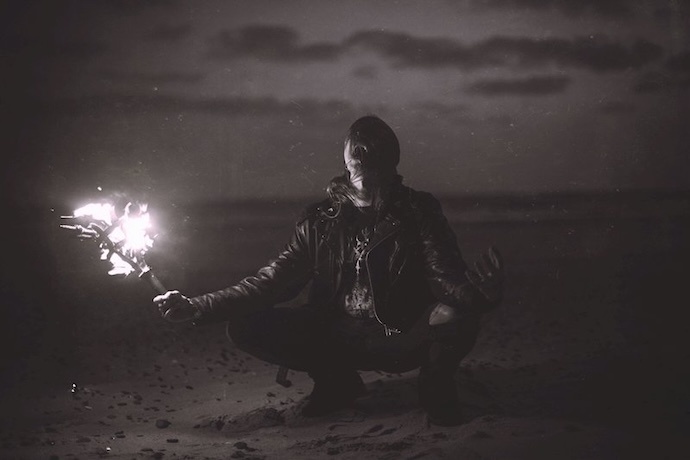
photo by Naya Buch
(In October of this year the Eisenwald label released a new album (Fællesskab) by the Danish black metal band Afsky, and that led our Comrade Aleks to reach out for an interview with Ole Pedersen Luk, which we present today.)
Arguably the most promising black metal entity in the Danish realm, Afsky still exists as a solo project, although its founder, Ole Pedersen Luk, toured with guest musicians in the fall of 2025 to support the release of his fourth full-length Fællesskab. While Afsky’s previous albums have displayed Ole’s interest in ancient literature and history in general, in his new songs Ole offers a critical assessment of modern society, going somewhat beyond banal misanthropy.
However, Ole has, again, framed his views on society in a universal format. The six tracks on Fællesskab are written in the spirit of harsh yet melodic black metal, with an extremely focused and intense delivery. This unique poetic perception of reality, coupled with perfectionism and, to some extent, a talent for storytelling, allowed Ole to articulate his ideas into a coherent artistic narrative.
At first, it seems like piercing vocals, signature black metal tremolos, and high-speed riffs leave little room for stylistic variation, and yet ghostly folk motifs flit by like shadows across a couple of tracks, and although all these features could be met in different proportions in a few up-to-date black metal albums, Ole managed to keep his original vision of black metal as it is. Due to the tour’s schedule it wasn’t that easy, but finally here it is – an interview with Ole himself.
Hi Ole! How are you? How did Afsky’s tour go?
Hi No Clean Singing! Thanks, I think it went as it should. It was the first time Afsky had a light tech, a sound tech, and someone to sell merchandise with us. It costs extra on all fronts, but it was definitely worth the investment. Usually I handle merchandise myself, and I actually really like it because of the contact with listeners/followers (I hate using the word “fans”). This time there was room in a different way to talk with people, and the others and I are usually also mostly found among the audience, especially after the show. I think I can safely say we all enjoy that. Not just standing on a stage. We are also fans of bands ourselves and like to party and be around people, and with that in mind I myself had much more time for that on this tour. So that was great. And people are generally just kind everywhere we go, and the response is usually good as well, so what’s not to like!
You founded Afsky as your solo project, and yet you strike to perform your music alive. What drives you to do it this way?
I feel like I’ve told this story many times, but briefly, I found some musicians because I was encouraged to be able to play a show a friend was organizing. That’s how it started. I also love being on stage and pouring my soul out in front of people, so I think it’s quite natural. When I started Afsky I had another band and got my need to play live fulfilled through that, so in the beginning it wasn’t important for me to get Afsky onto stages. But it didn’t actually take very long before we played live with Afsky. I believe that at the first show we only played the EP because Sorg hadn’t been released yet.
As I understand, your live crew partly consists of your colleagues from Heltekvad. Who are other guys? How difficult was it to gather a full lineup for live sets?
Yes, Simon Skotte, who also plays in Sunken, and I wrote the songs for Heltekvad during a week he visited before a show. Simon Frenning (Morild), who was also in Afsky’s live lineup back then, recorded the drums. Jonas Faghtman (Sunken, Gennem Taagen), who has also been part of Afsky’s live lineup, then played bass at the two shows we ended up playing live with Heltekvad. We had a couple of Afsky shows back then where we played Heltekvad as an encore. So it wasn’t that difficult, since all four of us were already playing in Afsky. Now only Simon Skotte is still playing live with us. So it’s much harder now, and that’s also why we haven’t played with it for a long time. But Heltekvad is not done for us. There will be more… one day.
Didn’t you think to turn Afsky into a band with a full lineup then? Would it be easier to deal with some of its aspects like gigs, etc.?
That is exactly what would kill my own spark. Because of previous projects and always having to compromise and agree with others, I started Afsky in the first place. I needed a project with a clear vision and style where I didn’t have to watch good ideas being taken apart again and again because everyone had to have something to say. Therefore I do sometimes miss making music with others — and it does happen — that was partly what became Heltekvad. When we’re out playing with Afsky, we function as a band; people have their opinions and offer input for optimization and improvement, everyone helps, and we do things as a unit. It’s just me who has delivered the music.
photo by C.Luk
Ole, your first band was Yea and the Moon back in 2002, and then it seems like you took a really long break. What didn’t work with that band? And what made you return to recording black metal stuff?
Haha, I think this is the first time I’ve been asked about Yea and the Moon in an Afsky context. In many ways that’s where it all started for me. Three teenagers in a rehearsal room with a bar right next door that had draft beer for 1 D-mark every Tuesday and Thursday. We basically lived in the rehearsal room from Tuesday to Saturday (minus Wednesday) every week.
We had zero formal training on our instruments and taught ourselves and each other everything. I played drums and sang in the band. I would rather have played guitar, but of the three of us I was the best on drums, so that became my role. I was probably also the one most ready to go wild on vocals, so that became me too. We wanted to play metal, but we ended up playing punk. We didn’t know better. I remember thinking it was crazy when one of the others showed that he had learned palm-muting haha. I remember thinking: fuck yeah, now we’ve cracked the code to metal.
It was fun times, but long before I started playing in a more serious way. Yea and the Moon — which is a line from the movie Bad Taste — existed from around 2002 to 2004, it ended when we all moved away from home and out of town. The first Afsky songs were written in 2014–15, so many years after that. I think we added the band to Metal Archives ourselves back then because we thought it was funny to appear among “real” metal bands. But we did play a few shows. Luckily it was before everyone had a camera in their pocket.
Metal-Archives defines the Afsky’s lyrical themes as “Death, Despair, Danish history”, how close is that to the truth?
It wasn’t me who filled anything in about Afsky on Metal Archives. I think someone from abroad added the “Danish history” part. I’ve used old Danish poems on one album, but even that album isn’t really about Danish history. The lyrics are a piece of Danish history, but the rest is misleading. I write lyrics about life, personal thoughts and experiences, about a world in decay that doesn’t seem to heal. If anyone reading this interview has access to Metal Archives, they are more than welcome to change it. But it’s not something I care much about.
And how much of these themes are in your new album Fællesskab?
I think I’d encourage people to read the lyrics themselves and form their own opinion. Overall, the album is about existing in the world and about standing alone because I don’t always feel I belong in certain groups. And I’m perfectly fine with that. I felt like that even as a child. Sometimes I thought maybe I was the “wrong” one, but already back then I probably had a belief in myself and my own values, and therefore I rested more in myself than my friends did, who were busy trying to belong to a group/community. And don’t get me wrong — I was also part of different groups — but I never really felt like I belonged. I always felt like a bit of an outsider. Later I learned that this was okay, and that it had value in itself not to need others’ acceptance to feel worth.
How do the new songs’ lyrics complement the album’s artwork? Do you see each of Afsky’s albums as a complex piece of art completed with music, lyrics, and the artwork?
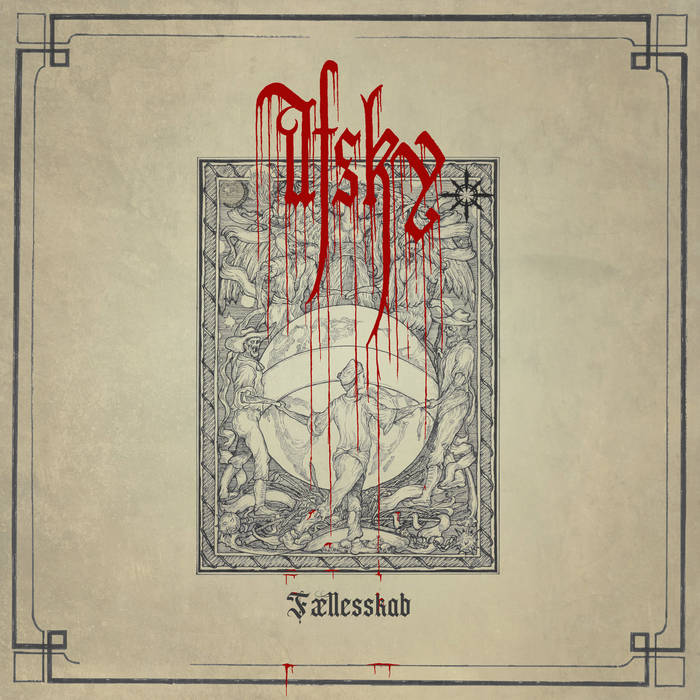
The image I used is a working-class illustration from 1889, Solidarity of Labour. A call for the world’s workers to unite and stand together in solidarity.
I had the image redrawn so the workers’ symbols were extended with weapons as a symbol of how the world’s nations mostly fight each other, and the people were given a more corrupted appearance to show the falseness of mankind. Humanity is for sale, and the worse the state of our world becomes, the more people are for sale.
The lyrics deal with various groups that pride themselves on being communities. But in a world where it’s soon everyone against everyone, I often see these communities more as a way of suppressing others in order to strengthen unity among those who are also against a multitude of things. It is never about cultivating what is good and healthy. And yes, I’m proud of all the releases I’ve made, and there is definitely a lot of thought put into the idea that music, lyrics, and ultimately the artwork must stand as a unified whole.
What was your original vision of Fællesskab? What kind of goals did you set before yourself when you started to compose first tracks?
Both on Ofte jeg drømmer mig død, Om hundrede år, and Fællesskab I’ve had a vision from the beginning. That’s why on all three albums I started by writing the music while simultaneously writing all six lyrics at once. I like conceptual work where there is a clear red thread throughout the album. If there was a goal, then it was at least to write something I myself found exciting and to surpass myself musically. After many years of working with music, I have a series of formulas under my skin. But if I follow them to the letter, it would bore me, so I always try to avoid falling into my own traps when I write music.
Your two previous albums Ofte jeg drømmer mig død (2020) and Om hundrede år (2023) got a good portion of positive reviews and recognition. How do you see their strengths? What did people usually note in these recordings?
People always tell me that I’m good at bringing out the melancholic and the sorrowful in my music. That’s of course something I consciously work on. I want people to get tears in their eyes when they hear my music. I make the music first and foremost for my own sake. It is my own pain and sorrow that becomes music. I think there are many people who feel my music speaks to them on a personal level. It is wonderful when my own emotions can be translated in that way.
Throughout my life, especially in my childhood, I listened a lot to classical music, which is also the genre most often used as film score, especially when very happy or very sad emotions need to be conveyed. Music supports emotion. So I think there is a clear connection between my own feelings, the inspiration from classical music, and the fact that it can be translated so that other people are drawn into my own universe.
photo by C.Luk
By the way, I found at Metal-Archives that you were born in Germany, so what attracts you in Danish history, which you seem to touch on in some of your songs?
I am a Danish citizen and was born in Sønderborg in Denmark.
Metal-Archives again! Okay, this year Afsky meets its tenth anniversary. Does it mean something for you? Do you feel that this project has grown its unique spirit and has bigger prospects to some degree?
Afsky has definitely grown in every way. It started as a side project, and I think there was a certain humility and respect toward my other band at the time that made me not just kick the door in with Afsky. I also didn’t have the need for that. I didn’t want to go solo — I just needed an outlet for the ideas I was carrying around. Over time Afsky grew bigger anyway, and there were many things I liked better about Afsky. So during a period when we were working on what became the last album released with Solbrud, and the whole thing also felt exhausting, I chose to pull the plug. I finished writing my part for the album and left the band. The others found another singer and guitarist and continued a bit longer, but the spark wasn’t really there anymore. So it was in every way the right decision to go my own way.