
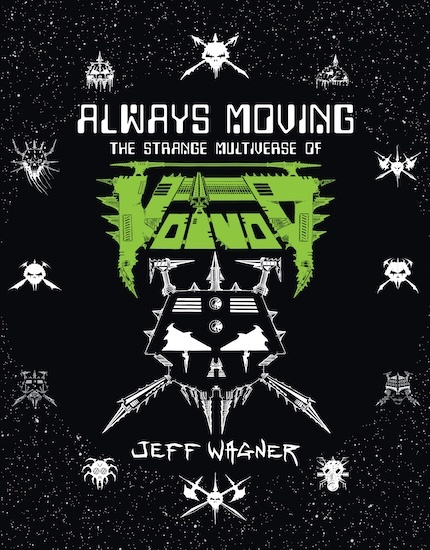
(Today we present Comrade Aleks’ excellent interview with veteran metal author Jeff Wagner, whose latest book — an extensive official biography of Voivod — is out now.)
Jeff Wagner is a writer and journalist who dedicated over 35 years of his career to the metal scene working with labels like Relapse, InsideOut, Century Media, and The End as well as being an editor of Metal Maniacs magazine. Besides that, Jeff is the author of Peter Steele’s biography Soul on Fire, an overview of 40 years of the progressive scene titled Mean Deviation, and Destination Onward, Fates Warning’s biography as well.
His new book is Always Moving – The Strange Multiverse of Voivod, a 540-pages-long journey into the realms of one of the ever-evolving and most exciting metal bands. Needless to say, no stone was left unturned during Jeff’s research, and he performed a great work reaching out to a lot of people connected with the band. More information on Jeff’s quest and his work ethics in the interview below.
Hi Jeff! How are you? What are you occupied with nowadays?
Hello, Aleks, and thanks for your interest! I’m right now signing Voivod books, running labels and stuffing envelopes for all preorder customers. The books arrived a few days ago and they look fantastic. On a personal level, we just moved again, our fourth move in a year (due to a house fire one year ago), and we finally feel stability and normality again, so… things are truly feeling hopeful again after the horror that visited us in late November 2024.
It’s sad to hear that the year was so turbulent for you, I hope that the next one will be calmer. How did you manage to find time to deal with the book when you were occupied with such a number of daily things?
Thank you. It’s been a little over a year and as I write, things are just calming down this week, a kind of stabilization we haven’t felt since the tragedy. When the fire happened, the book was 95% completed. I had intended to send it to the printer within the first weeks of 2025. So, it took almost five months to even be able to get my head around the book work again, and once I did, it fell together fairly quickly. It felt cathartic, and it felt like a reminder that things would get back on track eventually.
It also provided a great distraction to the challenges we were facing at that time. I even added a new chapter, to document the symphonic shows Voivod were undertaking in 2025. So, thankfully, yeah, I had most of it completed before the fire happened.
Recently we did an interview with David Gehlke, and I asked him the very same question: do you have any specific journalistic or whatever education or did you start to write just in order to support the scene no matter how? How much time did it take before you started to feel yourself experienced and competent enough?
I went through the usual English composition and literature classes through public school and always enjoyed them more than most other subjects. In college I took a journalism class or two. But really, I’m certain I would have written about music had I never even taken a single class on that or related subjects. In fact, I remember as a teenager, I’d write my own reviews of various albums, simply because I wanted to get my thoughts down on paper and see how that felt, and see if I could capture my thoughts on an album in writing. I never even showed my friends these reviews, out of embarrassment, probably, but was always driven to express my love for music in that way. I eventually began contributing to fanzines, and then in 1992 created my own fanzine. From there, it was just something I tried to hone and improve with each endeavor.
How much time did it take before I started to feel experienced and competent? I’d say decades. Around late 1996, early 1997, when I did Relapse’s Resound magazine (first issue) and then got hired at Metal Maniacs magazine in NYC, that’s when my life became writing, in terms of getting paid for it and how much I did it. I wrote and wrote and wrote. Not always stuff I’m happy with now, but I don’t think I’ll ever be happy with anything I write. Not entirely. Because once I get something out there, and it’s public, if I go back and read it, all I see are things I could have done better, and I get very critical of myself.
But, having said that, I remain proudest of my four books and the Arcturus – Stars and Oblivion box set notes. I can find faults in all of them, but at least I feel like I’ve got a handle on writing, finally. It’s only been a few decades to reach that point of semi-satisfaction, ha.
You’ve written about metal since 1994, and you were lucky to turn your hobby into full-time work that helps to pay the bills. Does your interest towards metal-music remain as passionate as before despite the change of priorities, despite age and some daily stuff?
Technically, my first writing that appeared in print was in 1988, for Canada’s Anti-Poser fanzine. I also wrote for Sheet Metal (Minnesota) and Curious Goods (California) around that time, maybe a few others. But as you say, yeah, it was simply a hobby then, and only in January 1997 did I turn it into a bona fide career.
My passion for metal remains strong, it’s in my blood for life. I can’t say I follow the latest metal releases with the same kind of attention and obsession as I used to, but I also don’t think there’s as much exciting, interesting, engaging, truly creative stuff out there right now as there used to be. Sure, way more bands than ever, but quality-wise, I find very few that are amazing. But that bar is set VERY high by past bands and albums, isn’t it? As far as my passion for listening and interacting with music, whether it’s metal or other music I’m into, that remains extremely high!
Jeff, you’re known as a zealous supporter of the progressive metal scene: Mean Deviation: Four Decades of Progressive Heavy Metal, the Fates Warning biography, and now Voivod’s biography prove it well. How would you summarize the nature of this musical direction after all these years? Does progression have its limits?
As I stated in Mean Deviation, “progressive” is not a sound, but an approach, or an ideal. It’s not one thing. On the other side of the coin, not every band that mutates in sound is progressive. And progressive isn’t necessarily about musical talent, as much as it is about creativity and imagination. So, I can’t even consider “progressive metal” a “direction.” And no, I don’t think progression has its limits, because I don’t think truly creative, experimental, unique, original music has limits. It’s just that most musicians and bands either don’t want to go all the way out in the stratosphere to attempt to find that limit, or they just can’t because they lack that kind of insane creative talent/impulse.
At the same time, more traditional and extreme metal genres somehow find a way to be original and grow their own individualities nowadays. Someone broadens the horizons adding new instruments to their palette, someone mixes genres, and the scene escapes stagnation still. Is it the same way “progressive metal” evolves? And the scale of the phenomenon is the only difference then?
Any kind of music hopefully is malleable enough where freshness and new ideas can enter, and further the genre’s scope. You got it exactly right, I think, when you use the word “scale.” It really is all about scale, isn’t it? No one would ever mistake AC/DC for a progressive band, but you compare their first album, High Voltage, to their last album, Power Up, well… you can hear it’s the same band but you can also hear the growth and the effects time and age have had on their sound. Whereas a band like Voivod made the length of their leaps and mutations from one album to the next much faster. So yes, scale! Good one!

By the way, how did it happen that Peter Steele’s story appeared in the list of your books? This book is something the scene badly needed; it’s just a bit (just a bit) strange to see it in your bibliography.
Ah, I’m afraid I’ve been typecast again! I’m now known as this “progressive guy,” and yeah, while my interests often skew in those sorts of directions, I love a lot of music that’s not considered progressive. I love classic Kiss (and even some ‘80s Kiss). I love Motörhead. I love Bolt Thrower. And for me, Peter Steele is, if not a progressive musician, an extremely original one. Elements of Carnivore are eclectic, and certainly Type O Negative had a lot of eclecticism and experimentation and boundary-breaking sorts of ideas and aesthetics in their music.
So, I don’t think it’s even a bit strange to see it in my bibliography. Steele is a musician I’ve admired and followed since 1986, and since there wasn’t a book out there on him, and since I wanted to read a book on him, I went ahead and wrote one. Simple as that.
How difficult was it to write about a person who already left this world? He left a huge legacy as well as a good reputation, but I wonder if it was easy to find out all necessary connections and people to interview.
Honestly, it felt easier than writing on someone who’s still around and being creative, because the story of a life lived from birth to death is a complete circle, whereas the still-living artist, there’s kind of a dangling ending there, if you get what I mean. I felt I talked to a great variety of people close to Peter, from family, members of former bands Carnivore and Fallout, record label people who knew him, neighbors, and many others. While there’s always someone else out there that certainly would have also been good to speak with, at some point I had to close up shop and work with what I had, otherwise the work of assembling the voices becomes untenable and could threaten to thin out the other voices. It’s a similar approach as I took with the Voivod book. Once I had about 30 or 35 people lined up to speak to, I cut it off.
Creating a book is a huge, time-consuming endeavour. How did you know you were ready when you started work on Always Moving: The Strange Multiverse of Voivod? An ambitious task by default.
It was indeed ambitious, and it turned out to have the longest gestation period of any book I’ve written, and it’s also the longest book I’ve written. I was ready simply because I felt it was time the world had a Voivod book out there. Plus, I know the organization, both the guys and their manager, James, and I felt they’d respond positively when I approached them. And they did.
To answer the part about how I knew I was ready, I had left InsideOut (the prog rock label) in 2019, and had plans to write both the Fates Warning and Voivod books. I had the naïve idea that I could work on both at the same time, but eventually realized it’s insanely difficult to work on two books at once. And the Fates Warning book took on a life of its own earlier than the Voivod one did, so I followed that path and got that one out in 2022. It’s then that I really started serious work on the Voivod book again, but yeah, this book and its idea actually started in 2019. It’s finally out and I’m relieved it’s behind me and out there in the world now.
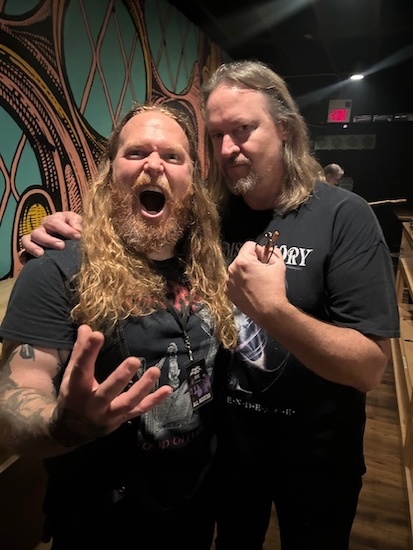
Patrick Crawford and Jeff Wagner
Martin Popoff wrote the book Worlds Away – Voivod and the Art of Michel Langevin, and he showed the band from a very specific angle as he made an emphasis on a visual side of Voivod. How did you reveal this theme of collaboration between the band and Langevin in Always Moving?
Yes, that was more of an Away art book, and it’s fantastic. For my book, it casts a far wider net, as it’s intended as a history of the band’s musical work, and of course all the stories and experiences and dramas that go along with it. But there are lots of visuals in Always Moving, and so Away’s artwork is all over the place in this book. It would be hard to write a proper Voivod book and NOT include a ton of Away’s artwork in it. And Away himself was very forthcoming with his art, providing a lot of stuff for me to use throughout the book’s pages. As a huge fan of his artwork, not to mention the music itself, it’s an honor for me to have worked with him closely on this project.
Away’s art is truly remarkable, and it radiates this unique hostile vibe. So, yes, it’s impossible to imagine a book about Voivod without a section dedicated to it. However, did you discuss with the band a chance to release a book alongside some new or relatively rare audio materials? Is it a good idea? Actually, I don’t remember books of that kind.
No, I wasn’t interested in doing something that would involve multimedia. I really love the book as a physical art form, as a standalone item, something to place on the shelf. It’s one of the reasons I don’t really care for doing my books as eBooks, although it has happened and I may eventually do it with Always Moving. There’s also the issue of publishing rights when you involve music, and that’s something I have no interest in dealing with. I know what it takes, and it’s a lot of boring legwork. Not worth it, in my opinion.
Voivod’s approach to their art was perfect from a creative standpoint: Besides distinctive music and visuals, they managed to keep their lyrical concept in their own original way. How do you value this side of the band? And did you spend a special place for that in the book?
I absolutely love Voivod’s lyrics. That’s mostly credited to Snake, but of course the themes have sometimes come from Away too. But yeah, so many, soooo many great lyrics in the Voivod discography. And I do focus a bit on lyrics as the book moves along covering their various albums and songs. Some of them I highlight in the text, because I feel they’re special enough, or relevant to the story, so yes, the lyrical aspect is something I touch on often in this book.
Making a book about bands of such scale always causes the same question: how to get in contact and receive proper objective comments from all people involved in the band and the business around it through its entire history. Do you feel that you succeeded in this task? Was this part of your work a stressful one?
The band made it very easy for me, granting me access to every living member, and also people around their sphere who I may not have had any contact with yet. The only member who refused to talk to me was Blacky, and I suppose if anyone knows anything about him and the unfortunate rift that he and the rest of the members share, then that won’t come as a surprise.
But yeah, access was pretty easy, as I’d worked with Voivod before on a number of levels, whether it was as a journalist doing interviews with them for fanzine/magazine stories, or being hired to write a few record label bios for various albums, and just being around the music “business” that they’re in. So, they’ve come to understand I’m a rabid fan of their band who also happens to write books. And as for other talking heads in the book, I reached out to members of Opeth, Cynic, Virus, Therion, The Accused, Enslaved, Deceased and others, and everyone was really happy to talk to me about Voivod, as these guys, and others, are all big fans. So I have a pretty well-rounded cast of characters who helped me tell the Voivod story.
Did you find enough space to throw a glimpse on the Voivod’s members’ side projects?
There are two Appendixes at the end of the book, and one of them is an expanded discography, which indeed includes the various Voivod members’ side projects.
Great idea! Jeff, how did Piggy’s family react to the writing of a book about the band? Did his relatives reach out? Were they willing to talk about his terrible illness and the final period of his life?
They seemed to be honored. The only family member I spoke to was Piggy’s sister, Christine, and she was wonderful, and seemed to speak for the whole family at times, so yeah, I’d say their response to this project has been a positive one.
By the way, what was most difficult thing regarding Always Moving?
Well, writing any book is a difficult task. But this one, I don’t really know why, it just took a long, long time to come together. And because nobody was breathing down my neck with a deadline, I had entire weeks when I wouldn’t work on it much, then I’d plunge back into it and work obsessively, and then pull back and not look at it very much, and it kept going back and forth like that for years. And then the fire of November 2024 delayed the book’s release by an entire year, because I was ready to finalize it just before that happened. That delay did allow me to add a final chapter, on their symphony shows of 2025, but yeah man, the most difficult thing for this book was how long the birth took. Although working on a book, it’s hard and intense, but I enjoy it very much.
Have you already received offers to publish the book in other languages? Did you expect that it will be a demanded work?
I haven’t, but I have received such offers with all my books, so I assume I’ll pursue one or two this time. Getting it into French would be a great idea, for obvious reasons.
How thoroughly does the book examine Eric Forrest’s car accident in Germany in 1998? Were witness statements from this incident presented? Is the legal proceedings against Voivod, which involved Eric’s insurance company, covered?
There’s an entire chapter devoted to this exact era, titled “The Coma Demos”. It focuses on the music the trio were writing at the time of the accident, and yes, there’s a lot of details revealed about how it actually went down with the insurance companies fighting, and all the rest of it. There are a couple grainy pictures of the van wreck, and also a picture of Eric in his hospital bed in Mannheim, Germany. So yeah, that part is covered thoroughly.
(As an aside, I want to let fans/readers know that I made a concerted effort to give each era/album the same amount of focus as the other ones. For instance, I’m not giving Dimension Hatross a big long chapter and then giving Negatron a short chapter. I give equal focus to each step in the band’s evolution.)
Were you able to spot if academic or metal music played the most crucial role in Voivod’s becoming? Can we imagine progressive metal without its background in classical music at all?
The huge stew of influences that inspires Voivod’s music through the years is covered thoroughly throughout the book. And indeed, Piggy and Blacky were especially into modern classical composers, and I even have Chewy commenting on where you can hear certain Stravinsky elements within certain songs. So yes, the melting pot of influences usually present in any progressive metal or rock band is certainly explored and referenced throughout this book.
Stravinsky! Exactly! Chewy mentioned him in his interviews. Do you dig into academic music yourself?
A little bit over the years. More often as research, as in the case with Voivod’s classical influences. But I’m not terribly into this kind of music, as a listener. I can appreciate it very much, but emotionally I’m usually not moved. And the way I listen and process the music that does move me, I probably approach it also as “academic music,” ha… but I know what you mean, of course.
You highlighted (in some of your interviews and in Mean Deviation as well) that almost in any metal genre we can find a band with a prog-approach to music they play. Can you say that there’s something that unites all progressive metal musicians? Can we put them in a different category in comparison with musicians who tend to hold onto more traditional ways of impressing themselves through music?
I may have answered this above, as I believe it’s about having a deep well of influences to draw from, a fertile imagination, and a will to explore new musical terrain. And I believe music should, to some degree, challenge the creator of the music and the listeners. And at the risk of upsetting someone out there, yes, we can definitely put these sorts of adventurous musicians in a different category than we can bands such as Sabaton, Unleashed, Amon Amarth, Powerwolf, and many others who seem to churn out the same album every time. There’s a place for that, and I’m not saying these bands aren’t good at what they do, but the mentality is totally different. It’s a “stick to your guns” mentality with these sorts of bands, whereas with progressive musicians, it’s more of a “melt the guns and use confounding psychic weapons” mentality instead.
I suppose that metal music’s popularity is declining year after year, and metal literature should be experiencing a decline as well. But the literature seems to be thriving like never before. We have the opportunity to read professionally written books about legendary bands like Voivod, Death, huge researches on topics like black metal or some domestic scene. And all of this has a bittersweet taste, as the books’ runs are low, and these bands will never gain the same level of popularity as they could twenty or thirty years ago. How do you feel about this? Have you come to terms with this state of affairs?
I don’t think metal’s popularity is declining at all. It seems really healthy from where I sit. Whether it’s a hunger for “legacy” bands playing entire classic albums at festivals, or celebrations like the Death to All touring unit, or the amount of new bands that are constantly releasing albums and touring, and the newer, younger generations who continue to delve into the old bands/albums, as well as the new stuff… it seems like it’s quite popular indeed. Of course, sales figures will never be what they used to be. That has changed for a variety of reasons that we’re all aware of.
And as to your point with books, it’s because the genre now has a solid history behind it that there are so many out now. In 1989, it would have been difficult to write books on most bands or the genre itself, because everything was still in the middle of its evolution, or deep within its first phases, and too new to really get a hindsight grasp of. But now, with 55 years behind it, metal music has a deep well of history to draw upon for the retelling via book projects.
I think it’s great that there are so many books out there, but, as you mention, it has also created a glut, or a surplus of choices. When metal books started coming out on a more regular basis, let’s say the late ‘90s, I could keep up with what was out there. But now, it’s impossible. I can’t read every single book I’m interested in, simply because I don’t read only music books, and I put way more emphasis on listening to music anyway, and that takes a lot of my time.
So… yes, it’s a wonderful thing that so many books are out there on this music, but it’s also causing a traffic jam where they’re competing against each other for the consumer’s money and attention. It’s a good problem, maybe?
It is! So why not stop on a positive note? Thanks for your time, Jeff, it’s much appreciated. However, is it too early to ask a question about your plans regarding a new book?
Having done my last three books myself, in every single aspect self-publishing, I’m a little worn out with all the extracurricular work involved. So I wasn’t planning on pursuing a book anytime soon. The four I’ve written are four I am very happy to have put out into the world. So I thought I’d take a break, or just stop altogether. However, I have been approached by two different musicians to help them with their own books, as a “ghost writer,” or an assistant, and both will be announced sometime in 2026, so I’m enjoying approaching music writing from that angle. It’s a different kind of role and challenge for me.
https://www.voivod.com/en/blog/38
Very cool interview. Was a big reader of Metal Maniacs back in the day and Jeff’s articles and reviews were some of the best and I would always check out whoever he recommended. Glad he’s still out there writing.