
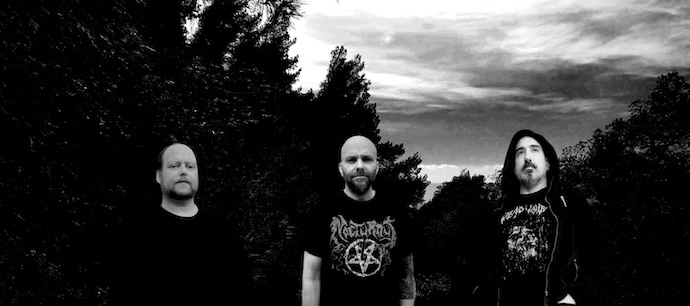
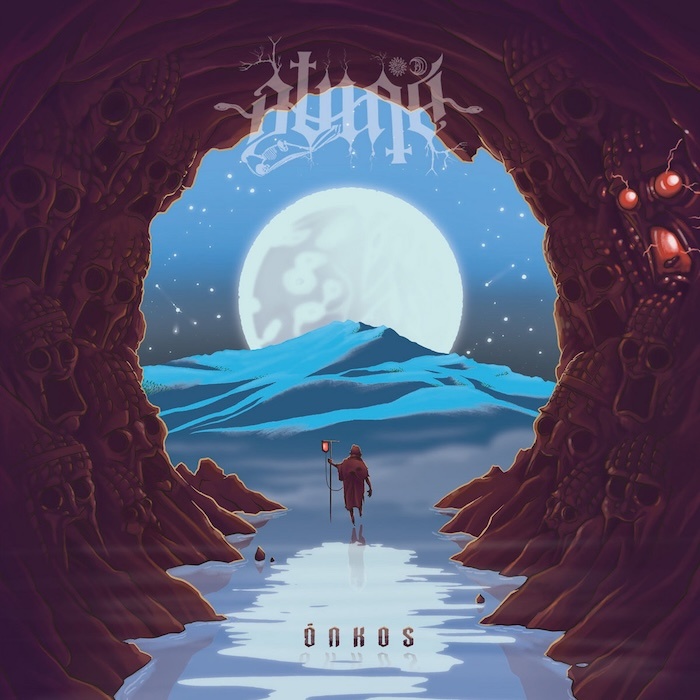
(We present Comrade Aleks’ interview of Ilia Rodriguez from the death metal band Binah — a very eloquent and moving discussion that focuses on Binah’s new album Ónkos, which was released last October by Osmose Productions.)
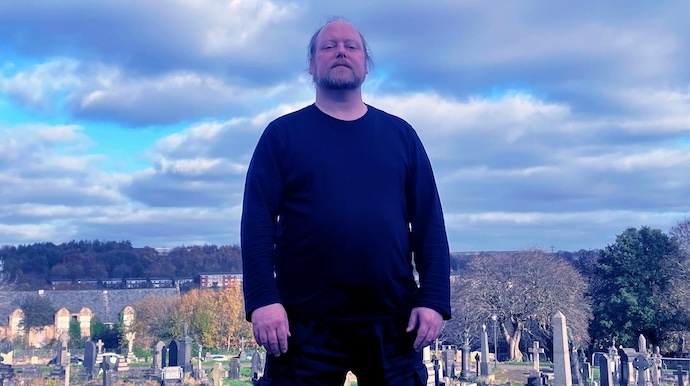
The underground champions Ilia Rodriguez (vocals, guitar, synthesizers) and Andrews McIvor (guitar, bass, synthesizers) have performed with numerous bands, but for 14 years now they’ve remained faithful to their joint brainchild, Binah. Rarely but effectively, they produce their technical death metal pieces, and Ónkos is the third full-length in Binah’s discography.
The duo recorded Ónkos with a guest-drummer – Dan Mullins, who’s involved in several other bands, notably Blasphemer and My Dying Bride. While Binah’s previous albums had a standard structure (intro, outro, eight tracks in between), the new work consists of two gargantuan tracks, “Mount Morphine” and “The After Evermath,” totaling 43 minutes. The songs vary from ambient intros to persistent and abstract death metal constructions and bulldozer riffs in death-doom vein.
This is an album with a real story behind it, and we’re going deep into it together with Ilia.
Hi Ilia! Thanks for your time! How are you doing?
Hey Aleks! Been a while since we last caught up, so “great” is the only acceptable answer.
Indeed, I barely remember when we did the previous interview. Maybe it was something related with Indesinence. So it could be ten years ago, no less. Meanwhile Binah’s Ónkos was released by Osmose on 31 October 2025. Did you play a release show? What has the band been up to since then?
Binah was created as a space to enjoy writing and recording music, while we were all busy with other active bands. As such, the band does not perform live. The sole exception was a 2014 show with Necros Christos, where timing, the promoter, and geographical proximity all aligned. With members now spread across Britain, Spain, and New Zealand, live performances are even less feasible today.
So you are located in UK, and what about the others?
I’m currently based in Spain, where I’ve been again since 2015. Dan lives in the UK, as does Anil. Andy also left in 2015, moving to New Zealand, where he now lives with his wife. He does however travel back to the UK once-yearly, which has allowed Code to maintain some recording and occasional live activity.
Your previous album Phobiate was released seven years ago, so what slowed down you and Andrew? How did you, as Binah, spend this period?
We were not fully inactive during all of this period: between 2018 and 2020 we worked on a three-song demo cassette, Amorte, released and distributed by ourselves, with material written during the Phobiate sessions but with their own sonic and thematic angle.
By 2022, the music for Ónkos had largely already been written and demoed. The recording and completion were delayed firstly due to our search for a drummer, and secondly due to some personal turmoil, including the cancer diagnosis and subsequent passing of my father.
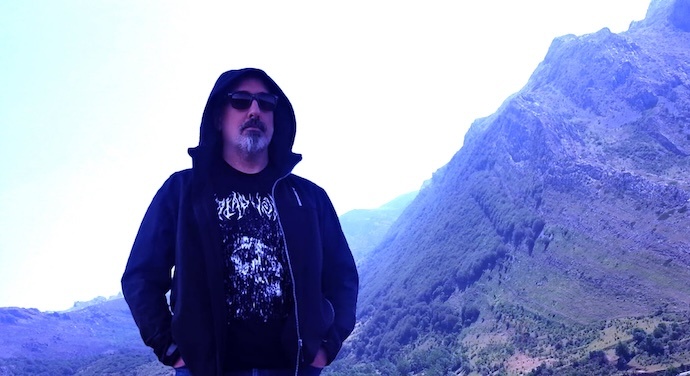
Accept my sincere condolences, Ilia, now it’s clear why the release was delayed. Taking into account the number of extreme metal releases people get on monthly basis, do you feel that it’s necessary to keep them informed about the band’s progress even when nothing happens on its side?
This largely comes down to personal perspective. We tend to avoid sharing updates unless there’s something genuinely relevant or interesting to communicate. Excessive over-sharing by some artists has always been a personal pet peeve, and at times has even detracted from my enjoyment of their music. Since Binah’s activity is effectively limited to releases, we’re generally restrained in how much we communicate, making a conscious effort not to overwhelm followers with unnecessary noise. For us, it has to remain about the music first and foremost.
What about your personal live activity? Do you play live nowadays with some other bands? Is there something attractive about this for you?
My first and only show with Necromaniac, back in 2016, was also the last time I performed live or spent time in a rehearsal room. I do miss it from time to time, though I don’t miss the amount of work and organization it sometimes took to make shows happen.
These days, the idea of going back to rehearsing doom or death metal doesn’t really appeal to me, but I’ve occasionally thought about joining a band in a very different musical space. That said, work, studies, and everyday life keep me busy enough that it’s not something I feel too much urgency about. Never say never, though.
For the first time you collaborated with Dan Mullins, who performs drums in a number of respectable bands. How did you manage to distract him from his tight schedule? Was it easy to get on the same wavelength?
This isn’t the first time the three of us have made noise together: we performed in 2008 as part of Code’s live lineup at Germany’s Festung in Bitterfeld, which was a hugely enjoyable experience both onstage and in terms of personal chemistry.
After Anil Carrier left the band, we explored other options before realizing the obvious choice had been in front of us all along. The three of us are similar in age and grew up in the same musical milieu, making it easy to connect creatively. Dan has truly excelled on this album, and the results speak for themselves. It’s worth noting that the Code live show ran flawlessly after just one rehearsal—a testament to Dan’s reliability and skill.
Ónkos is a concept album, so how did you come to this? How much of your own experience is in its story?
Ónkos is very much a case of art and life converging. While the music was ready by early 2022, I struggled to find a theme due to an intense period of loss and personal struggles. My father was diagnosed with kidney cancer and passed away on Christmas Eve 2023 after a long fight. In the months that followed, a family friend died, my father’s close friend succumbed to ALS, and my mother was diagnosed with melanoma, for which she is still undergoing treatment. Her partner also passed away last summer, weeks after being diagnosed with a brain tumor.
During this time, I felt surrounded by death and unable to write, despite the music being finished. I was reluctant to focus on illness or my own story, fearing it would feel predictable or exploitative, yet despite all efforts, no other inspiration came. Eventually, it became clear I had to fully commit to this path or abandon the material altogether. I realized that the universality of grief could form one of the album’s core themes, which led to the concept of ónkos in its broader Greek sense.
Once I accepted this, the blockage lifted: I finished all the lyrics in under a week and recorded the vocals alone in a single five-hour session.
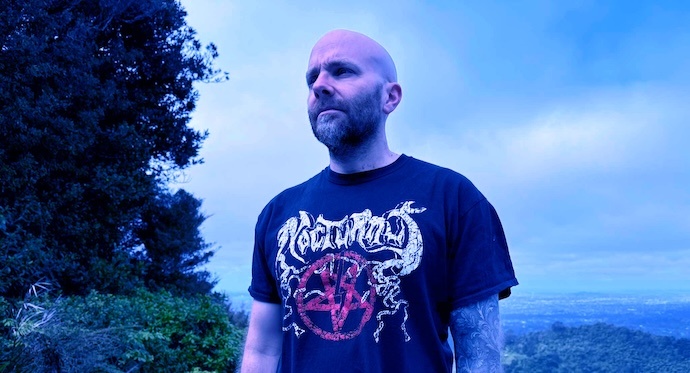
Do you feel now that you did everything right? I remember that Clouds’ first album has a similar concept, and I guess that it’s not the only other album of this sort. So I mean, it’s natural after all to channel your experience this way, maybe it even brings some relief in the end.
Loss, tragedy, and music often go together, and there are plenty of examples of artists working through grief this way. Even then, I struggled with whether I was doing the right thing. I felt relatively at peace with my father’s death in some ways, and I’m grateful that I was able to be with him at the end, difficult as that was. What troubled me more was the fear of misrepresenting his experience, and of doing so through death metal. While he was always supportive of my choices and proud that I was following my own path, metal wasn’t really something he connected with or would have chosen to listen to himself.
It took a lot of reflection before I accepted that centering the album on this experience was something I needed to do. A couple of records helped me come to terms with that decision. One was the reissue of Aphex Twin’s Selected Ambient Works II, which included new liner notes where Richard D. James talks about the death of his parents and how important they were to the original music. The other was Cotton Crown by The Tubs, whose cover features a photograph of songwriter Owen Williams being breast-fed in a graveyard by his mother, an artist who died by suicide. Owen later wrote a thoughtful piece about the challenges and risks of drawing on personal tragedy in art.
I wouldn’t compare myself to either of these artists, but seeing how they approached it helped me accept that this was a risk worth taking.
Ónkos is a multilayered and well-structured album; you travel from one theme to another, and all ideas complement each other. Why did you put it in two different tracks? Would it work as one complex piece?
The album was deliberately conceived with traditional double-sided analogue formats in mind, which made two pieces hovering around the 20-minute mark a natural choice. We ultimately see it as a single work, divided into two movements to accommodate both the physical medium and the narrative.
“Mount Morphine” chronicles the trajectory of cancer—diagnosis, treatment, illness, and death—from the perspective of the person undergoing it. “The After Evermath,” in contrast, focuses on the survivor left behind. Rather than following a neat, linear path of grief, it reflects a more erratic and unstable process: a psychological rollercoaster marked by periods of heaviness interrupted by sudden, often disorienting shifts in emotional state, at least as I have experienced it.
This distinction is mirrored in the structures of the two pieces. “Mount Morphine” unfolds in a largely chronological manner, while “The After Evermath” adopts a stream-of-consciousness approach to better convey the confusion and uncertainty of mourning. It is also largely through-composed, avoiding recurring motifs or verse-chorus frameworks, which further reinforces the unpredictability inherent in that experience.
How did you work on Ónkos regarding the album’s plot? Did you try to keep the tracks intense and vibe close to the lyrics? Did you set there a sequence of actions leading listeners from introduction and further to climax and denouement?
The music was written long before the lyrics, and it was almost serendipitous how closely the two ultimately aligned. The dynamics of the compositions naturally mirrored the experiences behind the words, often in very specific ways. On “The After Evermath,” for example, the line “…every voice of reason engulfed by the swarm” is followed by a riff that sonically evokes a swarm overtaking the vocal line. Likewise, the phrase “Depressogenic tapeworm hatched inside” is trailed by a guitar lead designed to convey what such an inner presence might feel like from within the host. Details like these appear throughout the album, as it was essential to fully immerse the listener in the narrative and place them at the centre of the experience.
The instrumental and ambient sections—including the electronically-driven openings and endings—are equally integral to the album and not mere mood pieces. While intros and outros have always mattered to us, this time these passages were conceived as fully integrated parts of the whole. They were a genuine collaborative effort, with Andy focusing on analogue modular synthesis, including layered Moog Matriarch parts, and myself contributing harmonic synths, choirs, field recordings, and samples.
A clear example is “Mount Morphine”: the opening choirs are layered recordings of my own imperfect clean voice, chosen to preserve emotional honesty in light of the lyrics to follow. By contrast, the closing section is designed to convey a moment of liminal, transcendental consciousness, and so features multiple sampled choirs fading in and out, including excerpts from State Ural Russian Folk Choir, a beautiful late-1950s recording I would recommend to anyone interested in Russian folk or choral music. This section also incorporates sound elements tied to my father’s life, such as trains, a bicycle, and, near the end, the sound of an old typewriter finishing a paragraph.
This is worth clarifying, as these sections have sometimes been described as mere atmospheric add-ons, which could not be further from the truth. While not everyone may enjoy them, they were never an afterthought. Every sound on a Binah album is intentional, reflecting musical influences that extend well beyond guitar-centric forms.
It’s great that you explained these ambient parts, because, honestly, I considered them just as regular intros and outros. Was it your intuition? How much time did you spend on these songs’ parts? Was it more difficult than to write the main body of the tracks?
We decided those parts were essential more or less at the same time as we settled on the idea of having two long-form tracks. They weren’t meant to function as simple intros, outros, or interludes, but as integral parts of the songs themselves.
Putting them together involved a balance between planning and intuition, along with a lot of back-and-forth, trial and error, and repeated listening in the context of the full tracks to make sure they genuinely served the overall narrative. Mixing was also a big part of the process, since every element needed to sit in exactly the right place.
I can’t really put a number on the time spent, but it certainly totalled many hours. We wouldn’t say it was easier or harder than writing the main sections—just a different way of approaching music and sound.
By the way, would this music work with other lyrics from your point of view? Could you or Andrew re-write all the lyrics for the same two tracks?
A fun aside: when we first began sketching ideas for the two songs—before things became, let’s say, more complicated—we briefly considered centering the album on space and galactic themes. The idea was quickly abandoned once I realized I couldn’t do it justice. While I have enough of an interest in astronomy, I felt I lacked the depth of knowledge needed to write about it convincingly. In hindsight, that was probably for the best. Releasing another two-song, space-themed death metal album shortly after Absolute Elsewhere would have been… awkward, to say the least.
What does extreme music mean for you nowadays? A necessary means of mental existence?
I consume all kinds of music, extreme or otherwise, and the older I get, the harder it is to define what “extreme” even means. Genres like death, grind, black, or doom metal were once clearly extreme, but over time that label feels diluted and commodified, especially when “extreme metal” is treated as a genre in itself. To me, intensity is relative: a song like The Psychedelic Furs’ “India” can feel as extreme as Dimmu Borgir’s “Raabjørn speiler Draugheimens skodde”, and artists past their sixties like Michael Gira or Scott Walker have created work darker and more punishing than much modern death metal, ours probably included. Music, like life, isn’t binary.
This question opens too many doors for someone like me. I simply love music—sometimes extreme, sometimes not at all. Sound fuels me and remains one of the main reasons I get up each day. I don’t know how much more music I have left in me as a creator, but I’m certain I’ll always keep listening.
What are your further plans regarding the band? Did you already think how to expand the ideas of Ónkos?
The over-saturation of death metal is undeniable, and we’re well aware that we’re not getting any younger either. At this point, there are realistically two paths forward: bringing Binah to a close, or making another release. There are still some uncertainties and hurdles to work through on a personal level, and if the latter proves possible, the creative direction is already clear to us. Without giving too much away, I can say the approach would once again be very different.
Thanks for the honest reply and for the interview as well, Ilia! It was good to talk about Binah, and I’m glad that you found time for that. Would you like to add a few more words for our readers?
Big thanks Aleks for reaching out and for making time to talk about Binah, much appreciated.
Life isn’t guaranteed, so do your best to live it fully and let go of bitterness when you can.
And thank you to anyone who connects with the record.
https://osmoseproductions-label.com/binah-onkos/
https://osmoseproductions.bandcamp.com/album/nkos
https://www.facebook.com/binahUKDM/