
(Today we present Comrade Aleks’ interview of the two members of the atmospheric black metal band Enterré Vivant, with a focus on their very interesting latest album released by the Antiq label.)
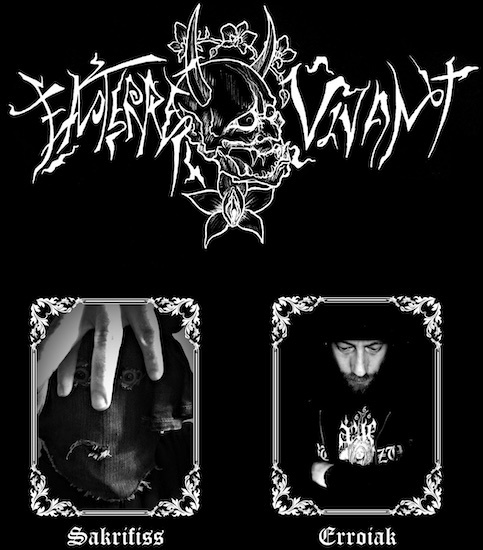
Akuzaï, the third album of Enterré Vivant, a duo of Erroaik and Sakrifiss, was released almost one year ago, and it’s still the most up-to-date album of this project which I didn’t totally skip yet failed to investigate properly during 2025. Being influenced by Summoning, Woods of Infinity, and Mystic Forest, this duo works remotely, as Erroaik locates in France, and Sakrifiss relocated to Japan over 25 years ago.
Enterré Vivant progresses coherently if we speak about the music, and Akuzaï delivers both depressive and atmospheric black metal with an authentic touch for sure, yet this time the projects also hooks with the plot behind ten new tracks. The album’s concept is centered around a Buddhist idea of ten sins and World War II, and one can barely connect one to another, so it was one of many points to organize in this interview.
******
Hi Erroaik! How are you? What’s new on your side?
ERROIAK: Hello to you and thank you for this interview! As for me, everything is going very well. I’m very busy with music at the moment, which is a very good thing because I always need to have something to compose or record!
What exactly are you doing now musically?
ERROIAK: I’m currently working on many things at the same time! I just finished recording vocals for the upcoming releases of my bands Hrad and Au Loin, and also bass and piano for other bands as a guest!
I’m now simultaneously composing and recording an album for my Black Metal project Erroiak and my dungeon synth project Udzaken. And I’m also working intensely on the next release from Enterré Vivant!
Your third album Akuzai was released in May 2025 — how do you see it many months after its release?
ERROIAK: Akuzaï was released nine months ago, and I’m very happy with the reception it received. To be honest, I don’t really remember seeing any negative feedback at all, so that truly feels great! I listen to it again from time to time and still enjoy hearing it just as much, so that’s definitely a good sign!
How would you compare Akuzaï and your previous works, music and lyrics wise? Do you feel comfortable with the current direction Enterré Vivant follows?
ERROIAK: Musically, I see it as a continuation of the previous album, Shigenso, but on a higher level in terms of composition and musical experimentation. I’m very proud of the work we both accomplished on this album! I really like the direction we’re taking: lyrically, Sakrifiss always comes up with themes that I find very interesting, with carefully crafted lyrics that are a real pleasure to sing. Musically, I keep evolving from one album to the next, I enjoy composing more and more, and above all, I truly love working on the arrangements!
The album’s concept is centered around a Buddhist idea of ten sins and World War II, an obvious connection for some, and quite specific for others. How do you bind both concepts together?
SAKRIFISS: Enterré Vivant has developed the habit of creating thematic albums, composing the number of tracks that matches each concept. For the EP Shiki, which dealt with the four seasons, we had four parts, and for Shigensô, which focused on the four elements – fire, wind, water, and earth – we also wrote four long tracks. In addition, we are a duo that seeks to build a bridge between Japanese culture and the West. For the album Akuzaï, we wanted to have more than just four tracks. So I made a list of topics I wanted to address, and I found that the ten sins according to one branch of Buddhism would be relevant. I thought that six regular tracks and four interludes would create a good balance for the album, so I started working on an introduction. That’s when I decided to use a Japanese imperial speech dating from the Second World War.
I realized that this war perfectly reflected all the sins I wanted to explore, especially since the Japanese experienced it differently. They too had to act immorally in order to survive, and then they also became victims with the atomic bombs. The sins – murder, lies, theft, and so on – and war are intimately connected and constantly influence one another.
But it’s hard to imagine that Unite 731 or the Nanjing Massacre were made in order to survive. At least in the original sense of the word. Did you touch such topics in your songs? Do they fit the album’s idea?
SAKRIFISS: I’m only interested in the population. There are no moments in this album where I portray Japan as a victim, but I make it clear that I’m talking about ordinary people. Those who are sent to war because of their own government, those who tried to survive after the bomb by protecting their belongings, sometimes even stealing from others… There is no “evil Japan” or “good Japan.” What matters are these populations we don’t talk about often enough, because we prefer to focus on the horrors committed by the military and orchestrated by governments. That’s what most films, documentaries, and history books are always about. But the daily lives of Japanese people during the war and in its aftermath? So rarely explored that I felt the need to take that perspective for this album. No matter who is responsible, what matters to me is the direct impact on ordinary people.
Enterré Vivant is a black metal band still, and sin is a common topic for this genre. How did you reveal it through the lyrics? Did this approach differ from teh more common metal view on it?
SAKRIFISS: Sin is probably a theme you often find in black metal, among many other recurring subjects, whether it’s nature, Tolkien, Satan, depression, or Vikings. I imagine it’s difficult to approach a truly rare theme. In any case, everyone has to choose a topic they feel comfortable speaking about. A lack of knowledge and a lack of sincerity become obvious very quickly when you write lyrics. It sounds false.
Here, I’m not speaking about the sins in a strict or abstract sense. Each composition bears the name of one of the ten sins, but the lyrics genuinely recount the reality of the war as it was experienced in Japan. You’ll find excerpts from letters written by kamikaze pilots who were forced to sacrifice themselves. Elsewhere, we portray civilians who were unable to help others in order to save themselves and who now live with remorse.
We didn’t need to think about what should be told in metal, because we simply had to report the reality of History.
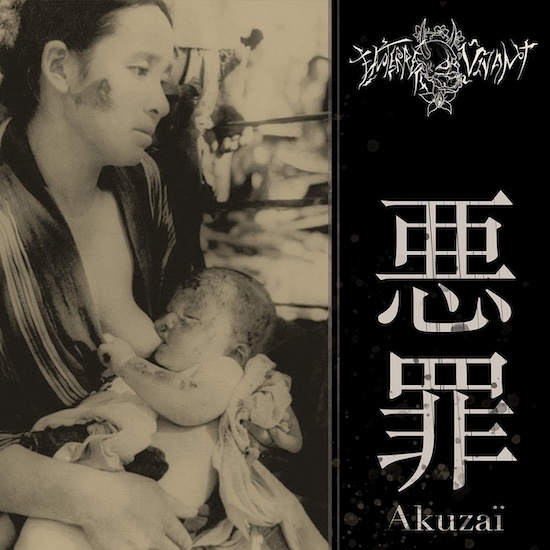
You used a photo of a mother and child who suffered during the bombing of Hiroshima as a cover photo. It’s not a common reference in the black metal scene, as we can say that the genre in general was built around other images. Why did you choose this one? Do you think it speaks to your audience?
SAKRIFISS: Since our beginnings, we have used illustrations or photographs from Japan. As the album deals with civilian victims, this photo quickly became the obvious choice. Some may use images they personally like or that appeal to the audience, without asking themselves whether those visuals truly reflect what their compositions contain. It would have been ridiculous to use an illustration of a forest, a mountain, or a giant monster. We try to remain logical and stay true to our approach and our message.
Do you see your way of attracting people’s attention to the WW II catastrophe as effective as The Byrds’ “I Come and Stand at Every Door”? Did you get specific feedback in Japan?
SAKRIFISS: I’m not familiar with American music, so I don’t have a reference for that particular song. My references for tributes to the catastrophe are mostly found in those made by Japan itself. The country has frequently addressed the themes of Hiroshima and Nagasaki in its cinema, and, of course, the Japanese continue to talk about them regularly. In Japan, people don’t cite The Byrds when trying to raise awareness about what happened.
However, it seems necessary to me that bands from different generations and styles speak about history from their own personal perspectives. As for me, I wrote about a topic that was close to my heart because I hear too often Westerners focus on the atrocities committed by Japanese soldiers or the actions of the kamikazes, while the reality of families, youth, and the general population remains largely unknown, if not ignored. It’s a difficult subject, but one that needed to be addressed at some point.
Actually I know The Byrds’ song because of Silent Stream of Godless Elegy’s cover version, yet thank you for the answer. The reality of civilians is ignored as long as it’s useful for any side of any conflict, as we can see it again nowadays. However, what do you think about people’s awareness regarding the horrors of WW II ? How often did you meet misunderstanding of the topics you speak about ?
I don’t blame people for not thinking more deeply about the victims of wars. They rely on the information they are given, and they don’t have the opportunity, or even the idea, to look into it more thoroughly. It’s not their fault if the media are compelled to resort to sensationalism, to amplify situations, and to focus only on the wrongdoing of one country (especially one that lost the war).
The situation in Japan is different, because people are more aware of the victims who died during the fighting, during the atomic bombings, but also afterward, when there were severe and often fatal health consequences lasting for decades. The war was over, but the suffering was not.
Did you search to play Enterré Vivant material with local musicians? Do you feel a necessity to play live at all?
ERROIAK: We are separated by 10,000 km, so it’s very complicated to even consider performing our music live! On my side, I know a few musicians in the Paris area who recently told me they’d be on board if we ever felt like it. But I don’t really see the point of putting together a live lineup without Sakrifiss—it wouldn’t make sense!
I experienced performing live with a band I sang for between 2020 and 2021, and it was an experience I absolutely loved. I’m starting to feel a bit of a desire to do it again, but I don’t want to rush things, so for now it’s just something I’m thinking about.
I bet that you are already half-way through a new album, what’s your progress? Can you share any news regarding it?
SAKRIFISS: We do have ideas, and we’re starting to shape them. A new theme, this time centered around the number 6.
ERROIAK: Ideas are beginning to take shape, and I won’t say more except that I’m spending a lot of time composing at the moment!
Okay, I understand your point. Yet what are your further plans for 2026?
SAKRIFISS: On my side, I’m going to release a second book, following the one that came out four years ago.
ERROIAK: I have a lot of musical projects on my plate—some already recorded, others in the process of being recorded with my solo project, as well as with Hrad and Au Loin, where I sing, plus appearances with other bands as a bassist. 2026 is likely to be a very active year for me, and I’m really proud of what’s coming out!
Sakrifiss, can you tell more about your previous and current books? Honestly, I didn’t hear about any of them.
Here is a link to my book: https://www.edt-flammes-noires.com/produit/sbm1/
In it, I present my vision of black metal. To put it simply, black metal is often described as “hatred.” But hatred is not innate, so I try to reflect on its origins, as well as on all the forms it can take. Hatred can lead to opposition toward religions, toward communities, or even toward oneself, creating a desire to escape into the past or into an imaginary world, and so on. This is what has shaped most branches of black metal: satanic black metal, depressive black metal, Viking black metal, atmospheric black metal…
I am currently finishing a book that will focus on the 2010s. It’s a period that isn’t discussed very much. I think there are already far too many books about the origins of the genre or about bands from the 1990s. It’s time to bring recognition back to the scene between 2010 and 2019.
Well, thanks again for the interview, it’s much appreciated. Did we skip something important?
The main points have been covered, thank you for this opportunity and for your interest in our project.
https://antiqofficial.bandcamp.com/album/akuza