
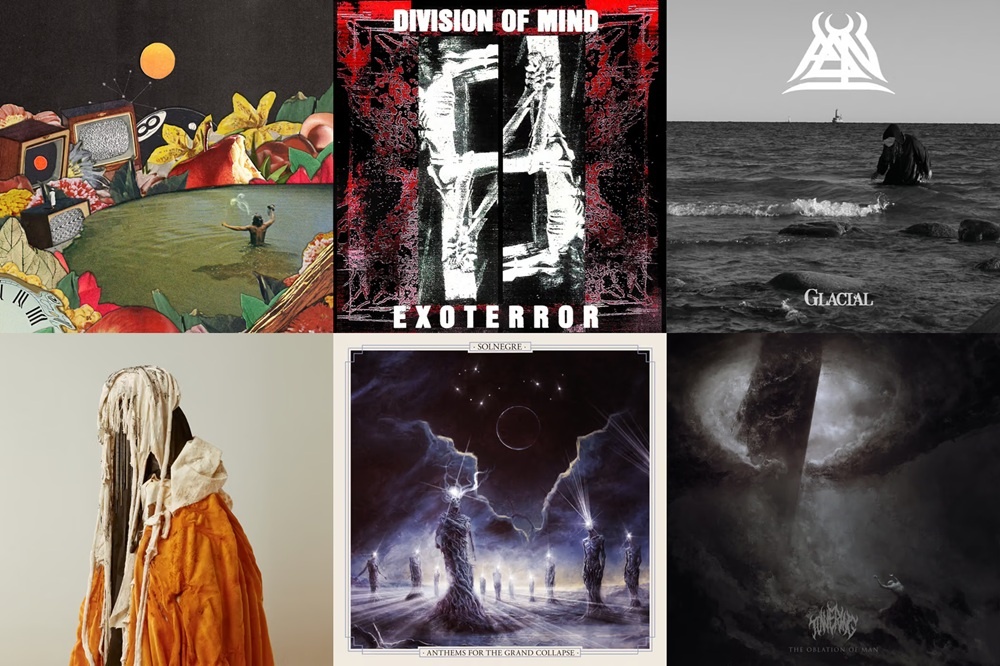
(Andy Synn has six stellar recommendations for albums from last month to share with you)
It’s always difficult to pick what bands I’m going to include in these monthly catch-up articles – I only have so much time, and so much space, I can give them, after all – but I’m pretty pleased with the variety of different styles on display across the six entries which make up today’s column.
That being said, if you’re still craving more new music from last month that you may have missed, I’d encourage you to also check out Astraya, Atlantic Ridge, Carrion Spring, Heiden, Maranatha, Sewer Altar, and The Saddest Landscape.
But first…
BODY THIEF – HALFWAY TO HALLELUJAH
I’m going to start things off today with something well outside of our usual remit… but since this is my column I get to write about whatever I like, and I really like this one.
This Baltimore-based group – who probably won’t be at MDF later this month, though I will be – deal in a bright, melodic, yet also oddly melancholic, mix of Emo/Indie, Dance Rock, Shoegaze and mathy Post-Hardcore that should (hopefully) appeal to those amongst our readers who are already fans of Astronoid, Good Tiger, and latter-day AFI (though their primary touchstones are probably more drawn from artists we don’t usually cover).
The catchy electro-punk grooves of fantastically titled opener “Screens of the Drone Age” will quickly let you know whether this album is for you or not – they definitly did for me – as the band’s infectious energy and twitchy technical ability is immediately apparent… after which, for good or for ill, the anthemic Pop-Rock meets Post-Hardcore brilliance of “Even In A Whisper” and the pulse-raising, toe-tapping, bass-driven grooves of “1990” should only reaffirm this initial impression.
If you’re still listening though – and, as you might have guessed, Body Thief have earned themselves a new fan in me, at the very least – you’ll be treated to such magical moments as the catchy-yet-complex “Moon |<Arat”, the sparkling instrumental interplay of “Here, Now” and the soulful, shimmering strains of “In The Garden”, as well as the unexpectedly powerful, Astronoid-esque “Everything In Black” (which has become a personal favourite of mine), all of which are more than capable of tugging on your heartstrings while also getting your body moving and grooving.
Sure, Halfway to Hallelujah probably won’t find an audience with most of our readers (and, to be clear, even I found the uber-poppy sounds of “Ride or Die” to be a little too saccharine for my tastes) but for those of you willing to push yourselves a little outside of guttural-heavy, blast-driven comfort zone there’s at least a chance you might end up discovering an unexpected new favourite here.
DIVISION OF MIND – EXOTERROR
In stark contrast to the previous album, Division of Mind‘s long-awaited 2nd full-length is all about visceral aggression and violent intensity, which kicks off (and I do mean kicks off) with the neck-wrecking chugs and vertebrae-popping snare (plus an ultra-aggro shout of “D O M”) of “H.I.D.E.” and then proceeds to pummel, pound, and punish your eardrums for the next 34-ish minutes.
Proudly wearing their influences on their collective sleeve(s) – think the nihilistic nastiness of Integrity, the ear-bleeding intensity of Earth Crisis (whose influence is particularly apparent during the likes of “The Secret” and “Seven Crosses”) and the monstrous impact of Merauder (with the thrashy ground ‘n’ pound of the title-track being a particular potent example) – but cranking up the heaviness to obnoxious, almost Death Metal levels (“Ambroxan” is more than equal in sheer, stunning weight to anything put out by Death/Hardcore crossover acts like Tribal Gaze or Xibalba) the group stamp their mark on things hard on Exoterror in a way which is pretty much guaranteed to leave a lasting impression.
Sure, a little bit of fight-fatigue eventually starts to set in – after all, there’s only so many times you can be hit in the face before you start to become a little numb – meaning a bit more variety in the violence might not go amiss (indeed, if the band were to integrate some of their obvious Industrial influences, which tend to be limited more to intro/outro/interlude sections here, into the mix more thoroughly I’d imagine that the resultant concoction would be even harsher, even heavier and even more memorable) but if you’re looking for an album more than capable of taking your head clean off with the musical equivalent of a roundhouse kick to the face… then this is the record for you.
PAN – GLACIAL
Genre-splicing is nothing new, obviously… but it’s also not an exact science.
Don’t get me wrong, if your goal is to maximise your mainstream appeal there’s a safe, predictable path for how to go about creating something as commercially viable (and artistically bankrupt) as possible, but it’s the harder, more jagged edges of the various extreme genres that have the greatest potential for being mixed and matched and connected in the most varied and vibrant of forms.
And that’s exactly how you get an album like Glacial, the long-awaited fourth full-length from Michigan metallers Pan, whose inventive stylistic hybrid – “Blackened Progressive Sludge Metal”, maybe? – continues to open up multiple new creative avenues which the band, as always, are keen to explore.
Comparisons to the similarly genre-blending style of Comorant can certainly be made, especially during the thrilling, visceral riffs, thunderous, elemental rhythms, and introspective acoustic melodies of songs like “Oblivion Sail” and “Temple of the Weary”, but there’s also some obvious (to my ears, anyway) influence from post-Blood Mountain era Mastodon (particularly when the band bust out the captivating clean vocals on “Valley of Rising Water”), while the more epic, sweeping moments of “Three Sisters” (which probably should have been the album closer, especially considering the poignant morse-code message featured during the song’s climax) and the aforementioned “Valley…” also recall local NCS favourites Witch Ripper at their best.
The band’s own identity, however, is never in any doubt, and is all over Glacial from start to finish, most notably in the intricate-yet-organic songwriting which allows them to shift seamlessly from a brooding, noir-ish slow-burn to nimble, proggy riffage, to dense, down-picked chugs and groaning, doom-laden chords, culminating in a soothing sequence of sombre, wordless singing and sombre acoustic plucking (“Under Countless Stars”) or switch smoothly from scorching, blackened blastbeats to soaring, prog-tastic soloing (“Three Sisters”) without ever losing the central thread of what makes this album so captivating.
THE PRESTIGE – ISTHMOS
I’ve joked before – though I wasn’t really joking as much as you might think – that the best Post-Metal bands are just “Hardcore bands having an existential crisis.”
And French quartet The Prestige epitomise this almost perfectly with their recently-released second album, which finds them shifting away from the frantic, almost Mathcore-ish approach of their debut towards a much more introspective (albeit still impressively intense) sound that owes more to say, Isis than Integrity.
But this focus on contemplation over chaos – though the crushingly heavy guitars and wild, pounding drums of “Debris” certainly provide the requisite noise and intensity, even if the song itself is a tightly-wound ball of tension and release that showcases the band’s more Post-Metal leanings nicely (especially during its absolutely colossal climax, which reminds me of Dying Sun at their heaviest and most humongous) – has, in truth, done wonders for the band’s sonic identity, opening them up to new ways of creating and communicating that have allowed them to become their best selves.
The simmering slow-burn, building to a skyscraping eruption of massive metallic catharsis, that is “Rose du Désert” is the sort of musical experience that’s impossible to fake… and equally impossible to forget… while the edgy ebb-and-flow “The Ascend” and the seething, surging emotional torrent of “Noire nuit” recall the proggier and more abrasively experimental vibe of the now sadly-defunct Eryn Non Dae.
It’s the brooding valleys and bombastic heights of ambitious seven minute closer “Sacrifice”, however, that really showcase how much the band have grown, how much they’ve changed – and Isthmos is all about change and metamorphosis, what it means and what it costs – in the years since their last album, and it’s my hope that this is just the first stage of an even greater evolution to come.
SOLNEGRE – ANTHEMS FOR THE GRAND COLLAPSE
The title track of SolNegre‘s most recent release, 2024’s Annihilation of the Self EP, was a twenty-one minute Doom Metal epic heavy (and I do mean heavy) on both atmospheric weight and metallic force, aided and abetted by some soaring, majestic synthscapes and dream-like lead melodies… which should give you some idea of the scope and scale of the band’s ambitions on their new album, Anthems for the Grand Collapse.
Easily one of the best Doom (or Doom-related) albums of the year, possessing a scintillating sense of grandeur and a vivid artistic vision thoroughly befitting the similarly epic and evocative artwork that adorns its cover (which is also in the running for one of the best album covers of the year too), Anthems… starts off very strong with the sombre grandeur and soaring gloom of “The Axiom” (whose weighty, wounded sound recalls the similarly doom-laden strains of Eye of Solitude or Swallow the Sun, albeit with an even proggier vibe in places) and only gets stronger as the record goes on.
“The Hollow Inside”, for example, is equal parts visceral introspection and artful cosmic vision – replete with a poignantly proggy mid-section which makes fantastic use of crooning cleans, shimmering synths, and mellifluous fretless bass work – while the thunderous guitars and existential ambience of “For All That Could Have Been” slows things down to almost funereal levels to really let the band, and their listeners, wallow and dwell in the desolation and despair.
But for all that Anthems for the Grand Collapse is a heavy album – both musically and emotionally – it’s also an album of surprising variety, with absolutely scintillating touches such as the gorgeous guest vocals on “In the Stillness of the Womb” and the radiant, melodic/synthetic undercurrent woven throughout colossal closer “A Path of Aloneness” ensuring that the audience remains rapt and mesmerised from beginning to end.
TOWERING – THE OBLATION OF MAN
As good as Towering‘s debut album was – and it was very good indeed – I’m confident in declaring The Oblation of Man to be even better (and one of the best Death Metal albums of 2026 as well).
Whereas their earlier material leaned heavily on the band’s Immolation influences and Morbid Angel-isms (which is no bad thing) their sound on The Oblation… has expanded in a direction closer to that of Ulcerate (especially during the album’s more oppressive and claustrophobic moments) and Svart Crown (circa Profane) that highlights a newfound focus on space and texture, shape and tension, rather than simple OTT aggression.
That’s not to say that Towering have gone soft by any means… the seething darkness and nigh-on unstoppable blastery of “To Die Once and Emergy” and the dizzying lead-guitar work and dervish-like drumming of “The Devouring Presence” (drummer Mortem is an absolute beast on this album, FYI) should easily put paid to any suggestions of that nature… but there’s definitely more than meets the eye (or ear) to them than ever before.
This is immediately made apparent by the cultivated contrast between dissonance and melody, atmosphere and intensity, which makes up “Asceticism” – a song which offers a deeper glimpse than ever into the growing depths of Towering‘s sinister, soul-crushing sound – with the likes of “Shattering Individuality” and “Herald of the Black Sun” then building upon this expanded, and expansive, sound by putting almost as much weight on the space between the notes and the lingering presence of every hanging chord as they do upon every humongous riff and strangling tremolo twist.
It also helps that vocalist Tom Silver’s increasingly raw and ragged howl – which possesses the sort of venomous rasp that might tempt lesser writers/reviewers to use the word “blackened” – communicates significantly more rage and anguish than your average, de rigeur death-growl, with the end result of all this being an album that’s all-but-guaranteed to appear on a number of “Best Of…” lists come the end of the year.
Body Thief – god damn this is great. I was sold once the Good Tiger comparison was there and same, the opening cut hooked me!