
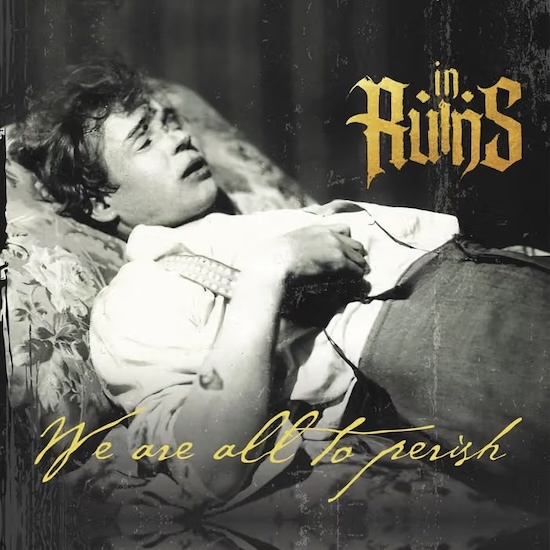
(Our Norway-based writer Chile prepared the following eloquent review of a new album by the Romanian band In Ruins, which was released in March by Meuse Music Records.)
What is it which really matters in our lives when we spend our whole existence staring right at death’s hollow face? Coming ever closer to its unjudging oblivion with each passing day, always taking us unexpectedly under its dark wings, death has been a fascination for the duration of all human civilization.
It is certainly a wonder that all aspects of our lives are so influenced by the only thing which lies outside of our living experience, and of which we know nothing. As the old saying goes, if there is us, there is no death, and if there is death, there is no us.
As the questions of death have been on the minds of philosophers, writers, and artists throughout history, it is not surprising that the concept of ending themes has found its strong foothold in music also, and since we are here, metal music particularly.
Now, it is not necessary to go into details of how metal embraces the ideas and the mystery of death, we have all heard our share of varying viewpoints through various genres (death metal, anyone?). So, we turn our spotlight to a singular example, and by involving literature in this equation, some bands do pique our interest on the very first listen.
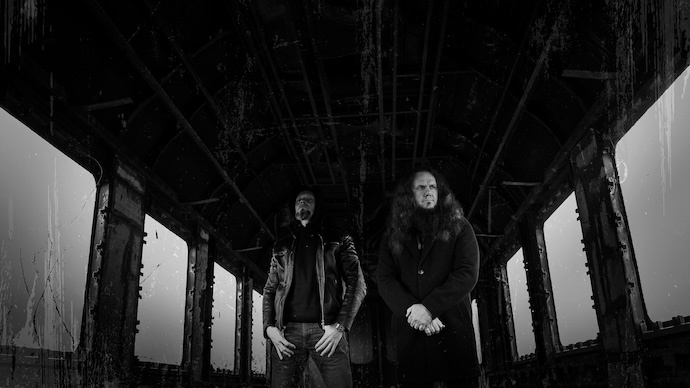
In Ruins are relative newcomers on the scene, and with one previously released EP from 2022, these experienced musicians from Romania have been building up slowly towards their debut album We Are All to Perish which finally saw the light of day earlier this year in March through Meuse Music Records.
Consisting of four long tracks, the album is a fever dream for fans of that particular mixture of doom and death metal, rolling slowly like the sands of time on the way to eternal sleep. It should be said that music itself is morose, and slow to a point that it could just as easily be labeled funeral doom as it rarely picks up any speed, as opposed to their EP Ruthless Portrait, which was a clearer representation of the doom/death variant.
Things get even more interesting when we dive into the literary concept behind the record. As foretold by the cover photograph depicting the deathbed of the famed Russian poet Sergei Yesenin who slit his left wrist, then used his own blood to write a final poem, and then hanged himself all at the young age of 30, it is this tragic event that led to the inspiration for this album.
The band uses Yesenin’s poems as starting points for their expansive sound of dread and melancholy, channeling those final tortured moments of a poetic soul so ravaged by the world that it would rather leave it altogether instead of looking for a helping hand from his fellow man.
Starting off with the monolithic “I’m tired of living in my land“, the band sets the stage for this heavy affair. Like awakened from the twenty centuries of stony sleep, this beast growls and moves its slow thighs towards where silently sleeps the river and the dark pines hold their peace. Riffs are sparse, but effective in conveying this growing unease of one’s dissociation from the world.
“I do not regret, and I do not shed tears” continues the dialogue with the passing of time, with Yesenin’s lyrics shining profusely and being set in motion by the series of mournful guitar phrases whirling like a slow dance of falling leaves deep in the birch forests of the poet’s homeland.
Seemingly more of the same, “We’ll depart this world for ever, surely” also shows the poet’s propensity for finding that single glimmer of hope in a chaotic world. Like finding somebody new who seems to recognize your inner workings right from the first moment, it is a victory in itself, and the song pushes that point to its soulful conclusion.
To be completely honest, it is with the last song named “Farewell” where the band show that diversity can be achieved even within the genre constraints. Driven by Orthodox chanting that adds a magnificent amount of mysticism, “Farewell” marks the last song Yesenin wrote just before his death and the band put all their faculties into it. It is atmospheric, laced with ethereal female vocals, and drenched in the melancholy of passing, with the poet himself proclaiming that there is nothing new to be said about dying, and to keep on living is also not new.
In the end, even though I consider myself more of a fan of speedier types of metal in general, I’ve found myself completely mesmerized by the sheer magnitude of emotions ensconced in these 43 minutes. One could say this only shows the true staying power of metal transcending genres and art forms in attracting new fans, in which In Ruins should surely succeed.
https://inruins13.bandcamp.com/album/we-are-all-to-perish
https://meusemusicrecords.bandcamp.com/album/in-ruins-we-are-all-to-perish-mmr069
https://www.facebook.com/InRuins.ro