
(written by Islander)
Prepare to jump off your usual beaten tracks, indeed off the tracks of the world altogether, as we present Carmina Inferorum — Latin for “Songs of he Underworld”. This is the debut album of the mysterious Polish avant-black-death-metal band KUR•NU•GI•A (not to be confused with the Ohio death metal band Kurnugia or the Finnish black metal band Kurnugia). It will be released by Godz Ov War Productions on May 22nd.
Curious about the band’s rendering of the name and what it refers to, I found a source (here) that includes this description:
Kurnugi, also called Kur-nu-gi-a, was the Sumerian underworld. It was dark, vast, and final. It lay beneath the earth, beyond the Mountains of Sunset. Souls descended here after death, stripped of light and joy. The dead ate dust, drank from mud, and lived in shadows…. Kurnugi was not punishment; it was fate.
Those words increased my curiosity about the music before hearing a single note, as did a Lovecraftian chant that appeared in the announcement of the album by Godz Ov War on social media (a chant that’s interpreted to mean “In his house at R’lyeh dead Cthulhu waits dreaming”):
Ph’nglui mglw’nafh Cthulhu R’lyeh wgah’nagl fhtagn…
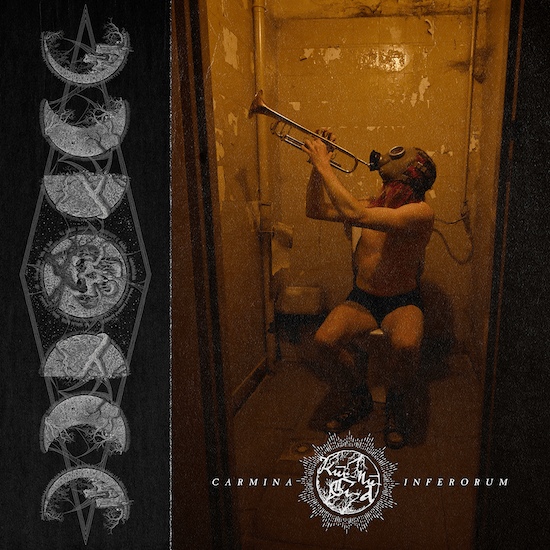
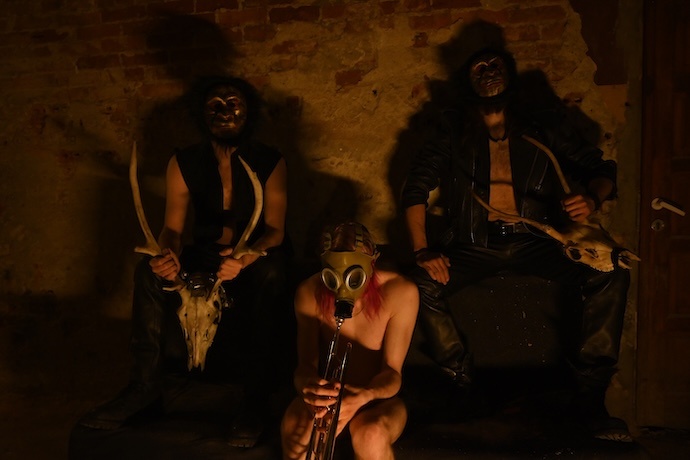
But the album’s cover image and KUR•NU•GI•A’s band photos made me even more curious.
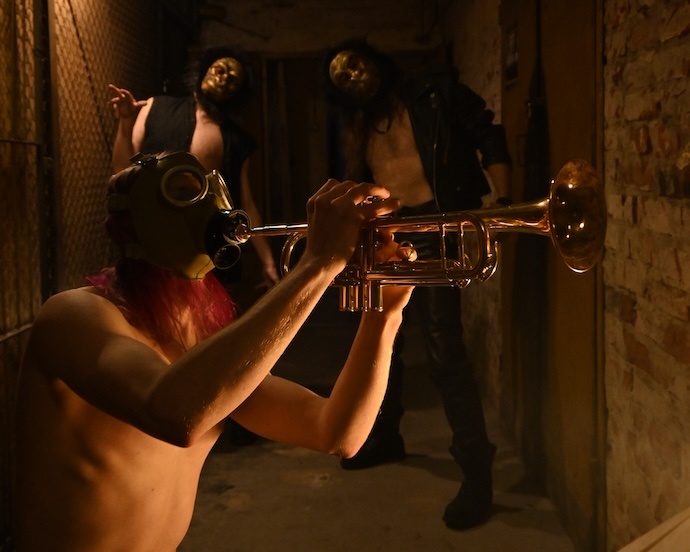
Is there indeed a trumpet in the music? For the answer, continue reading. Can a trumpet be played through a gas mask? Probably not? Maybe? We have no experience in this area.
The album’s first song is “Spiraculum Vitae“. Very quickly and then more steadily it creates an extremely creepy atmosphere, through an amalgam of ringing chimes, squalling and squirming dissonance, and deeply humming bass tones. And yes — it’s a trumpet that’s making those uncomfortable squalling and squirming sounds!
Having induced feelings of chilling uneasiness in listeners, KUR•NU•GI•A then start stomping and scratching, throbbing and ejecting monstrous snarls, and allowing that squirming trumpet to rear its head again, along with eruptions of frantically quivering fretwork, magma-strength bass-bubbling, and even wilder vocals. It’s a macabre experience, but an earth-moving and head-moving one too.
Depending on your tastes, that unconventional opening song might leave you simultaneously bewildered and dazzled (as it did me), and hopefully at least curious to see what these idiosyncratic psychonauts might do next.
What they do next, in the song “Divide et Impera“, is to assault the listener with thunderous crashes, miserably wailing trumpet tones, demonic spoken words, acetylene-strength abrasion-bursts, and enormous subterranean throbs. The music rabidly roils, piercingly screams, violently convulses, and uses big pumping beats to help keep all these elaborate (and bizarre) twists and turns on course (barely).
You begin to get the feeling that KUR•NU•GI•A have divined what dead Cthulhu dreams about in his house at R’lyeh, and their music is the translation of those hideous dreams into sound. The songs are surreal, inventively elaborate but twisted into very strange configurations, and yet also primally compulsive in their continuously variable rhythmic maneuvers.
The following six songs strengthen those impressions. They include horribly gasping, gnashing, roaring, and howling vocals, as well as possessed near-sung cries and solemn chants. They include floor-bouncing industrial-strength grooves; piercing and peculiar but sometimes seductive or psychedelic trumpet accents; layerings of dissonant guitars that are vicious, demented, tormented, and ecstatic; and assorted electronics deployed in ways designed to enhance both the mutilation of sanity and the seduction of the innocent.
It’s not the kind of music that leaves much room for headbanging, much less humming. Instead, it’s the kind of music that creates frightening but relentlessly fascinating spectacles, deranged at their core but ingenious.
To be clear, the songs aren’t as scattershot as the previous paragraphs might lead you to expect. There is a method to KUR•NU•GI•A’s madness. All the twists and turns, all the elaborately morphing and mutilating ingredients, are impressively plotted, even though it might take more than one listen to make that clear.
And further to be clear, KUR•NU•GI•A are quite attentive to the reptile brains of listeners, the primitive sectors that get muscles moving without thinking about it while the thinking parts are getting scrambled and slivered.
I’m not very good at making comparative references, and so I rarely try. But I’ll go out on a limb and say that in listening to Carmina Inferorum I got flashes of Voivod, Gorguts, Imperial Triumphant, Igorrr, Dødheimsgard, Oranssi Pazuzu, and Krallice — but with extra madness. You might get different flashes, but I hope you’ll be adventurous enough to find out.
P.S. Don’t miss the doubled trumpet performance in “Snake is Blind” or the mescaline-soaked closer “Raise the Dead“.
Godz Ov War will release Carmina Inferorum on CD and digital formats, and you can order it now. The cover photo is by Tymoteusz Husarz, with cover design by Michał Grabowski.
PRE-ORDER:
https://godzovwar.com/shop
https://godzovwarproductions.bandcamp.com/album/carmina-inferorum
KUR•NU•GI•A
https://www.facebook.com/kurnugia666
https://www.instagram.com/kur.nu.gi.a
Id add Ottone Pessante into the mix, ofc for the brass, but also the drumming.
I love that band and should have thought of them — thanks for the idea.