
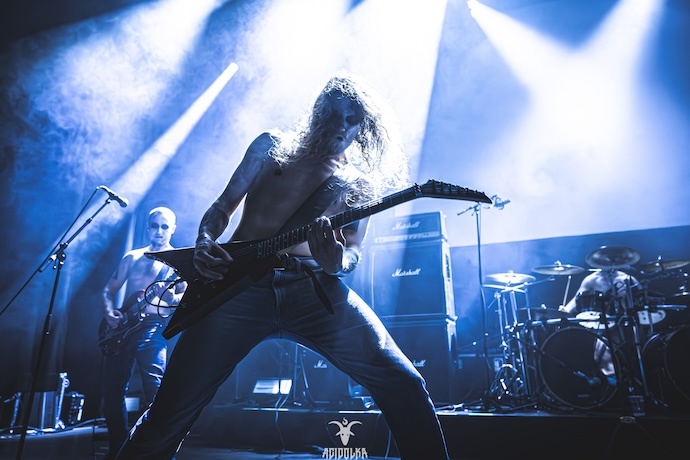
photo by Acidolka Photo
(We happily welcome back The Goat Tavern, a metal enthusiast based in the UK but with roots in Poland whose contributions to metal you can also find here and here. This time he has brought us an extensive, truly wide-ranging, and impressively articulate interview he conducted with Nihil, frontman of the groundbreaking and ever-evolving Polish band Furia.)
For nearly twenty-five years, Furia have stood apart – not only within Polish black metal, but within the genre as a whole. Restlessly evolving while remaining unmistakably themselves, they’ve built a body of work that defies easy categorization, drawing equally from black metal, theatre, Silesian identity, and a deeply personal search for meaning. I spoke to the frontman of the band, Nihil in search for answers to questions that many of us wanted to ask for a long time.
******
Hi, Nihil. Thanks for taking the time to talk to me. I know you’re a busy man. Are you watching the World Cup final tonight, or are football and sports generally not really your thing?
Oh, I’m definitely watching it! Before I discovered heavy metal, football and ice hockey were my first passions. I don’t really follow either sport on a daily basis anymore, but I always try watching the World Cup and the Olympics.
While preparing for this interview, I realised it’s been more than ten years since we last sat down for a proper conversation. That’s far too long. Looking back, how would you sum up the last decade for yourself as a musician, and for Furia as a band?
A tremendous amount has changed, first and foremost because of our involvement in Wesele. We’ve now been performing that production for almost nine years. Wesele changed us completely. On top of that, I think each of us has entered a different stage of life. That’s just what comes with age.
It also opened new opportunities for us, but perhaps even more importantly, seeing theatre from the inside opened our minds. It allowed us to grow enormously as artists and gave us a real creative renewal.
Jan Klata’s 2017 production of Wesele (The Wedding) is one of the most influential modern interpretations of Stanisław Wyspiański’s canonical 1901 drama. The key artistic decision was placing Furia on stage throughout the performance as the live wedding band. Rather than simply providing music, they become a permanent symbolic presence acting as another set of characters.
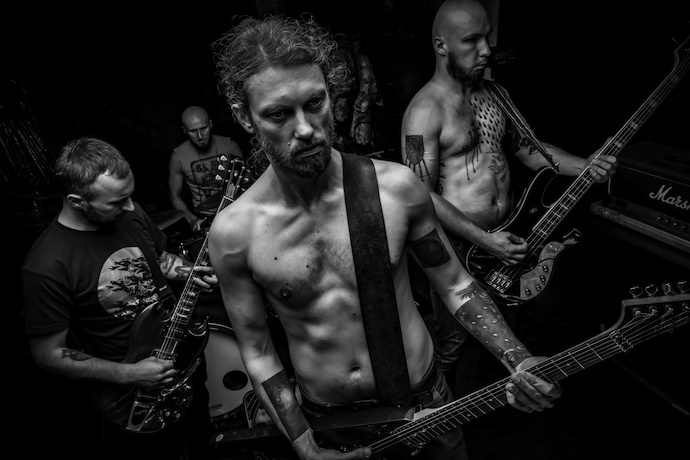
photo by Radek-Krzyzowski
Has your relationship with music itself changed as well?
Absolutely. I’m not sure I can fully put it into words, but I’d split it into two perspectives: the listener and the creator.
As a listener, not all that much has changed. I still experience music as something I need to stay connected to the sacred. What has changed is simply that I’m older now. Both in music and in everyday life, I’m looking more for peace than for an outlet of emotions. We get that outlet on stage anyway. As a result, my taste has changed quite a bit. That’s the listener’s side of things. As a creator, my relationship with music has surely changed too but that’s a huge subject in itself.
Then let me narrow it down a little. Has the way Furia approaches making music changed over the years?
That’s a better way of putting it. Yes, it has, because we’re simply a different band today. Not just because we’ve matured, but because Furia itself occupies a different place now. Life keeps accelerating, and therefore Furia has become a little more task-oriented.
At the same time, I don’t think we’ve lost that deeper layer we’ve always tried to excavate. What has changed – at least to some degree – is the spontaneity. There was a time when everything we created emerged completely organically. Nowadays, simply because of the way life works, we must be more organised. Things are much more structured than they used to be.
That’s interesting, because it somehow connects quite nicely with something I wanted to ask you later. But first I’d like to revisit a question, that you struggled with a little bit, when I asked it ten years ago. Let’s see how you manage this time. If you had to describe Furia in just three words to someone who’s never heard the band before, what would you say?
That’s a difficult one. The first thing that comes to mind is the etymological association that, only now after all these years, I realise describe us remarkably well. I’m thinking of words like passion and suffering, both of which are connected to the meaning of the word furia. After all, furia can be translated into English as passion. And passion also carries the meaning of suffering – as in the Passion of Christ. That’s exactly the sense I have in mind.
Other words I’d use to describe Furia are, perhaps, depth, self-discovery, understanding. Sorry, I’m already going beyond the limit of three words, but they’re all inseparable from one another. So yes – Furia is the search for answers and passion.
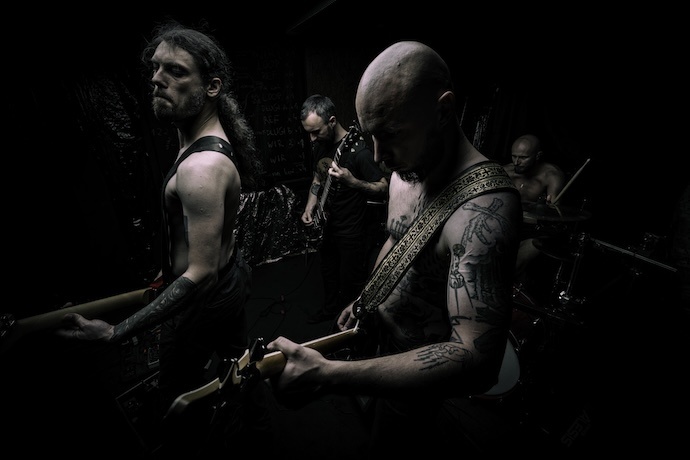
photo by Radek-Krzyzowski
That definitely went better than it did ten years ago.
Really? I don’t even remember how it went back then.
It didn’t! (laughs). We actually ended up trying to come up with the words together.
To be honest, I usually have the same problem. Whenever I want to recommend Furia to someone outside Poland, I never quite know how to describe the band in a single sentence, or which album I’d tell them to start with if they wanted a representative introduction. Most often I simply recommend my personal favourite, Nocel, and leave it at that.
Do you think Furia is, in general, a difficult band for people to approach – especially if they don’t speak Polish and aren’t familiar with the cultural context?
Absolutely. And exactly for the reasons you’ve just described. There isn’t a single work that represents Furia as a whole. I think of Furia as one large work of art – or perhaps one phenomenon but with many different manifestations. Every piece we’ve created has its own distinct colour and character.
We never repeat ourselves. There are no two albums alike, no two concerts alike. Yet paradoxically we do keep repeating ourselves in a way, because everything is ultimately about the same thing. People often say that every writer spends their life writing the same book over and over again. We do exactly that – we just write it differently every time.
Many years ago, the term Nekrofolk became closely associated with Furia. Do you still think it’s an accurate description of the band?
Not entirely, for very specific reasons. And once again, it’s something that’s difficult to explain to someone outside Poland.
Over the years I’ve become deeply immersed in what we call traditional Polish culture. The further I’ve gone, the more clearly I’ve come to understand the distinction between folk music and traditional music. That’s an important distinction. Folk music is essentially a form of popular music that draws on traditional culture. It borrows certain musical or lyrical devices, certain aesthetic markers, to evoke a traditional atmosphere.
What interests me today is tradition itself. That’s something much deeper than simply referencing an aesthetic. It’s about trying to reach the very essence of things. It’s about asking who we really are. It’s a search for identity – in this case as Poles or as Silesians, though ultimately it’s a question that concerns humanity as a whole.
Because of that distinction between folk and tradition, I gradually stopped identifying with the term Nekrofolk, even though, in a sense, it’s still a valid description. I’m not offended when people use it, and I certainly wouldn’t tell anyone not to.
So people don’t have to burn their Nekrofolk t-shirts?
No, absolutely not. From a purely promotional point of view, it’s actually a great little hook. It’s memorable and it sticks in people’s minds. I just don’t use it myself anymore.
If I were to sum it up, I’d say that Nekrofolk still describes us in a very broad sense. The Nekro part is still relevant, although its meaning has evolved. In the early days it reflected a rather youthful fascination with death. Today it refers more to the past, the otherworld, the sacred. The same applies to Folk. It still points towards tradition, but no longer primarily in an aesthetic sense. Today it’s about meaning rather than style.
I’d like to go back to the band’s beginnings for a moment. I know Furia was born out of your fascination with the Norwegian black metal scene, and I could always hear those northern musical references on your first two demos. Looking back now, how do you remember those early days? That was almost twenty-five years ago, wasn’t it?
I remember them both very fondly and very painfully.
Painfully, because we were unhappy – we felt alienated from the world and from ourselves. But I also remember those days with great affection because of the spontaneity I mentioned earlier, and because we were such a close-knit group. Furia has always been a reflection of who we were as a collective of people. In that sense, they were beautiful times. We’d spend hours in our forest, drinking beer and talking endlessly about things that, at least to us, felt profound.
Speaking of Norway, were there any particular bands that inspired you back then?
Oh, absolutely! Even before Furia existed, we were completely consumed by that scene. Those were still the days when our generation wasn’t immersed in it the way people are now. The music wasn’t readily available, so we mostly knew the bands that had already made it to the surface. Mayhem, Darkthrone, Satyricon, Immortal – that was our world.
Then Taake appeared. Namtar got their first album in the post from a friend who lived near Łódź. He mailed it over so Namtar could copy the cassette, photocopy the cover artwork, and send the original back. I copied my tape from that cassette and redrew the logo in pencil.
These days he’d just send him a Spotify link.
Exactly. In that sense we still belong to the old generation, although in reality we were something of a transitional one. Then Taake came along – and that’s when Furia came into being. The immediate trigger for starting the band was our absolute obsession with Taake’s first two albums, at a time when practically nobody in Poland – or even in Europe – had heard of them.
I think it’s still rather obvious how much Furia drew from early Taake, and in many ways still does. As a guitarist, I can still feel traces of those first Taake recordings in my hands.
Given how fascinated you were with Norwegian black metal – and Taake in particular – it must have been quite a special experience finally getting to play in Norway last year, at Beyond the Gates in Bergen.
These days maybe not quite as much – we’re old men now, and things don’t excite us on quite the same level anymore. But back then, Bergen was like hearing the word Disneyland as a kid. We were so obsessed with Norway that when we were students we hitchhiked there, and we eventually made it to Bergen. So, playing Beyond the Gates was incredibly satisfying. As kids we wouldn’t even have dared dream that one day we’d be invited to Bergen to perform.
Inspiration is one thing, but Furia developed its own unmistakable identity remarkably quickly. Your debut, Martwa Polska Jesień, is regarded by many as one of the defining albums of the Polish black metal scene. That combination of rawness, your unmistakable melodic sensibility, and the atmosphere of your native Silesia became Furia’s trademark. At what point did you realise the music you were making was becoming something unique?
It’s difficult to pinpoint a specific moment. But the first thing that came to mind when you said that was that, strangely enough, I felt we were unique right from the beginning – even though, aesthetically speaking, we were basically just copying Taake and Norwegian black metal in general. Of course, that’s a completely subjective view.
We didn’t yet have the means to express ourselves properly, so what came out were clumsy imitations of the Norwegians. But from the very start there was an attempt – sometimes conscious, sometimes not – to understand ourselves and to keep digging deeper into our own psyche. Over those twenty-odd years we’ve refined our craft, we’ve grown as artists, and, quite naturally, we’ve gradually become ourselves.
I also feel that over the years you’ve carved out your own little niche within the Polish scene. There are several bands that seem, musically or lyrically, to draw inspiration from Furia. How do you see that? Do you think you’ve created something influential, even if only on a relatively small scale?
That’s an interesting question, because I’m not sure I see it quite the same way.
As usual, my answer is both yes and no. On the one hand, I don’t really notice people borrowing our aesthetic. In fact, I’m not even sure I’d be able to name the bands you’re talking about. I’m curious to hear who you have in mind.
On the other hand, I do think we’ve had an impact on the scene – but in a very specific sense. Recently there’s been a growing willingness among bands to be more courageous, to follow their own path instead of conforming. I think that’s a very healthy direction, and I’d like to believe we’ve contributed to it in some small way.
And perhaps also encouraged bands to experiment a bit more?
Yes, that’s part of what I mean.
The first bands that come to my mind are Kły and Gorycz. There’s also Wesele. Regardless of whether they’re good or bad bands, or how closely they resemble Furia musically or lyrically, you hear them and you immediately think of Furia.
Perhaps… yes. You may well be right about Kły, although I’d like to add something in fairness to them. I know the guys quite well. I produced their records, so I have a pretty good insight into how they work. They’re a perfect example of what I was talking about earlier. They’re a group of people who’ve created their own little world. If Furia has inspired them in any way, it’s in giving them the confidence to present that world unapologetically and to do everything on their own terms.
I think I know what you mean. One of Furia’s greatest strengths has always been its unpredictability and willingness to experiment. You started pushing yourselves in new directions with Księżyc Milczy Luty in 2016, then came W Śnialni, which really divided listeners. Just when everyone expected even more musical curveballs, you returned in 2023 with Huta Luna, which is arguably your most straightforward black metal album in years. Where does that unpredictability come from?
Once again, I’d go back to the very essence of the word furia. You can imagine it visually as a bolt of lightning – something completely unpredictable. That’s the feeling behind fury itself: a blind eruption of emotion. That’s the answer to your question. Blind fury. Every emotional outburst – and that’s exactly what fury is – is, by its nature, unpredictable. That’s how we’ve managed to preserve our spontaneity, and I still love that about Furia. We’re still searching for answers, even though we’ve already found many of them. But the very act of searching means we don’t yet know what the final answer is. In that sense, we’re still blind. And that’s precisely why we’re unpredictable.
I remember visiting your studio before Huta Luna came out. You played me some of the new material, and I was genuinely surprised by the sheer speed of it all – I couldn’t imagine how the finished record was going to sound. Over the years, though, I’ve learned that with Furia the only sensible approach is to expect the unexpected. Can you predict, even to the slightest extent, where Furia is heading next? Or does that blind fury really strike without aiming?
I can’t predict it. There isn’t any grand plan. Every time we begin working on a new record, we don’t have the answers yet. We choose subjects precisely because we’re drawn to the unknown. That’s one of Furia’s defining qualities – we never know what’s waiting around the next corner.
One thing about Furia that is predictable, though, is the line-up. You’ve had the same four people for years now, with hardly any changes. Do you think a stable line-up is essential if you want to create something meaningful?
Absolutely! For us it’s fundamental. I find it difficult to imagine a band without a true collective behind it. Of course, there are one-man projects supported by hired musicians that work perfectly well in some cases. But for Furia, our strength has always come from being a genuine collective.
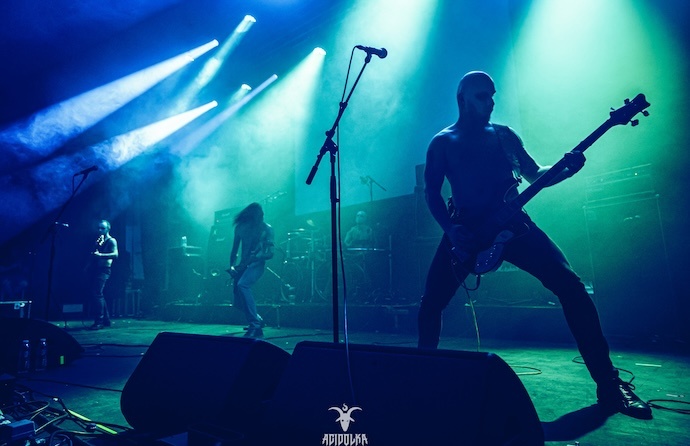
photo by Acidolka Photo
Looking back over nearly twenty-five years, is there a particular period you remember most fondly? Or perhaps one album that immediately brings back especially happy memories?
Honestly, I remember every period we devoted to creating a song or an album with great affection. It’s a bit of a paradox. On one hand, everything is steeped in suffering, struggle and decadence. On the other, I look back on all of it very fondly. Perhaps those positive memories come from experiencing the creative act itself – the sense of community, the satisfaction of working together. Of course, whichever album I think about, every single one also reminds me of the absurd amount of work we put into it. After all, this has never been our day job.
One thing that’s become quite noticeable over the last few years is that Furia has slowed down considerably when it comes to releasing new music. Why aren’t we getting new records as frequently as we used to?
There are three reasons. The first is simply life itself. That’s self-explanatory. The second is that all four of us have increasingly demanding creative projects outside Furia, and they take up a great deal of our time. The third is that whenever a spontaneous idea appears, we try to immerse ourselves in it. We try to focus on it, develop it properly and really understand it. We’ve always worked hard, but years ago we were much more carefree. We’d simply follow wherever our instincts led us – and I don’t mean that in a negative sense. Today we’re older, and in that respect we’re a little less spontaneous.
That said, over the last decade we’ve accumulated enough ideas for somewhere between five and ten releases. It’s just that real life – and everything else I’ve mentioned – means we’re still waiting for the right moment.
Another noticeable change is your lyrics. Compared to the early days they’re much more minimalist and, at least on the surface, less poetic. Do you feel you simply have less to say with words these days? Or is Furia gradually moving towards making an instrumental album?
I’d actually say the opposite. I think they’ve become more poetic.
That’s true, depending on how you look at it. But they’re certainly much more condensed than they used to be.
Exactly. My development as a lyricist has simply been part of growing older and refining my craft. I can spend five or even ten years writing a single text, stripping it down, reducing it again and again until only two words remain.
To this day I’m very satisfied with the lyrics to Swawola Niewola, because everything I wanted to say is there – and in truth, it’s saying an enormous amount. At the same time, I’m aware that not everyone is able to connect with what’s hidden beneath the surface.
Everything has become much more compressed.
Exactly. Take Zamawianie Wirujących Sarmatów (Czwarte), for example. I spent ten years writing that text, and in the end not a single word appears in the piece itself, because everything is already contained in the title.
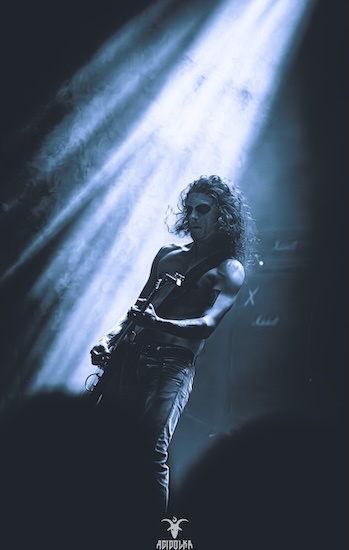
photo by Acidolka Photo
I’d like to move on to something that’s personally one of the most important aspects of Furia for me – your live performances. As you know, I’ve seen you play countless times in different countries, and yet I still get genuinely excited every single time. One thing I’ve always admired is how you manage to recreate the atmosphere of your records almost perfectly on stage while keeping the visuals incredibly minimalist. At the same time, it ties back to what we were talking about earlier – your unpredictability. I’ve never seen two identical Furia concerts; you always manage to surprise me somehow. I could probably talk about your live shows forever, but what I’m really interested in is this: in your view, what makes a Furia concert a successful one?
Honestly, I haven’t the slightest idea. In a way, our last concert wasn’t all that different from our very first one. What I mean is that we’ve always approached live performances in exactly the same way – we walk onto the stage and release the energy. That alone probably answers your question, because it also explains why every concert is different. We simply surrender and let that fury take over.
On the other hand, our concerts have changed enormously, simply because we’ve learned how to play properly. We’ve evolved into a much more sophisticated live machine. Back in the day we were just four wired-up guys charging onto the stage, plugging in our cables and throwing the first punch. Today we’ve got an incredible crew behind us – sound engineers, lighting designers, visual technicians, stage crew. We’ve invested heavily in our sound, in our equipment, and in improving every aspect of what we do live. But despite all that, we’re still standing on that very first stage. We walk out, we ignite ourselves, and that’s it.
Alright then, can you remember any particularly bad shows? Any concerts you’d rather forget?
No. I don’t want to say every concert we’ve ever played was great, because that certainly isn’t true. But I’ve never walked away feeling ashamed of what we’d done. Nothing has ever happened that made me think – that was a disaster. I’m always satisfied to some extent – sometimes more, sometimes less. Although I should stress that’s only from my own perspective.
And what about places you’ve played outside Poland? You’ve toured quite a bit over the years. Are there any that stand out in your memory?
Oh, I could go on forever. Japan immediately comes to mind – that trip felt incredibly far away and almost unreal. Then there was Istanbul, which was equally exotic and bizarre. We were held at the border for nine hours, arrived at the venue massively late, and ended up with only twenty or thirty minutes to perform because the venue had to close.
I also think of Antwerp. We were late there as well because the Channel Tunnel had been blocked while we were travelling from England. We played in some squat, but the atmosphere was absolutely mystical.
Then there’s Primavera in Barcelona – a festival full of hipsters – and the wonderful week-long holiday we had there afterwards. The entire Balkan tour deserves a mention too, simply because of the unique atmosphere of that region.
And every concert we’ve played in Ukraine. One that especially stays with me is Odessa in 2014, shortly after Russia invaded Crimea. People were genuinely surprised and deeply grateful that we’d come at all. Really, it’s been twenty-five years of incredible memories.
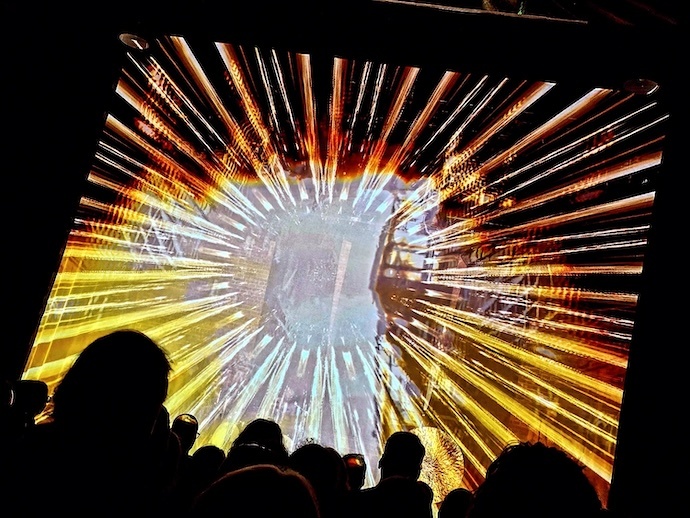
photo by The Goat Tavern
We saw each other in Łódź less than two months ago during your special cinematic performance, Furia Gra Kino (Furia Plays Cinema). Combining live music with cinema is a rather unusual concept – I certainly hadn’t seen anything like it before. You saw for yourself how much of an impression it made on me afterwards. Do you think this format could work outside Poland? Do you think the historical and cultural context is essential, or can people approach it as a blank slate?
I think people can absolutely approach it without any prior knowledge. In fact, we’re already talking to promoters about trying to bring the project to Western Europe. What Furia Gra Kino is built around is very specific. If you’re not Polish, it’s difficult to fully grasp the atmosphere of our region – Silesia. At the same time, though, it’s a surreal story about Silesia, and in that sense it’s universal.
I’d like to believe people don’t necessarily need all the context. Because it’s presented through surrealism, you stop trying to analyse everything rationally and instead respond emotionally. I can imagine audiences connecting with it on that level.
Besides, Britain, Germany, France – they all have industrial regions with their own strange identities. I suspect people from those places could recognise something of themselves in what we’re presenting.
That was exactly my impression watching it in Łódź. It felt surreal and abstract enough that anyone could find something of their own in it. As for the more documentary-style sections that appear throughout the performance, you could simply subtitle those. The rest would speak for itself.
Yes, that’s exactly what I’ve been thinking. The factual parts could simply be translated with subtitles. I don’t understand them myself (laughs). It’s an incredibly technical language…
…which somehow makes the whole thing even more surreal.
Exactly. And that’s entirely intentional. Those passages aren’t there so we can understand how the Spodek Arena was constructed. They’re there to create a certain mood, a certain aura. We don’t actually need to understand them. It’s enough to know what they’re about. That alone creates an image in our minds. Subtitles would simply give people something to latch onto by picking out a few individual words.
From a technical standpoint, though, the whole production looks incredibly demanding. I saw it backstage in Łódź, and it seemed like a hugely complicated operation.
For a small band like us, it’s absolutely enormous compared to an ordinary concert. Now we’ve got the whole cinematic side to deal with. We need a dedicated screen, a dedicated projector, and on top of that we work with a visual artist, Bogna Przewoźniak, who performs with us live. She isn’t just pressing play. Each song has its own pool of film sequences, and she mixes them live during the performance.
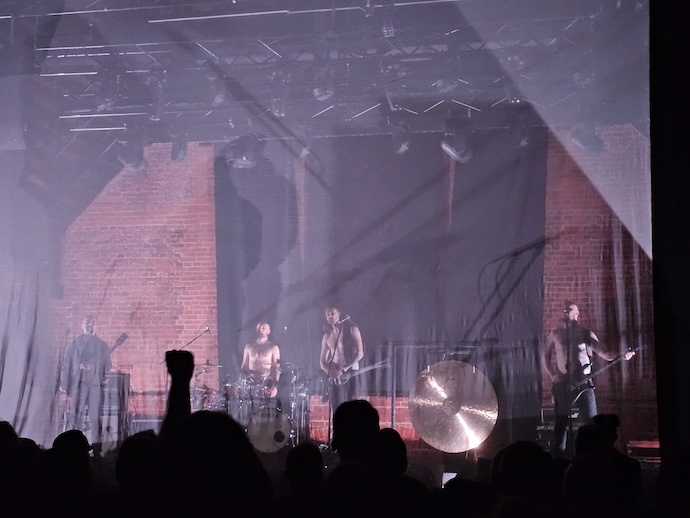
photo by The Goat Tavern
It really is an impressive production. Two years ago, you played Fortress Festival in the UK, where you were very well received. Personally, if the logistics could somehow be worked out, I’d love to see Furia Gra Kino in Scarborough. On the main stage of that theatre, it would look absolutely incredible!
Yes, I can definitely picture that as well. I’d happily go back there. It’s a wonderful place.
Do you miss being woken up by seagulls every morning?
I wouldn’t mind at all. I have very fond memories of that trip – we had a fantastic time there.
As far as I remember, you’re not particularly enthusiastic about performing albums live in full – especially the older ones. But next year marks the twentieth anniversary of your debut album. Have you given that any thought?
I should clarify something first. I have absolutely nothing against classic albums performed live – as long as I’m a fan of them. (laughs)
These days there’s a trend of metal bands touring classic records. I like that. I’d happily go and hear, let’s say, Emperor perform Anthems to the Welkin at Dusk in full. At the same time, though, it often suggests those bands no longer have equally strong new material to present.
When it comes to Furia, I’m simply not interested in revisiting the past. We’ve changed too much. I stand behind everything we’ve ever recorded, of course, but I honestly wouldn’t feel like playing Martwa Polska Jesień in its entirety today. And then there’s real life again. Preparing something like that would be such a huge undertaking that it would take too much time away from creating new things.
Before we leave the subject of concerts: if someone offered Furia a short US tour under the right conditions, would you go?
Absolutely. I’d mainly be excited to finally see America. I’ve never been there, and I’d simply like to confront my own image of the country with reality.
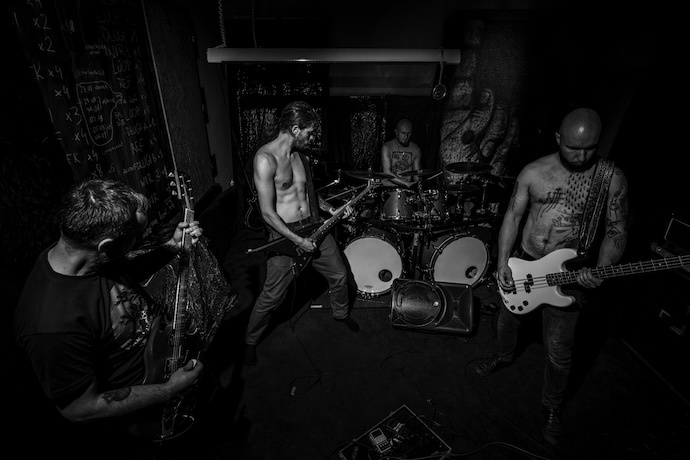
photo by Radek-Krzyzowski
Is it true that once you turned up to your concert somewhere in Poland and, instead of playing your own songs, performed nothing but Darkthrone covers?
Yes (laughs). That was a very long time ago. It happened in Poznań and it was one of those youthful impulses we used to have. We suddenly thought, Darkthrone never play live… so maybe we’ll do it for them. It was a birthday concert for Bloodthirst – we were good friends back then and we decided to surprise everyone. We never announced it beforehand.
How did the audience react?
That’s the funny part – quite a few people were genuinely disappointed. (laughs)
Speaking of Darkthrone, what did you think of their latest album?
I haven’t actually heard it yet. These days I’m mostly looking for peace in music. Whenever I have time to listen to something, I tend to reach for music that calms me rather than agitates me.
The reason I ask is that I wonder whether Furia has reached a similar point to present-day Darkthrone – a band that no longer has anything to prove and simply follows its own path regardless of how people react.
Yes… Although, if a psychoanalyst examined us, they might conclude that Furia is constantly trying to prove that it doesn’t have anything to prove. (laughs)
Something I’ve never forgotten happened years ago. Before one of your concerts, I asked whether you’d be playing Zamawianie Drugie. It was less than two years after Nocel, and the song always got an incredible reaction live. You could almost call it your biggest crowd favourite at the time. You casually told me you weren’t going to play it because you’d grown completely tired of it. That made me wonder: is the musician there for the listener, or is the listener there for the musician?
I think it works both ways. On one hand, audiences probably shouldn’t expect artists to create only what people want to hear. If they do, the quality of the art inevitably suffers. We’ve seen that happen to many of the classic metal bands we grew up with. They’ve fallen into that trap and – I’ll deliberately put this rather harshly – they’ve started trying to satisfy the expectations of the consumer.
On the other hand, I think anyone who says they create only for themselves while simultaneously releasing records and performing concerts is lying. The moment you choose to share your work with others, you’re creating for someone else as well. That means you should respect your audience and, to some extent, take their expectations into account.
I’d always look for a middle ground. Of course, I want to give people something they’ll enjoy – after all, they’re kind enough to come to our concerts and appreciate what we do. But becoming entirely driven by audience expectations is equally pointless. At that stage it simply turns into business – a chase for money or applause.
A few years ago, Furia received a nomination for one of Poland’s most prestigious cultural awards, the Paszporty Polityki, in the Popular Music category. Black metal as popular music – that sounds almost contradictory. Do you think black metal has lost some of its underground spirit as it has entered the mainstream? Has it really become music for the masses?
I think the genre has clearly split in two. Black metal now flows in two separate streams. One has become thoroughly mainstream and continues to reach broader audiences. The other remains black metal in the truest sense of the word, carrying on the genre’s traditions and I think it’s doing that remarkably well.
I don’t think we can reduce the issue to saying black metal either is or isn’t mainstream. It’s much more complicated than that. And to some extent, black metal entering the mainstream isn’t necessarily a bad thing.
On one hand you’ve got a band like Furia receiving a Paszport Polityki nomination. On the other hand, you’ve got Dimmu Borgir, which is just commercial rubbish.
The Paszporty Polityki (Polityka Passports) are among Poland’s most prestigious annual cultural awards, presented since 1993 by the weekly magazine Polityka. They recognize outstanding emerging or mid-career artists and creators in fields such as literature, film, theatre, music, visual arts, and digital culture.
As we slowly come to the end of our conversation, I’d like to ask about some of your other projects. What happened to Morowe or FDS? They were both fascinating projects, and if I remember correctly, some of the material was already at a very advanced stage years ago.
Morowe is finished, and it won’t be coming back – even though we actually recorded a new album. The line-up that made that record fell apart after an argument, so it’s simply never going to be completed.
At the same time, I’m still on excellent terms with Tomek, with whom I founded Morowe. We’ve actually been working together for many years on a new record that’s grown partly out of the ashes of Morowe and partly out of what FDS gradually evolved into. Besides Tomek, Cień – who sang in FDS – will also be involved. The album is already at a very advanced stage. The only thing we’re missing now is the time to finish it.
And MasseMord? Is that chapter completely closed now?
Yes. MasseMord is over. Quite simply, we no longer have that much aggression inside us. We no longer feel the emotions that gave birth to that project, so there’s no point forcing it to continue.
Fair enough. More recently you’ve also released your solo project, named simply Nihil. It’s much more ambient but still contains some genuinely heavy and emotionally difficult moments. I remember being quite surprised when you sent it to me. Could you tell us a bit more about it?
The first thing I should say is that it isn’t a project called Nihil. It doesn’t really have a name at all. It’s simply my own recording, titled Polska Raga Poranna. It’s an intensely personal work that emerged after something inside me exploded once we’d finished recording Huta Luna with Furia. That album was incredibly demanding, especially from a technical standpoint. We recorded it live in the studio, which required an enormous amount of effort. Afterwards I experienced something like a collapse, and that ultimately gave rise to these emotions.
The work itself is deeply rooted in many years of studying the concept of positive disintegration. Polska Raga Poranna is built around the spoken word. It sits somewhere between an album and a radio drama, so I wouldn’t necessarily recommend it to listeners who don’t understand Polish.
What’s happening in the creative world of Furia right now?
As I mentioned earlier, we’ve got no shortage of ideas. In fact, we’re already eager to start bringing some of them to life. We’ve had enough time to recover from the Huta Luna sessions, which were so demanding, and we’d really like to start developing these new ideas together in the rehearsal room. But once again, ordinary life keeps getting in the way.
At the moment we’re focused on concerts. Although, to be honest, I think of Furia Gra Kino almost as another album. Even though it doesn’t contain new songs, it represents a completely new chapter for us – a new adventure. We’ve expanded Furia by adding moving images, exploring territory we’d never entered before. We’re eager to perform more of these special shows, so for now that’s where our attention lies.
To finish, I’ll stick with tradition, because it’s something I’m always curious about. I won’t try to be clever – I’ll simply ask: what are you listening to these days? Anything you’d recommend, whether metal or otherwise?
I don’t listen to much metal anymore. But since this year marks the fortieth anniversary of Slayer’s Reign in Blood, I went back to it recently and realised it still sounds fresh and brilliant.
There’s also Sumac, an American-Canadian supergroup that I occasionally put on. They’re a fascinating band. Aaron Turner plays in it – he’s now the guitarist and vocalist in Neurosis. Other than that, I mostly try to calm myself with whatever I consider good music.
I think that’s the perfect note to end on. Thanks so much for your time.
Thank you. It’s been a pleasure talking to you.