
(written by Islander)
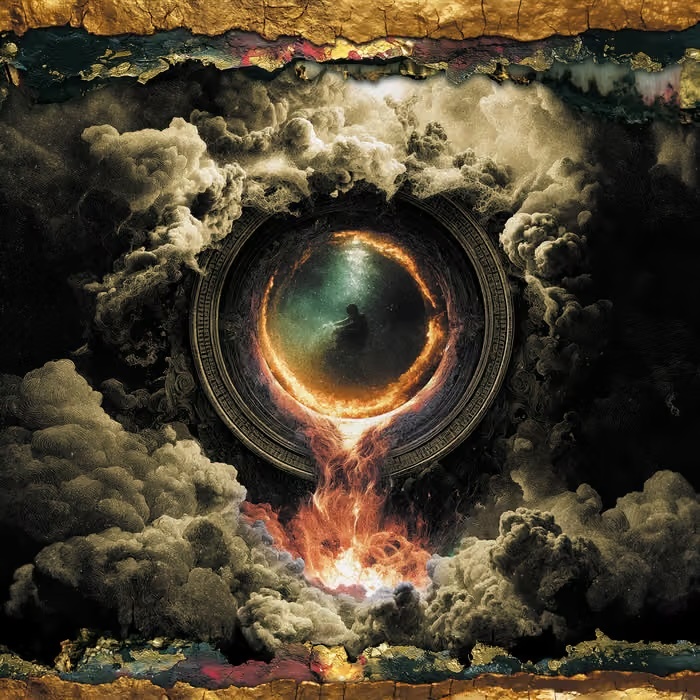
On October 16th ATMF will release a new album named The Great Jihad by the Italian esoteric extreme metal band Urna. It is Urna’s fifth album since the band’s inception in 2003 but their first one since ATMF released Mors Principium Est thirteen years ago. Obviously, Urna’s creation of the new album has been quite a journey, especially since early demos for songs on the new album were already taking shape in the early period after the last album’s release. We’re further told that the album was recoded through multiple sessions between 2014 and 2025, across Italy and the United Kingdom.
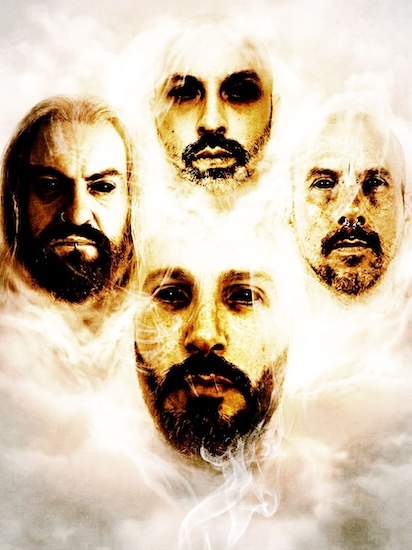
Urna’s lineup for The Great Jihad is a new one. In addition to founders RM and MZ it includes Sibilans (Anamnesi, Simulacro) on drums and T (Sangue Nero) on bass. It is also the first Urna album with lyrics entirely in English (with the exception of their 2003 debut Justa Funebria, originally performed in Italian, the band’s releases have traditionally employed Latin).
The album also has an unusual and deeply thought-out conceptual perspective, one summarized as follows:
In esoteric and mystical Islamic traditions (such as Sufism), the phrase “The Greater Jihad” (Jihad al-Nafs) refers strictly to the internal spiritual battle—the struggle against one’s own base desires, ego, and illusions to purify the heart and align with the divine. The entire record has been framed around this concept, defining RM’s continuous internal spiritual journey through Hermetic philosophy, Kabbalah, Buddism, and more.
The music has also evolved, and we have a striking example of that evolution in the album track we’re premiering today, “Dream Death, Towards Rebirth“.
ATMF’s press materials have described the musical changes:
More poisonous and tense than its predecessors, The Great Jihad retains the crushing atmosphere and funeral doom connection that have long defined URNA, while pushing their faster passages towards a harsher, more abrasive form of black metal. Amid the weight and aggression, vast, sideral melodies emerge from the darkness, adding a solemn dimension to an album steeped in occult and esoteric atmospheres. The result is a work that feels both familiar and renewed, balancing oppressive density with moments of stark, otherworldly beauty.
And we have this statement from Urna themselves:
This has been an incredibly ambitious work. It’s taken us many years to define the natural succcessor of our previous album Mors Principium Est, a work that links with the concept then explored in this new work. In the past we have been known for our crushing fusion of funeral doom, black metal, and cosmic ambient music. In this album we tried to take things even further: faster tempos, harsher black metal moments, a darker feeling in the songs (especially thanks to our new bass player T and drummer Sibilans that have contributed to expanding our sonic journey).
For a more in-depth understanding of the song we’re premiering, we will share vocalist/lyricist RM’s extensive comments about it just after the song stream below. But we ought to get right to the song without further delay.
(I’m just operating on the well-founded assumption that the minds of most people who land here are hurried and they won’t want to scroll much further before beginning to listen. But if you’re more patient than the average human, you really should read RM’s statement about the song before listening to it.)
As the song’s name signifies, it is intended to carry listeners forward on a linear, spiritual trajectory through death and toward rebirth. Musically, it does this in a way that’s breathtaking, and allows no room for the band’s favoritism for crushing funeral doom.
The song begins the transition toward rebirth with a stunning overture in which the music blazes and gloriously blares above vividly throbbing bass notes and punchy percussion, eventually joined by solemn yet gritty growls (on the verge of throat-singing) and extravagant cries.
The song’s soaring melody is exultant and splendorous, but it begins to subtly change and to flow in grand panoramic waves, still gleaming and vast but even more otherworldly. The timbre of the music also becomes darker and more unsettling, more stressful and disorienting, though no less immersive — and the rhythm section’s vivid interplay is still riveting.
The lead guitar seems to wail, and the rhythm section then softens, ushering in a more hallucinatory phase of the song — which in turn transforms into blackened tumult, with drums furiously blasting, the bass heavily heaving, guitars writhing, and other layers wondrously swirling. Even after the drums’ fury subsides, the music remains jaw-dropping and the vocals extravagant.
Even if you didn’t know anything about the song’s inspiration or the lyrics, I think you would find it a soul-stirring experience, a spiritual experience, though on an even more primal and visceral level the bass-and-drum grooves will be just as hard to forget.
The Great Jihad includes six songs, divided into two parts, one named “Creator” and the other named “Created“. “Dream Death, Towards Rebirth” is the second of the three songs in the half titled “Created“. As promised, here is vocalist/lyricist RM’s extensive statement about the song (below this we’ll give you useful links and more music):
The lyrics in this track discuss spiritual transumation through death and towards rebirth/reincarnation. They do so by observing various concepts linked to three well distinct traditions: Tibetan Buddhism, Jewish Kabbalah, and Hermetic Alchemy. In this context, physical death not as an end, but as a necessary catalyst for spiritual evolution.
The opening lines focus heavily on the transition through death via a “state of conscious unconsciousness” and “dreamless sleep”.
This is a direct reference to the Bardo Thodol (The Tibetan Book of the Dead), which teaches that the moment of death provides a rare window to achieve liberation if one can remain conscious. The invocations calls upon the Trikaya (the three bodies of a Buddha): Dharmakaya (The Truth Body): represented by the “deep darkness” and “dreamless sleep”. In esotericism, this darkness is not evil but represents the Primal Void, the unmanifested from which all existence springs. Entering this consciously allows a soul to merge with the ultimate truth. Sambhogakaya (The Bliss/Body of Enjoyment): The subtle, luminous body experienced in clear-light states or deep, conscious dream realms. It is the bridge between the unmanifested and the manifested. Nirmanakaya (The Emanation Body): The physical form that a spiritual being takes to manifest in the material world—the final stage of “towards rebirth”.
The lyrics later shift to Jewish mysticism by introducing the concept of Gilgul (Gilgul Neshamot). In Kabbalah, Gilgul refers to the transmigration or recycling of souls, sparked from a divine source and must inhabit physical bodies to accomplish specific spiritual tasks (Tikkun). If a soul does not complete its mission or perfect itself in one lifetime, it undergoes Gilgul, transmigrating into a new form to continue its work. The Monadic Cycle: The cyclical nature of this process is mirrored in the repetition of “.. towards rebirth..” throughout the lyrics, emphasizing the relentless, turning wheel of cosmic correction.
Then there’s an important biblical passage from Deuteronomy 32:39: “I kill, and I make alive; I have wounded, and I heal…” From an esoteric standpoint we get back here to The Great Jihad between real/unreal, terrestrial/divine, etc. Light cannot exist without darkness.
We then move across a real alchemical formula where “Dream Death” is required to experience “Rebirth”. This quote encapsulates the classic Hermetic alchemical process of Solve et Coagula. The old ego, form, and spiritual impurities must be completely broken down (“wounded”, “kill”) before they can be purified, reassembled, and resurrected into a higher spiritual state (“heal”, “make alive”). Passing the Veil: The “Veil” represents the barrier between the mundane material world (Malchut) and the higher spiritual spheres. Passing through it requires total surrender to this divine, crushing, and renewing force.
Ultimately, the lyrics in this track functions as a ritualistic chant where the music complements the impact of the concept.
The song aims to take the listener on a linear, spiritual trajectory: Material Life Fading > The Veil > Dharmakaya/Void > Gilgul/Transmigration > Alchemical Rebirth.
Death is here seen as a sacred, conscious sleep where the soul is broken down by the Divine only to be recast into a more perfected emanation.
The Great Jihad was mixed and mastered at MZ’s 322 Studio in early 2026. The artwork was created by Francesco Gemelli. ATMF will release it on CD and digital formats, and it’s available to order now. In addition to the links below we’re also including a stream of the first song revealed from the album — “Second of Three” — which is included in the album’s first Part, “Creator“.
PRE-ORDER:
https://tornfromthegrave.com/collections/metal-odyssey-pre-order-now/products/urna-the-great-jihad-cd-pre-order
https://atmfsssdtp.bandcamp.com/album/the-great-jihad