
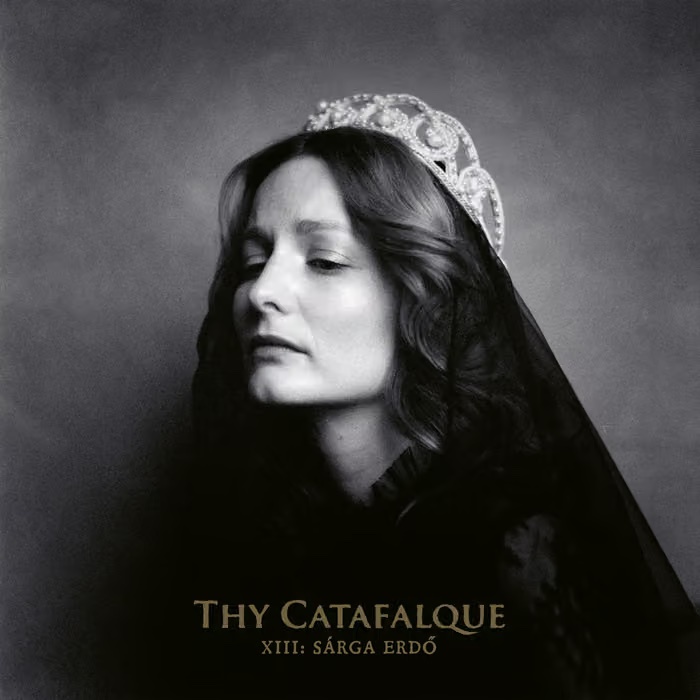
(On November 20th Season of Mist will release a new album by Thy Catafalque, and that eagerly awaited event has brought our old friend Professor D. Grover the XIIIth back to us, as this band always does, with the following review.)
Greetings and salutations, friends. Once more, the impending release of a new Thy Catafalque album activates me like a sleeper agent and sends me into review mode. XIII: Sárga Erdő represents the 13th full-length Thy Catafalque album, keeping with the Roman numeral sequencing started on the last album (not to mention a Roman numeral particularly close to my blackened heart), and it finds the band as a well-established live act. Tamás Kátai, still the driving force and sole member of Thy Catafalque (as far as the studio goes), has surrounded himself with a steady cohort of live musicians and has fully assumed live bass duties.
On XIII, as with previous albums, Kátai handles guitar, bass, keyboards, and some vocals. Also as on previous albums, Kátai features a number of guest musicians, here a staggering 34 different people, plus a 20-voice men’s choir on ‘Cseremisz’.
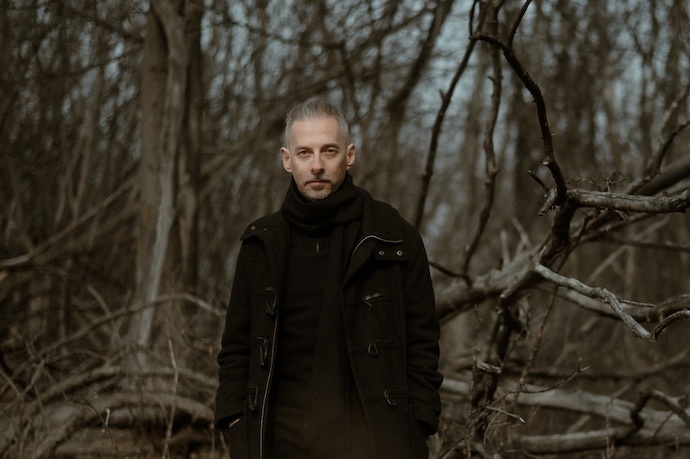
Photos by © Orsolya Karancz
As previously mentioned, the assorted members of Thy Catafalque’s live incarnation appear: vocalists Martina Veronika Horváth, Ivett Dudás, Gábor Dudás, and Bálint Bokodi, guitarists Krisztián Varga and Zoltán Vigh, cellist Michaela Lilla Bos, and in a notable first, drummer Árpád Szenti.
That’s right, XIII is the first Thy Catafalque album to feature live drums. Perhaps it’s a testament to Kátai’s drum programming skills, but this actually makes slightly less of an impact than I would have expected, although the result does sound a bit more organic. There are also appearances from a number of musicians who have collaborated on previous albums, too numerous to mention here.
The press material for XIII mentions that the usual folk elements are used a bit more judiciously than on previous albums, implying that it’s a bit more stripped down than its predecessor, and while I found myself expecting something a bit closer to Alföld, which felt very minimalist, the result is actually something closer to Alföld’s predecessor Vadak, which still stands as my favorite modern Thy Catafalque album.
Truth be told, despite the addition of live drums and the change in songwriting approach, XIII still sounds like a Thy Catafalque album, and that is decidedly a good thing.
I’ve said this in every Thy Catafalque review that I’ve done, probably, but the real genius in Kátai’s songwriting is that he can throw together any combination of elements in his songs, with one or two of any number of vocalists, and in the end he’s still going to end up with something that sounds like Thy Catafalque.
After 15-plus years of listening to his music, I’m still not any closer to fully understanding why this is, but it is the case nonetheless. Bálint Bokodi vocals, Krisztián Varga guitar leads, and a kamancheh (‘Búcsú A Piros Madártól’)? Sounds like Thy Catafalque. Ivett Dudás vocals and an alto saxophone (‘Dunnák Alatt Kék Mező’)? Also sounds like Thy Catafalque. Ivett and Gábor Dudás vocals, a string arrangement, plus trumpet, trombone & flugelhorn (‘Kút Vizén Nap Forog’)? Yup, sounds like Thy Catafalque.
I also want to specifically recognize Kátai’s bass skills, which have been improving as he has made the instrument his own in a live setting. His basslines have always been pretty solid, and occasionally he would bring in a guest musician to drop some fretless bass on previous albums, but I feel like the bass has a greater presence on XIII.
The slap bass on ‘Cseremisz’, for example, is insanely catchy and a highlight of the album. And one of my favorite moments comes on ‘Puszta’ (one of the album’s outright heaviest tracks); there’s a flourish between riffs played on guitar, and then a second time, played on bass, then once more on guitar. It’s this weird, almost slap-bass little thing that only shows up the one time, but I love it.
If you’ve reached this point in the review, and are unfamiliar with Thy Catafalque’s music and are wondering just what the hell this album sounds like, well, I hate to say it, but you’re better off just listening to the whole album. I could point you in the direction of one or two songs, but with a musical style that is this varied, that would only give you a small piece of the Thy Catafalque experience.
Once upon a time, Thy Catafalque could be considered progressive/avant-garde black metal, but the black metal label feels woefully limited here. Progressive metal is probably a decent starting point, but doesn’t necessarily account for the folk elements, or the quiet contemplative moments, or the synth melodies, or the disco strings on ‘Kút Vizén Nap Forog’.
The truth of it is, Thy Catafalque transcended labels 8 or 9 albums ago. This is music that needs to be experienced. It is frequently beautiful, heavy, melodic, rooted in a culture with which I’m unfamiliar. XIII: Sárga Erdő is, like most of the albums that precede it in Thy Catafalque’s discography, a coherent whole that is greater than the sum of its parts.
There are tracks that work independently, and with so much variety from track to track (and even from moment to moment within individual tracks) it may not initially seem coherent, but it really is the kind of album that needs to be experienced in its entirety. There are so many little moments in this album that bring me joy, or make me feel melancholy, or just outright make me want to bang my head and flail my arms.
Some day, I may understand how Tamás Kátai manages to keep making incredible, creative music. More likely, I’ll remain in awe of his skills while still being completely mystified. Either way, I plan to enjoy the ride.
https://orcd.co/thycatafalquesargaerdo
https://thycatafalqueuk.bandcamp.com/album/xiii-s-rga-erdo
https://www.thy-catafalque.hu/
https://www.facebook.com/thycatafalque/
https://www.instagram.com/thy_catafalque/