
(written by Islander)
Szivilizs is a “copy/paste” band name. You can sound it out with your mouth or in your head and understand what they’ve done, but only a calligrapher or a monk would have the time to type out Szivilizs letter by letter in writing an article about them. The time is better spent thinking about how to explain their music.
We metalheads are often simple creatures who think in simple terms. We describe music as “riffs” or “atmospheric”. It “grooves” or it “rips”. It’s “fire” or it’s “ice”. If it gets complicated or unpredictable it’s “weird”. If the melodies sound like something that pre-dates the 1960s it’s “medieval”.
Okay, that was a joke. Not all of us are that simplistic (simpleminded?) in the way we think about metal. But it’s true that most of us don’t have deep learning about musical traditions that pre-date the last century, and what we might think of as “medieval” musical traditions might have originated after the Middle Ages. And if we have any idea at all about what qualifies as “medieval” influence in metal, the odds are it’s because we’ve been listening to certain strains of black metal or dungeon synth.
Putting my own cards on the table, I certainly have no such deep learning. The impressions I have of medieval musical traditions aren’t rooted in much more than certain kinds of “high church” music and chants, certain Christmas carols, and soundtracks to films set roughly in the Middle Ages.
Based on that shallow exposure, it’s understandable why (copy/paste) Szivilizs has been branded “a paragon of medieval black metal”. And yet in the case of today’s song premiere we should do more than brandish that label and be done with it, because the music demands more than that.
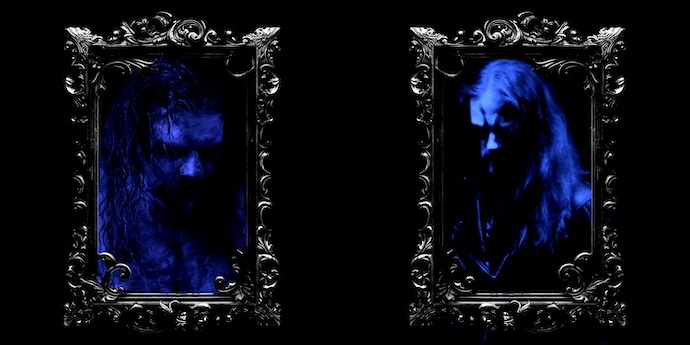
Szivilizs is not only the name of the band but also the name chosen by the music’s Swiss creator, who typically does everything but is joined on a new album by a live drummer. That new album is named Totätänzer, and it’s the project’s second full-length, following 2022’s Grabsuchtslieder. It will be released by Dominance of Darkness on December 17th. Circulating press materials offer this description:
Transportive to the extreme, Totätänzer is a mystical journey into ages past, thematically dedicated to the Renaissance. Joining Szivilizs here is drummer Dyet; together, this iteration of Szivilizs create a raw and yet somehow-kaleidoscopic landscape of stained-glass synths, hypnotically buzzing strings, howling & emotive screams, and rhythms that are patient and measured but never strictly slow.
Indeed, these scabrous but also clearly defined elements merge into a mesmerizing tapestry of sumptuous atmosphere and bittersweet melody, sending the listener straight into the Swiss mountains. Snow-covered Alps, cold sandstone, and the romanticization of a defining historical era are woven into a musical experience….
Did you notice the reference to the Renaissance? Historians, including music historians, put time frames around “the Middle Ages” and “the Renaissance”, but they overlap. And of course music flows forward rather than making sudden sharp turns (or usually it does), and so while “Medieval music” and “Rennaissance music” have separate Wikipedia entries, the boundaries between them seem more like matters of convenience than things you’d have to climb over or push through.
Well, we should leave to more learned people the task of identifying the sources of musical influence that Szivilizs has drawn from in creating Totätänzer. I’ll just try to express the sensations it generates and the feelings it inspires, in the context of the one song from the album that we’re about to premiere. But before doing that, I should share the results of my googling about the meaning of the album’s name.
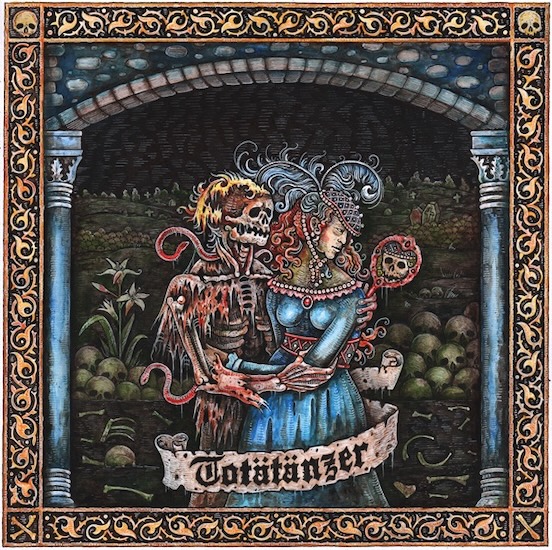
That cursory research suggests that Totätänzer refers to a participant in the Totentanz (the Danse Macabre or Dance of Death) — a late-medieval artistic and literary allegory depicting Death leading people from all social ranks (from popes and emperors to commoners) to the grave to emphasize the universality of mortality (see this source).
The name of the song we’re premiering is “Baerner Jungfer“. What that name refers to isn’t clear to me either, but my best guess based on some googling is that it refers to a Swiss alpine region that includes the Jungfrau mountain peak and the Jungfraujoch railway station (“Top of Europe”).
As for the music, it mysteriously rings and ripples but also abrasively scathes, and here the drums do speedily clatter as well as steadily clop. The crackling screams are furious, but voices reverently sing — though at times it may be difficult to distinguish those tones from the elegantly gleaming and slowly flowing synths that shine in the song’s highest range; they meld together.
Down below the bass prominently hums in musing tones and vibrantly throbs, while far above other tones vividly sparkle and dance. The drum patterns shift constantly until near the end when they fall silent and brittle lyre-like strings return us to mysticism and mystery.
And so the music proves to be elegant and refined, ancient and alluring, but it’s also raw, raucous, and raging. Its sounds are ethereal and they shine, but they also lacerate like storms of grit. All by itself, the song could be a rendering of the Danse Macabre, with Death leading the way from early times to the present day.
Totätänzer features distinctive cover art by one of our favorites, Luciana Nedelea. Dominance of Darkness will release it on CD and vinyl LP formats. For more info, check the locations linked below, and after the links please listen to the album’s first single, “Fründ Hain“.
DOMINANCE OF DARKNESS:
https://www.dod-records.de/
https://dod-records.bandcamp.com/
https://www.facebook.com/dominanceofdarkness/
https://www.instagram.com/dodrecords/
SZIVILIZS:
https://www.facebook.com/szivilizsBM