
(written by Islander)
In October of last year we premiered the debut album of the Polish avant-garde black metal band CAŁ● — Ludzie błądzący w nocy (“People wandering in the night”). CAŁ● is one of many vehicles for the creative expressions of the Polish musician (or musicians?) Ø Grémium, who has (have?) also created music under the names of such bands and projects as Ùna, Apostasus, Toska, Nocte, Etěr, Exudation, and Widź.
I am not a succinct writer, even when I have the time to focus on concision, but the review I joined with that album premiere was extremely wordy. The music had set my mind spinning in a multitude of directions and the words just kept spilling out in a feverish attempt to express what I was hearing and how it made me feel. Ultimately I decided that trying to cut back the verbiage or organize it better would make it a less immediate and less authentic representation of the music’s designs and effects.
As you can see, we are returning to CAŁ● today, on the day when they and Devoted Art Propaganda are releasing a new EP named Zanim Minie Ciemność. We are very happily sharing a full stream of the record below, preceded by another torrent of words, though a somewhat reduced deluge because we’re considering only four songs this time instead of nine.
At a very high level, somewhere above the elevations at which aircraft cross the Atlantic, the music is once again a head-spinning and genre-jumping experience. The record as a whole (including its outward trappings) reinforces the impression that Ø Grémium’s interests in literature, visual art, and music are wide-ranging, an impression strengthened in detail through some private e-mail conversations. Those conversations have provided insights into the meaning of the new EP’s song titles.
The first of those songs is “Za Kończenie“. It is similar to the Polish word “zakończenie”, which means “ending”, but by separating “Za” from “Kończenie” CAŁ● has turned it into something like a drinking toast — “For the ending”. By putting this song first, CAŁ● is trying to tell us something, though I’m not sure what. But what the hell, drink!
The song sounds like a host of chimes ringing, strange chimes that are both jubilant and unsettling. The chimes begin to frantically writhe as percussive cannonades, rapidly rumbling bass notes, and maddened howls join in. The tempo changes without warning; the drums vanish for a time; the music fizzes, glitters, and jazzily swirls; it also convulsively screams, brutishly jolts, and eerily rings. The ending is just as eye-popping as the beginning.
The instrumentation is elaborate, multi-layered, ever-changing, widely varying in its carefully crafted tonalities. At times the song sounds like it is striding across many centuries of musical tradition. The music is seductive and startling. It beckons and it blasts, creates strange spells and extravagant spectacles, and doesn’t reveal all its secrets in just one listen. It proves once again that a label like “avant-garde black metal” only makes sense for CAŁ● because it’s such an amorphous appellation.
The second song “Odorem ziemi” translates more directly into English, meaning “By the stench of the earth”. As compared to the riotous extravagance of “Za Kończenie“, the reverberations of the second song’s slowly strummed notes create a dark mood. Other filaments of sound arrive, along with pattering drums we might call tribal, to help create a hallucinatory experience.
The vocals are terrifying, and the music erupts in frightening ways as well, creating a thunderous surge within which the music warbles and wails. But CAŁ● again changes direction constantly, slowing down and speeding up, ejecting wild cries and unhinged shrieks, letting vaporous musical sprites woozily wander and wooly beasts heave, spiking the music with shrill and feverishly quivering tones, creating avalanches and fanfares of ominous grandeur and bizarre dances.
CAŁ● told me this about the title of the third song, “Kto nie dotknął ziemi ni razu, ten nigdy nie może być w niebie“:
This is direct homage to the legendary Polish Gardzirnice theatre that originated in 70s Poland and has been a creative force recognized world wide. This is a quote from its founder and main driver Włodzimierz Staniewski. The track has no words but its title is perfectly fitting for the vibe of the track. The meaning is “Who never touched the earth, can never be in heaven”.
As represented, this is an instrumental track, and the shortest of the four on the EP. The music shimmers and shines in ways that evoke the worn-out adjective “cosmic”, but CAŁ● peppers those ambient rays with a wide array of other sonic spices, including the wandering of a big growly bass, quick bursts of guitar jazziness, and flashes of siren-like alienness. The atmosphere is futuristic, noirish, narcotic, mysterious.
The fourth and final song is “Zgubi się we mnie“. I received this explanation of it:
It can be translated as “(Thou) will be lost in me,” which again, is a deliberate choice for an ending of the EP as the lyrics are centered around the word CAŁ● which is a made-up word that, depending on context, means different things. In this case CAŁ● is what (the listener) is to be lost in.
After the relative placidity of the third track (and in the case of CAŁ●, “placidity” is a very relative term), the final one jumps with rocking beats and surges with heavy thrust, and once again the throat-ripping vocals are wild. Once again, the music includes manifold ingredients in the higher end of the tonal range, some of which sparkle, some of which scream, some of which moan.
The drumming is in constant flux, and it turns out that the vocals will be too, as intriguing feminine singing joins in, as well as spoken words. The music throbs like an enormous vein, squalls as if a jazz band’s horn section dropped way too much acid, breaks out in gleaming spasms, sounds ecstatic and freewheeling and romantic and befuddling. But oh what fascinating bewilderment this is! What wonderful methods for the madness….
Of course different people are fascinated by different things. The same experience might enthrall and astonish some people and leave others thinking it’s a hare-brained scheme that’s nonsensical. In the case of this new CAŁ● EP, I’m powerfully fascinated, and unsure whether I’ve heard anything this year that has fascinated me more. I find it easy to get lost in. I find it a welcome reminder that while much of daily life can be as dull as dishwater, it can also be as dazzling as a diadem. As for you, well I just hope you’ll give it a chance — which you can do now:
Here are a few more details that I’ve learned in answer to my questions, and once again I regret not asking many more questions:
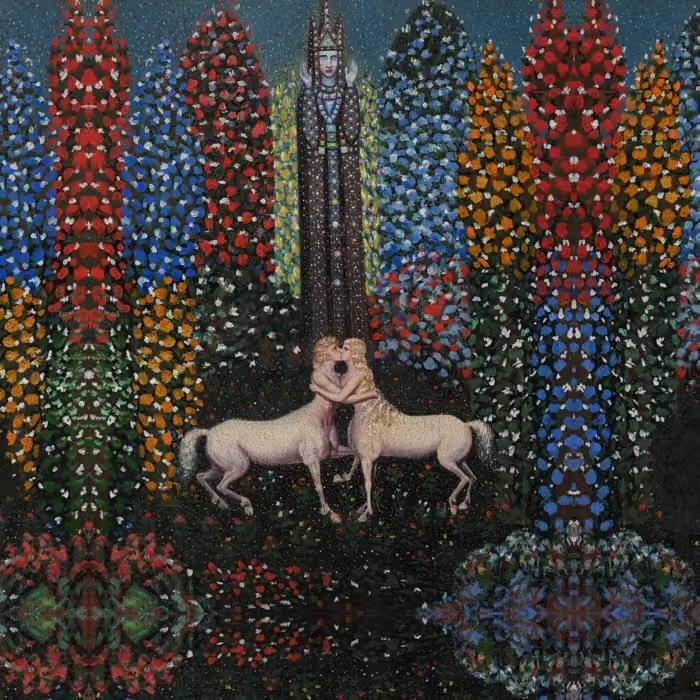
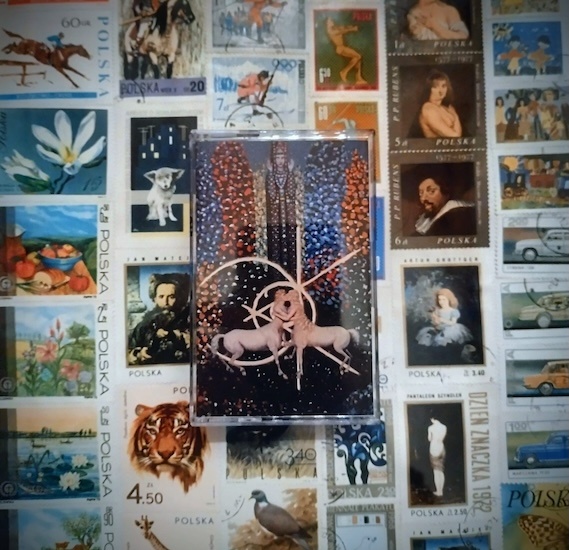
The artwork for the EP is a collage created by Ø Grémium from a painting by Bolesław Biegas, who was a Polish surrealist and symbolist painter. As Ø Grémium described, “His work is extremely unique and evocative which we do feel fits CAŁ● perfectly”.
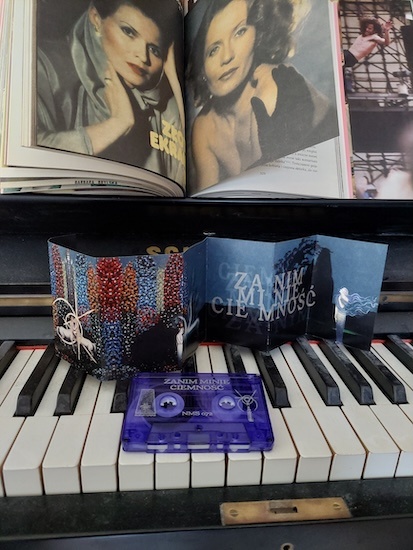
As for the photos of the women in the book propped above the piano in a photo I included up above, it’s the same person. Ø Grémium explains that she is a Polish actress, Grażyna Szapołowska, very popular in ’80s. “One of the more popular movies where she was the main actress was Kieślowski’s ‘short story about love‘. She or photos of her are not directly related to CAŁ● but it does fit a certain atmosphere from which CAŁ● originated.”
Zanim Minie Ciemność will be released on cassette tape by Devoted Art Propaganda and digitally by the band. You can order it at the locations linked below.
TO ORDER:
https://callo.bandcamp.com/album/zanim-minie-ciemno
https://d-a-p.org/
TO FOLLOW:
https://www.instagram.com/o_gremium