
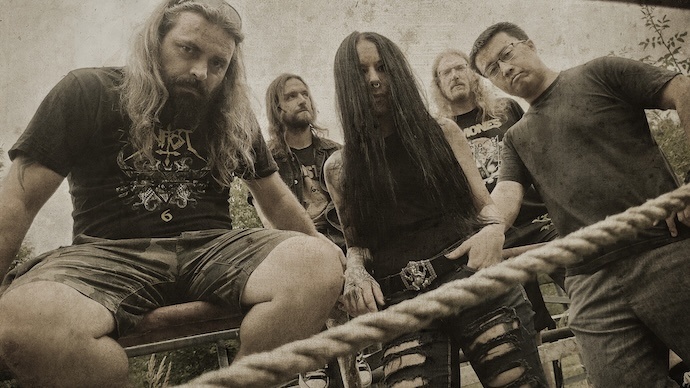
(On October 15th the German band Gorleben will have their second album released by Darkness Shall Rise Productions. The music and other aspects of the album are fascinating (as we’ve already previewed), and so is the following interview conducted by Comrade Aleks with Gorleben member 235U.)
Gorleben was named after a municipality in Saxony, next to which an ill-famous radioactive waste storage facility is located. Hence the radioactive hazard sign in the logo, hence the nicknames of the participants taken from the names of radionuclides, hence the themes of the songs.
43 minutes of Menetekel are divided into four tracks. “Countdown” begins with a dreamy psychedelic theme accompanied by the sounds of nature, but gradually “the electricity turns on” and the melody becomes doomy, menacing, and heavier. It’s strange, but at some point it seems that two different tracks are playing: something like mid-tempo gothic metal and melodic death-doom in the vein of Katatonia. Gorleben know how to keep their identity yet also keep to the “Katatonia” scenario, further adding to their palette a duet of growls and harsh female screaming.
Suddenly, electronic samples penetrate the composition, and the riffs become chopped, industrial, and the male growl is replaced by a heart-rending black scream. In short, a lot happens in the first thirteen minutes of the album.
“Erg” demonstrates the same duality, and agonizing extreme vocals can surface simultaneously with trembling, melodic guitar trills. This track has the frantic pressure of depressive black and post-metal, but Gorleben still defy classification and do not constrain themselves by the boundaries of genres. The combination of extreme themes, some instrumental fragments of psychedelic dreams and original keyboard melodies with a retro flair is characteristic of “Sarkophag” and “Menetekel”, but I would probably note one characteristic feature of the entire album: it is interesting to listen to. This puzzle of styles sounds attractive, it is original, and, what is important, the proportions are chosen in such a way that the material sounds digestible.
As I was curious about the band’s inner machinery and so on, we organized the interview with them, and 235U (guitars, vocals) promptly answered.
******
Hi Gorleben? How are you? Are you preparing for the Menetekel release somehow?
Hey, yes, we’re actually preparing shows within a little tour soon to promote the release of our upcoming album. Release date will be October 15th via Darkness Shall Rise Productions.
Let’s return back in time. You named the band after the municipality which is known mostly because of a radioactive waste disposal facility located nearby. What drew your attention to its case?
This is a little more difficult. We started the band as a doom/death metal project with no songs below 10 minutes of duration. After the first rehearsals, we were in need of a fitting name and theme. The name Gorleben sounds quite stirring in German and the post-apocalyptic themes suit our concept of music because it’s very spacious in total. So it was pretty apt for us to choose this name.
Your first album Game Over (2022) was already composed as an original mix of death-doom and black metal. Why do you choose this combination of these genres to transmit your message? Did you have some examples in mind? Or was it done intuitively?
Well, on one hand there was the idea of extensive songs by all means which should turn out heavy and dark. Also, the first members of Gorleben starting the project were already involved in both metal genres, delivering destruction, death, and abysses of humanity as common themes. On the other hand we’re creating music which we like and listen to in private. That’s why the new album has so much more influences from other genres. So things come intuitively during the composing process to create the music and transport of a certain message as we like it. As comparable examples for the first album we can name bands like Dawn of Solace, Cult of Luna, and Black Sun Aeon among others.
Let’s take the first track “Countdown” for example. It’s a thirteen-minute-long piece with a long quasi-psychedelic intro, with a clear death-doom part, and then you just throw everything into it. There’s a part when it sounds like two tracks played at once: one is mid-pace death-doom in a vein of Katatonia and another one is keys-oriented. And there are two different extreme vocals too, as well as that harsh shouting stuff and an almost industrial section… How did you manage to combine so many elements in one song?
This is what the concept of the new album is all about. When you take a closer look at the other songs, you can separate these into two elements as well. We’re keen to bring the predicted apocalypse into our present and make it experienceable from two temporal dimensions – future post-apocalypse and the present in which we all are actually in.
The composing of a song takes quite a long time for us, because we have so many ideas we want to put into it, but always take care that there aren’t too many elements, simply to keep the flow of the song. It’s a very thin line we’re walking, but this approach did match with our last album and hopefully works again – for our traditional as well as the welcome new audience, to provide them with a solid concept including a still urgent and clear message with our actual release.
By the way, what’s first for you – music or the necessity to spread the message?
Honestly: both and equally treated in our workflow. We’re setting up an order of different arts which include a message as well. Everyone consuming our outputs should be served with an opportunity to get and form their own message out of it. Our releases aren’t about the music only but about lyrics and many more details wrapped around, i.e., the artwork.
Do you feel that listeners get it right? How actively do you spread your message yourselves?
We don’t really know and simply never can be sure if people get our message the way we had in mind. Perspective and interpretation is also on them and to their own, as said. Plus, we didn’t perform the new songs yet – just our single was published. But so far we can state that the previous album spread exactly what we’ve wanted – the feeling of being in a post-apocalyptic scenario. This is also what we’ve got as feedback from a lot of people. Given our own private daily scenarios and news on media, we discuss upcoming social breakdowns, ask what several signs could bear and think about the upcoming future, which could be a very dark one for the following generations of course.
The artworks of both Game Over and Menetekel look like a caricature — are you involved in social activism somehow? I just see that Martin performed more “standard” metal-artworks, so I suppose that his approach to Gorleben is an individual one.
We’re not directly or actively involved in social activism except with our music. But we think this is also a way of activism. Martin as one of the first members of Gorleben has a closer connection to the band and thus also to the topics we’re processing. As said before, it isn’t about the music only but the transported message as well.
You took nicknames after radionuclides — was it done as a part of the band’s image or do you work in a field of radiochemistry?
No, none of us works in this field. The nicks are taken as a certain part of the “image” like you described it. We call it an overall experience of our work. In our opinion, everything needs to be adjusted to fit into a concept for the consumer to clear up and define the underlying message. We wanna pick them up and take them with us over the times they’re consuming or dealing with our creations. We want them to dig and dive into it to the maximum possible for them.
Nice idea indeed. What about your live performance? Do you use some extra attributes at the stage? Barrels with a radioactive hazard sign? Radioprotective suits?
We actually already use a barrel, equipped with lights inside and with a radiation warning symbol on it as a kind of backdrop. Plus UV-Spots combined with UV-Makeup and two heavy duty microphone stands, which are made from insulators for high-voltage lines. We are always brainstorming about new ideas or requisites to push the concert atmosphere more lively.
The title song’s name “Menetekel” appeals to the legend of Belshazzar’s feast, a warning, a writing on the wall, that means “you have been weighed … and found wanting”. A quite sophisticated way to say “doom is upon you”. How much do you care about Gorleben’s image in this context? Do you aim to leave your trace in the extreme underground?
We’ve chosen the name of the song “Menetekel” because it’s one of the oldest known prophecies. After and likely with it, the big empire of Babylon collapsed. There are so many parallel aspects to our present situation, that the resulting terminology around Menetekel is predestined for our message. However, if someone feels the need to put us into a religious context, feel free, we are very curious about the belays. We all couldn’t care less about a genre-specific image created by well-known bands. We are what we are – individual, wide-ranging, and overall different.
I suppose that the “Sarkophag” song is dedicated to the Chernobyl catastrophe. What are the other songs, “Countdown” and “Erg”, about?
No, sorry. “Sarkophag” is about the German called “Endlager” which is a nuclear waste disposal facility as an intended final solution for over thousands of years. “Countdown” describes the result of destroying humanity by itself into a countdown into eternity, and the countdown on it is already running. “Erg” is actually about the component time, which is running continuously but no one is paying attention to it since it’s passing by. The song was written in a desert where 235U got the knowledge of the point that time is nothing and just passing by but yet quite important because it’s running and passing by.
In a desert? Really? How did it happen?
Yes, it happened to U235 during vacation in Morocco. He had been sleeping in a camp in the desert called “Erg Chegaga”. The locals there had a guitar and thus he had played the guitar the whole day while sitting on a dune.
Can you tell more about songs’ lyrics? From the outside it looks like you highlight the role of the radionuclide usage industry in general in humankind’s unavoidable death, yet we use radiation effects in medicine, industry, in scientific research, and so on. It is not the bullet that kills a man, but another man, like that.
Sure, the origin of our idea is laid in a German documentary called “Countdown to Eternity”, where the participants discussed how to explain the irrefutable facts to people in the future, that nuclear waste disposal facilities include nuclear waste and can’t be opened until time X. They thought of symbols, which can still be understood in more than 10,000 years; they thought of some sort of nuclear priest organization transporting the knowledge from generation to generation. Also some really interesting issues were mentioned – like we aren’t able to understand the real meaning of the hieroglyphs carved into the walls of the pyramids. These are “just” about 4,500 years old – so how do we get the mind of creating a warning which could be understood in 10,000 years?
At this very moment humanity thinks that we’re so intelligent, so clever and well-educated, that we fully grasp and understand what we are doing. But back in the ’80s we threw nuclear waste into the ocean because we had the (always varying, but possibly tendentiously bent) “scientific evidence” that it would not harm us. Well, we’ve been wrong and this circular reasoning got only 45 years until refuted. So who are we to think we are capable of giving a guarantee for 10,000 years?
We know that nuclear science can also be used to help people, especially in the medical field, but when humanity is inventing, experiencing or discovering something new, it’s always been used to destroy something first, or at least besides the healing or value-creating intentions.
How often do you play live and with what kind of bands do you usually share the stage?
We’re trying to hold on to live activities but it has become difficult for the underground scene more and more, especially for a small band like us. As our music is influenced by a load of genres we already shared the stage with doom, black, death, thrash, and even heavy metal bands, as well as punk, stoner, and core bands – while, according to their voices, it was always a positive surprise for the people who weren’t familiar with us and our music before.
Yes, I actually wanted to ask how problematic it is to find a suitable company for gigs, taking into account that Gorleben performs music that is difficult to pigeonhole… But you say that it became difficult to hold on to live activities – why? Are venues closed since covid? Or is it because of people visiting gigs less and less?
At the moment there is a lack of money for most of the people because of a significant, certain shortage and inflation and thus skyrocketing costs for basic supplies like electricity, fuel, gas and oil. So people can hardly afford any kind of “luxury goods”. Second, there are so many places, venues offering everyday arts, bands and more – this sometimes leads to some sort of oversupply. It is an economic principle that demand determines supply and vice versa. We deeply hope that things get better soon, but eventually consider how many really good bands are around and also think of how often you can attend their shows to support them. With that in mind, we are just a small band and no big crowd noticed us so far – no complaint but an objective view to our actual level and the situation in general. It is what it is, but we’re eager to change it.
What are your overall plans for 2025?
It’s actually touring and presenting our new album on and off stage to and for the people, spreading our radiant message (pun intended). And probably starting to write new songs. 😉
How many gigs do you already have in your list? Where will you play?
It looks quite good for our tiny tour now but it was a very hard bumpy road to get there. Most of the shows are on German soil in cities like Halle, Amberg, Erfurt, Hildesheim, and of course Dresden. One gig will take place in Slovenia, organized by friends. On our last tour we did two shows in Austria. So we eagerly try to enlarge our audience number and our geographical range.
Okay, thanks for the interview. I really hope that we’ll have a chance to do another interview when you have another album. Any final words for our readers?
You’re welcome. We don’t wanna forget to thank you and your readers very much for your interest and the opportunity to present ourselves here. Keep on supporting underground extreme music, it’s a very important sub art, addressing and expressing real issues and grievances = reality!
https://www.facebook.com/GorlebenUran236/
https://gorleben.bandcamp.com/
The band is from Dresden, Saxony, while the nuclear waste facility is in Lower Saxony, a completely different state.
Exactly, and there was no mention that they’re from Gorleben itself.