
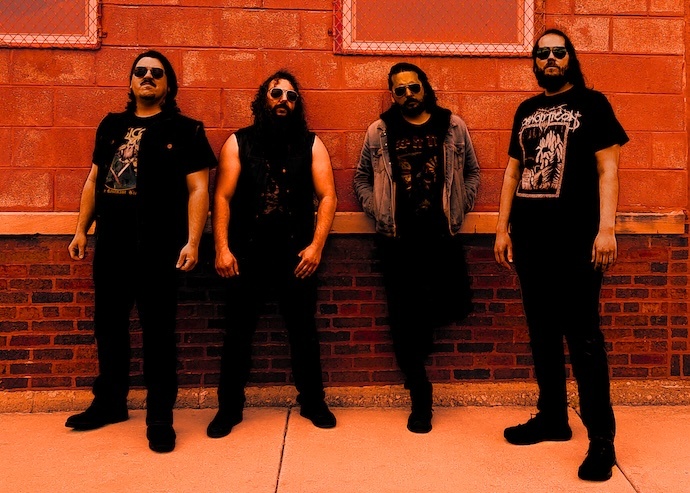
photo by Matt Chains
(Comrade Aleks has brought us a truly excellent interview with members of Chicago-based Fer de Lance, whose enthusiasm for metal and their own music-making is highly infectious. Their latest album, which is an exception to the not-entirely-serious rule in our site’s title, is also an excellent one, and worth checking out before, during, or after this very engaging discussion.)
Around 2019, MP Popeye (vocals, guitar) and Pat Glockle aka Rüsty (bass) left the Chicago heavy doom band Professor Emeritus, so it took their friend Lee Smith another six years to find a new lineup and record a second, and by the way, very cool, album. But it was all part of a cunning plan, as MP and Rüsty quickly found collaborators (Scud on drums and J. Geist on guitars) and formed their own band, Fer De Lance, and in 2020 recorded the EP Colossus, followed by their full-length debut, The Hyperborean, in 2022.
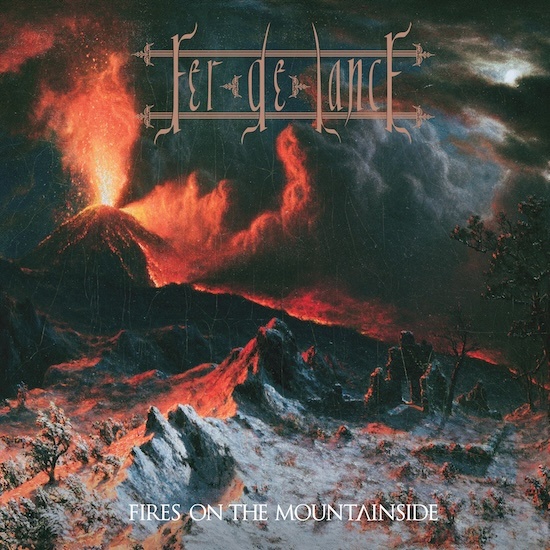
To Fer de Lance‘s credit, they didn’t waste any time and are already thundering along with a second, more powerful album. Fires on the Mountainside combines a number of musical concepts, among which are doom metal, classic heavy metal, even some elements of Mediterranean folk, and the epic nature of Viking-era Bathory.
It’s a curious thing, but the guys really managed to skillfully blend the purity of epic doom with the raw energy of heart-pounding straightforward acts, as heard in “Fire & Gold.” Or check out “Death Thrives (Where Walls Divide)” — how often do you hear such a sublime, heroic, and yet so naturally flowing vibe? Fer de Lance are equally at their best when they maintain a measured narrative pace, where they deliver with competence and confidence.
But they also naturally charge at full gallop in a battle formation (“Ravens Fly”); such grandiose, uplifting, triumphant narratives, imbued with the spirit of defiance and freedom, enhance the album. Everything exudes freedom and power. Fer de Lance are so good that even the nine-minute “The Feast of Echoes” and the thirteen-minute “Fires on the Mountainside” retain their dramatic intensity and somehow naturally hold your attention until the end.
A shockingly cool album. Have you heard anything like it this year? No, you haven’t, there wasn’t anything like this. Well, the album was officially released in June, but if you missed it, then this interview with MP, Scud, and Rüsty may stimulate you to pay attention to it.
Hail Fer de Lance! What’s new on your side? How are you doing?
RÜSTY: Greetings, No Clean Singing! I’m doing well over here! Especially with cool folks like you reaching out to talk about Fer de Lance. We had a pretty busy and exciting Spring this year with our tour of the Eastern USA, followed shortly by the release of our new album. It feels like it’s been pretty well received. More recently, we’ve been enjoying Summertime in Chicago, working on new songs, and talking about more records and shows. I’m feeling energized.
MP: Hi, NCS! Doing fine! Thanks for the interview. We are definitely in awe of the response to Fires on the Mountainside. We’re slowly working our way through some show offers and making tour plans. As RÜSTY said, we are working on some new music as well as some old music written around the same time as FOTMS. The next album has already taken a pretty distinct shape!
SCUD: Hails No Clean Singing! Since coming back from doing our East Coast tour, I’ve been spending most of my time in either a pool or a jacuzzi. Pretty stoked on how much love we’ve received from the new album and have just been soaking it all up along with the sun this summer.
I believe that you heard it, yet it wouldn’t harm everyone if we told once more that Fires on the Mountainside is a masterpiece of doom metal. You don’t need to listen to it twice to get the sheer scale of melodies and the entire composition of this material. So did you know from the start how great the album would turn out to be?
RÜSTY: First, wow! Those are heavy words. Looking back and considering MP’s original demos, I remember feeling the songs were all very strong and different from our previous work. I guess I started to get an idea that the album was something special once we got further into the recording process and the songs started to take shape. I could really feel that everyone, including Matt Russell and Arthur Rizk in the studio, was giving it their all to make the album sound as great as possible.
SCUD: Why, thank you, we definitely attempted to step up our “epicness” on this record, and it sounds like we achieved it! Although our previous album was quite the mountain to climb in terms of sheer atmosphere, I felt this album was going to overshadow it once MP started sending me the demos. I had no idea what the response would be, and I had so much doubt that after I recorded my drum parts, I stopped listening to any subsequent progress. It wasn’t until after hearing the album and after Arthur Rizk had used his wizard magic that I knew that we had accomplished something truly powerful.
MP: Thank you! I knew as soon as I wrote the song “Fires on the Mountainside” as one of two long epics that I wrote back-to-back that I had written something important, not just musically, but a concept and story that I needed to get out as well. We had “Feast of Echoes” and “Ravens Fly (Dreams of Daedalos)” already, but FOTMS kind of put everything in perspective and gave us a constellation to steer by. I have a lot of belief in what I am doing, what we are doing, so in every album I’ve seen something special.
Did you work all together on Fires on the Mountainside? Or is there a main songwriter in the band?
RÜSTY: MP is definitely the vision man and main creative force of Fer de Lance. Over the years, things have grown more collaborative and collective in support of that vision. We only started playing live after the release of The Hyperborean. FOTMS is the first album where we were able to play the songs together before entering the studio. I’ve also been bringing songs to the band and was thankful to contribute “Fire & Gold” to the new record. MP and I often work together to finalize lyrics. Scud really forged into a mighty pillar of the band in the making of FOTMS. His drum parts and dedication to his craft really impressed me. One day, he was explaining how he arranged drums and his drum philosophy, and it pretty much blew my mind.
MP: Yeah, this album could not have been made without RÜSTY and SCUD. They are a pretty thunderous rhythm section, and I am very happy to have them in the band. Speaking of SCUD’s drum philosophy, it made RÜSTY forget that time and space existed, that water was wet, and up from down. Human sacrifice! Dogs and cats living together! Mass hysteria!
SCUD: This album has solidified our songwriting process as a group, and I couldn’t be prouder of us and how strong it has made our band. It all starts with the quality steel provided by MP, then my mighty hammers forge the blade, and lastly, it is RÜSTY’S special arcane enchantments that perfectly craft our mighty swords, er, I mean songs. As for my revered drumming philosophy, you might be asking? It is simple: have fun!
Hah, yes, philosophy! Are you still at the stage of wondering how exciting and big the doom metal world is? I mean that you sound like a true zealous believer who’s possessed by music. You sound damn excited speaking about your music, so I believe that you really believe in it. “Doom over the World” or Doom Metal Brotherhood thing!
RÜSTY: I’m still in awe of our natural world, the Earth and its oceans, forests, and mountains. Considering time and history, it’s almost insane that we are even here and have resources to create and preserve, writing, and music. In that sense of pure bewilderment and love for life, I’m possessed by music. As a listener, it sustains me. It’s a feeling. It’s magic! I think the excitement you are sensing is that we’re feeling proud of the record we made together, accomplished from the success of our tour, and fired up to continue on our creative journey.
SCUD: It’s pretty fantastic that we as humans get to create loud, weird, heavy noises in rhythm and other people listen and are like “woah, this is sick!”, then they in turn make their own loud, weird, heavy, rhythmic noise. It’s both an honor and a privilege to be part of this cycle that has existed for tens of thousands of years, and with this wonder and excitement, I hope it lasts until the end of time itself.
Okay, I’m surprised with the answer, but accepted! How much did this material change since the first stage of its creation? Did it come easy or were there any difficulties on your way?
SCUD: I love getting to hear MP’s demos, and I’m forever grateful that I get to add my personal touch. While MP’s drum programming is pretty good, they are just computer drums, and they lack the humanity that’s needed for good metal music. So my favorite thing to do is to interpolate those tracks and inject some rhythmic emotion. I sat in my basement with these demos, playing along and recording for months until I felt they were perfect. The process may seem crazy to some, but for me, it’s my passion, and I love getting the opportunity to give life to songs.
RÜSTY: The drum parts he tracked ended up differing from the demos so much, I had to rewrite bass parts on many songs and delay recording. It was a challenge at first. Once I got the bass guitar reworked to fit the drums, things took shape. I remember there seemed to be a consensus among the collective that the new drum parts took the songs into adventurous rhythmic territory and that, quite possibly, we were becoming a prog rock band.
MP: Yeah, SCUD’s drums were a big and very good departure from my demos. There are times in “FOTMS,” “Children of Sky and Sea,” or” Ravens Fly” that I hear bits and pieces of my demo drums, but all of SCUD’s new parts are improvements, along with RÜSTY’s new bass parts (to fit SCUD’s drums). Guitar/vox-wise, the changes between demo and final song were just changes in what I improvised when recording. You hear something in the studio, and you just need to follow it, and something new is created.
Our new style of recording–some at my home studio, and taking our time at Matt Russell’s studio–allowed me to really explore some new possibilities, add keyboards, more solos, and sound FX. There are always tons of difficulties still, both personal and technical, but we’ve come a long way from Colossus in solving these. Overall, or maybe comparatively, this was a pretty painless album.
Did you think to record the songs all together at the studio? You know, a kind of stereotype about “metal life”: having fun at the studio, having fun at rehearsal place, sweating in the van, and having fun in a process, and so on. Nowadays, when there are so many opportunities to record remotely, it looks like something different. At least from the position of a listener, when you try to get a band’s motivation.
MP: Yeah, maybe that stereotype is a holdover from the ’70s and ’80s? Music doesn’t pay our bills. Gone are the days of the record label paying for bands to spend months in a château in Southern France converted into a makeshift recording studio while also footing the bill for daily allotments of cocaine. For an underground metal band, recording is a struggle. Yeah, practices are a lot of fun, touring is even more fun, and playing on stage is one of the greatest things on our Earth.
Recording in both a studio and at a home studio has the benefit of both saving money, but also for bands like us, where the studio version of a song can sometimes be very different then how we play it in a demo or live, it allows us to breath, listen, and come up with something really cool. A lot of my solos on Fires on the Mountainside came about because I heard something new, and I took my time to figure out a solo that made the song better.
I’d say for a listener, don’t romanticize the “The Decline of Western Civilization Part II: The Metal Years” style of partying, romanticize the band struggling to release new heavy metal music in a late-stage capitalist society surrounded by generic and corporate-written music while music streaming apps replace album sales, giving you micro-fractions of a penny: an epic struggle if ever there was one!
RÜSTY: I would love to record an album all together. Maybe someday the stars will align for us to do that. We know our time in the same room is limited and I think we do well to make the most of it when we are together. We still had a lot of fun making FOTMS. The overdub sessions at our practice space were probably too much fun. There, MP and I arranged and recorded the choirs, drums for “Fire & Gold”, and percussion. Listen to “Tempest Stele” and imagine us bashing on the tambourine or whatever we could find to make the right sounds. In the bridge of “Ravens Fly”, we wanted an anvil sound to represent Daedalos at work. I found two thin, heavy pieces of metal I rescued from the alley years back, and finally, their destiny was revealed. I clanged them together in every which way until we found the perfect sound. That was a little triumph of steel!
SCUD: Although we didn’t spend our entire studio time together, we still fit that “metal life” stereotype pretty closely. Maybe our having fun doesn’t get quite as rowdy as MP described from the metal days of yore, but we still hang out and “have fun” regularly. We still go to shows together, drink beer, watch dumb movies, play cards, and sweat it out in our 7×10 practice spot banging out the tunes we end up taking to the studio. This isn’t a metal album recorded in complete isolation, it was recorded with our own individualities in mind (AND by doing some home recording we saved money for more beer!) Our motivations may be admittedly kinda nerdy in general, but is that not metal? To live the life of an outcast? To find meaning and community within this world of heavy metal chaos? I think so.
You’re from Chicago, and Trouble started there as well, but I doubt if this band had a direct influence on Fer de Lance. Which wave of doom metal is more interesting for you? Are you into the stuff those bands of the past produced or are you more into the bands who developed their ideas later?
MP: I am no doom aficionado. Although I am a fan of most of Black Sabbath’s albums, and epic doom like (especially) Atlantean Kodex and recently Doomsword. So, I’ll have to field this question to RÜSTY and SCUD.
SCUD: I regret discovering Trouble way too late in my life. Seeing them live this year absolutely blew me away with their dueling guitar solos and crushing riffs. I’m not a big traditional doom guy either, but I do love me some death doom a la Spectral Voice, Primitive Man, and Ahab, or stoner doom like Electric Wizard and Chicago’s own Bongripper. Those definitely influence my playing more, BUT there is a special spot in my heart for Candlemass’ Nightfall. That album is, in my opinion, perfect. I’ve listened to it at least once a month for a decade now, and it is one of my all-time favorite albums. It grooves so hard, and I just can’t resist singing aloud. YOU ARE BEWIIIIIITCHED!
RÜSTY: If we’re talking doom, I guess we have to acknowledge Black Sabbath as the best and, to me, the true doom innovators. Now it’s easier to answer. I’ve found much past and present doom metal to enjoy. Upon moving to Chicago, I was just getting into metal from punk thanks to European power metal bands like Gamma Ray and Blind Guardian. I knew little of ’80s metal music aside from the huge songs like “The Number of the Beast” or “You’ve Got Another Thing Coming.” The fine Chicago underground metal folks quickly educated me on the ’80s, including doom bands like Candlemass, Solitude Aeternus, and Cathedral. Of course, there was special energy shown for local legends Trouble, Dawnbringer, and November’s Doom.
My scene also did great work to show me tons of amazing cult metal bands, as well as NWOBHM (this was huge for me!). We’d find new bands, too, often from Europe, or at least record labels in Europe. I remember being really blown away when I first heard albums from While Heaven Wept, Mausoleum Gate, and Atlantean Kodex around this time. Of more recent doom-forward releases, I’ve been really digging Villagers of Ioannina City, Mother of Graves, Fires in the Distance, Dream Unending, and of course, Crypt Sermon.
Ah, yes, how could I forget these ones! By the way, MP, how can you perform such exemplary doom but feeling no connection with the genre?
MP: Great question! I didn’t even know I was in a doom band. Whatever music I write and perform I believe in and put all of myself into it. No half-assing here! So, if the music I make sounds like doom music to you, and you dig it, there you go, that’s awesome!
I found or misheard some Bathory vibes in the “Fire & Gold” song — did you have it on your mind when you were writing the song?
RÜSTY: I probably have Bathory on my mind too much! The atmosphere on some of their albums is insanely impressive. I’ve got great memories of listening to Bathory around the campfire. In MP and I’s “Moros Nyx/Professor Emeritus Days,” we camped a lot. It was when Bluetooth speakers became affordable to us. We could jam tunes while camping. Amazing! Towards the end of most of these nights, usually when we were nice and happy on (probably) too much rum, MP would play the best stuff like “One Rode to Asa Bay” or “Foreverdark Woods.” With the campfire roaring, it was mesmerizing. This is when I really took notice of Bathory. My experiences on those nights with that music surely influenced the journey we ended up taking on “Fire & Gold.”
MP: When RÜSTY sent me a rough demo of “Fire & Gold,” I 100% heard a hint of Bathory but also a little Ennio Morricone in it. I think we leaned on those things even harder in the studio. It really became some very cool music.
SCUD: I also love me some Bathory. A lot of my drumming inspiration for Fer De Lance comes specifically from Blood Fire Death and Hammerheart. The drumming is so simple but adds so much power to their music. Makes me really feel like I’m galloping on a horse through the battlefields or rowing a longboat on a troubled sea. RÜSTY handled all the percussion on “Fire & Gold” and he did a killer job. I can tell there’s some Ennio Morricone in there as well because it’s such a cinematic piece, even down to the percussion.
Fires on the Mountainside creates this sense of coherence and solidity, like if the album were a conceptual one. So are your songs connected with one idea? Or is it rather a kind of main mood that unites them all?
MP: It’s difficult to answer this question. FOTMS is a concept album. However, the concept isn’t laid out before you; moreover, some songs just set the mood and context, and the tracklist is a cut-up of the concept. Our last album, The Hyperborean, was much more of a concept album with a linear story from point A to point B. However, there are some “scenery” songs on that album as well. My favorite song on it, “Northern Skies,” is really just my ode to cold nights, isolation, and thousands of stars in the sky. Fires on the Mountainside isn’t a linear story, which is why we begin with the ending. It’s purposefully out of order. We wanted to hammer on a very obvious point that greed, fear, walls, and empires are always antagonists in the constantly revolving history and stories of humankind, but we also wanted each song to sit in and outside the concept.
Today I recalled New York based Realmbuilder, although I doubt that the band still exists, as one of its members Craig Zahler is probably occupied with screenwriting things… However, they told, if I remember correctly, that they felt themselves quite isolated there. However, can you say if there’s an active doom scene in Chicago? How easy is it to organize gigs there or do you prefer to play in other cities?
RÜSTY: I remember that name Realmbuilder from browsing underground metal distros like SKR! I’ll have to look them up. We were grateful to be invited to support Trouble at what ended up being their sold-out return show. Mother of Graves, from nearby Indiana, also played. You had early and late doom music being played together. The crowd seemed into it! There is also Dawnbringer, Avernus, and November’s Doom. I think we’ve got a strong doom scene.
I guess it depends on whether we are talking about music or shows. It seems to really come down to each show’s lineup and its luck. Chicago is a huge city, and if Iron Maiden plays the night of your show, you can bet it will affect attendance. It does seem like people are going out less in the post-COVID world, but it’s hard to tell. We had good success on our recent tour out east (with the excellent Serpent Rider from Seattle) this past June. We played in 6 cities we’ve never visited and played some of the best Fer de Lance shows yet! It is hard work to put together, but totally worth it, especially when you meet people out there that love heavy music as much as we do!
MP: I guess I haven’t thought about the doom scene much in Chicago. I think metal shows, where you have drastically different bands playing with each other, are my favorites because you get something new and different. Legions of Metal Fest is great for that because there’s always something for everybody and something new to check out. I do wish there were a lot more local metal variety in Chicago and more scenes congregating together. As a band that straddles multiple genres and scenes, we want to be the glue of a diverse show in a diverse city. But, the city is also separated by city vs ‘burbs, city bands vs ‘burb bands, and rarely shall the two meet. It seems like being a part of a ‘burb band keeps you pretty excluded from the city life and from the zeitgeist (and fewer newer bands, more tribute acts). Never mind what kind of nonsense is happening with the black metal scene in the ‘burbs… it isn’t worth thinking about.
However! As RÜSTY said, the tour with Serpent Rider was great, and it was fantastic to play with our friends in Olorin (IL), Iron Flame (OH), Sauron (MI), Wild Beyond (PA), and Obsidian Blade (DC), and all the bands at Stormbringer Metal Fest, from Power and Heavy Metal to Doom and Black Metal, from city to city, Chicago to Massachusetts. Every show was interesting, every band killed it, and people showed up! Metalheads seem starved for good shows, good times, and new music, and this brings out the truest of us, no matter the genre.
SCUD: Realmbuilder. That’s a cool ass name, I’ll have to check them out too. I can’t really speak on the Chicago scene as I live about 3 hours west on the other side of the state. There really isn’t a lot of metal here, especially in a similar genre, but there are some sick bands like Strange News, Frontal Assault, Pit Lord, Fungal Mass, and Everlasting Light. The scene itself is very eclectic, which actually keeps it strong. Everybody is just interested in new music, no matter what kind, as long as it’s performed well. I love playing in town just cuz it’s close to my house, and I love playing in Chicago, but I really love hitting the road and meeting new people the most.
How do you see Fer de Lance’s prospects taking into account your live experience? Can the band become bigger without taking part in main festivals and not being signed on a major label?
SCUD: The few festivals and large shows we’ve done have been so great that I feel like we’re a huge band signed to a major label. I’ve played to some of the best crowds on the sickest stages because of this band that I may not have played otherwise. My hopes for the future of this band are growing bigger, but looking back and seeing how far it has come satisfies me. At the end of the day, I’m just happy that I get to play metal.
RÜSTY: I could see Fer de Lance on bigger fests or labels some day, but it is not a goal. In the end, I guess it depends if they come for us. Bigger fests, major labels – that all means more business, more emails, complicated contracts, more money, more merch, more time doing non-creative work. And one day we could be further down on that path. But, I am quite content with our journey thus far. It’s been a great experience for us working with Enrico (Cruz del Sur Music), who released all 3 of our records. He’s been encouraging, supportive, and instrumental in getting our records recorded, pressed, and distributed to the metal-loving people!
Is a gig of Fer de Lance and Professor Eremitus possible in a future?
RÜSTY: If you book us, we’d probably come!
SCUD: That’d be cool. I’ve seen their drummer Chris’s other band Nequient a few times; it’d be sweet to see him drumming in a band that isn’t just his impressively fast d-beats and blasts.
The album’s inlay was created by Annick Giroux. Did you ever play with Cauchemar? And did you ever play in Canada?
RÜSTY: Indeed it was! Annick also created the layout designs for The Hyperborean. She really understands the nature and concept of Fer de Lance. It’s been a great partnership. Her designs let the physical media both match the atmosphere of our music and enhance the experience of listening to it. Her design eye is amazing. I also very much miss her record label, Temple of Mystery. I think she did all the layouts for her releases. Everything on her albums always looked so great, especially those Pagan Altar represses. We’ve never had the chance to play with Cauchemar or in Canada, but we’d love to do that someday.
MP: Annick is a pleasure to work with, and we are big fans of Cauchemar. It would be great to play in Canada and return to the Northern clime!
SCUD: Oh, I’d love to play a gig in Canada, eh.
What are your plans for the rest of 2025?
RÜSTY: We have not really made any firm plans. Well, except that we just booked something in Europe for next year. So there’ll be some tour planning soon. We introduced keyboards on FOTMS, so we’ve been daydreaming about adding that to the live band. Other than that, we’ll continue our writing and demoing of new songs. I think we have a firm theme and concept for the next album, as well as ideas for other releases. There is energy. We are looking forward to the next mountain.
SCUD: I’ve heard some rumbles and echoes of new music, as well as some rumors of more gigs overseas. For now, I’m just relaxing through the rest of the year and taking it easy, but next year is shaping up to be quite a busy year for us.
MP: New music is already visible on the horizon, tours are being planned, and some festival dates may start to be announced soon. You can’t yet see the fire, but can you smell the smoke?
Oh, yes, I smell it! Thanks for the interview gents, it was pleasure to have this conversation. However, did we skip something important?
RÜSTY: It takes us a lot of time and energy doing these text interviews, so we really appreciate you sending the follow up questions. As for skipping something important, the only thing I can think of is this: This is No Clean Singing and there is definitely clean singing on all of our records!. So what’s the deal with that!? In any case, thank you for spreading the word about Fer de Lance! From Chicago, peace and love to you, the reader, to No Clean Singing, and to our listeners and supporters all over the world.
SCUD: Thank you No Clean Singing! Way back in 2011 your website was a fundamental piece for a young me to find new black metal bands. It’s so awesome that it has come around full circle and now I’m in an interview! 2011 me would be stoked so truly, thanks for the interview and all that you do in exposing people to new music! For my parting words, a wise philosophy: have fun and read No Clean Singing!
MP: Thanks again, No Clean Singing. Parting words, is that what we are doing? Thanks for checking out Fer de Lance and our new album, keep checking out those underground metal bands, and treat each other well!
https://www.facebook.com/FerdeLanceMetal/
https://ferdelancemetal.bandcamp.com/