
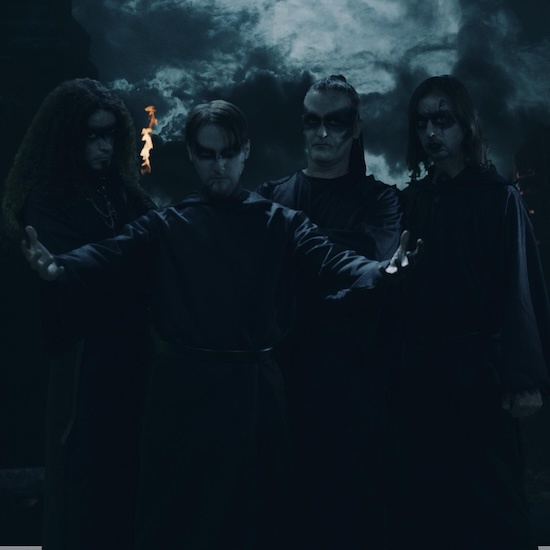
(Today we present Comrade Aleks‘ interview of Lord Ashler, bassist of the multi-national black metal band Gjallarhorn’s Wrath, whose debut album The Silver Key is out now on Non Serviam Records.)
There was no way to pass by a release with obvious references to Lovecraftian mythology. The Silver Key may not be his coolest story, but as an important part of the Dream Cycle, it remains a landmark in his bibliography. Gjallarhorn’s Wrath is a young international black metal project that has nothing to do with Norse mythology, according to which Gjallarhorn was the golden horn of Heimdall, the guardian of the gods. The sound of this horn is supposed to herald the coming of Ragnarök, but I didn’t encounter anything of the sort in the project’s first album.
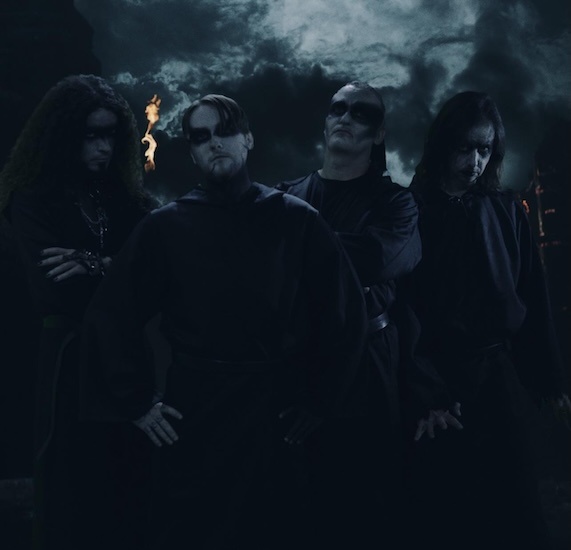
Formally, the members of Gjallarhorn’s Wrath live in four different countries, but in reality, the guitarist, bassist, and drummer hail from Spain, where they once played black metal all together. Only vocalist Alex Caron is originally from Canada.
The guys describe their black metal as “symphonic,” and such qualifications always make me wary, but Gjallarhorn’s Wrath successfully avoid all the traps of the unbridled carnival madness that some “symphonized” bands tend to indulge in. Orchestrations are present, they are tasteful, but, as a rule, they fade into the background compared to the guitar, which is naturally the main driving force of the songs, and, despite some theatricality, the project easily switches to the mode of destructive manifestations and, more rarely, reaches the level of infernal cacophony.
We interviewed Gjallarhorn’s Wrath’s bass-player Lord Ashler recently, and you can find it below easily.
Hail Gjallarhorn’s Wrath! How are you? What’s new on your side?
Greetings. We’re in a great place right now, as we have just recently released our debut full-length album. So far, the reception has been very positive, which both pleases and surprises us in equal measure.
The band’s name is new in the extreme metal underground, so how did you start the project? As four of you live in three (?) countries, how did you know each other?
Four countries, to be precise. The band’s name may be new, but its roots reach a long way back in time. Three of its members (Javi Iron, Arash, and myself) are originally from Barcelona. That’s where we first met and founded Oblivion after having played in some other local bands. After we disbanded, each of us ended up in a different part of the world, but we stayed in touch nonetheless. Then, some years ago, the possibility arose of making music together again. That’s when we met Alex, our vocalist from Canada, through online forums. We liked his style and thought it would fit just right with the music. You could say the stars aligned. We had the line-up, the material, and the will, so it was just a no-brainer to kickstart this new project.
How did you find that Alex was available to perform black metal vocals, as he didn’t take part in any other band before?
Alex has in fact collaborated with several bands before. We came across his work through the internet and thought his vocal range would suit the music, so we approached him and asked him to demo some of our material and add his vocals on top. What we got was really good stuff so we immediately asked him to join forces.
You and Arash played in the Spanish band Oblivion almost twenty years ago. Do you have other experiences besides this band? Where did you train your black metal skills?
Let’s not forget that Javi Iron was also a founding member of Oblivion. As I mentioned, we’d played in local bands before, all of them small acts. After we parted ways, Javi has been writing music on a professional level for some time. And I’ve also kept writing and playing myself, although not professionally but just for the sake of it. The fact that we have never truly stopped making and playing music has obviously contributed to hone our skills so that, far from becoming rusty, we’ve actually grown as musicians.

Your first album The Silver Key is released by Non Serviam Records. How did you get on this label? Was it a regular way of sending promos in any perspective?
It was very clear from the get-go that we wanted to put our music out there for people to hear. In time, we reached a point where we had a full album already recorded and a couple of promo videos edited. All the material was there and we felt proud of it, so we started our research. In the end we decided to go with Non Serviam for several reasons, but mainly because they loved our music and gave us complete creative control. I think it’s paramount that everyone involved in a project believes in it and is passionate about it.
Which of Non Serviam Records’ bands did you know before you were signed? Were some of them your pen-pals or maybe some of them inspired you directly?
Truth be told, we didn’t really know any of the bands on the label before signing with them, although we did become interested later on because there’s quite some intriguing and varied material there. Our most direct influences date back to the second wave of Norwegian black metal from the ’90s (Immortal, Satyricon, Mayhem, and especially Emperor). With time, those early influences have merged with other more recent bands and genres, along with things like film soundtracks. One thing we have very clear though is that we don’t want to sound like any other band or follow any trend, but rather to forge a sound of our own that can bring something new to the scene.
Do you have a main songwriter in Gjallarhorn’s Wrath? How did you work on The Silver Key material?
Living in different countries, you need to establish a workflow that everyone can adhere to. Generally, Javi Iron would present a draft of a song which we all proceed to discuss. Once the final structure has been agreed, Alex provides the lyrics, and everyone starts working on their parts and arrangements. At this point new ideas will emerge, which need to be discussed as well until everybody agrees that the song is finished.
You tend to symphonic black metal, and orchestration is a controversial element in metal: you can save the song with it or you can spoil it – depends on the situation. How did you find a proper balance between main parts and keys?
The trick here is to treat it as a part of a whole, just like you would do with any other instrument. Every part needs to make sense and be in service of the song and the moment, not the other way around. You may notice that the orchestra, while generally present, tends to take a backseat to the guitar, which is the main driving force of the songs. The orchestra is a support that helps give body, shape a mood, and also highlight certain moments. Then sometimes it will briefly take the lead, but these moments are few and far between. We are careful not to have two lead voices at once to avoid clashing and muddiness.
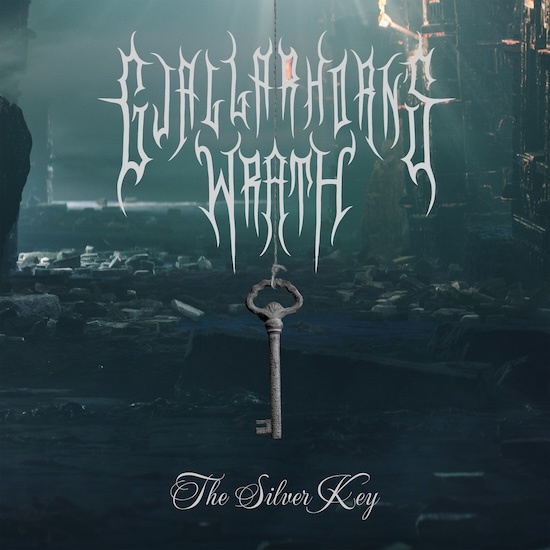
The album’s title is associated with the short story by H. P. Lovecraft with the same name. Was the title song based on Randolf Karter’s trips indeed?
Certainly. Some of us are huge fans of the mythos, and it was a deliberate idea to write a song based on Carter’s dream cycle. They’re some of our favorite short stories, and the whole oneiric imagery and cosmic horror fits the music perfectly. The key itself, besides this obvious reference, is a recurring theme that also appears in our promo videos. This reoccurrence, along with its symbolism, made us feel it was appropriate to name the album after it.
Did you discuss with Alex, as the lyrics’ author, how to make the songs help to develop the texts’ plot? How, for example, did you work through the “Through the Gates of the Silver Key” song?
Actually, that was the only track where we gave Alex a clear direction. We knew we wanted a song based on the universe of the Mythos, and specifically on that short story. But, aside from that particular case and the album intro, Alex has had pretty much complete freedom to choose whatever theme the music would inspire him. Then, like with the music, we have suggested some tweaks here and there to polish and embellish the lyrics, but lyrics are ultimately his territory.
The Silver Key is part of the complex and multilayered Dream Cycle. Did you take this story out of context or do other tracks continue its line somehow?
The dream cycle is directly alluded to in the aforementioned song and, partly, in the album’s title. Even the intro for the album is based on the mythos. But it’s important to emphasize that this is not a concept album and it was never conceived as such. The rest of the tracks are diverse and each of them deals with its own unique theme. On the other hand, the evocation of other fantastical worlds is indeed a common element.
What are the other topics you explore in your lyrics?
Both our music and lyrics strive to somehow combine darkness with a hint of light. They are all born from a dark place, though, and there’s always an element of tragedy and drama behind them. The themes are diverse, ranging from fantastical stories, some of them based on works of popular culture, to myths and legends, folklore, and a touch of the occult. There’s even some material of a more personal and intimate nature, something some might consider almost taboo in the genre. But we would rather not be guided by clichés nor limit ourselves in any sense.
What makes you proud of the album? What do you like the most in The Silver Key?
I could mention several things we’re proud of. But if I had to choose, I would surely highlight above all else the fact that this project is something we have created and crafted from scratch with our own hands, from start to finish. The songs, the videos, the production… Each and every aspect. It’s been a huge learning process, no doubt, and there’s a lot of work behind it, but I believe the end result speaks for itself. It’s amazing to see how far you can go when you pour yourself into something.
You chose “Wiccan Wyrd” and “A Silent Scream” for official music videos. Why did you choose these two? And did you aim to make a video from the start? Was it necessary for you or was it the label’s request?
The videos were not a request from the label, but rather something we did on our own accord before even contacting them. We liked the idea and thought a music video would be a strong calling card for us, with the added potential to reach more people. It did sound like a wild idea at the time, but Javi Iron had some filming experience, so we took the plunge, trusting the end result would be satisfactory.
As to how we decided which songs would be made into videos, it was actually very straightforward. We all agreed these were two of the strongest candidates for a single. They’re both very solid tracks, they represent the whole of the album, and at the same time they complement one another showing two facets of the band like two sides of a coin.
Did you ever discuss a chance to perform this album on stage?
There have been talks about it, but it’s not something we are pursuing at the very moment. We believe our priority right now should lie in writing and creating new stuff.
What are your further plans for Gjallarhorn’s Wrath?
Right now we are immersed in promoting the album, but we are already looking ahead. Our main focus is to keep creating and exploring new paths. And, hopefully, forging a style and a name for ourselves in the scene. In fact, the wheels are already turning…
Thanks for the interview! Any last words for our readers?
Thanks to you. There’s little else to add, save to extend our gratitude to all who have listened to our album and gave us their support and feedback. Now bask in the music and soak in the atmosphere while a new page is being written in the shadows…
https://www.facebook.com/Gjallarhorns.Wrath
https://non-serviam-records.bandcamp.com/album/the-silver-key
Excellent album. Symphonic for sure, which is just fine by me. This would be glorious live.