
(The eyes and ears of Moonsorrow fans should perk up today because of the following interview Comrade Aleks has brought us, the principal subject of which is a new book about the band based on extensive interviews of Moonsorrow’s members. Aleks will introduce the author.)
I hadn’t heard of Grilo do Demo, but Moonsorrow fans are likely familiar with his unofficial and, at the time, fairly detailed biography of the band, which he consistently posted online about fifteen years ago. An enthusiastic journalist, he wrote for a couple of webzines until he met Leo Aragon, who had the idea of making a documentary about Moonsorrow, using that very biography as a basis.
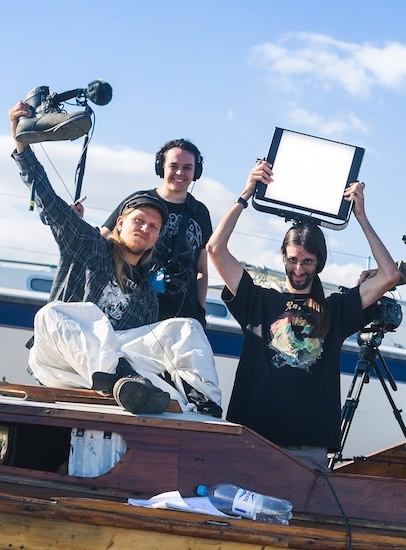
The band was ready to meet him halfway, and the friends and a couple of like-minded individuals traveled to Finland, where they conducted extensive video interviews with the musicians and those involved on the spot. The film’s production stalled at some moment, and you’ll know why from this interview… However, such valuable material, of course, was unlikely to lose its relevance, and the movie’s crew didn’t want to waste the momentum, so over time, they agreed that the footage could supplement Grilo‘s biography. The rest, as they say, is history…
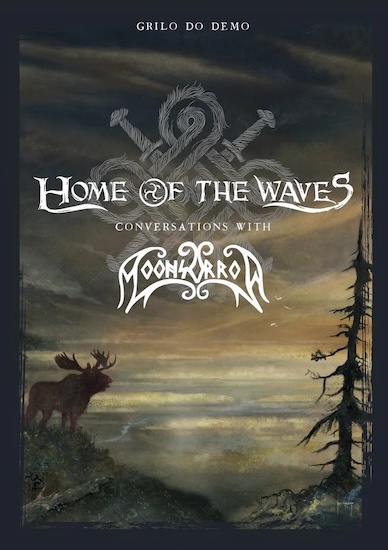
What do we have now? As Cult Never Dies, the publisher, states: Home of the Waves: Conversations with Moonsorrow is a substantial 388-page hardback, featuring a 24-page colour photo gallery and a total of 150 images, most of which have never been seen before. You can pre-order it, and if you’re really into this, here’s the interview with Grilo himself.
Hi Grilo! How are you? How soon will your book Home of the Waves: Conversations with Moonsorrow hit the shelves of online shops?
Hi! Thanks for taking the time to talk about this book and about Moonsorrow! I’m super excited, as you can imagine. The book, if everything goes well, will hit the shelves the third week of October — not just online shops, as it also will be available in brick-and-mortar shops, and at any events Cult Never Dies attends with their stand.
Grilo, you have some background in music journalism, right? Can you tell about your path to the point when you felt yourself ready to take on this endeavour and take part in filming the story of Moonsorrow and then in writing part of it as a biography?
That’s right, although it was always quite amateur. For two or three years I was interviewing bands actively for a webzine. This is also the period when I published my first Moonsorrow biography, which was quite thorough at the time. I later joined Leo’s webzine, where I focused on live reports. It was during that time that Leo had the idea of filming a documentary, using my biography as a basis. My path from the moment I heard that suggestion to the point I felt myself ready was about one or two seconds. 🙂 Later, turning that into a book was not so much a matter of feeling ready, but rather an urge to release that material in some way.
By the way, what’s up with your first Moonsorrow biography? Is it available still?
Yes it is! It only reaches up to 2008, and the grammar is horrible haha, but it’s very detailed and I’m still quite proud of it, because right now it’s the only source for a lot of that information (most of the sources I used have now disappeared from the internet). You can find it at https://moonsorrowbio-en.blogspot.com/. You will also find an immense compilation of interviews from all eras, and lots of audio and video bootlegs.
It’s an obvious question, but I feel that it’s right to start with it. What made you start working on a documentary and then on a book dedicated to Moonsorrow?
The documentary was Leo’s idea. He studied cinematography and wanted to make his debut, and he thought this could be a good project, so he invited me to collaborate. When years passed and the movie stagnated a bit, I figured I’d release the material in the form of a book. It’s very different from what the movie will be anyway, it has a completely different approach, so I’m not worried that the readers of the book won’t be interested in the movie. Much the opposite, actually. And vice versa. Those who like one will most probably want to check out the other.
Can you tell on which stage the filmmaking stopped? What are its prospects now?
In the months that followed the filming period, we transcribed everything together, and Leo made a structure for the movie using those transcriptions. He made a script that would make sense from the point of view of storytelling and started editing the scenes. But then he started having health issues, and he’s still dealing with them after several years. He insists that the movie will be finished eventually, so I’m still looking forward to that!
You mentioned the whole crew who worked on the documentary in the book’s introduction, so can we say that all of them contributed to the book in their own way? Or did you choose for the book those interviews you prepared mostly yourself?
The answer to the second part of the question is very simple: I chose ALL of the interviews for the book. 🙂 None have been left out of it.
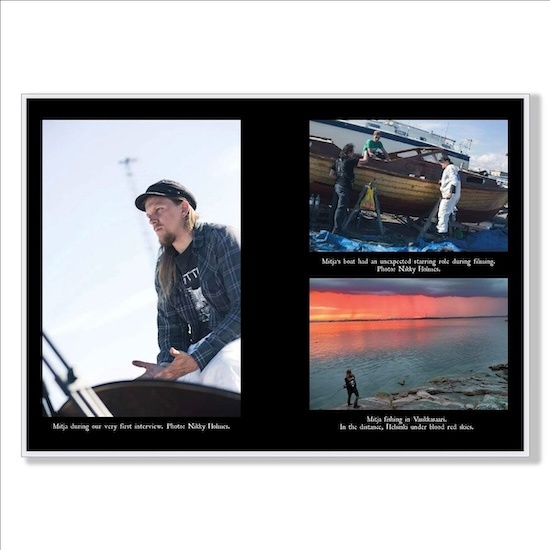
The book has contributions from everyone indeed, but in different forms. Leo and I were the ones who prepared the interviews — he would decide on the topic of the day and what he wanted to get out of the interview, and I would then write the questions and conduct the conversation (although we worked quite closely, and the tasks weren’t so strictly divided). Pillau did offer some good ideas about the general direction of the interviews, but he had enough on his plate with the technical aspects of filming, and Alexis focused on everything sound-related (and supplying extra doses of enthusiasm; you should have seen the guy). Nikky, the photographer, could only join us for 5 out of the 12 days, but she took some wonderful pics that you can now see in the central pages. Some of them look like Baroque paintings to me, I couldn’t resist comparing them to Caravaggio in the captions, really amazing what that woman can do!
So yes, everyone’s work is featured in the book, because it’s full of text transcribed from Alexis’s audio recordings, stills taken from Leo and Pillau’s videos, and photographs taken with Nikky’s camera.
Will you add now some extra materials to the documentary in order to make it more different, more individual?
Well, in terms of footage, it won’t be only interviews, it will also have some footage from the places, additional ambient shots and stuff like that. If you mean more interviews, then no, no more interviews. But honestly, that won’t be a problem. The whole order, format, build-up, narration, tension and everything else in the documentary will be completely different from the book. Both use the same source material, but plastic and gasoline also come from the same source material, and nobody would put plastic in the tank of a car… 🙂
I know that the Folk Metal Big 5 book tells the story about five original Finnish Folk Metal bands — Ensiferum, Moonsorrow, Finntroll, Turisas and Korpiklaani. Did you have a chance to read it before starting your own book?
Yes and no. Yes, because I have a copy at home. No, because it only exists in Finnish and I don’t understand a word. 😀 However, you know what? That book mentions me! The bibliography includes a reference to my biography blog. I even exchanged some messages with the author, Markus Laakso. I love the other bands too, and besides, his Amorphis biography is excellent, so I really hope Folk Metal Big 5 will be released in English at some point.
I bet that Dayal Patterson edited the text as well, did he? How much did Cult Never Dies change your plot regarding the book’s structure?
Dayal did the first proofreading, which was very much needed because I’m not a native English speaker and he is. But his modifications were only limited to grammar or the phrasing of some sentences. He totally respected my original structure — and everything else — at all times. He actually did have two great suggestions: the short notes at the beginning of each biography chapter — which allowed me to include some extra nerdy details — and the band’s official promo pics — which allowed me to unearth some rare and even never-before-seen ones. My approach was quite purist at first; I intended to use material exclusively from the filming period. But Dayal didn’t impose anything at all. He just had some good ideas, and it would have been a pity to waste them out of stubbornness. 🙂
How long did you think about structuring the book this way? It’s quite atypical, as you start with discography and then switch to individual interviews…
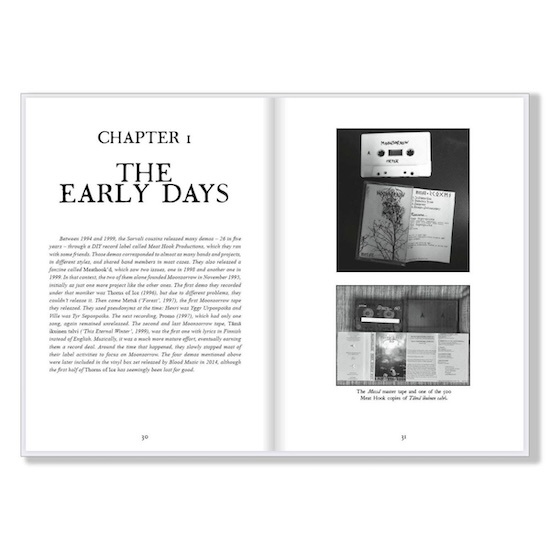
At first, I just planned to structure the interviews chronologically. But we went through the biography of the band with all five official members, and — who wants to read the same story FIVE times? It already started to become a pain when I was only transcribing the third one. 😀 That’s why I had the idea of making a composite and have it told in that “choral” way. That makes up the first part of the book, and then the second part is the rest of the interviews, in chronological order, as I had intended originally, with all the narration and the stories that I wrote around them.
I’m quite satisfied with how the biography turned out, honestly. I think it’s a lot more interesting and dynamic than it would be otherwise. How did you like it?
It’s atypical, as I said, but quite enjoyable! There’s nothing unnecessary, and all main lines are covered. So, yes, I think it’s atypical, but in-depth work, and I appreciate such an approach. What about Moonsorrow’s members? Did you let them read the complete version before sending it to the publisher? Personally, I would do it this way, because it’s the better way to convey the very idea of the band properly?
Yes of course, I sent each of them their own parts before anybody else, in case there was something they felt uncomfortable with, or something I misunderstood. There were no additions or deletions, only a couple of reorganizations and format changes.
It’s said at the very beginning of the book that your attitude towards making the film was changed due to the necessity to have some conflict to be solved (as Leo insisted). How did you find the crucial points of that? How would you determine this conflict?
To be clear, “conflict” in storytelling doesn’t need to mean actual conflict between people. It’s rather an obstacle to overcome, or a situation that needs to be changed. For example, in a story as innocent as Walt Disney’s Pinocchio, the conflict is that he wants to become a human boy. We needed to find something in Moonsorrow’s history that made them want to move on in a different direction, either artistically or personally. We actually found a couple of those elements, and the reader can discover them in parallel with us, interview after interview. You start with regular questions, but you understand certain things from the answers and then dig deeper. As the interviews went on, we focused more and more on those topics. That’s why the interviews at the end are so different from those at the beginning.
Right, I mean those. So can you highlight at least some of those most crucial topics?
No spoilers! 😀
What were the most difficult stages of gathering the data for the book? Were there topics you or the band avoided raising?
Some topics were a bit more difficult to approach in a way that wouldn’t feel superficial. The more abstract ones, or the delicate ones. Some topics may trigger different assumptions in the mind of the interviewer and the interviewee, and you have to make sure that both of you are talking about the same thing. I’m sure the attentive reader will spot some instances of this. But hey, it wouldn’t be so interesting if we only spoke about riffs for 388 pages, would it? 🙂
There were indeed some topics during the filming period that were suggested and then dropped, but the reasons were either that those topics weren’t so interesting after all, or that the band members simply didn’t have much to say about them. So, nothing was lost, honestly.
I noticed, that there are not many of regular “drinking tour stories” in the book, although I remember from the Sentenced biography that they didn’t have much fun on their tours either. They just… couldn’t have fun, almost physically. Did you try to dig out more anecdotes of that kind? Of course, none expected the epic stories of Motörhead’s scale, but who knows…
We didn’t touch much on those topics, it’s true. It wasn’t a conscious decision. I guess we just didn’t think of it as a priority when coming up with topics. Mitja does tell an anecdote or two, if I remember right. However, if you read between the lines, you can sense that there was a lot more going on in their early years… I’m thinking about some comments in Ville and Marko’s joint interview, for example.
How was it possible to interview Markus Eurén?
It wasn’t particularly difficult, he’s as friendly a guy as the other five. Just not as talkative. 🙂 That’s why he usually doesn’t give interviews. When a magazine wants to interview Moonsorrow, there’s always someone else in the band who volunteers first, it’s as simple as that. I guess you can see why when you read his interview. 🙂 But in no moment did he refuse, there was no need to convince him, nothing like that.
Moonsorrow has its philosophy, and partly it’s reflected in the lyrics. Didn’t you think to publish the lyrics’ translations in the book as well? Did you feel the seduction to create a tome that would cover the entire Moonsorrow philosophy in all its nuances?
I never intended to include the lyrics, honestly. The purpose of Home of the Waves is to make the interviews publicly available and add some context to them. While we did discuss lyrical themes and concepts in our conversations — and there are some details like the inspiration for the Varjoina story, for example, or the conceptual relation between Voimasta and Tulimyrsky — we didn’t do a deep dive. Don’t get me wrong — analyzing the lyrics in depth would definitely be an interesting exercise. Just not in this book.
As for your second question — yes I do feel that seduction very strongly. I had thought of writing a book about Moonsorrow for years, and what I had in my head had nothing to do with this. I still haven’t given up on the idea, time will tell… 🙂
Are you pagan yourself?
No, not really.
I know that each country has its own field of interests, so I wonder if Moonsorrow is commonly famous in Spain. It’s very difficult thing to publish metal books in non-English-speaking countries, so do you see a chance to release it in Spanish? And will there be a Finnish edition as well?
I suppose Moonsorrow is equally famous everywhere. After all, very few people are interested in that style of music. But if you like this sort of metal, with strong atmospheres and long developments and moods ranging between aggression and melancholy, Moonsorrow is probably one of the first names that will come up.
Concerning translations, an important point is that they’re not up to the writer or the original publisher. For a book to be published in Spanish, for example, there needs to be a publisher in Spain (or some other Spanish-speaking country) who wants to release it. Translations of metal books aren’t so rare, I see French and German and Russian translations of other books, but in Spain you can’t find anything more obscure than Iron Maiden. I actually think that it’s mostly because nobody tried. I’m sure if a publisher decided to release a Cult Never Dies book, for example, and did some proper promotion, it would probably sell decently. I am a translator myself, actually, so I hope I can one day work on the translation of my own book!
A Finnish edition seems more likely, because Moonsorrow is a Finnish band after all. If a publisher in Finland decides to have it translated and publish it there, we will be immensely happy to license it.
The group was charged with some ridiculous accusations of alleged Nazi connections, and it seems to be a global problem now, as any pagan band could be blamed because of some suspicion. Is it a problem of the modern “civilized” world where everyone could be offended by anything from accidentally getting a glimpse of some old documentary or by a fart in a public transport? Does it become a rule, and metal bands know their restrictions? (although they are still allowed to do their anti-Christian-stuff)
I wouldn’t say it’s a problem of modern civilization, because this exaggerated attention to offense is quite recent, I think. Something of the last 20 years, perhaps? That’s a heartbeat in historical terms. Also very US-led, with other, US-influenced countries following. I doubt anyone cares about that stuff in Mongolia or Burundi (but I have no clue, maybe they do?). It even seems to be losing momentum nowadays. It will probably go away in a decade or less. I’m just not sure if what’s coming next will be any better.
Agree, I would say that it depends on country. But there are too many unhealthy trends, although we speak about metal, and I doubt that this form of art is healthy in some of its extreme forms. However, what does metal offer you? Is it an instrument of escapism, a form of entertainment or something?
Metal, or music in general, gives me enjoyment of course, but especially, it has served as inspiration for doing most of the best things I did in my life. For example, I took Russian lessons because I liked Slavic folk metal bands (stopped long ago but I’m glad I learned back then); I traveled to otherwise unexpected places with the excuse of a concert; I made good friends… I learned how to produce a podcast, I wrote a book… 🙂
How will you and maybe Moonsorrow support the book’s release? What are your plans regarding this?
You can be damn sure that I’ll be mentioning the book in all of my Moonsorrow-related projects, which include several Facebook pages, an Instagram profile, a podcast, and a digital fanzine. (All the links you need can be found at linktr.ee/moonsorrow.podcast.)
Other than that, we wanted to do a presentation event in person, but sadly, it seems it won’t be possible. As for the band, right now they don’t want to do anything else than finishing the next album — the only exception being sporadic shows — which I can understand, honestly.
And do you plan to start another book now? Do you see a proper topic for a next book and do you feel enough inspiration?
If I write another book now, or in the coming 1-2 years, it probably won’t have anything to do with Moonsorrow or even with music. But at some point, I would like to write another Moonsorrow book. Less subjective and more detailed. I’ve had the idea for years, but I couldn’t resist giving priority to an oral history when given the chance. Home of the Waves was a unique opportunity because nobody else in the world outside of our team has material like this. It’s a rare thing even in the biggest mainstream. There aren’t oral histories of Queen, Deep Purple, or Metallica. But there is one of Moonsorrow. And I hope it will make all fans proud!
Thanks for the interview Grilo! I wish you all the best with Home of the Waves’ release, and I hope that we’ll have a chance to see the film soon too. Thanks for conversation, it was quite nice! Did we skip something important? Any links are welcomed.
Thank you, thank you, thank you! Concerning links, most of my Moonsorrow stuff can be found at linktr.ee/moonsorrow.podcast, people should subscribe to the Moonsorrow fanzine at verisivut.info, and I’m building www.homeofthewaves.com so that everything book-related can be found in one place. I don’t think we skipped anything, you touched great topics! Thanks again!
Pre-orders for the book are available now via:
Cult Never Dies UK & ROW Webstore (also with art print): https://cultneverdies.myshopify.com/collections/all-publications/products/home-of-the-waves-conversations-with-moonsorrow-hardback-book
Cult Never Dies EU Store: https://cultneverdies-eu.travelling-merchant.com/merchandising/book/grilo-do-demo-home-of-the-waves-conversations-with-moonsorrow-book
Cult Never Dies EU Store (with art print): https://cultneverdies-eu.travelling-merchant.com/merchandising/book/grilo-do-demo-home-of-the-waves-conversations-with-moonsorrow-print-book