
(Today is the day when Iron Bonehead Productions releases the debut album by the eldritch Australian death metal band Olde Outlier, and coincidentally it is the day when we publish the following excellent interview by our Comrade Aleks of the Olde Outlier songwriter and current drummer Beau Duer.)
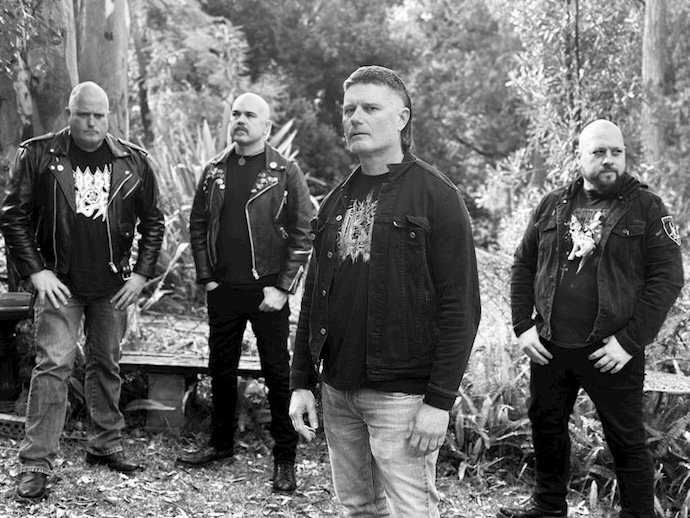
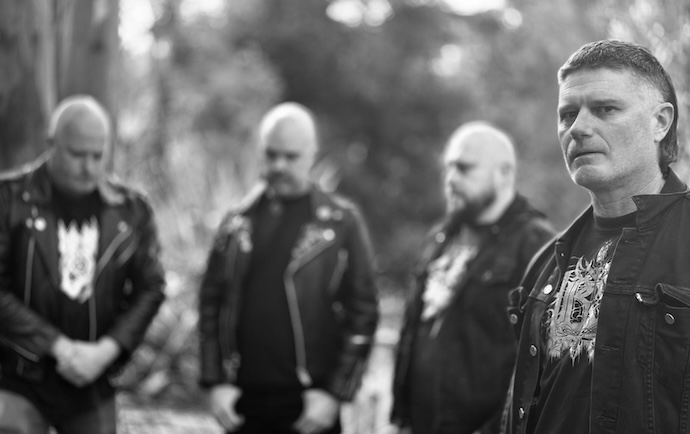
The Australian group Olde Outlier is the successor to the disbanded death-black metal act Innsmouth, whose members already had years of experience cutting extreme metal. The names of these underground scene veterans are Beau Duer (drums), Ben Askew (guitars), Mark Appleton (vocals), and Greenbank (bass). Together they bring back to life the spirit of early ’90s death metal, with a lean toward rough death-doom in the spirit of early Tiamat, resulting in four solid, well-developed tracks.
The first track, “The Revellers,” is a good start: eight minutes of inventively performed, focused, old-school death metal, but with pure, abstract, atmospheric melodies. The ravenous mid-tempo “The Sounding of Hooves” quickly transports us into the catacombs of Paradise Lost-esque death-doom, and it’s not the only time Olde Outlier changes the track’s direction in its 11-minute runtime. “Swept” doesn’t disappoint either, captivating us with its unabashed retro charm, embedded in the instrumentation, the melody, and the vocalist’s raspy growl. The technically proficient “From Shallow Lives to Shallow Graves” exudes the innocence of the extreme metal scene’s early years, as does the closing track, “All Is Bright.”
But I’m not going to do another review, as we had a conversation with Beau himself, so here’s a better narrator regarding Olde Outlier and everything around it.
Hi Olde Outlier! How are you? Who’s online today?
Greetings friend. All is well, or at least as good as it needs to be. This is Beau here, I play drums in Olde Outlier.
Glad to meet you Beau! So, the band’s name is sonorous yet new, so how did you gather together in the name of “arcane death metal”?
It started out with with just myself and our bassist Travis. We had been working on music, that was very much a continuation of Innsmouth, under the name Black Hooves. We had a few songs, but we decided that we should really do something a bit different.
We scrapped those songs, tuned our instruments up to E standard and started afresh. We worked together, coming up with the bones of what has become our first album. It was just the 2 of us for some time; I was playing guitar and drums and Travis bass. At some point we decided we needed our old friend Mark on vocals who was the vocalist at the end of Innsmouth, although with a very different vocal style. Mark was playing drums for a little while, but we decided we should really get a guitarist and I moved on to the drums. We played the songs to Ben, another old friend, who we agreed would fit the bill. He liked what he heard, joined, and the gathering was complete.
What about the band’s title? Is it a kind of manifest? As a sign of holding to retro paths?
It’s not really a manifest nor is it a sign, at least not in the way you guess. The Olde relates more to ourselves being that we’re not so young anymore. We are all, in our own ways, outliers, so this made sense to call ourselves Olde Outlier! I also like the aesthetic of how those words look together. I think it’s a good name and a little different.
Some of you started in the band Innsmouth, what didn’t work with it?
It wasn’t that Innsmouth didn’t work. My fire kind of died at the time, my mind was a bit fucked, and I just didn’t want to continue with music. I was responsible for its demise, for better or worse.
Were you just disappointed with the scene and the place the band occupied there, with a lack of feedback and so on? Or was it rather personal reasons?
No it was nothing like that. I mean, the scene had lost some of the magic of how it was for me in the ’90s by that stage, but Innsmouth were pretty well received here for the most part. There were plenty of gig offers although we didn’t play live very often. Innsmouth wasn’t for everyone and Olde Outlier won’t be either and that’s not a problem for us. It was solely for personal reasons that it ended when it did.
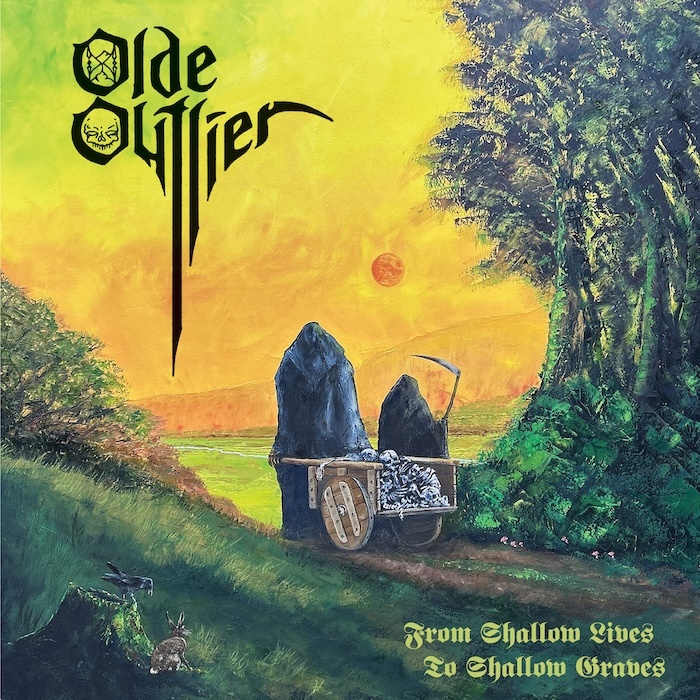
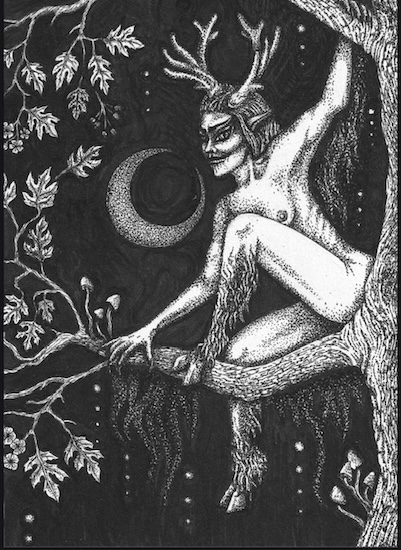
Each album starts with an artwork, and From Shallow Lives to Shallow Graves has an exceptional one! How did you come out with such an image? Does it speak everything you wanted to express through it?
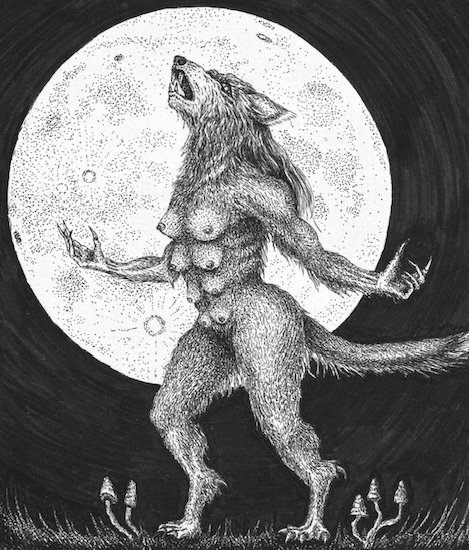
Thank you. We are all damn happy with how the artwork turned out and it fits the vibe of the album well. It was painted by our vocalist, who was also responsible for the Innsmouth album cover. I had a basic concept for the artwork and Mark brought it to life. His vocals are filled with passion as are his paintings. Three of the four sets of lyrics are represented with the artwork and the fourth is where the album title is taken from. Some elements of the artwork are hidden for now but this will make sense with our next release. The back cover and inner sleeve contain work from another artist named Mandy Andresen (who was also responsible for the otherworldly and brilliant band Murkrat), very different in style, but fantastic and inspired works in themselves.
Yep, I know Murkrat and I remember that morbid Drudging the Mire artwork, impressive indeed. Did you play together in Innsmouth’s days? By the way, do you have a company of like-minded bands to perform with Olde Outlier?
I would have loved to play a show with Murkrat although unfortunately they never played live.
We haven’t made the decision to play live yet and I’m not entirely convinced that we will, at least not for a while. The focus for now is on writing new material. If we do though, we have a company of like-minded individuals with whom we would surely like to share the stage. Playing live just doesn’t have the same appeal it once did but we’ll see what happens down the road.
From Shallow Lives to Shallow Graves has a kind of progressive touch; at least you tend to diversify and you know how to compose epic and intricate songs. What drew you to such a form of self-expression? How natural was this twist after Innsmouth?
It was not really a decision to write such long songs, maybe more so that I don’t know when to stop. The songs kind of build upon themselves and as I don’t always follow a more traditional song structure this adds to that progressive element you mentioned. I tend to write songs in sections and don’t always return to the same theme so I guess that’s progressive although I hadn’t thought of it that way.
A lot of the stuff I write doesn’t want to co-operate with its counterparts so we force them into submission sometimes. The rehearsal studio refines this process and we end up where we end up. This form of self expression is the result of putting a part of ourselves into the songs and sometimes digging the grave a little bit deeper. Innsmouth ended going on ten years now so a lot of water has flowed under the bridge since then. The main thing is that Olde Outlier is less limiting in the type or style of riffs we use, and as such a lot more influences have made themselves apparent.
How difficult is it to combine sections you composed in one piece? And why did you decide to put in this effort and record these longer tracks rather than a number of shorter songs? Was it a challenge?
I find songwriting difficult in general and it does take quite a while to write some of these songs, although sometimes things just flow. I didn’t realise just how long some of these songs had gotten as they don’t seem that long when we play them in rehearsals, yet I knew I didn’t want short songs either, I wanted something that built up and was a bit like a journey. The challenge was more in the form of taking the different styles of riffs and making them sound cohesive and natural. I chopped and changed a lot of stuff before reaching the end and then more changes came about in the rehearsal room with the rest of the band. A couple of the newer songs are looking a bit shorter in lengths to break things up a bit but I imagine there’ll be some more ten-minute epics as well.
There are death-doom influences in this album as well, where did you draw these ones from?
I would say they were drawn from a deep well, as doom metal has always been close to my heart.
There were a lot of albums, when I was younger, that made a massive impression on me that lasts to this day. Albums like Paradise Lost’s Gothic and Katatonia’s Dance of December Souls are the first two that come to mind. What I really love though is traditional doom. Old Candlemass, Solstice, Confessor, Revelation, Trouble, Cold Mourning, Count Raven, Angel of Damnation, early Cathedral, Solitude Aeturnus, and old While Heaven Wept. Stuff like that. I also like a lot of Italian stuff that’s not so easy to categorize, like Paul Chain, Hands of Orlac, Black Hole, and Abysmal Grief. I don’t really like the style typically classified as stoner doom though.
At first I was surprised with such an in-depth knowledge of the doom scene, as you mentioned a few very unobvious acts like the Italian ones for example. But now I see that you were in one of those rare Australian doom bands, Stone Wings, for some period of time, so now it’s clear. Why don’t you mention Paramaecium? Weren’t they famous in Australia?
Well sure I can mention Paramaecium, back in the early to mid nineties there were only a handful of death-doom bands in Australia and maybe no traditional doom bands, at least none that continued for long that come to mind. The main ones for me were Cruciform, Paramaecium, and of course Mournful Congregation. We had Elysium and recorded one album under that name before we changed the name to Stone Wings. There were other bands too but not a lot, and I am not someone who considered Disembowelment to be a death-doom band as much as I love their music.
I don’t think Paramaecium were famous by a long shot but maybe they were bigger overseas than here, at least when their first album came out anyway. Exhumed of the Earth is a beast of an album and for me the best they ever did; it’s the only album by them I still own. To my ears the best death doom album from that period in Australia was Cruciform’s Atavism. They were getting better and better and it’s a great shame it fell apart when it did. They did reform in recent years although it was never the same. These days there’s a lot more of this style of bands in Australia but I don’t know the half of them.
On the subject of Paramaecium though, one-time guitarist Chris Burton has put a crushing death-doom band together in the form of Grotesque Bliss, whose demo was released on wax via Iron Bonehead earlier this year, and also one of our few traditional doom bands, Crone, have reared their heads again and are working on an album. Look out!
Thanks for the recommendation! Your album leaves an impression of a complex work, yet it sounds so damn natural. You know, like this moment in “The Pounding of Hooves” at 9:00 with that yell. Killer and spontaneous. How did you work on the album? How much did you improvise in the end?
Thanks, I am glad it has a natural sound to other people’s ears, it’s what we were aiming for.
The way we work is probably quite prehistoric by modern standards. We spent a lot of time rehearsing and refining the songs and listening back to the rehearsals and then went into a studio; there was no pre-production or demos done first. We were just trying to capture that feeling we had when we rehearsed, which was very strong and haunting at times.
We steered clear of the regular studios most other metal bands around these parts used and took our chances at a studio that mainly recorded folk and country music. That presented its own challenges but they were overcome. We all find a lot of modern music far too cold and calculating and we wanted something warm and human sounding. There’s obviously no click track used and not much compression mainly because this is how we like music to sound. All of the guitar harmonies, leads, and extra percussion were basically improvised in the studio. We just went in with bones and came out with a semi-functional cadaver.
Song lyrics aren’t something a lot of people are interested in, yet some bands have quite unique concepts behind their texts. What was your vision of Olde Outlier’s concept when you started the band? How was it embodied in the album’s lyrics?
Song lyrics have always been very important to me. An album that I like musically that also has great lyrics takes it to another level. In some cases where the lyrics are very inspired and connected to something outside they can have different effects and open vistas to other planes, at least they do for me.
There are many great lyricists in the realm of heavy metal and yet also many who just write them as an afterthought. Unlike Innsmouth, Olde Outlier doesn’t have a concept though, as such. The lyrics are dark and in part inspired by myths and folklore, with themes that interest me in my current reality tunnel. I spend a lot of time on them and if people are interested in lyrics about such things maybe they will appeal to them in some way and heighten their listening experience. It’s also important that the lyrics fit the music, and I hope they do.
Innsmouth’s concept was based around Lovecraftian horrors, so why didn’t you return to that with Olde Outlier?
I think I had covered everything I wanted to in that direction and there is always so much more to explore. Innsmouth wasn’t strictly about Lovecraftian horrors and there were other elements yet that did make up the basis of it. I tried to take things a lot deeper with those lyrics than the standard “Cthulhu rising” shit a lot of bands have done. I have been a fan of that man’s work since I was a young teenager and it was important to pay homage to his vision with care. There were times toward the end when I almost felt that something was paying some sort of attention to what I was doing.
Staring too long into the abyss maybe…
Never say never though, if we do decide to bring some of those elements into Olde Oultier then they would fit I think. I mean, are not Lovecraft’s creations Olde Outliers in a sense? Or maybe closer to Great Old Outliers!
That would be a nice title! Thanks for the interview, Beau! Did we miss something? Do you want to add a few words for our readers?
Thanks very much for the interview and your interest in Olde Outlier, we appreciate the support.
I think we covered everything we need to for now. Live long, listen to Motörhead, and stand for the fire demon. Over and out.