
(written by Islander)
Yesterday’s column was shorter than usual. I explained then that I was leaving home early for a day-long outing with my spouse. That happened, and what we did together was a tremendous amount of fun. But we didn’t get back to our island home until nightfall, and I didn’t spend what was left of the evening messing with NCS stuff.
As it happens, I’m leaving home again with my spouse this morning to do something else she planned. So once again, I’m having to shorten the volume of music as compared to what this column usually includes. Luckily, I had already listened to everything I picked during the past week, so I wasn’t starting from scratch. But with more time I would have included more.
The first three selections came easily — I initially paid attention to them based on my past experience with the bands’ music, and their new stuff definitely doesn’t disappoint. The fourth one was just me getting a wild hair, and the impulse paid off.
AIN SOPH AUR (Brazil)
As has become something of a tradition, I, Voidhanger Records recently announced a new group of album releases in one fell swoop. Three of them — by Dionysiaque (France), Bekor Qilish (Italy), and The Oldest House (Spain) — are scheduled for release on March 27th. The fourth one, by Ain Soph Aur, has a release date of April 3rd, and that one (Theos-Vel-Samael) is the source of the extensive song I picked to lead off today’s column. Before I get to it, here’s the label’s introduction:
Twenty years after their founding, Brazilian AIN SOF AUR are not only still active, but continue to be the embodiment of occult black metal that treads the Left-Hand Path, flowing through Draconian currents and Chaos Gnosticism. Theos-Vel-Samael marks their return to the scene and is once again a dark and epic work, rich in symbolism.
“Theos is Greek for God, Vel as an interpretation of a sharp and ferocious symbol of wisdom, while Samael—though connected to Lucifer—should be read separately as Sama-El, aka the Poison of God,” AIN SOF AUR explain. “In other words, the path to divine knowledge lies in the Poison of God, as a means of dissolute existence in order to reach the Apotheosis, the supreme dark enlightenment.”
Theos-Vel-Samael revolves around three long compositions, three movements that embody the idea of Visio, Vires, Actio: Vision, Force, and Action. The first movement is somewhat hypnotic and trance-inducing, divine consciousness manifesting as vision. The second movement transmutes this vision into a flourishing and violent force, while the final track—the album’s most aggressive and death metal-oriented moment—transforms the entire vision into action. “The whole work is the final incantation of the Void,” state AIN SOF AUR, “consolidating the transmutation through fire and the conductive veins of divine poison.”
Based on both that description and also some familiarity with Ain Soph Aur’s previous releases, I think this album will best be understood and appreciated by listening to in its entirety. Unfortunately, for reasons explained above, I haven’t yet been able to do that yet. But just listening to the second of the three tracks in isolation is still a powerful experience.
Over the course of its nearly 14 minutes, “II” does create the experience of a transmutation. It begins slowly and disconcertingly, with notes both dismal and miserably writhing, and with overarching moods of menace and eeriness. Gradually the intensity builds, strengthened through cracking beats, slugging grooves, and malignant, abrading growls.
The guitars continue to writhe and to throb in dissonant chime-like tones, but the music also begins to flare and blare in tandem with more vigorously hammering beats and more unhinged snarls. As the tempos continue changing, the guitars contort and wail, disorienting the listener and adding more fuel to the music’s unnerving tension.
The song unfolds like a strange and poisonous hallucination, undeniably intriguing and even perversely spellbinding but also unhealthy. Perhaps most intriguing of all is the rippling clean-guitar arpeggio that seizes attention like sorcery in the song’s latter half, and the ritualistic beats that follow that.
As forecast, a crashing and ecstatically convulsing crescendo (in which the vocals go mad) then arrives, though it’s a reprisal of that occult arpeggio which ends things. All in all, an amazing song.
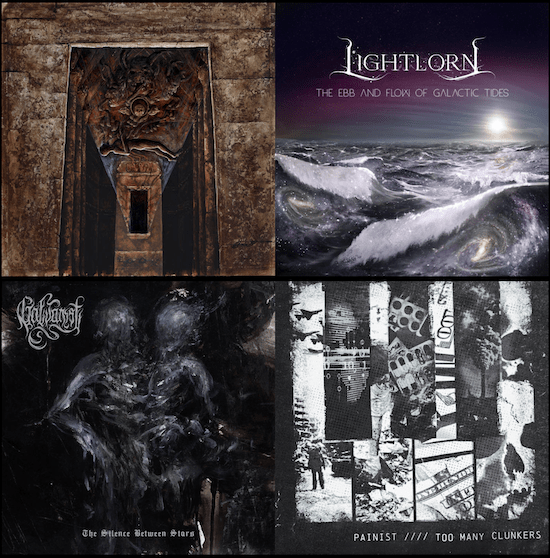
The album’s stunning cover art was created by Dávid Glomba.
https://i-voidhangerrecords.bandcamp.com/album/theos-vel-samael
https://www.facebook.com/i.voidhanger.records
LIGHTLORN (Sweden)
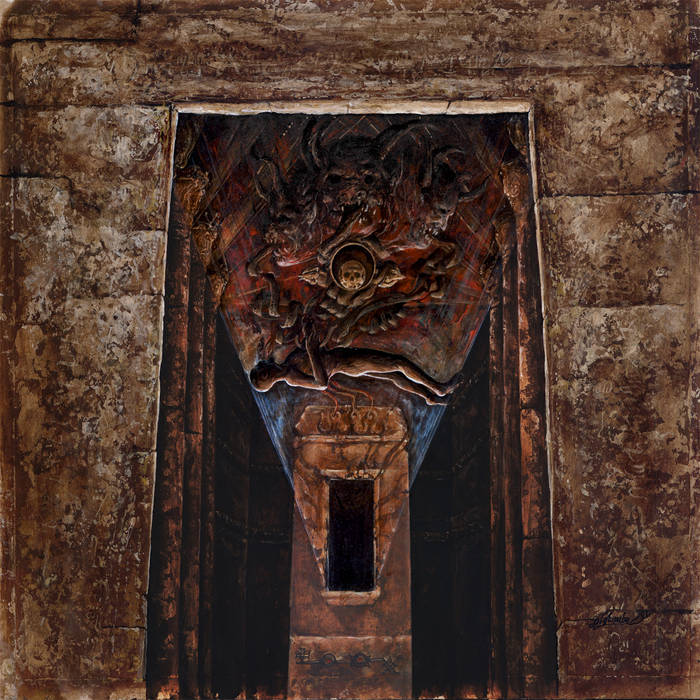
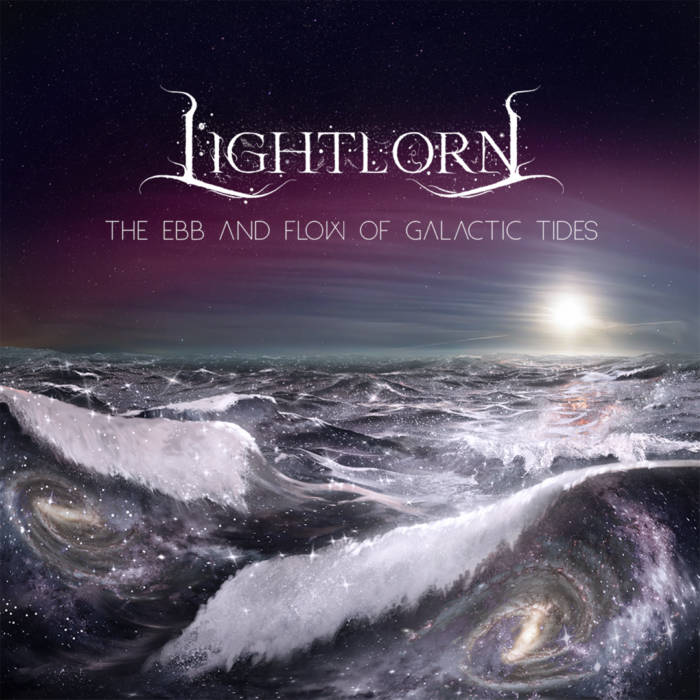
Last October I had the pleasure of premiering a terrific new Lightlorn single named “To Dream of Distant Stars“. I also shared the news that Lightlorn were at work on a new album — and now it has been announced. Bearing the title The Ebb and Flow of Galactic Tides, it’s set for release on March 6th, and two songs from it have been released for streaming so far. Regarding the album’s conceptual framework, here’s the band’s statement (articulate and even eloquent, as usual):
Aeons after the Universe was spat forth from the unknowable nothingness of pre-existence, upon a small, rocky world orbiting an unremarkable G-type main-sequence star located within an arm of an unexceptional spiral galaxy, a carbon-based organism experienced the emergence of consciousness; ergo, the Universe became self-aware.
The organized chaos and entropy to which all matter necessarily succumbs notwithstanding, these ill-fated creatures rage against the inevitability of their demise.
They love, hope and dream, and they kill, destroy and wage war; they erect ageless, towering monuments and build vessels to carry them to the stars at which their species has gazed for millennia.
Although they are vast in number, each one feels itself unique, extraordinary. With myriad aspirations, desires and fears, these life forms persevere through the most arduous adversity, with an immutable yearning to be part of something greater than themselves, but rarely comprehending the true marvel of their existence – despite its bewildering improbability.
Generation upon generation they proliferate, evolve, and philosophize, seldom recognizing that all they are, all they know, and all they ever will be, is solely contingent on the ebb and flow of galactic tides…
One of the two songs out now is “Emergent Chaos“. Lyrically, it “explores the parallel phenomena regarding the emergence of the universe from nothing and the emergence of biological consciousness. How the human mind (along with any extra-terrestrial minds that may exist out there) is essentially the universe itself becoming self-aware.”
The music is itself vast and wondrously violent. A piercing lead guitar brilliantly flares and swirls above music that vividly flickers and flows, driven by turbulent propulsion and fronted by explosive screams. The music also brutally pounds and virulently burns; the bass is a prominent heavily undulating presence; and the vocals are utterly wild in their scorching intensity.
Before the song ends, the guitars strangely quiver, surrounded by swaths of symphonic expanse, and then the song blazes, climbing to a breathtaking new zenith of wonder and torment.
The other song, “I Carry Galaxies“, is based on a quote by Nietzsche: “Whoever looks into himself as into vast space and carries galaxies in himself, also knows how irregular all galaxies are; they lead into the chaos and labyrinth of existence.” The lyrics elaborate on this idea, that each of us is not just one thing, but multitudes.
Another big subject, to be sure, and the song itself is a relentlessly gripping but dramatically changing experience. Initially, the riffing abrasively throbs; the drums calamitously boom and batter; and in the upper reaches, the music glitters and pulses. But the band’s guest Flo V. Schwarz (of the German band Pyogenesis) ethereally sings, creating a stark contrast with the frightening intensity of the harsh vocals. And once again, Lightlorn dramatically expand the immensity and swirling wonder of the music.
Those guest vocals turn out to be an ingenious facet in a very heavy and harrowing song, and in a similar vein the band bring in keys that ethereally ring and ping — just before a cataclysm of blasting drums, boiling riffage, and high-end fevers. Overhead, way out in the sonic cosmos, the song remains wondrous.
But there’s still more, including a gloriously grand heavy metal riff that surfaces at the 4:45 mark; a magnificently uplifting melodic motif; and a heart-bursting clean-sung harmony. What a wonderful surprise this song is!
https://lightlorn.bandcamp.com/album/the-ebb-and-flow-of-galactic-tides
https://www.facebook.com/lightlorn
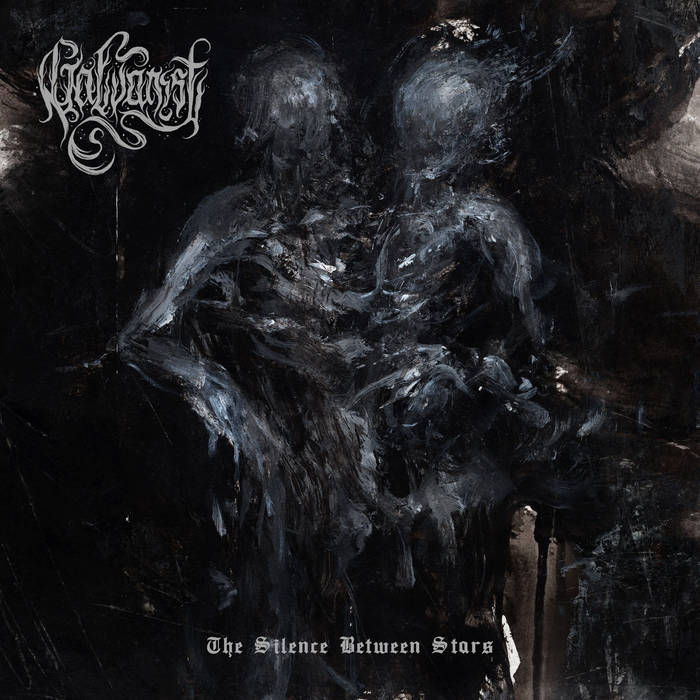
GALVANIST (U.S.)
Nearly four years ago we premiered and reviewed a demo named Connection, the full-length debut of Galvanist from Bozeman, Montana, whose lineup includes members of Arkheron Thodol and Cellar Vessel. It became a thrilling favorite among all the many records I heard in 2022. I concluded a wordy introduction with these words:
It’s such a deeply involving and elaborate experience, one that changes moods, inspires imagination, and jolts the spine with equal power. And thus it’s a genuine pleasure to share it with you now.
It was also a genuine pleasure to discover that Galvanist now have a new album coming our way. Titled The Silence Between Stars, it’s set for release on March 19th. They offer this description:
This meditation explores the agonizing onset of an individual’s physical incarnation, and the search for purpose, the relation between entities, between persons and place, and the transcendent remembrance of beings and realities existent beyond the corporeal.
The first song we can all hear now is the new album’s penultimate track, “Hauntology“, which includes synths performed by the band’s guest Harul “Menelvegor” Vinay, and guest vocals in the startling outro by Jacob Myers.
Not surprisingly, given the nature of Galvanist’s previous music, “Hauntology” is a genre hybrid. It explodes in a torrent of blasting drums, crazed screams of torment, maniacally boiling riffage, and searing tones that flash out of the upper reaches. The music becomes expansive and wholly enveloping, near-cosmic in its scale, but intensely distraught at the same time.
The song seems to heave and groan as well as sending out flickering rays of blinding brilliance, and it also begins to surge with a grim and vicious pulse. It savagely gnaws and chews in the low end, while the synths feel like vistas of nebulae above the grinding ugliness, and the vocals also extravagantly wail as well as tear their throat open.
Beautifully glittering but sorrowful keys enter the excursion, but in other respects the music (and especially the vocals) remain tormented. The bass provides a battering-ram punch and more nimble nuances, and the drums seize attention with their speed and variability, while the music’s stratosphere chimes and glimmers, indeed like celestial wonders sparkling above towering edifices of daunting darkness and earth-shaking upheavals.
I expect I will have more to say about the album as a whole in the vicinity of its release date. The fascinating cover art is the work of Bahrull Marta.
https://galvanist.bandcamp.com/album/the-silence-between-stars
https://www.facebook.com/galvanistdoom

PAINIST (?)
Earlier this month we premiered a song and video for a Texas-based black metal band named Ferndom, whose music was principally performed on a violin. As a clever play on that, the artist calls himself Vileinist. Now we have another clever play on words with Painist, whose sole creator introduces their debut EP Too Many Clunkers this way:
In an era of tribute bands, where rock feels like it already lost the war, someone decided to collide two obsessions that were never meant to coexist: distortion and piano.
What most conservative musicians would call an error, mutated into something else.
No guitars. No bass. Just a cheap piano, raw distortion, physical impact, and the sound of an instrument being stripped of its dignity.
We should note that for most of the EP’s song Painist also added “the physical intensity and tempo of crust drums”, and vocals that come across like a hybrid of fanatical yells and strangled snarls.
You really can detect that a piano is being used, but I doubt you’d figure out that only a piano is being used to generate what’s happening around those maddened vocals and crust-punk beats.
In the humorously named “Crustaccato” (not the only song title that plays with classical-music tropes) you can hear the chords discordantly clang and the keys maniacally jump, but the piano parts must be layered, because something does sound like a bass and other things sound like groaning menaces, abrading sandstorms, or freakishly quivering menaces.
“The Implicit Coda” drives with blasting drums and violent gales of scalding but agony-steeped sound. Again in the mix, you can make out a madhouse piano being violently hammered, but the music also brutishly throbs, painfully wails, and devolves into a grisly miasma while a voice feverishly declaims.
“Mental Health Étude” shifts the mood in more dismal, depressed, and disoriented directions (though the vocals are still berserk), and at the end, “Body Sonata” feels like a dissonant musical spasm (no idea what kind of piano-torture makes those sounds); even though the drums rhythmically boom and crack, and some chords gloomily clang, it mainly feels like intense pain — until a classically inclined closing piano arpeggio takes the stage with a person miserably crying.
The EP clearly represents a kind of wild-hair experiment, but it’s well worth your time — at least if you’re in the mood for a mind-boggling and occasionally abusive adventure — for reasons other than the instrument that Painist principally uses, and the ways in which that instrument is rudely “stripped of its dignity”.
Thank you so much for your review!!!
You are most welcome. Don’t stop!