
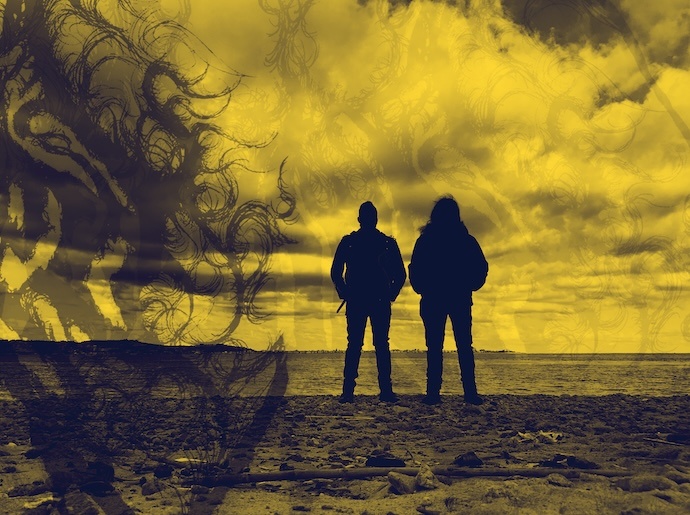
(Prepare for a fascinating interview by our Comrade Aleks of one or more members of the Italian duo Diespnea, focusing on their also-fascinating album of avant-garde black metal that was released last month.)
Anonymous avant-garde black metal entity Diespnea, based in Southern Italy, is here with their new full-length album Radici (Roots). Released by code666/Aural Music on the 13th of February, this work is based on traditional black metal concepts mixed with universal “southern” atmosphere. These specific features appear in many forms, starting from a distinctive tribal chant and atmosphere of Amazonian beliefs and finishing with the authentic atmosphere of trance-inducing Mescaline rituals.
This anthropological black metal is grim, mysterious, and psychedelic to some degree, and Diespnea seems to found their unique identity. But let’s let Diespnea speak for themselves — here’s an interview with the band’s member(s).
Hi Diespnea! How is it going? What’s new on your side since the release of Radici happened?
Hi NCS! Not much to be honest, we have been busy with all the stuff for the album promotion.
Well, Radici is your second album, so what new did you discovered in Diespnea for yourself? Did you find new dimensions to express your ideas and emotions?
We think the most impact was on the sense of freedom we discovered with this new album, removing from our insides the old black metal clichè, which started to feel restrictive for us, both musically and personally. With this album we lived through a series of transformations and with the idea of not going back anymore. This work meant for us something different than pleasing our comfort zone, and at the same time doing stuff regardless of what are the common expectations of the black metal scene.
You mix both traditional black metal vibes in your music with occasional Southern touches and channel it through a kind of avant-garde prism. How did you find that this genre may refer to the landscape of another kind in a metaphysical sense?
This is interesting, and actually it depends a lot on our origins, since we are both from the South of Italy and our environment directly influenced the total vision of our music. It’s also true that for many, many years, in our personal lives, the lens of black metal always brought us to being inspired by “nordic” sounds and landscapes, and the self-discovery process which came out during the composition of Radici unveiled instead what we truly are.
What was this point of revelation? How did you originally figure out that this way might work?
When we started this project together, it just came out naturally to make things a bit different than usual. Even in Pneuma you can hear a very distinct mediterranean landscape. So there wasn’t really a specific point of revelation; the entire project revolves around making a very personal type of music, and most of all of having fun while doing it.
How did you find a balance between traditional black metal sounds and those “Southern” aspects you added to the palette of Radici?
Working on it has been complicated, especially at the start, because the first songs we were completing came directly from the Pneuma era and even earlier, so their structure and sound was a lot more black metal compared to other songs which came out later on. From the moment when we started to compose the fresher stuff, we were experimenting with sounds and pedals and we discovered what we liked to keep as essential textures of this new album. Then, on a third phase, we reworked the older songs implementing some of the newer ideas and the result is what you heard. Probably this created the balance between the two worlds.
Did you change those older songs by adding new elements or did you change melodic lines or the delivery maybe?
Introducing the new elements to the older songs didn’t make them so different from their first versions; the melodic lines where the same but some more electronic vibes have been added in some riffs. Maybe the biggest changes have been made to the drumming and some FXs.
“Radici” means “Roots”. What kind of roots do you mean?
With the term “Roots” we liked to play around an old concept typical of black metal, which is the tradition, so to speak. For us “roots” are not just a way to characterize and identify oneself, but also a connection point, an opening to other people, other worlds, other cultures, exactly as it happens between plants. In this sense, we wanted to flip its historical meaning and strip away all the restrictions associated with the term and the extreme ideologies revolving around black metal itself. Instead of misanthropy they bring union, instead of narrow-mindness they bring openness, instead of elitism and racism, they bring cross-pollination.
Sounds like that statement “god divides us, death (or black) unites us”! Do you have a kind of circle of like-minded bands around you or abroad?
We are in contact with some bands with whom we feel on the same wavelength for many transversal reasons, but we can’t tell for sure if there is somebody else like-minded on this specific topic, especially because those other bands aren’t part of the black metal scene. We would love to get in touch with other people/bands thinking the same way.
“L’Abbraccio del Serpente” has quite an intriguing start, as if you have a certain plot behind it. So what’s this song is about? How is it connected with the album’s central motive?
The big inspiration behind this song was the movie “El Abrazo de la Serpiente” and the mythological figure of the Chullachaqui, typical of Peru’s amazonian culture. The lyrics talk about a tribe living hidden in the forest bonded to something ancient, like a river linking us to visions and tales which belong also to us. There is sadly an end, an epigone, to all this, when all this knowledge becomes impossible to remember, as if memory is an empty shell and in that moment it’s like we feel disconnected and lost in a world we don’t recognize anymore.
The Chullachaqui is a forest spirit who imitates humans, but he is empty, soulless, and mocks us while we are struggling to understand if we are still searching for our true nature or if we are completely lost. It’s weird because despite being the most “standalone” song of the album, its concept actually connects everything we said until now.
There are some elements of tribal chants and, probably, music in some songs. What inspired you to explore these territories? Did you refer to a specific culture?
During the recording process of the album we tried to experiment but also to perform chants as a freeing act and, with the exception of “L’Abbraccio del Serpente”, there weren’t specific references to some territories. We wanted to bring out a common universal and atavic language which may resemble a Sardinian pastoral chant as much as a Native American tribal chant.
Interesting… Recently I interviewed Malauriu, and they used Sicilian in some of their past songs. Which reference to your own local culture do you have in Radici?
We generally take masks, cults, apotropaic symbols and studies about South Italy as a reference, citing for example the anthropologist Ernesto De Martino. We think there is a substrate of common traditions permeating the entire concept of South Italy and this is the one we try to express in Radici, not focusing on specific territories. Metaphorically our daily lives are portrayed in some of the lyrics as well.
At the same time, there are quite industrial beats in “Vultures”. How about them? Which role does this element play in Radici?
Our desire was to discover new sounds through making music, not strictly belonging to the metal world, and the industrial beats just came out naturally while we were creating. It’s part of something not pre-planned but the fruit of the evolutions of our ideas.
Would you use more of this in a future album?
The next album will be wildly different from Radici and probably there will be no fit for industrial beats on it. But who knows, we like to experiment and surprise ourselves as well.
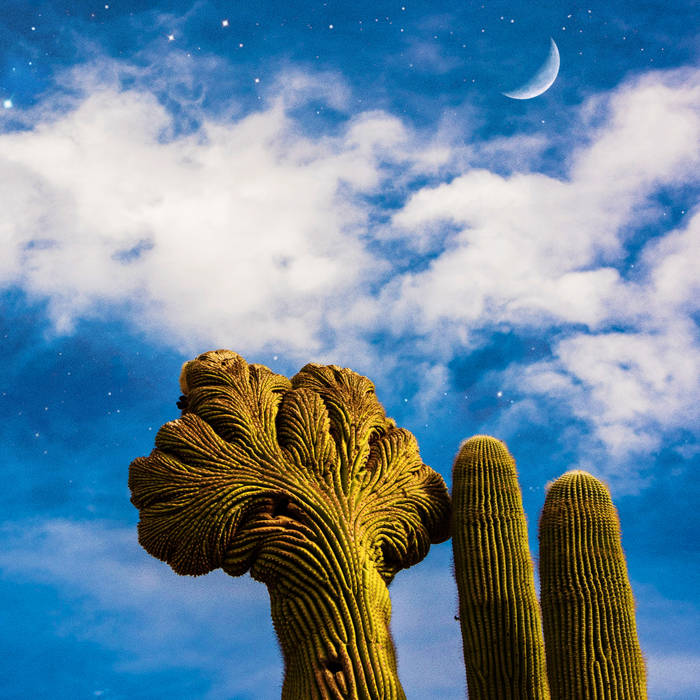
The album’s artwork, at first, looks like if the band performs desert or psychedelic rock. Didn’t you think that it might scare off your potential audience? And merch… I wonder if t-shirts with cactus may be popular enough.
This is funny, and yes we were wondering the same as a side-thought, but the artwork was chosen because we wanted something alien and different, with all the pros and cons of this choice. We don’t care who is scared off by the artwork, instead we care about who is attracted because of it, and the same principle is applied also to our music choices. There are psychedelic elements in the album, such as in “Necromanteion” and in “Mescalynia”, so we think the comparison may fit.
Actually, that’s something I wanted to ask. Is this psychedelic vibe something you experienced personally or is it a kind of interpretation of the things you read or heard?
One of us experienced this personally and is also the main lyricist so everything boils down to this. It’s really weird to describe this type of experiences by words, and this is why we let those feelings flow inside our music. Every specific effect in “Mescalynia” for example has been tinted by a trip.
Is Diespnea a studio project? Are you going to perform the new album live?
Yes Diespnea is a studio project and we are currently not playing live, but doing it some day is definitely something we would love to do.
What are your further plans the rest of 2026?
This year we are going to work on a collaborative release and the next album.
How much can you already reveal regarding these projects?
It will be a split between us and another artist, but at the moment everything is in very early phases and there isn’t much we can unveil.
Thanks for the interview! If we skipped something important, just bring it on! And I hope that we’ll have a chance to discuss another Diespnea album sooner or later.
Thanks to you, it has been a pleasure! We just want to share the availability of our new album Radici both as CD and LP on the official Aural website and on Bandcamp.