
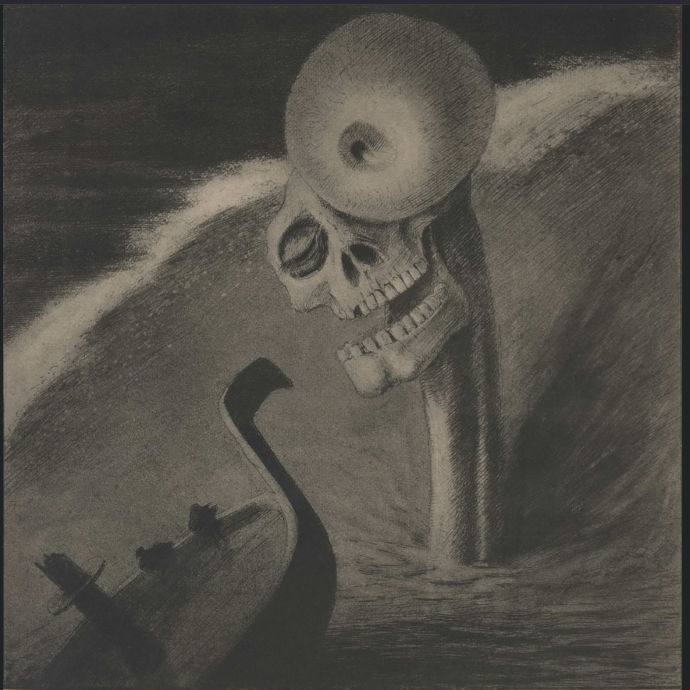
“Das Grausen” (1901-1903) – Alfred Kubin. Sourced from the Obelisk Art History project and serves as the Smiqra and Ὁπλίτης banner image. Expressionist symbolist and at times avant-garde Austrian artist who also wrote one novel.
(The release of the debut album Rɡyaɡ̇dźé! by the Chinese project Smiqra probably provided the motivation for our contributor Vizzah Harri to get in touch with the project’s creator JL, but the interest had already flourished due to JL’s other previous musical projects. In any event, the interview that Harri presents below was the result of a roughly year-long dialogue, and it is a fascinating thing to read at your leisure.)
The multi-instrumentalist, linguist, and shapeshifting artist JL, of Smiqra, Ὁπλίτης and Vitriolic Sage fame, graced us with a correspondence in a language they are not fluent in. It’s remarkable that they set aside time to read, translate, and answer our questions while they were still very busy academically.
The term avant-garde often gets thrown round without much thought as to what it means or pertains to. If you ask a philosopher, art professor, music theorist, and a critic you might come to a bunch of different answers as to how it relates to their context. Generally, it has to do with exactly what it means in the original French, advanced guard. That which pushes the boundaries of convention. In that comfortable niche of discontent with the status quo, Smiqra and Rɡyaɡ̇dźé! comes across as a logical evolution from Ὁπλίτης, an album that was reviewed here last year.
Enlightenment was the first EP of their first project, Vitriolic Sage. The first track was Chanson de raison, song of reason, with Chanson Des Émotions, song of emotions, as the closer; which seems kind of flipped. However, the last line reads that the protagonist deifies, “Je devins le dieu…” which in essence is the path of philosophical black metal. In other interviews JL has stated their position regarding philosophy and in no uncertain terms shouts their position in tracks like Rɡyaɡ̇dźé!’s 反哲學牛 (anti-philosophical bull).
Creators like to focus on the present and the future though; dwelling on the past can feel mundane. Sometimes consumers of art in whichever form have to make do with less information. Not everything has to be explained (I didn’t get the memo, as can be discerned further down). Any of JL’s releases would be a good starting point in discovering their music, though unlike concepts that follow storylines there is no correct point of inception for any of their work. Except for perhaps degree of intensity, and even then, who am I to gauge what the goldilocks level may be?
As Vitriolic Sage’s discography evolved, track lengths stretched to reach past 14 minutes on Feuerschlucker, and if one follows the trajectory of Ὁπλίτης and then Smiqra, there is a condensing and then a condescension towards form and convention, towards language, linguistics, and artistry in music which is laid out in Feuerschlucker’s essay on Bandcamp so evocatively:
“This is the principle, the Only principle…” said the transcriber, sitting in that cramped attic which used to bear the name of “his spiritual safehouse”, but had long been transformed — transformed as gotten smothered, engulfed, or completely taken control, inside out — by heaps of scrolls and notes accumulated over decades of his so-called “purest chasing of the enlightenment”; as such he spoke, without actually making any sounds, without pronouncing out loud those words or random assemblages of vowels and consonants — one could say that he was pronouncing by remaining silent, that he was trying to comprehend (and hence, correcting, for his own sake) his hard-fought (and purest) discoveries — years of the strictest contemplation over the “art of language” — from poetry to philosophy; comprehending as he was, like many other unanimously molded occasions before, by first obscuring, then proceeding with a ruthless obliteration of the principle of such discoveries, by silencing and deliberate mispronunciation, until every bit of his findings — every paragraph of his notes and scrolls — had been rendered utterly incomprehensive, henceforth completely useless to the Humanity at large; this had always been his single one purpose, for he had always despised humanity with all the vitriolic malignance he could ever muster, not for their conspicuously impudent hypocrisy, but the fact that they — his fellow compatriots — simply couldn’t handle the aftermath of seriously facing and scrutinizing his discoveries, for he had known all the time that “the knowledge and its patterns which he’s been chasing after for so long burns like heavenly fire”, that accepting thoughts and intelligence as such is tantamount to swallow its burning flames, to become “the Feuershlucker”, to succumb himself — first those “other principles” he’d once processed, then his entire being — to that formless fire as a sacrificial offering, to transform by self-smothering, to transcribe by self-obliteration. Such manipulative incest of vowels and consonants had borne his third reminiscence — “…this is the only principle,” hence the Sage continued his deranged transcription-by-continuing-eradication: “Philosophy, poetry, linguistics, any other art of language, in principle shall always go against each other — disprove, repel, mutilate, befoul, the annihilation is eternally mutual.”
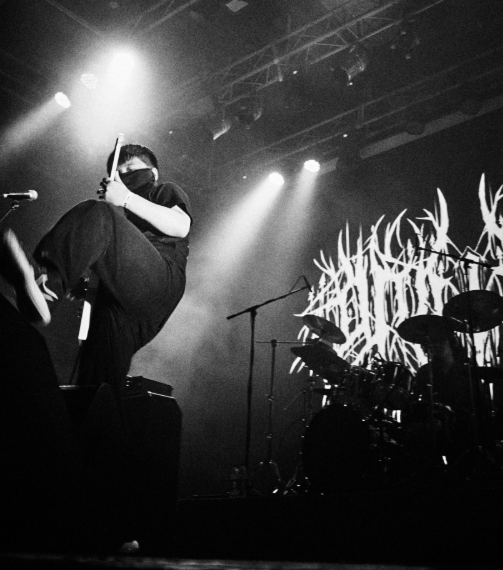
Πτολίπορθος/JL performing as Ὁπλίτης – September 2023
10 releases in less than four and a half years, that is, 8 full-length albums and 2 EPs across three projects. Five of those albums were released within just 376 days. The only reason JL is slowing down in output is because of their academic work, which is rigorous and relentless.
As a non-muso I can get carried away with questions and focus before realizing what musicians actually want to answer. For many artists it can be kinda onerous to get inundated with questions on older output, so this interview spanned quite a few emails over a year. If it seems disjointed and that the answers are sometimes shorter than the questions, it can be ascribed to the simple truth that this is a way to learn how-to from opposition. Mistakes, faulty assumptions, ideas lost in translation, tone-deafness, not reading the room. This exchange can serve as a great educational tool on how not to conduct an interview.
Some of the downright convoluted queries were met with straight-up apophthegms (curt witticisms, and rightly so). Art does not have to be overinterpreted, and as you’ll come to learn from this practitioner of sonic magick, it should first and foremost be about fun.
******
Thanks for taking the time to do this! There are rumors that you are a linguist, how are your studies going or are you currently doing fieldwork?
JL: Thank you for the review earlier!
I’m about to start my doctor’s degree in linguistics – if this could make me a “linguist.”
I’m doing fieldwork now indeed.
Going through your social media rules out the question of whether you’re a cat or dog person. Does your cat travel with you?
JL: 1000000% cat person. But I don’t have a cat yet. I don’t have a fixed address and I think it would not be good for my first cat.
Ὁπλίτης’s Bandcamp avatar
Which Chinese artists do you look up to?
JL: None… [after some extended thought] … musically, probably no one.
Which musical entities did you grow up listening to?
JL: Children of Bodom and Trivium the most. I’ve been revisiting COB, it’s so much fun! 2011 was the best… not 1999-2003! Post-2013 Trivium really sucks, but 2003-2013 was god-tier.
What was your musical journey as far as learning instruments and eventually recording your own music?
JL: I’m not a particularly good instrumentalist—my left-hand technique on guitar, for instance, looks rather clumsy, and it was only three or four years ago that I improved my picking technique (a bit…) cause I used to pick totally from my upper arm which looks so ugly. But anyway, what I’m trying to say is that I’ve basically been driven purely by interest, without any formal systematic training, throughout my “career.”
What was your first instrument, and which instrument do you find the most fascinating to play outside of guitars, bass, and drums?
JL: My first instrument was a Schecter stiletto 6 string bass lol
I would love to be better at piano…
You’ve used French, Latin, English, Dzongkha, rGyalrongic, and Mandarin (普通话) in your lyrics. In choosing which language to use, does it sometimes stem from having expressions that are untranslatable between different camps of lexis and therefore more potent within the language of choice?
JL: I don’t know, it depends on the fun I have out of it.
At the end of Vitriolic Sage’s “Enlightenment” we get a riddle, “skar ma dang khrag,” which on initial searches produced a crude Hindi translation for “sakar maan daang kharag” or सकर माँ दांग खरग, which means “mother squirt” haha (prime example of how inaccurate rudimentary online translators can be). Is it closer to Dzongkha? Could you please correct our crude understanding?
JL: This is actually just Tibetan. It means ‘star and blood’.
Ever met anyone that is beyond tone-deaf? As normal people would’ve been able to preempt regarding creatives queried about past work, JL did not really want to expound on his work under the Vitriolic Sage moniker, elaborating only to say that they are not particularly fond of that project, summarily closing the door with “Very bad.”
Your answer to the first VS question was quite cryptic, I take it you felt you’ve moved on from it and want to focus on new stuff?
JL: Yeah definitely.
Are there pieces of music from the last 5 years that have been in constant rotation for you, and are there any pieces of music that you consider to be near perfect from start to finish?
JL: Porcupine Tree – Fear of a Blank Planet
Which works of literature do you hold most dear or do you find have influenced your trajectory as an artist?
JL: I’m just reading grammars and linguistic articles every day. I’ve been living in an anti-literature way for several years: I read academic products only. This is actually kinda involuntary I would say because the academic inventory we have now is already inexhaustible. And I have to keep up with the others.
So, I really haven’t cared much about any literature. Instead, you can see some funny ethnolinguistic, ethno-zoological or ethno-anthropological elements coming in.
Will we ever see JL play live outside of China? And which artists would you hypothetically like to share a stage with?
JL: I once had a chance but I had to turn it down sadly because I also have to do fieldwork at that time. I believe this may metaphorically hint at the answer to your question.
Peaceful artists.
What has been your best experience playing live?
JL: Sadly, I haven’t played enough gigs to give you a satisfying answer.
And for that matter, who are the best acts you have experienced live?
JL: I actually haven’t been to a concert for more than two years and the old memories are dying. I’m losing interest in concerts. I find it extremely hard to say.
[JL did later mention that the best recent concert they’ve been to was that of their friends’ band, which without pressing further has been assumed to be that of 非邪 of Holokastrial that provided guest vocals on Rɡyaɡ̇dźé!]
“Συμμαινόμεναι Διονύσῳ Ἐλευθέριῳ”and “Συμμιαινόμεναι Διονύσῳ Ἐλευθέριῳ” from 2024’s Παραμαινομένη differed in title by but one character, “ι.” Is it the change of simply a verb to an adverb or is there more to it than that?
JL: Συμμαινόμεναι & Συμμιαινόμεναι are actually participles of two different verbs here.
We can break them down to two basic verbs:
(a) μαίνομαι maínomai ‘I am mad’ (so Ancient Greek dictionary gives the first person form as the so-called ‘citation form’)
(b) μιαίνω miaínō ‘I stain, I soil, I defile’. Its middle form is μιαίνομαι miaínomai ‘I stain, soil myself’.
[if you really didn’t know where to start delving into the discography, this last track up here once got described as a “most astonishingly sorcerous and mind-warping slab of sonic crack”]
You’ve been asked about linguistics before, so I apologize if this goes over old ground for you, but do you have any thoughts on the idea of universal grammar as opposed to Dan Everett’s supposition that there is none, or that the structure of language cannot be separated from meaning?
JL: Universal grammar is bad. Or I’m bad.
That was a question based on occidental theories of language — what are some interesting approaches to language from an Asian perspective?
JL: None.
(East) Asian ≈ European » American linguistics
A dude named Kevin Dawe described traditional music of Crete in an article titled Minotaurs or musonauts as follows: “The spaces of Cretan musical networks remain like the corridors of the labyrinth inhabited by a musical minotaur that confronts intruders; later recoiling into the secrecy and safety of the inner chamber of ‘the tradition’” So in your opinion, is the minotaur the defender of tradition?
JL: I don’t know. It’s just funny. I like cattle.
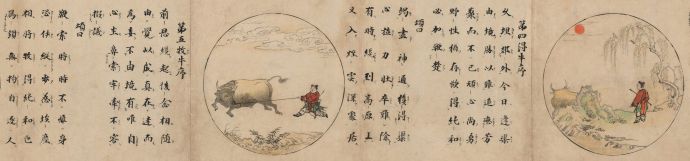
R-L Perceiving- and Catching the bull, from the Ten Bulls by Kuoan Shiyuan/廓庵師遠 (1278)
What are some things you’ve learned in field work and in studying languages that you might not have encountered if you chose a different field?
JL: I grew up in the city, with absolutely no experience in farming or herding. I don’t recognize any plants; I know cattle exist, but I didn’t know there were different kinds. I used to wonder why a language needed so many words related to cattle, blah blah blah.
If you’re in China, you can still meet people living relatively primitive lives in the southwest. Oh, actually, no, they’ve also begun a semi-modern, semi-primitive lifestyle, but they still remember what their original way of life was like (like about seventy years ago), and I can ask them to tell me. These experiences allow us a glimpse into the way these groups have lived for thousands of years. But please note that I’m not talking about anything related to religion here; it’s purely about their way of life: herding, tents, wheat and barley, brewing wine, the wind coming down from upstream…
Are there any unsolved problems or controversies in linguistics that music lovers and musicians might find interesting?
JL: I don’t know in general. One case in Ancient Greek is the tonal system of Ancient Greek. To start with, people might find it counter-intuitive that Ancient Greek is actually a tonal language. Yeah, it has tones. But secondly, it does not possess the same tonal system as languages like Mandarin, Cantonese do.
So generally, people describe the tonal system of Ancient Greek as pitch accent. There has been a lot of ongoing effort trying to elucidate the real pronunciation of these tones. One interesting approach is analyzing these tonal values with the help of Ancient Greek music. I remember that there was one article related to that last year. And there are even some YouTube videos about it.
What are some of the most common misconceptions of old, dead, or minority languages?
JL: “The Inuit people have more than 30 words for ‘snow’!”
If your dates say this to you, please dump them immediately.
“Our language has a lot of ways to swear…”
Man, this is a really classical bad take. Every language does. And when people say this what do they expect me to respond???
“Those minority languages are too backward.”
If not having a specific native word for ‘telephone’ means being backward to you, fine.
Sino-Tibetan can perhaps be written as rGyalrongic(?), so is it fair to say that if I see the pattern of the same first 4 letters in Rɡyaɡ̇dźé!, does it have something to do with the language and the people you have been studying in Tibet?
JL: Sino-Tibetan can’t be written as rGyalrongic actually. Rgyalrongic languages are a part of Sino-Tibetan. But they are extremely conservative and can contribute a lot more to the historical linguistics of Sino-Tibetan.
Indeed, Rɡyaɡ̇dźé is written in the language that I investigate the most. It means Chinese cattle.
When doing fieldwork, what has been the biggest revelation where you found something within the minority language or culture informed by language and vice versa that was a real eye-opener?
JL: Almost always at the language itself, like one huge “oh wow” moment is when I found out how this language is deeply akin to a mysterious dead language named Tangut, once spoken in the northwest of today’s China. You can wiki this language yourself and see how crazy the script of this language is. And the fact that this language is a brother of this small dying language spoken in these villages that most people absolutely don’t give a fuck? Too cool bro.
The language you studied in your thesis is called Phosi. Would you mind sharing any metaphors/idioms/phrases that are interesting?
JL: “bərzə̂ ɣə-klə̂ɣ=shi, vdɜlê=tə=tɕhɐ nə-f-tsə̂ ko nə-mɐ̂-dɜ̂-vî.” -Si le couteau n’est pas assez coupant, il ne pourra pas couper le cou. — Un vieux dicton en Phosi (If the knife is not sharp enough, it will not be able to cut the neck – an old saying in Phosi)
Phrases like that are fascinating, apologies for asking too much, but are there any more?
JL: Sadly no, not because I don’t want to, it’s just these expressions are actually very hard to document.
Oxen, yak, bulls, dzo, are a constant theme throughout Rɡyaɡ̇dźé!, so what are some ways that these animals inform the life and culture of people in the regions you spent time in for fieldwork? And what can we learn from them?
JL: I actually have an article about it and it will make a great response but it’s still under review… let’s just hope that I’ll get the response soon. [it has subsequently been accepted by BSOAS and undergoing editing]
The renowned Canadian pianist Marc-André Hamelin once stated that the Scarbo suite – from Ravel’s transliteration of Aloysius Bertrand’s Gaspard de la Nuit – “is one of the greatest examples of musical illustration of a literary source [and] is one of the two [or] three greatest phenomena in 20th century piano literature.”
It’s taken as a given that most forms of extreme and alternative music sprout from music first, words later, but as someone that works with the bones of language, do you sometimes construct pieces from poetry or word seeds first, and if not, is it an idea that appeals to you?
JL: Actually yes, I call this Zeuhling. Sometimes I start with a set of sentences, and then see if I can build a riff upon it.
This album is infinitely jammable even in its manic ferocity. Did you try any different approaches in writing or recording this time round?
JL: Not at all I think?… I’ve pondered this question again recently and I really would say not at all.

Marmite and Vegemite sandwiched by Bovril (images © to Andrew Smith and Willis Lam/Wikimedia Commons/CC-BY 2.5)

.jpg)


The Marmite question (Bovril for the carnivores, or Vegemite for our friends down under, and as slang for the uninitiated being a polarizing topic) is often the one regarding gear. You record, mix and master everything yourself. What gear do you use and can you guide us through your writing and recording process?
JL: Normal computer. Focusrite audio interface that is literally everywhere. A DI box. Shure SM-57.
There is no fixed writing process for me, though I really heavily rely on GTP [guitar pro software]. I need accurate tabbing and then I can treat it like a demo.
Recording process is just very normal I think. Repeating over and over again.
You would know way more about how interconnected languages are; my Vietnamese is pretty rudimentary but the first two words that you utter for the whole album, and therefore “I am the broken generation” sound like “nếu…thì” – “if…then” in Vietnamese, which has been heavily influenced by traditional Chinese, so is it perhaps a type of morphological calque?
JL: Haha sorry I really can’t share at least for now! But it’s not related to Vietnamese, it’s kinda related to Phosi.
It seems like you memed the fuck out of yourself, language, metal, and even your album. If one were to search for Smiqra’s Bandcamp link it opens on “Major Revision!” as a statement and later we get the declaration in voiceover “this morning we found the heavily minotaurized corpse of J.L…” Is that even close to what was recorded and this is reference to the death of Ὁπλίτης no?
JL: Your transcription is generally good, thank you. Because I wasn’t having a good time trying to get some of my articles published back in 2024… In 2025 too. Fuck these anonymous reviewers, pure fucking scumbag.
The voiceover goes further to state that J.L. dies “epi-morphologically,” rising above language so to speak, and with all the Yak, bull, oxen, as well as Tibetan Dzo references, the latter two of which are historically sterile (?), is the reference a castigation, a criticism of consumption, or simply a fun language meme?
JL: Actually, only the male dzo (cattle-yak hybrid) is sterile, not the female dzo. Again, this is about my bad experience in Academia in 2024, but my contact with all sorts of cattle during my fieldwork is inspiring me like never before.
“反哲學牛” sounds like an anime or 80’s TV show opening theme transliterated into a metal song which then exponentially ascends in pacing and slides into the three tracks following with no break.
Upon reading other interviews you’ve done, it has come up that you find inspiration from anime and other media, was that the case for Rɡyaɡ̇dźé!?
JL: Actually no, it is very much inspired by fieldwork experiences.
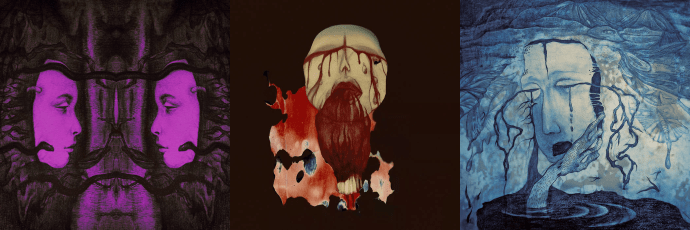
Ascension, Feuerschlucker and 梦路 art by ginseng
姜爽 Shuang Jiang (ginseng) did the artwork for all your Vitriolic Sage full-lengths; how was it working with this artist? Is it possible that you’ll work with them again?
JL: Our cooperation has been very smooth and pleasant. I very much enjoy working with her and I will definitely work with her again.
Where did you get the striking artwork for the Rɡyaɡ̇dźé! album? (Deng from Pest Productions is credited with graphics, is it his art?)
JL: In short, this cover image is originally in the public domain—it comes from an archaeological discovery. However, the original image quality was not very high, so after doing some processing myself, I handed it over to Deng from Pest Production to help enhance the quality.
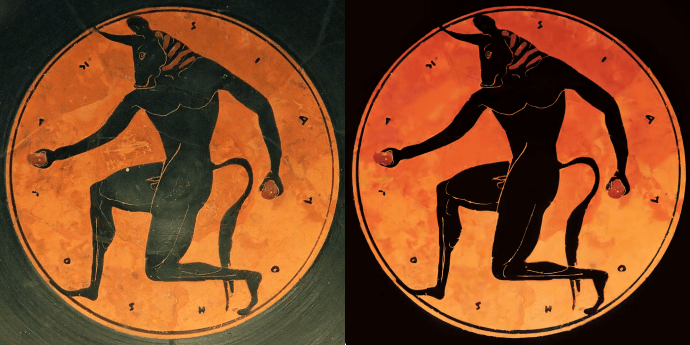
Rɡyaɡ̇dźé! album cover Right with the original on the Left: The Minotaur on a tondo of an Attic bilingual kylix, ca. 515 BCE, National Archaeological Museum of Spain no. 1999/99/80 (image © Marie-Lan Nguyen/Wikimedia Commons/CC-BY 2.5)
Can you share the meaning of the text encircling the minotaur?
JL: I remember something like “the beautiful boy (ho pais kalos)”.
In your discussion with Jelly Bones, you mentioned a new project named “Dgra, a Tibetan word meaning enemy.” Is Smiqra the brainchild and eventual conclusion of this idea’s inception?
JL: Smiqra is something that came out of multiple prolonged fieldwork sessions, I think. Dgra… somehow it still hasn’t started… Actually it has started, but I really don’t appreciate what I’ve done with it, so it’s again on hold.
With the advent of Large Language Models (LLMs), it seems that my browser searching ability and the quality of results have been compromised. I attempted to etymologize your name, Jactus, for which I had to rule out “cactus” and “iactus” as search criteria and it brought me to “new old words” haha. Are you just a breathing meme at this point?
JL: I probably am. Maybe I’m a bull.
But Jactus is just a stupid name that I came up with a few years ago plz forget about it…Teenage years…
Do you think there are questions people are not asking regarding LLMs/AI?
JL: It’s good it helps me a lot… Copyright issues will always be a difficult problem to solve…
If “po-ti-ni-ja!” is a phonetic rendition of a certain Vlad, is “qa-si-re-u!” a similar rendition of Que Sera?
JL: Actually no. You probably know the word Basileus. It’s the Ancient Greek word for “king”. This same word is written as qa-si-re-u in Mycenean Greek, pronounced as [ɡʷasilews] (let’s not mark the tone for the moment…).
Track 6 of Rɡyaɡ̇dźé!, 未知舞蹈, contains the first mention of “cheap patriotism, served on finest plates… Conscience tossed to the dogs.” It’s nearly an acoustic piece and one of the pieces that really does stand out for playing on the fringe, and it also reminds the listener how diverse your sound is. How many and which instruments did you use in the production of this record? And, what are your thoughts on patriotism in our world that has gone through globalization and then quite a bit of shrinking since the pandemic?
JL: Less than 10 [instruments] I think. And computer is also a great instrument…
I think it’s bad. Usually, I’d say that patriotism in China is lame ass, but it appears that the US isn’t really doing any better with [Mandarin Mugabe, Tito on Temu or everyone’s fave: Tangerine Palpatine] … why copy China omg
I care more about self-identification tho, like it’s not saying I don’t care about my country then, actually I do a lot and I don’t really enjoy living in other countries. I love my home, everything about it. But patriotism is lame and cringe. [upon pressing further on which instruments, the artist responded that they “would like to remain taciturn about this”]
Does the track “1960” have to do with Chinese history?
JL: It actually refers to the generation born in 1960 (Gen X?). I found out that a lot of problems that I encounter in recent years stem from them. And they are a really shitty generation per se, I hate a lot of them. Believe it or not, it was them who shaped our teenage years in general…
The only song containing lyrics on Bandcamp is #13, 犏牛心. I’m too dumb to figure it out, could you please clarify?
JL: “Heart to the dogs”
The ultimate track runs closer to some of the epic-length songs on previous releases under the Ὁπλίτης banner. There’s an audio clip around the 4-minute mark that sounds like it’s from a piece of media with a voice-over that eventually gets drowned out, which I doubt is contained within the lyrics. Could you enlighten us as to what is stated, seeing as it seems like an important link?
JL: From a film named Ala changso. To know this, I recommend everyone to simply just watch it themselves!
The post-script on Bandcamp reads as follows: “各种语言的文字游戏、牛、批判、JL 的日常生活、人,” which to the lazy translator reads as “Word games in various languages, cattle, criticism, JL’s daily life, people.” Going on prior answers to queries for other publications, is this album closer to how ballistic you wanted to go with your music and in reaching “theia mania,” or “divine madness?”
JL: I think you could say so even though I don’t want to be saying anything like “yo my music pursues this crazy idea called ‘xxx’ (whatever the term people would coin)”. I want to make music for fun. [and] Yeah, I guess I changed really quick… I’m constantly evolving. I will hate something I like so much right now in the future.
What was the most fun part of creating this last record that’s more than a year old already?
JL: I almost always have trouble summarizing things up… but probably still just “the fun of trying new food”.
Three words, you can answer any way or at any length you’d like, it’s not a test. Yes, it’s a haiku depending on pronunciation…:
- vocabulary
- heterogeneity
- serendipity
JL: I like how you give me these three options almost as if I’m a native speaker of English lol. I might choose serendipity because I think I’ve been having really bad luck lately. I’m disappointed that so many bad things happened at once, and the occasional good thing that did happen was just a fleeting moment. I was originally planning to choose vocabulary because I am, after all, a linguist, but while I was finishing this interview, I received some more bad news. Luck is very important, isn’t it? I try to comfort myself with that thought, maybe it’s just bad luck. I only got the pity part in serendipity. [We sincerely hope that your luck turns for the better!]
The previous question was a bit silly so how about a word that people (I) like to tag your music with: What does the word avant-garde mean to you?
JL: Lol I don’t really think much of my own work and I don’t think I have anything to do with avant-garde. Maybe a few years ago I still had some ambition and would have answered with something like, “Oh, avant-garde is what I’m after,” but now I’d just say that avant-garde has nothing to do with me. I don’t remember tagging my stuff with this word either.
[the tags on Bandcamp for Ὁπλίτης are not what you’d normally expect: metal / this sucks / China
Smiqra’s tags: metal / thrash metal / zhejiang / cat emoji / conscious rap / funny music / garbage / music for oxen / not french / China… the only album to contain the avant-garde tag is from the old stuff of VS; Feuerschlucker]
Working on a master’s thesis and now going for your PhD, how do you make time for music!?
JL: I haven’t been writing any metal for like 10 months… I only make some beats now. Indeed, you’ll have to give up one of them.
[can’t help but think that this future doctor is still gonna scalpel the living fuck out of our ears with linguistic chaos manifesting in blackened brain-melting ambrosia stat-ishly]
Rɡyaɡ̇dźé! ends with an impressively lunged lady sounding out an incredibly formidable note. It certainly is not over for JL as far as music is concerned, or will we simply keep seeing signatures of your work under different pseudonyms in the future?
JL: I really don’t know! [but after months of pondering] … I think yes.
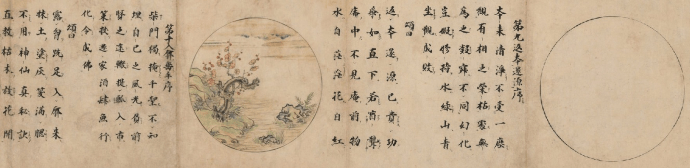
R-L Both Bull and Self Transcended, Reaching the Source, from the Ten Bulls by Kuoan Shiyuan/廓庵師遠 (1278)
Finally, do you have a message for our readers and your listeners?
JL: I suck in general. I kinda “evolve” all the time so don’t take what I said or made too seriously. (evolve might be the wrong word here since I’m not necessarily becoming better…)
[Thanks again for your time and patience JL, you rock, and the world is a richer place for your contributions to it!]
Listen to Smiqra here:
Media links:
https://hoplites.bandcamp.com/
https://vitriolicsage.bandcamp.com/